Twenty years ago, China helped reshape the global economy in ways few countries ever have.
Factories expanded at extraordinary speed. Exports surged. Consumers across Europe and North America gained access to cheaper products ranging from household goods to electronics. Businesses benefited from lower production costs, and inflation remained lower than many economists expected.
Yet the benefits were not distributed evenly.
As production shifted toward China, industrial regions across Western economies struggled to adapt. Factories closed. Manufacturing employment declined. Communities built around industrial work spent years searching for replacements that often never fully arrived.
That experience still lingers in the background of economic debates today.
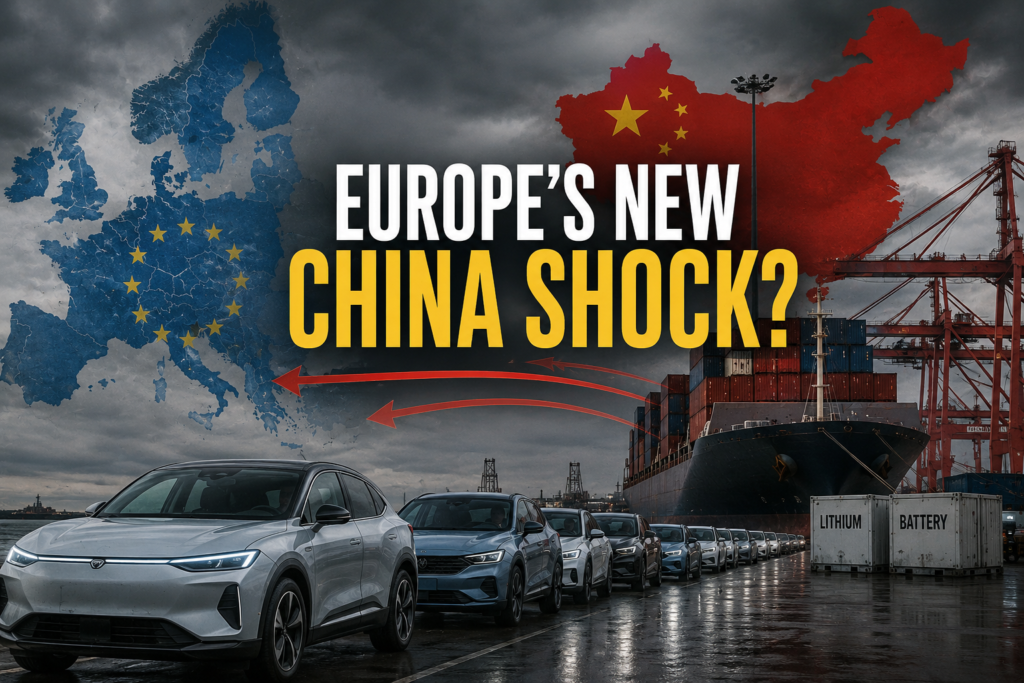
Now Europe is increasingly worried that a new version of that story may be emerging. The concern is not clothing, toys, or furniture. It is electric vehicles, batteries, solar panels, industrial machinery, and other sectors that many governments believe will shape the next era of economic growth.
The first China Shock was largely about moving factories.
The second could determine where entire industrial ecosystems take root.
That may sound like a subtle difference. It isn’t.
What Was the First China Shock?
China’s entry into the World Trade Organization in 2001 accelerated its integration into global markets. International companies invested heavily in Chinese manufacturing, attracted by lower costs, improving infrastructure, and access to a vast workforce.
The outcome was transformative.
Chinese exports expanded rapidly. Consumers gained access to cheaper products. Businesses built increasingly sophisticated global supply chains. For many companies, China became the center of the manufacturing world.
At the same time, many industries in Europe and the United States struggled to compete with the scale and efficiency emerging from China. Some adapted successfully. Others contracted. Some disappeared altogether.
Economists continue to debate the precise impact of the first China Shock, but policymakers tend to focus on a different lesson.
Industrial decline rarely begins with factory closures.
It usually starts much earlier.
Investment slows. Suppliers lose contracts. Skilled workers leave. Research spending becomes harder to justify. By the time the largest factory in town closes, the underlying ecosystem may already have been weakening for years.
That lesson matters because Europe believes it can see similar pressures developing in several industries today.
Why Officials Are Talking About a Second China Shock
China’s economy is very different from the one that drove global growth in the early 2000s.
Growth has slowed. Consumer demand is weaker than it once was. The country’s property sector has struggled through a prolonged downturn.
Manufacturing, however, remains a formidable strength.
Over the past decade, China invested heavily in electric vehicles, batteries, renewable energy equipment, industrial machinery, and advanced manufacturing. In several sectors, Chinese firms now operate at a scale few competitors can match.
When domestic demand softens while production capacity continues expanding, companies naturally look beyond their home market.
Europe’s concern is not necessarily that Chinese firms are producing too much.
The situation is stranger than that.
Chinese companies are becoming globally competitive at exactly the same moment Europe is trying to build many of the same industries.
Policymakers are confronting an unusual challenge. Governments typically try to create domestic champions before foreign competition becomes overwhelming. Europe is attempting to do both at the same time.
Timing may be the most important part of this story.
Had Chinese manufacturers reached their current scale ten years earlier, Europe might not have viewed the issue through a strategic lens. Had it happened ten years later, European industries might have had more time to establish themselves.
Instead, both developments are colliding at once.
The Industries Europe Is Most Worried About
Electric Vehicles
Europe’s automotive industry remains one of its greatest industrial assets.
Companies such as Volkswagen, BMW, Mercedes-Benz, Renault, and Stellantis support millions of jobs across manufacturing, engineering, logistics, and services.
The transition to electric vehicles is reshaping that landscape.
Chinese manufacturers such as BYD and SAIC are no longer competing only within China. They are increasingly expanding into international markets, including Europe, with vehicles that combine competitive pricing, growing technological sophistication, and large-scale production capacity.
European authorities have responded by investigating Chinese EV imports and examining whether state support may be affecting competition.
But the debate extends beyond vehicle sales.
Automobile production tends to create dense industrial networks. Suppliers cluster around manufacturers. Skilled workers follow investment. Research facilities emerge nearby. New companies often locate where expertise already exists.
Success attracts more success.
Failure can work in much the same way.
One reason governments worry about losing manufacturing is that industrial ecosystems rarely disappear all at once. They erode gradually, often before the broader economy notices.
Batteries
If electric vehicles are the visible part of the transition, batteries are the foundation underneath.
Chinese companies such as CATL have become dominant global players after years of investment and expansion. Europe has attempted to build its own battery industry, with companies such as Northvolt becoming symbols of that effort.
Battery manufacturing offers a useful example of how industrial systems work.
Large production facilities reduce costs. Lower costs attract customers. More customers justify further expansion. Suppliers move closer to factories. Specialized talent follows.
Scale advantages often become self-reinforcing.
That is why governments around the world are competing to attract battery gigafactories. The factory itself matters, but what happens around the factory may matter even more.
Solar Panels: A Lesson Europe Has Not Forgotten
Europe has lived through a version of this debate before.
In the early years of the solar industry, several European manufacturers held strong positions in the market. As competition intensified and lower-cost imports expanded, much of that manufacturing capacity gradually shifted elsewhere.
Solar installations continued growing.
Renewable energy adoption accelerated.
Consumers benefited.
Manufacturing largely did not.
For many policymakers, the solar industry serves as a reminder that increasing adoption does not automatically translate into industrial leadership.
That memory shapes today’s discussion.
Ironically, Europe’s concern is partly the result of policies that worked. Governments spent years encouraging electric vehicles and renewable energy. Those industries are now expanding rapidly worldwide.
The complication is that some of the most competitive producers emerged outside Europe.
The Contradiction at the Center of the Debate
Europe wants three things simultaneously.
It wants faster electric vehicle adoption.
It wants faster deployment of renewable energy technologies.
It wants stronger domestic manufacturing.
The problem is that these goals can conflict.
Cheaper imports can accelerate climate objectives by reducing costs for consumers and businesses. Lower-cost electric vehicles can encourage adoption. Lower-cost solar panels can speed up renewable energy deployment.
From an environmental perspective, that is often a positive outcome.
From an industrial perspective, it can be more complicated.
If imported products consistently undercut domestic producers, local manufacturers may struggle to scale, attract investment, or build the supplier networks needed to compete over the long term.
There is no simple solution.
The debate is not really about choosing between green goals and industrial goals. It is about whether governments can achieve both at the same time.
That is a harder question.
But Is It Really a Second China Shock?
Not everyone accepts the comparison.
Some economists argue that today’s situation differs fundamentally from the early 2000s. The original China Shock affected a broad range of industries and unfolded during a period of accelerating globalization.
Today’s competition is concentrated in a smaller number of sectors and is occurring in a far more fragmented geopolitical environment.
That criticism is worth taking seriously.
History rarely repeats itself neatly.
Still, the comparison persists because policymakers are worried about a familiar outcome: losing industrial capabilities they later decide they need.
Beyond Europe
Europe is not alone in thinking this way.
The United States has adopted subsidies, tariffs, and industrial policies aimed at strengthening domestic manufacturing. India is attempting to expand its role in global supply chains while attracting investment into strategic industries.
Many developing economies face similar trade-offs.
Affordable imports can support growth and lower costs. Governments, however, also want local jobs, local investment, and domestic production.
Those goals do not always point in the same direction.
The Geopolitical Layer
What makes this debate different from earlier trade disputes is that governments increasingly view manufacturing through a strategic lens.
A useful comparison is semiconductors.
For years, policymakers focused primarily on innovation and design. Over time, many governments became uncomfortable relying on a relatively small number of overseas suppliers for technologies they considered essential.
A similar logic is now appearing in discussions about batteries, electric vehicles, and renewable energy equipment.
The debate is no longer simply about who invents technologies.
It is also about who produces them.
Many countries are discovering that innovation does not automatically guarantee industrial leadership. A nation can develop breakthrough technologies while production, investment, suppliers, and skilled workers gradually migrate elsewhere.
What is at stake is not simply market share.
It is who builds the technologies, owns the supply chains, captures the investment, and benefits from the jobs created by the next generation of industries.
What Happens Next?
That remains uncertain.
Europe may succeed in strengthening domestic manufacturing while remaining open to global competition. It may not.
Policymakers are betting that industrial support measures can preserve production capacity without significantly increasing costs.
The answer could take years to become visible.
That uncertainty often gets lost in political debates.
Industrial policy rarely produces immediate results. Success and failure usually emerge slowly, through investment decisions, hiring patterns, supplier relationships, and factory construction that unfolds over many years.
Which brings us back to the central question.
The first China Shock forced governments to reconsider some of the assumptions behind globalization.
Today’s debate asks a different question.
Can countries remain open to global trade while preserving industries they increasingly believe are too important to lose?
There is no consensus answer yet.
What is clear is that the discussion is no longer about finding the cheapest place to manufacture products. It is about deciding which industries countries can afford to lose—and which they cannot.
The answer may shape economic policy long after the current debate over China fades.