Most people never watch a G7 summit.
They do not follow policy communiqués or pay close attention to discussions about energy security, supply chains, and strategic risk. Those conversations often seem far removed from everyday concerns.
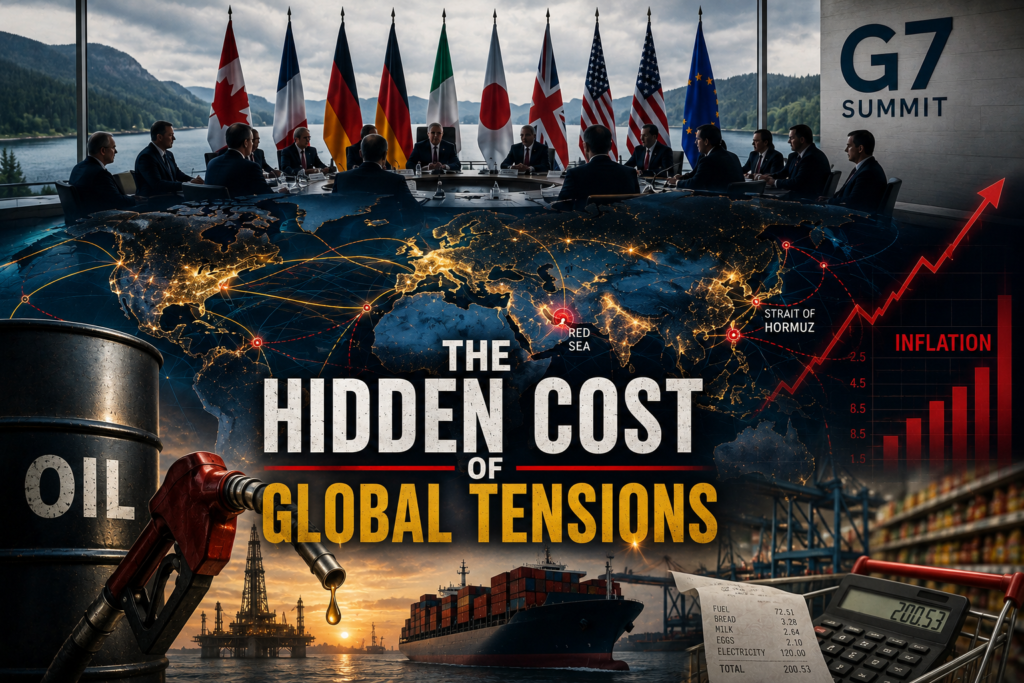
Yet the subjects debated at gatherings like the G7 have a habit of reappearing in places people care about immediately: fuel stations, grocery stores, electricity bills, mortgage payments, and household budgets.
That is why energy occupied such a central place in this year’s discussions.
On the surface, leaders were talking about oil markets, shipping routes, critical minerals, and economic security. Beneath those topics sat a larger concern: how to prevent the next disruption from becoming the next inflation problem.
Because inflation rarely begins where consumers first notice it.
Why Energy Is No Longer Just an Energy Story
Energy has become one of the most important strategic issues in the global economy.
The aftershocks of the Russia-Ukraine war continue to reshape markets years after the conflict began. Germany’s effort to replace Russian gas supplies revealed something policymakers had long understood in theory but had not fully confronted in practice: dependence often looks efficient until access becomes uncertain.
That lesson has spread well beyond Europe.
Across the Middle East, tensions continue to influence perceptions of risk in oil markets. Even when production remains stable, uncertainty itself carries economic weight.
Financial markets often react to fear long before they react to shortages. By the time consumers notice a problem, investors may have been pricing it in for months.
That dynamic helps explain why energy has become such a persistent concern for governments. Modern economies depend on stable energy flows in much the same way the human body depends on a stable blood supply. Most of the time nobody thinks about it. When something interrupts the flow, everything else becomes harder.
What governments once viewed primarily as efficiency, they increasingly view as dependence.
That shift in thinking may prove more important than any single policy announced at the summit.
The Inflation Story Most Consumers Never See
People tend to think inflation begins at the checkout counter.
In reality, inflation often starts months earlier in places consumers never visit. It begins in energy markets, freight networks, industrial facilities, ports, and logistics systems that operate far from public attention.
A rise in energy costs moves through the economy gradually. Fuel becomes more expensive. Transportation costs increase. Manufacturing expenses climb. Businesses absorb some of those costs, delay others, and eventually pass part of the burden along.
By then, the original cause may feel disconnected from the final outcome.
A shopper standing in a supermarket rarely associates higher food prices with developments in a shipping corridor thousands of miles away.
Yet those connections exist.
Agriculture depends on fuel-intensive machinery, fertilizer production, transportation networks, refrigeration systems, and logistics infrastructure. The same is true for countless other industries.
Oil is often described as a commodity.
In practice, it behaves more like an invisible operating system running underneath much of the global economy.
Inflation is often treated as a monetary problem, even when its origins are logistical.
That distinction becomes particularly important during periods of geopolitical tension, when disruptions in physical infrastructure can matter just as much as decisions made by central banks.
A Lesson Governments Learned the Hard Way
When Russian gas flows into Europe collapsed after the Ukraine war, governments discovered a difficult reality.
Energy systems can take decades to build but only months to disrupt.
Replacing lost infrastructure is usually far slower than losing access to it.
That lesson extended far beyond pipelines.
It influenced how governments think about ports, semiconductor supply chains, critical minerals, strategic manufacturing capacity, and other systems that had previously been viewed largely through an economic lens.
The world spent decades trying to make supply chains cheaper. It is now spending billions trying to make them survivable.
That may be the single most important economic story behind many of today’s policy discussions.
Why Shipping Routes Became a Strategic Concern
Few people spend much time thinking about maritime chokepoints.
Yet an extraordinary amount of global commerce moves through a handful of narrow routes.
The Red Sea has become one of the clearest examples.
When attacks disrupted commercial shipping in the region, several major carriers began rerouting vessels around the Cape of Good Hope. On a map, the adjustment appears modest.
In reality, it can add thousands of miles to a journey.
Longer voyages consume more fuel. Insurance costs rise. Delivery schedules become less predictable. Inventory planning becomes more complicated.
Rarely do those disruptions appear immediately on a store shelf.
Instead they move quietly through supply chains.
A retailer adjusts delivery expectations. A manufacturer absorbs higher freight costs. A distributor delays inventory replenishment. Consumers eventually encounter the result without ever seeing the chain of events behind it.
One reason inflation feels confusing is because its causes and consequences often occur in different places and at different times.
That disconnect creates a political challenge as well. Voters experience higher prices immediately, while the events that contributed to them may have occurred months earlier and thousands of miles away. The public sees the outcome. Policymakers spend most of their time debating the causes.
What G7 Leaders Are Really Trying to Prevent
A common misconception is that international summits are designed to solve immediate problems.
Most are not.
They are attempts to reduce future vulnerabilities.
That distinction matters because much of what leaders discussed at the G7 involved resilience rather than relief.
Energy diversification, strategic reserves, alternative supply routes, critical mineral access, and domestic manufacturing capacity all fall into that category.
At first glance these initiatives seem straightforward. More resilience sounds obviously beneficial.
The reality is more complicated.
The same globalization model that helped reduce inflation for decades may now be contributing to some of the vulnerabilities that make inflation harder to control.
Addressing those vulnerabilities often requires duplication, redundancy, and backup capacity.
All of those things cost money.
For years businesses were rewarded for building lean supply chains. Today many are being encouraged to build stronger ones.
The two objectives are not always compatible.
A more resilient economy may ultimately prove more stable.
It may also prove more expensive.
Markets can tolerate high prices more easily than they can tolerate uncertainty. That helps explain why governments are increasingly willing to accept higher costs in exchange for greater security of supply.
Whether consumers are equally willing to make that trade-off remains a different question.
Has Inflation Really Been Defeated?
Inflation has cooled considerably since the peaks experienced across much of the world in 2022 and 2023.
The sense of crisis that dominated economic discussions two years ago has faded, and policymakers have gained room to focus on broader concerns.
But there is a risk in assuming lower inflation means underlying vulnerabilities have disappeared.
Many have not.
Energy markets remain exposed to geopolitical disruptions. Shipping routes remain vulnerable. Climate-related events continue to affect agricultural output and infrastructure. Strategic competition between major powers continues to reshape trade patterns.
The headlines have changed faster than the underlying risks.
That distinction matters.
History suggests inflation rarely returns in exactly the same form. Policymakers are often prepared for the last crisis just as the next one emerges from somewhere unexpected.
What Consumers Should Actually Watch
For most households, fuel prices remain the most visible signal.
Food prices often follow.
Utility bills matter as well.
But consumers sometimes underestimate another factor: expectations.
When households expect prices to rise, behavior changes. Spending decisions become more cautious. Businesses delay investments. Borrowing decisions become more conservative.
Economics is not only about prices.
It is also about psychology.
Confidence can amplify stability.
Fear can amplify inflation.
That is one reason energy markets attract so much attention. They influence both.
Why Countries Like India Pay Close Attention
The vulnerabilities discussed throughout this article become particularly visible in countries like India.
As one of the world’s largest crude oil importers, India remains highly sensitive to movements in global energy markets. Sustained increases in oil prices can affect inflation, trade balances, transportation costs, manufacturing activity, and currency stability simultaneously.
In many ways, India sits at the intersection of several trends shaping the global economy.
Strong growth prospects.
Rising energy demand.
Expanding industrial capacity.
Continued dependence on imported energy.
That combination creates enormous opportunities during periods of stability and significant challenges during periods of volatility.
Events discussed at the G7 may originate thousands of miles away, but the economic effects often travel much further than the political discussions themselves.
Global energy markets do not recognize political membership lists.
The Bigger Story Behind the Summit
The bigger story is how governments increasingly view the global economy.
For decades, efficiency served as the organizing principle of globalization. Countries sought the cheapest energy, companies optimized supply chains, and businesses expanded production networks across borders.
The system delivered enormous benefits.
It helped reduce costs, improve productivity, and keep inflation lower than it might otherwise have been.
But every advantage carried a hidden assumption: that the world would remain relatively predictable.
Recent years have challenged that assumption.
The pandemic exposed supply-chain fragility. The energy shock following Russia’s invasion of Ukraine exposed strategic dependencies. Disruptions in major shipping routes exposed logistical vulnerabilities.
What appeared to be separate crises often revealed the same underlying weakness.
Interdependence created prosperity.
It also created exposure.
That is why discussions at the G7 increasingly revolve around resilience. Not because leaders oppose globalization, but because they are trying to determine how much vulnerability modern economies can afford to tolerate.
The next inflation shock may emerge from a place consumers never expected.
A shipping route, a pipeline, a regional conflict, a drought, or a piece of infrastructure most people have never heard of.
By the time the effects appear in a supermarket receipt, a utility bill, or a household budget, the chain of events will likely be months old.
That is ultimately what G7 leaders are debating—not today’s prices, but the resilience of a global economic system that remains deeply interconnected and occasionally fragile.
The modern economy is still remarkably efficient.
The question governments are increasingly asking is whether it is resilient enough to stay that way.