For decades, the global economy rested on a simple belief: countries that trade heavily with one another become less likely to clash.
That assumption shaped much of the globalization era. Companies built supply chains that stretched across continents. Governments encouraged trade. Consumers benefited from lower prices, while businesses gained access to larger markets and cheaper production networks.
Few countries benefited more from that system than China.
Over several decades, China transformed itself into the world’s manufacturing powerhouse. It became deeply embedded in industries ranging from consumer electronics and industrial machinery to solar panels, batteries, and electric vehicles. Western companies invested heavily in Chinese production networks, and consumers around the world became accustomed to the affordability those networks helped create.
Today, many of the same governments that once championed deeper economic integration are actively looking for ways to reduce their dependence on China.
At first glance, that seems like a remarkable reversal.
But the shift did not happen overnight. It emerged gradually as policymakers began viewing some of the very dependencies created by globalization through a different lens. Concerns about critical technologies, supply chains, industrial capacity, and access to strategic materials increasingly became questions of economic security.
The irony is difficult to miss. The global system spent decades rewarding efficiency and specialization. Now many governments are investing significant resources to make those same systems less dependent on a single source.
What was once a niche discussion among trade officials has become a recurring theme in political speeches, corporate boardrooms, and international summits.
The question is no longer whether economic tensions exist.
The more interesting question is whether the world is entering a new kind of economic Cold War.
What Does an Economic Cold War Actually Look Like?
The comparison is not perfect.
When most people think of the Cold War, they picture a world divided between competing political and military blocs. The United States and the Soviet Union operated within largely separate economic systems, with limited trade and little integration.
Today’s situation looks very different.
The world’s largest economies remain deeply connected. Trade flows remain substantial. Multinational corporations continue to operate across borders, and supply chains built over decades are still functioning across much of the global economy.
Yet governments are increasingly using economic tools to pursue strategic objectives.
Instead of military alliances and arms races, the focus is often on export controls, technology restrictions, industrial subsidies, investment screening mechanisms, and efforts to reshape supply chains. The objective is usually not direct confrontation. More often, it is reducing vulnerabilities while preserving influence.
That creates an unusual situation.
Countries are trying to become less dependent on one another while remaining economically connected.
A decade ago, many of these discussions would have been confined to specialist policy circles. Today they sit near the center of economic strategy.
Perhaps the clearest sign of change is how quickly the language has evolved. Terms such as “friend-shoring,” “economic security,” and “de-risking” were once largely confined to policy reports. Now they appear regularly in election campaigns, business conferences, and international gatherings.
Something has shifted in the way governments think about globalization.
Why China Sits at the Center of the Debate
China’s role in the global economy makes it impossible to avoid in discussions about economic security.
Over the past few decades, China built an industrial ecosystem that few countries can match. It became a dominant force across manufacturing, logistics, processing, and industrial production at a scale rarely seen in modern economic history.
In hindsight, China’s rise exposed a contradiction at the heart of globalization that many policymakers spent years overlooking.
The system rewarded efficiency, specialization, and scale. Yet those same advantages gradually created concentrations of economic power that some governments now view as potential vulnerabilities.
In many ways, China’s current position is a consequence of its own success.
The more central China became within global supply chains, the more governments began asking what would happen if those supply chains were disrupted.
Consider rare earth processing.
Although rare earth minerals are mined in multiple countries, much of the global processing capacity remains concentrated in China. Those processed materials eventually find their way into electric vehicles, renewable energy infrastructure, smartphones, advanced manufacturing systems, and defense technologies.
That may sound like a technical issue, but its implications are surprisingly broad.
The concern is not simply where resources originate. Policymakers increasingly focus on where bottlenecks emerge and how difficult those bottlenecks would be to replace during a disruption.
Consumers rarely think about supply-chain resilience when buying a smartphone. Governments, however, often start thinking about resilience after a disruption occurs. By then, reducing dependence can become far more expensive and politically complicated.
Supporters of diversification argue that excessive concentration creates strategic risks.
Critics contend that governments sometimes overestimate those risks while underestimating the benefits of specialization and open trade.
Neither side has entirely settled the debate.
The G7 Signal: A Change in Priorities
One reason the conversation has intensified is the growing focus on economic security among advanced economies.
Recent discussions among G7 nations have highlighted concerns about critical minerals, industrial competitiveness, strategic technologies, and supply-chain resilience. None of these topics are entirely new. What has changed is the priority attached to them.
For much of the globalization era, efficiency was often treated as the primary objective.
Today resilience is competing for equal attention.
Critical minerals provide a useful example. Lithium, cobalt, nickel, and rare earth elements have become essential inputs for batteries, semiconductors, renewable energy systems, and advanced manufacturing.
Countries that once paid relatively little attention to mineral supply chains are now pursuing partnerships, investment initiatives, and industrial strategies designed to secure access to these resources.
Interestingly, many multinational companies now find themselves navigating two conversations at once. Investors still reward efficiency and profitability. Governments increasingly reward resilience and diversification. Those incentives do not always point in the same direction.
There is another tension here as well.
Supporters of these policies argue that supply-chain resilience is becoming a strategic necessity. Critics respond that governments may be drifting toward protectionism under a different name.
The debate is often framed as a choice between efficiency and security.
Reality is messier than that.
Most governments appear to be trying to achieve both simultaneously.
The Rise of De-Risking
One of the most revealing developments in recent years is the language policymakers have chosen to adopt.
The preferred term is increasingly “de-risking” rather than “decoupling.”
The distinction matters because the two concepts imply very different futures.
Decoupling suggests a broad separation between economies. In practice, that would be extraordinarily difficult. Modern supply chains were built over decades and involve thousands of interconnected relationships that cannot easily be replicated elsewhere.
De-risking takes a narrower approach.
Rather than reducing all economic ties, governments focus on sectors viewed as strategically sensitive, including advanced semiconductors, telecommunications infrastructure, batteries, artificial intelligence systems, and critical minerals.
The goal is diversification rather than disengagement.
In many ways, de-risking reflects an uncomfortable compromise. Governments want the security benefits of reduced dependence without sacrificing the economic benefits of integration. They want more resilient supply chains without dramatically higher costs. They want strategic autonomy while remaining connected to global markets.
Whether all of those objectives can coexist remains uncertain.
The challenge is easy to overlook.
Reducing dependence does not necessarily eliminate vulnerability. In some cases, it simply shifts vulnerability elsewhere.
Technology: The New Strategic Battleground
If there is one area where economic competition increasingly resembles strategic rivalry, it is technology.
Semiconductors have become the clearest example.
Advanced chips support artificial intelligence systems, cloud computing, military technologies, industrial automation, and modern communications networks. Control over these technologies is now viewed by many governments as a strategic advantage rather than simply a commercial success.
Recent restrictions on advanced semiconductor exports and chipmaking equipment illustrate how technology policy has increasingly become a tool of geopolitical competition.
People often talk about semiconductors as though they are primarily a technology story.
Governments increasingly treat them as industrial infrastructure.
Unlike many earlier industrial competitions, leadership in advanced semiconductors does not merely influence commercial success. It increasingly affects who controls the technological foundations upon which future industries may be built.
Artificial intelligence has added another layer to this competition.
A decade ago, many policymakers would have viewed AI primarily as a research and innovation issue. Today discussions about AI frequently overlap with conversations about industrial policy, energy infrastructure, national security, and economic competitiveness.
The shift has been remarkably rapid.
Could Global Trade Be Reshaped?
The effects are already becoming visible.
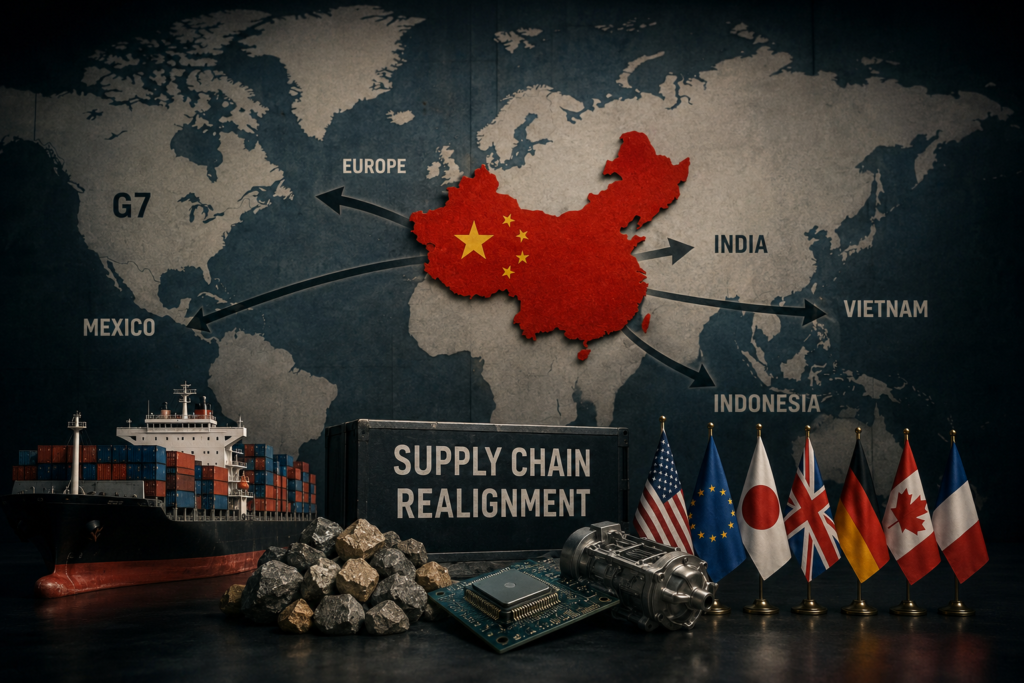
Manufacturing investment is expanding in countries such as India, Vietnam, Mexico, and Indonesia as businesses seek greater diversification. Apple’s growing manufacturing footprint in India has become one of the most visible examples of the widely discussed China+1 strategy.
Yet the reality is more complicated than simple relocation.
Supply chains are ecosystems. Moving final assembly is often easier than replicating entire supplier networks that took decades to develop.
Economic resilience sounds appealing in principle. In practice, every additional layer of resilience usually comes with a cost, whether in the form of higher prices, lower efficiency, or slower decision-making.
There is a certain irony in this.
For years, governments encouraged companies to build globally optimized supply chains because efficiency was viewed as a source of economic strength. Now many of those same governments are encouraging businesses to build redundancy into systems that were originally designed to eliminate it.
That does not necessarily mean the strategy is wrong.
It simply highlights the trade-offs involved.
What Does This Mean for India?
India occupies an interesting position within this evolving landscape.
As companies explore alternative manufacturing destinations, India has attracted growing attention because of its large domestic market, expanding industrial base, and efforts to strengthen local manufacturing capabilities.
Opportunities clearly exist.
But success is far from automatic.
Supply chains are not individual factories. They are networks of suppliers, infrastructure, logistics systems, skilled labor, financing, and supporting industries that develop over time.
Attracting investment is only part of the challenge.
Building an ecosystem around that investment is often the harder task.
The story is therefore more nuanced than headlines suggesting factories are simply moving from China to India. Some production may shift. Much of it may diversify. The distinction is important because diversification does not necessarily imply replacement.
A New Era of Economic Strategy
The debate over China is not really a debate about China alone.
It is a debate about the future of globalization itself.
For decades, policymakers largely assumed that efficiency, integration, and resilience would reinforce one another. Increasingly, they are discovering that those objectives do not always move together.
That realization is reshaping economic strategy around the world.
Trade, technology, industrial policy, and national security are becoming more closely connected. Governments are paying greater attention to supply chains, strategic industries, and access to critical materials than they did even a decade ago.
None of this means the global economy is suddenly splitting into isolated camps. Trade remains extensive, businesses continue operating across borders, and in many industries there is still no realistic substitute for deeply interconnected supply chains.
The real question may not be whether globalization is ending.
It may be whether globalization is entering a new phase—one in which efficiency is no longer the only measure that matters.
If that is the direction of travel, the consequences will extend far beyond China. They will influence how governments think about technology, manufacturing, energy, economic security, and industrial strategy for years to come.
And that may ultimately be the most important development of all.