How critical minerals, AI, semiconductors, and industrial power are quietly reshaping the global economy
For much of the twentieth century, understanding global power often meant understanding oil.
The countries that controlled major energy reserves held enormous strategic influence. Oil shaped alliances, fueled industrial growth, influenced foreign policy, and occasionally became a factor in conflicts that altered the course of history. Entire regions rose in geopolitical importance because they sat atop resources the world could not function without.
Oil still matters.
But focusing only on oil increasingly misses the larger shift underway.
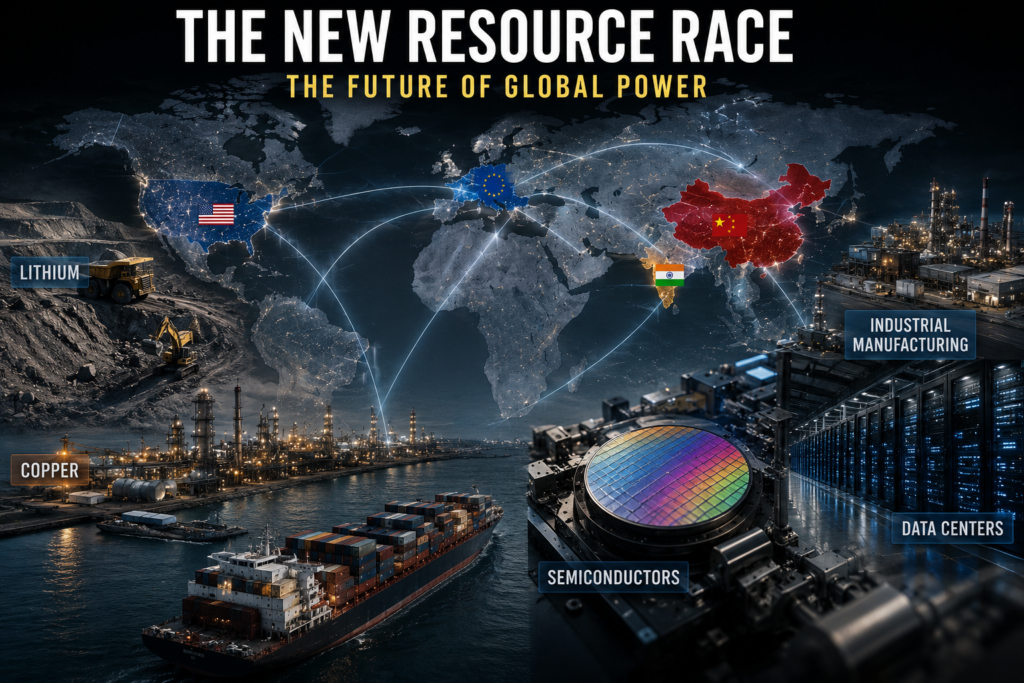
The world is entering a new era in which geopolitical power depends less on controlling individual resources and more on controlling entire industrial ecosystems—the networks of mines, refineries, factories, semiconductor facilities, power grids, logistics networks, and data centers that transform raw materials into economic and technological power.
That distinction may prove more important than many people realize.
For decades, globalization rewarded efficiency. Countries specialized, supply chains stretched across continents, and businesses concentrated production wherever costs were lowest.
Now governments are starting to ask a different question.
What happens when efficiency creates dependence?
The End of the Efficiency Era
Recent discussions among G7 leaders reflected something bigger than concern about minerals or trade.
They reflected a growing realization that the assumptions underpinning globalization are changing.
For years, businesses optimized supply chains around cost. If production could be moved to a cheaper location, it usually was. Redundancy was viewed as waste. Concentration was often viewed as efficiency.
The model worked remarkably well.
Until it didn’t.
The pandemic exposed vulnerabilities. Semiconductor shortages exposed more. Rising geopolitical tensions exposed even more.
What governments once viewed primarily as economic infrastructure, they increasingly view as strategic infrastructure.
One of the least appreciated shifts in the global economy is that governments are no longer optimizing for efficiency alone. Increasingly, they are optimizing for resilience—even when it is more expensive.
The irony is that globalization succeeded so well that it created many of the dependencies governments now want to reduce.
That is not a simple adjustment.
Building alternative supply chains is easy to announce and extraordinarily difficult to execute.
Factories take years to build. Mines take years to develop. Refineries require expertise, capital, and regulatory approvals. Entire industrial ecosystems cannot be created with a single policy announcement.
Yet governments appear increasingly willing to absorb those costs.
That alone says something important about how they view the risks.
The Hidden Insight Most People Are Missing
Most discussions about critical minerals focus on resource ownership.
But ownership is only part of the story.
The more important question may be who controls what happens after extraction.
A country can possess significant mineral reserves and still capture only a fraction of the strategic value. The real leverage increasingly comes from refining, processing, manufacturing, and integrating those materials into products the world depends on.
Australia provides a useful example. It is one of the world’s most important lithium producers, yet much of the value generated from lithium occurs further down the supply chain through refining, battery production, and manufacturing.
The same pattern appears elsewhere.
Chile plays a critical role in global copper markets. Indonesia has aggressively pushed to expand domestic nickel processing rather than simply exporting raw materials. Several African nations possess substantial mineral resources but continue to face challenges capturing higher-value stages of production.
Ownership creates opportunity.
Integration creates power.
That may be one of the defining lessons of the modern resource race.
Why “The New Oil” Is the Wrong Comparison
Critical minerals are often described as “the new oil.”
The comparison is useful. It is also incomplete.
Oil created leverage primarily at the point of extraction. If a country controlled major oil reserves, it often controlled the most valuable part of the chain.
Modern supply chains work differently.
Power is distributed across multiple stages.
Mining.
Refining.
Manufacturing.
Semiconductor production.
Energy infrastructure.
Logistics.
Software.
Data centers.
A country can dominate a supply chain without controlling most of the underlying resources. China’s position in several critical industries illustrates why.
That is what makes the current competition more complex than previous resource races.
The future may not belong to countries with the largest resource deposits.
It may belong to countries that build the strongest industrial ecosystems around those resources.
That is a very different challenge.
Why Critical Minerals Matter More Than They Appear
The phrase “critical minerals” sounds technical.
Its implications are not.
These materials sit at the center of industries governments increasingly view as strategically important.
Lithium has become the headline resource because modern batteries depend on it.
Copper may be even more important.
It rarely attracts the same attention, yet nearly every major electrification strategy depends on it. Electric vehicles require large amounts of copper. Power grids require it. Renewable energy projects require it. Data centers consume enormous quantities of it.
Many long-term energy-transition plans assume copper production can expand significantly over the coming decades.
Whether supply can keep pace remains one of the least discussed questions in the entire transition.
New mines often take years to develop. Environmental reviews can delay projects. Financing remains uncertain in some regions.
The challenge is not simply finding resources.
It is bringing them online fast enough.
Rare earth elements tell a different story.
Despite their name, many are not especially rare. The challenge lies in processing them economically and at scale.
That is where strategic leverage emerges.
Countries often focus on where resources are found. Increasingly, the more important question is where they are processed.
China’s Advantage Is Bigger Than Mining
Many discussions about critical minerals focus heavily on extraction.
That perspective misses part of the picture.
China’s advantage was not built solely through resource ownership.
It emerged through decades of investment in refining capacity, manufacturing infrastructure, industrial clustering, logistics networks, and workforce development.
Much of this appeared to be ordinary industrial policy at the time.
Today it looks increasingly strategic.
China understood something many others overlooked: controlling the middle of the supply chain can be just as valuable as controlling the beginning.
In some sectors, perhaps more valuable.
Its position is not simply the result of government planning. Scale matters. Infrastructure matters. Experience matters. So does the ability to attract industries that reinforce one another.
Industrial ecosystems tend to become stronger over time.
That is one reason they are difficult to replicate.
The United States, for example, has responded through initiatives such as the CHIPS Act, which seeks to strengthen domestic semiconductor manufacturing. The European Union has pursued similar objectives through measures including the Critical Raw Materials Act. India has launched its own critical mineral initiatives while expanding domestic manufacturing ambitions.
The challenge is not announcing these policies.
The challenge is sustaining them long enough to produce results.
Many governments speak confidently about supply-chain resilience.
Fewer have demonstrated the patience required to build it.
The AI Race Is Also a Resource Race
Artificial intelligence is often described as a digital revolution.
In reality, it is remarkably physical.
Every major AI breakthrough depends on infrastructure that most people never see.
Advanced semiconductor fabrication plants.
Massive data centers.
Power generation.
Cooling systems.
Industrial metals.
Specialized manufacturing equipment.
The software receives the attention.
The infrastructure does the heavy lifting.
Some advanced AI facilities consume electricity on a scale comparable to small cities. A single leading-edge semiconductor fabrication plant can cost tens of billions of dollars before producing a single chip.
The future of AI may depend as much on energy availability and manufacturing capacity as on software innovation.
That connection is becoming increasingly difficult for governments to ignore.
Resource security and technological leadership are becoming part of the same conversation.
The countries leading in AI increasingly need access not only to talent and capital, but also to semiconductors, electricity, industrial capacity, and resilient supply chains.
The race for AI leadership is gradually becoming a race for industrial capability.
What Happens If This Trend Continues?
No one knows exactly how this competition will evolve.
Forecasts vary considerably, particularly regarding mineral demand and AI infrastructure growth.
Still, several scenarios are beginning to emerge.
If China maintains significant influence across critical processing and manufacturing sectors, its strategic importance could remain substantial for years.
If the United States and its partners successfully diversify supply chains, global dependence on a handful of industrial chokepoints could gradually decline.
If demand for critical minerals significantly outpaces supply, industries ranging from electric vehicles to renewable energy could face higher costs and slower expansion.
And if AI investment continues accelerating at its current pace, competition for semiconductors, electricity, industrial metals, and specialized equipment could intensify further.
The next phase of globalization may involve more duplication than integration.
America is building strategic capacity.
Europe is building strategic capacity.
India is building strategic capacity.
Japan is strengthening supply-chain resilience after years of efforts to reduce vulnerabilities in critical industries.
Governments are not abandoning globalization.
They are trying to make it less fragile.
Whether that objective can be achieved without sacrificing significant efficiency remains an open question.
Could India Benefit?
India occupies an interesting position in this emerging landscape.
The country is pursuing ambitious goals in manufacturing, semiconductors, electronics, renewable energy, and industrial expansion.
These priorities align closely with the sectors driving the new resource race.
India’s Critical Mineral Mission and recent efforts to secure access to strategic resources reflect growing recognition that future industrial competitiveness depends on more than market size alone.
At the same time, challenges remain.
Building domestic capabilities across multiple sectors requires capital, infrastructure, technology transfer, skilled labor, and long-term policy consistency.
Many countries underestimate how difficult supply-chain transformation can be.
India is not alone in facing that reality.
The opportunity is significant.
The execution challenge may be even larger.
The Bigger Story
Critical minerals matter.
Semiconductors matter.
Artificial intelligence matters.
But the bigger story is not any single resource or technology.
It is the emergence of a new model of power.
For decades, the global economy rewarded efficiency. Production concentrated in specific locations. Supply chains became longer and more interconnected. Businesses optimized for cost.
Governments are increasingly optimizing for something else.
Resilience.
That shift is reshaping industrial policy, trade relationships, investment decisions, and geopolitical strategy.
The twentieth century was largely defined by competition for energy.
The twenty-first century may be defined by competition for industrial ecosystems that transform resources into technological power.
That is a subtle but important difference.
The countries that gain the greatest influence in the coming decades may not be those with the largest mines, the biggest oil fields, or even the most advanced technologies.
They may be the ones capable of connecting resources, manufacturing, energy infrastructure, semiconductors, logistics, and innovation into systems that competitors struggle to replicate.
Many governments are beginning to recognize that reality.
Whether they can successfully build those systems is a different question.
And that question may shape far more of the next decade than most people currently realize.