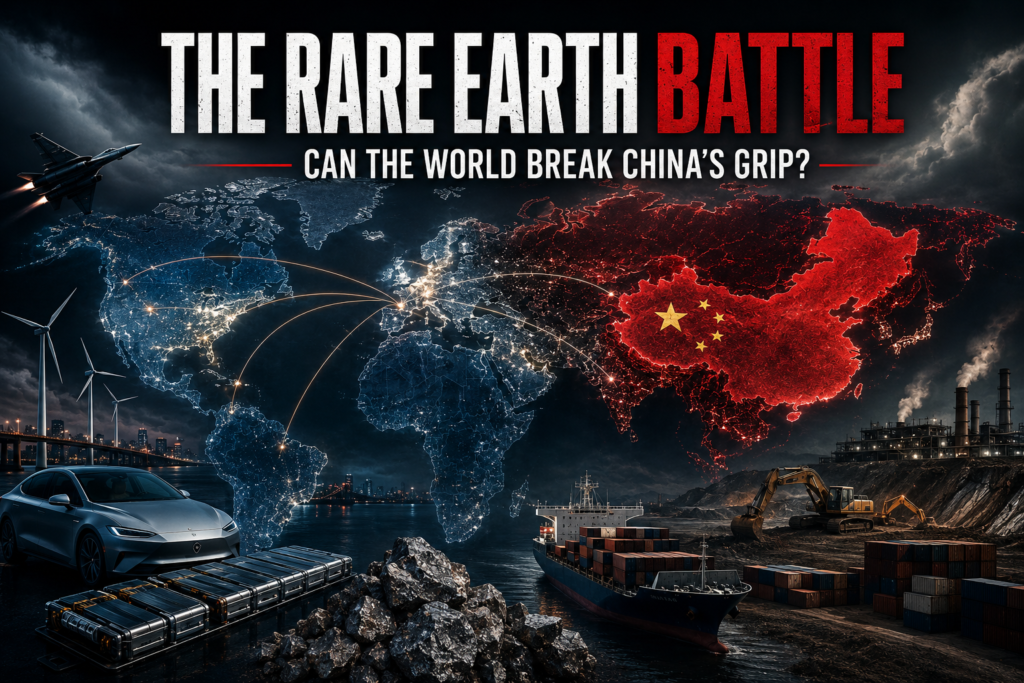
Most people never think about rare earth elements.
Yet a disruption in their supply chain could affect everything from electric vehicles and smartphones to fighter jets, renewable energy infrastructure, and advanced manufacturing. The materials themselves are largely invisible. Their importance is not.
That disconnect helps explain why rare earths have become one of the most strategically important resources in the global economy.
A decade ago, discussions about rare earths were largely confined to mining specialists, manufacturers, and a handful of policymakers. Today, they are part of a much broader conversation about economic security, technological competition, and the vulnerabilities hidden inside global supply chains.
At first glance, the debate appears straightforward. China dominates much of the world’s rare earth supply chain, and other countries want alternatives.
The more interesting question is why this issue suddenly feels so urgent.
Rare earths are not a new discovery. China’s role did not emerge overnight. What changed is the way governments think about dependence.
For decades, efficiency was the organizing principle of globalization. Companies were rewarded for reducing costs, simplifying production, and sourcing from wherever manufacturing was most competitive. Strategic resilience was often treated as a secondary concern.
That assumption is now being tested across multiple industries at once.
Rare earths happen to be one of the clearest examples.
What Are Rare Earths and Why Do They Matter?
Rare earths are a group of seventeen elements used in a wide range of advanced technologies. Despite the name, many are not particularly rare in the Earth’s crust. The challenge is finding deposits that can be developed economically and then processing those materials into forms manufacturers can actually use.
That distinction matters more than many people realize.
When most people hear discussions about critical minerals, they tend to imagine mines. But mining is only the beginning of the story. The more difficult and often more valuable stages come later.
A smartphone contains several rare earth elements that support speakers, screens, and vibration systems. Electric vehicles rely on rare earth magnets to improve motor efficiency. Wind turbines use them as well. The rapidly expanding infrastructure behind artificial intelligence depends on supply chains that ultimately rely on these materials.
The defense sector may be even more dependent. Fighter aircraft, guided missiles, radar systems, satellites, and advanced communications equipment all require components that incorporate rare earth elements.
The materials themselves are small. The industrial systems built around them are not.
What often gets overlooked is that the rare earth challenge is not really about scarcity. The world is not running out of minerals.
The challenge is that industrial expertise accumulates much more slowly than mineral deposits are discovered.
How China Built Its Position
China’s dominance is often portrayed as a story of geology.
That explanation is convenient because geology feels permanent and unavoidable. The reality is less simple.
China certainly possesses significant rare earth resources, but its current position is largely the result of decades of industrial investment. Beginning in the 1980s, the country steadily expanded mining operations while also building processing facilities, refining capacity, manufacturing networks, and technical expertise.
Meanwhile, many Western economies moved in a different direction.
As globalization accelerated, companies increasingly prioritized efficiency and lower costs. Manufacturing migrated toward the most competitive locations. Processing capabilities followed. Supply chains became concentrated because concentration often made economic sense.
Looking back, there is a certain irony in today’s debate.
Many of the countries now working to reduce dependence on China helped create the conditions that made that dependence possible. For years, efficiency was rewarded. Strategic resilience was not.
That does not mean those decisions were irrational. They reflected the incentives of the time.
But incentives change.
Over several decades, China built something more valuable than mining capacity. It built an ecosystem. Processors, refiners, engineers, suppliers, logistics networks, manufacturers, and specialized expertise developed together.
Countries can discover mineral deposits relatively quickly.
Expertise cannot simply be mined from the ground.
Why Rare Earths Have Become a Geopolitical Issue
For years, rare earths were mostly viewed through an economic lens.
Today they are increasingly viewed through a strategic one.
Trade disputes, export restrictions, semiconductor competition, technology controls, and broader geopolitical tensions have encouraged governments to reexamine supply-chain risks that once received little attention.
It is tempting to assume that the concern revolves around an immediate shortage.
That interpretation misses something important.
Even the possibility of disruption can change behavior. Companies alter investment plans. Governments build stockpiles. Manufacturers search for backup suppliers. Capital starts flowing toward alternatives long before an actual crisis occurs.
In some ways, the conversation resembles earlier debates about oil security during the 1970s. The circumstances are different, but the underlying lesson is familiar: dependence often feels efficient until it suddenly feels dangerous.
Supply chains rarely attract attention when they work. Their importance becomes obvious only when they fail.
That lesson has become increasingly difficult for policymakers to ignore.
The Rare Earth Lesson Is Bigger Than Rare Earths
This may be the most important part of the discussion.
Rare earths are often treated as a niche mining issue. In reality, they are part of a much larger shift in economic thinking.
Similar debates are unfolding around semiconductors, pharmaceuticals, batteries, energy infrastructure, and advanced manufacturing technologies.
For much of the past thirty years, governments largely assumed that efficiency should be the primary objective of global supply chains. If production became cheaper and faster, concentration was often accepted as a natural outcome.
Today, a different question is emerging.
What is the cost of resilience?
The answer is rarely straightforward because resilience is expensive. Building redundant supply chains, maintaining strategic stockpiles, and developing domestic industrial capacity often costs more than relying on the most efficient supplier.
That creates a tension that policymakers are still trying to navigate.
The goal is not necessarily self-sufficiency. For most advanced economies, complete self-sufficiency would be unrealistic.
The goal is optionality.
Rare earths simply happen to be one of the clearest illustrations of this broader transition from efficiency-first globalization toward resilience-focused globalization.
The United States Is Looking for Alternatives
The United States has spent recent years trying to strengthen its position in critical minerals.
Projects such as the Mountain Pass mine in California, operated by MP Materials, have become central to those efforts. Mountain Pass was once one of the world’s most important rare earth sites before years of decline underscored how much production and processing capacity had shifted elsewhere.
Yet Mountain Pass also highlights how difficult rebuilding industrial capacity can be.
Opening mines is only one challenge. Processing facilities must be built. Skilled workers must be trained. Infrastructure must be expanded. Capital must remain available even when commodity prices fluctuate.
The biggest challenge facing the United States may not be mining at all.
It may be rebuilding capabilities that gradually disappeared over several decades.
That process takes time, and the exact pace of progress remains difficult to predict. Mining projects frequently encounter regulatory, financial, environmental, and technical obstacles.
Political urgency can accelerate investment.
It cannot compress decades of industrial development into a few years.
Europe’s Calculation
Europe faces a somewhat different challenge.
Its industrial strategy is closely linked to electric vehicles, renewable energy deployment, advanced manufacturing, and climate-transition goals. Each of those priorities depends heavily on secure access to critical minerals.
As a result, European governments have become increasingly focused on diversification.
Companies such as Lynas Rare Earths have gained greater strategic significance because they represent processing and production capacity outside China. That does not eliminate dependence, but it broadens available options.
The distinction is subtle.
Yet it may become increasingly important.
The question facing Europe is no longer simply who owns resources. The question is who can reliably process them, manufacture with them, and deliver products at scale.
India’s Opportunity—and Its Challenge
India is often presented as a potential beneficiary of supply-chain diversification.
There is a reasonable case for that view.
The country is expanding its manufacturing base, attracting global investment, increasing electronics production, and pursuing ambitious renewable-energy goals. Those trends align naturally with rising demand for critical minerals.
Still, it would be a mistake to view this purely as a resource opportunity.
History suggests that the countries capturing the greatest value from strategic industries are often those that master processing, logistics, manufacturing ecosystems, and technological capabilities—not simply extraction.
That distinction may shape India’s trajectory.
If the country can strengthen processing capacity, infrastructure, industrial coordination, and long-term policy consistency, it could emerge as a more significant participant in global supply chains.
If not, much of the higher-value activity may continue occurring elsewhere.
The outcome remains uncertain.
Opportunities in industrial policy often appear obvious in theory. Capturing them in practice is considerably harder.
Why Replacing China Is So Difficult
Many discussions about rare earths eventually arrive at the same conclusion: diversification is necessary.
The harder question is what diversification actually means.
For some observers, it implies replacing China.
That is probably unrealistic.
A competitive supply chain requires much more than access to minerals. It requires processing facilities, transportation networks, manufacturers, suppliers, technical expertise, financing, and customers willing to support the ecosystem commercially.
China already possesses much of that infrastructure.
Even when new mines emerge in Australia, the United States, India, or elsewhere, portions of the supply chain may continue relying on capabilities concentrated in China for years to come.
This is why the rare earth battle is not a race to discover minerals.
It is a race to build industrial ecosystems.
And industrial ecosystems are among the most difficult things to replicate quickly.
What Happens If Diversification Fails?
The consequences would extend beyond governments.
Electric vehicle manufacturers could face higher costs. Renewable energy projects could encounter delays. Technology firms might struggle with supply constraints. Defense industries could face procurement challenges.
Most consumers will never hear about rare earth separation facilities, refining plants, or processing technologies.
They may only notice the consequences when products become more expensive or harder to obtain.
That is often how supply chains work.
Their importance becomes visible only when something interrupts them.
A More Likely Future
The most realistic future probably does not involve replacing China.
It involves reducing concentration.
China is likely to remain a major player. The United States may expand domestic production. Australia could strengthen mining output. India may build additional processing capacity. Europe will continue seeking strategic partnerships.
The result could be a more distributed system than the one that exists today.
Not independent.
More resilient.
That distinction may ultimately define the next phase of globalization.
The Global Rare Earth Battle Is About More Than Minerals
Rare earths sit at the intersection of technology, manufacturing, energy policy, economics, and geopolitics.
What began as a relatively obscure industrial issue has evolved into a strategic challenge shaping decisions in Washington, Beijing, Brussels, New Delhi, and beyond.
The debate is often framed as a competition for resources.
In reality, it is increasingly a competition for capabilities.
Control over mineral deposits matters.
Control over the industrial systems that transform those deposits into economic and strategic power may matter even more.
The countries that shape the next generation of strategic industries may not necessarily be the ones with the largest reserves underground.
They may be the ones capable of building resilient ecosystems above ground.