For much of the past three decades, China occupied a position in the global economy that few countries have ever achieved.
Factories across the country produced everything from smartphones and industrial machinery to the components hidden inside thousands of everyday products. Global supply chains gradually reorganized themselves around Chinese manufacturing. For businesses, the logic was difficult to ignore: China offered scale, efficiency, supplier networks, infrastructure, and a workforce capable of supporting industrial expansion on an extraordinary level.
Over time, dependence became normal.
Companies stopped asking whether they should rely on China and focused instead on how much of their operations they could move there.
That calculation is beginning to change.
Trade tensions, technology restrictions, geopolitical rivalry, supply chain disruptions, and growing concerns about economic resilience have pushed governments and corporations to rethink how concentrated their manufacturing footprints should be. What was once a discussion among procurement teams and trade officials has become a central economic and strategic question.
As companies search for alternatives and governments encourage diversification, one question is drawing increasing attention:
Can India turn this shift into a long-term economic opportunity?
Why Is the World Trying to Reduce Dependence on China?
The answer is not a single event.
It is the accumulation of several developments that have gradually changed how businesses think about risk.
US-China Trade Tensions
Relations between the United States and China have become increasingly complex over the past decade.
Tariffs, export controls, restrictions on advanced technologies, and competition in strategic industries have created uncertainty that did not exist at the same scale twenty years ago. Companies that once optimized almost exclusively for cost are now spending far more time evaluating geopolitical exposure.
Manufacturing executives rarely enjoy surprises. When future trade rules become difficult to predict, diversification starts to look less like a strategic option and more like a necessity.
Lessons From Supply Chain Shocks
The COVID-19 pandemic exposed vulnerabilities that many companies knew existed but had never fully tested.
Factory shutdowns, shipping delays, container shortages, and logistics bottlenecks rippled through industries around the world. A disruption in one region suddenly affected production schedules on the other side of the globe.
Many companies emerged from that period with a similar conclusion: efficiency matters, but resilience has value too.
That realization continues to shape investment decisions years later.
Strategic Industries and National Security
Governments increasingly view certain industries through a strategic lens rather than a purely commercial one.
Semiconductors, telecommunications equipment, pharmaceuticals, critical minerals, and defense manufacturing are now discussed alongside national security concerns. Access to these industries affects not only economic growth but also technological competitiveness and strategic autonomy.
People often talk about semiconductors as a technology story.
Governments increasingly treat them as strategic infrastructure.
Rare Earth Dependence
Rare earth minerals illustrate the challenge particularly well.
These materials are essential for electric vehicles, renewable energy systems, advanced electronics, and defense technologies. While several countries possess rare earth resources, China dominates much of the processing capacity required to turn those materials into usable industrial inputs.
Possessing mineral resources is only part of the equation. Processing capacity is where strategic leverage often emerges.
That reality has encouraged countries across North America, Europe, and Asia to explore alternative supply chains.
Ironically, China’s success may be one reason diversification is accelerating. Companies are not necessarily looking elsewhere because China became weak. In many sectors, they are doing so because China became too central to global production.
That level of concentration creates its own risks.
Where Are Global Companies Looking Instead?
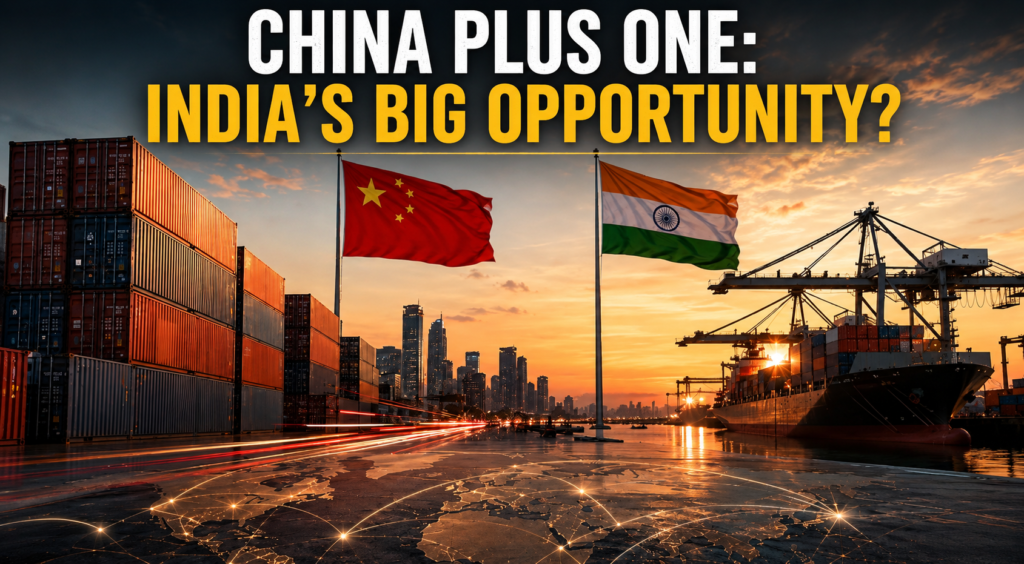
One phrase appears repeatedly in boardrooms, investor presentations, and government policy discussions: China Plus One.
Understanding the China Plus One Strategy
The concept is straightforward.
Companies maintain operations in China while expanding manufacturing into additional countries. Rather than abandoning China, they reduce the risks associated with relying on it too heavily.
The strategy has already reshaped investment flows.
Vietnam has attracted significant electronics manufacturing investment. Mexico has benefited from nearshoring trends and proximity to the United States. Indonesia has gained attention because of its natural resources and industrial ambitions.
Vietnam’s experience is particularly interesting. The country has successfully attracted global manufacturers and integrated itself into export-oriented supply chains. Yet its domestic market remains much smaller than India’s, limiting some of the long-term opportunities available to investors.
And then there is India.
Unlike many competing destinations, India offers both manufacturing potential and a massive consumer market. For multinational firms, that combination creates a different kind of investment story. A factory built today for exports may eventually serve one of the world’s largest domestic markets as well.
An interesting reality often gets overlooked in these discussions. Many companies pursuing China Plus One strategies continue expanding operations in China at the same time. Diversification usually means adding production locations, not replacing existing ones. The phrase itself can be misleading. The goal is often “China plus another country,” not “China instead of another country.”
Why India Is Attracting Global Attention
India’s growing role in supply chain discussions is not the result of a single policy announcement.
Several structural advantages have become increasingly relevant as companies diversify their operations.
A Large Domestic Market
With a population exceeding 1.4 billion people, India offers a scale of domestic demand that relatively few countries can match.
For multinational corporations, the ability to manufacture and sell within the same market changes the economics of long-term investment. Production facilities can potentially serve both global customers and a growing domestic consumer base.
That flexibility matters.
A Young Workforce
Demographics have become an increasingly important part of economic competitiveness.
Many developed economies face aging populations and shrinking labor forces. India remains comparatively young, creating opportunities for workforce expansion over the coming decades.
Demographics alone do not guarantee economic success. Skills, productivity, and job creation ultimately determine outcomes.
Still, countries generally prefer having demographic opportunities to managing demographic decline.
Government Incentives
India has spent years attempting to strengthen domestic manufacturing through targeted industrial policies.
Programs such as the Production Linked Incentive (PLI) schemes aim to attract investment across sectors including electronics, semiconductors, batteries, and renewable energy technologies.
The goal is not simply to increase production. It is to encourage companies to build deeper roots within India’s industrial ecosystem.
Infrastructure Improvements
Infrastructure has long been one of India’s most frequently discussed challenges.
It is also one of the areas where meaningful progress has occurred.
Investments in highways, freight corridors, ports, airports, and logistics networks have gradually improved connectivity across the country. These projects rarely generate the excitement associated with technology startups or stock market rallies, but manufacturers pay close attention to them.
A smartphone manufacturer deciding between two countries may never make front-page news. Yet that decision can hinge on factors such as port congestion, trucking times, rail connectivity, and customs clearance procedures.
Industrial competitiveness often looks surprisingly mundane from the ground.
Digital Transformation
India’s digital infrastructure has become another source of economic appeal.
The expansion of digital payments, online platforms, and public digital systems has demonstrated an ability to deploy technology at remarkable scale. While digital transformation does not directly create factories, it can reduce friction across large parts of the economy.
Businesses notice these things.
Not because they are headline-grabbing, but because operational efficiency compounds over time.
Industries Where India Could Benefit Most
The more useful question is not whether India will benefit from supply chain diversification.
It is where those benefits are most likely to emerge.
Electronics Manufacturing
Electronics manufacturing is perhaps the most visible example.
The shift is already underway. Companies such as Apple and manufacturing partners like Foxconn have gradually expanded production in India, not because China suddenly lost its manufacturing strengths, but because companies increasingly want additional production hubs alongside their Chinese operations.
Apple’s growing production footprint in India also illustrates both the promise and the limitations of diversification. Assembly activity has expanded noticeably, but much of the broader supplier ecosystem remains concentrated elsewhere in Asia. The example highlights a reality that industrial policymakers know well: attracting factories is often easier than replicating decades of supplier relationships, specialized expertise, and manufacturing clustering.
The opportunity extends beyond assembling finished products. The larger prize lies in developing supplier networks, component manufacturing capabilities, engineering expertise, and export ecosystems around those facilities.
The factory is only the beginning.
The ecosystem is where long-term value is created.
Semiconductors
Few industries carry more strategic importance today than semiconductors.
India faces a difficult path if its goal is to become a major chip manufacturing hub. Taiwan’s dominance was built through decades of ecosystem development, specialized expertise, institutional support, and enormous capital investment.
That history is a reminder that industrial leadership rarely emerges quickly.
Yet semiconductor participation is not an all-or-nothing proposition. Opportunities exist in chip design, packaging, testing, research services, and supporting infrastructure. Many countries are discovering that meaningful participation in the semiconductor value chain can begin well before they build cutting-edge fabrication plants.
Renewable Energy Supply Chains
The transition toward cleaner energy is generating demand for solar equipment, battery technologies, energy storage systems, and related industrial components.
Governments around the world are investing heavily in these sectors. As a result, the supply chains supporting them are becoming increasingly valuable.
India has an opportunity to strengthen its position across multiple segments of this ecosystem, particularly if domestic energy demand continues expanding.
Defense Manufacturing
Defense production is attracting renewed attention globally.
Strategic partnerships, domestic manufacturing initiatives, and efforts to strengthen national defense capabilities could create opportunities for India to expand its industrial footprint in the sector.
Historically, defense industries have often produced spillover benefits that extend well beyond military applications. Technologies developed for defense frequently find commercial uses years later.
Rare Earth Processing and Critical Minerals
Rare earth discussions often focus on extraction.
The larger opportunity may lie elsewhere.
China’s influence stems not only from resource availability but from its ability to process and refine materials at industrial scale. Building that capability requires infrastructure, expertise, environmental management systems, and long-term investment.
If India can develop meaningful processing capacity, it could establish a position within one of the most strategically important supply chains of the coming decades.
The Challenges India Still Needs to Address
Opportunities are real.
So are the obstacles.
Infrastructure Gaps
Despite recent progress, infrastructure quality remains uneven across regions.
Manufacturers evaluating major investments eventually focus on practical questions. How reliable is the power supply? How quickly can components move between suppliers? How long does customs clearance take? Can goods reach ports without costly delays?
The answers to those questions often matter more than investment announcements.
Manufacturing Scale
China’s manufacturing rise was not the product of a single decade.
It emerged through years of infrastructure investment, export-oriented policies, supplier development, workforce training, industrial clustering, and integration into global trade networks. Entire ecosystems evolved together.
That scale cannot be replicated quickly.
Regulatory Complexity
Large industrial projects require predictable rules and efficient execution.
Investors generally value consistency as much as incentives. Delays, uncertainty, and administrative complexity can influence investment decisions long before construction begins.
Skill Development
A young workforce provides potential.
Industrial competitiveness requires capability.
Advanced manufacturing increasingly depends on engineering expertise, technical training, operational experience, and specialized skills. Developing those capabilities takes sustained effort over many years.
The Coordination Challenge
Perhaps the most difficult challenge receives less attention.
India does not need one successful factory.
It needs thousands of suppliers, logistics providers, manufacturers, training institutions, financiers, and service companies operating efficiently together.
Industrial ecosystems are coordination systems.
A world-class factory can be built in a few years. A world-class industrial ecosystem often takes decades.
Can India Replace China?
Probably not.
At least not anytime soon.
China retains enormous advantages in manufacturing scale, supplier density, logistics infrastructure, export capacity, and industrial specialization. Many global supply chains remain deeply embedded there.
Even companies pursuing diversification continue investing in China.
That is unlikely to change quickly.
The more realistic question is whether India can capture a larger share of future manufacturing growth and investment.
Viewed through that lens, the opportunity becomes much more tangible.
India does not need to become the next China to benefit substantially from shifting supply chains. It simply needs to secure a meaningful share of the investment now spreading across multiple destinations.
What Could the Next Decade Look Like?
If current diversification trends continue, global manufacturing may become more geographically distributed than it has been at any point since China’s accession to the World Trade Organization.
Rather than relying on a single dominant production hub, companies may operate networks spanning multiple countries. One country may specialize in assembly, another in components, another in processing critical materials, and another in advanced manufacturing.
The future may not belong to one manufacturing center.
It may belong to interconnected manufacturing ecosystems.
Whether India becomes one of the most important nodes in that network remains an open question.
The global economy is not entering a post-China era. It is entering an era where resilience matters almost as much as efficiency.
The countries that benefit most will not necessarily be those offering the lowest costs. They will be the ones capable of building reliable industrial ecosystems at scale, attracting investment consistently, and converting industrial activity into long-term competitive advantages.
India has many of the ingredients required to do that.
The opportunity is real, but its ultimate scale remains difficult to predict. Much will depend on whether today’s investment announcements eventually translate into the supplier networks, industrial capabilities, and ecosystem depth that define lasting manufacturing success.
Supply chains rarely change overnight. They shift gradually, investment by investment, factory by factory, supplier by supplier. Whether India emerges as one of the major beneficiaries of that shift will depend less on global headlines and more on thousands of decisions made quietly across boardrooms, industrial parks, and manufacturing floors in the years ahead.