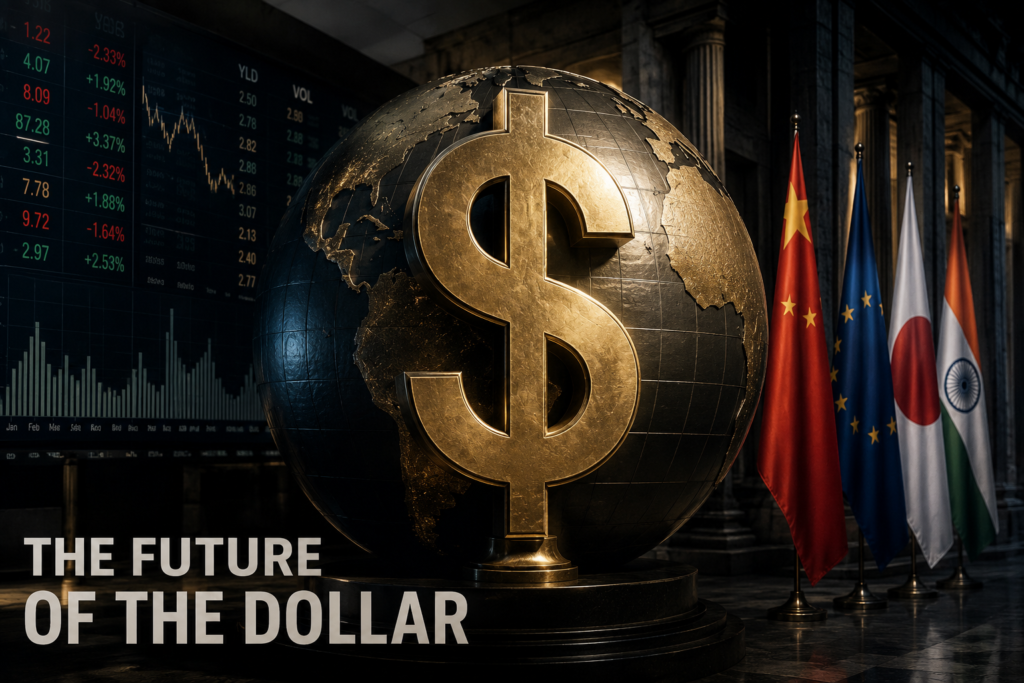
For years, predictions of the dollar’s decline have appeared whenever geopolitical tensions rise, new economic powers emerge, or the international order seems to be shifting.
Yet despite repeated forecasts of its downfall, the U.S. dollar remains at the center of global finance.
That alone makes the topic worth examining carefully.
Few debates generate as much attention while producing so little immediate change. Every few years, a new argument emerges explaining why the dollar’s dominance is becoming unsustainable. Then another crisis arrives somewhere in the world, investors move into dollar assets, and the conversation begins again.
Still, something about today’s discussion feels different.
Governments are openly exploring alternatives. Local-currency trade agreements are becoming more common. Central banks are adjusting reserve strategies. Payment systems that operate outside traditional dollar channels are gradually expanding.
The question is no longer whether countries would like more options.
The question is whether those options are beginning to matter.
The dollar’s position was never simply the result of American economic power. After World War II, the United States possessed enormous industrial capacity, a growing economy, relatively stable institutions, and financial markets unlike anything else in the world. The Bretton Woods system formalized the dollar’s role, but its influence survived long after that arrangement ended.
Businesses needed a reliable currency for international transactions. Governments needed somewhere safe to store reserves. Investors wanted large, liquid markets capable of absorbing enormous amounts of capital.
The United States happened to provide all three at the same time.
Over decades, the system reinforced itself. Commodities were priced in dollars. Loans were issued in dollars. Trade contracts were written in dollars. Financial infrastructure evolved around dollar-based networks because that was where the activity already existed.
A central banker managing reserves in Southeast Asia, an energy trader pricing crude oil in the Gulf, and a multinational corporation financing a project in Latin America may all have different reasons for using dollars. Together, however, they reinforce the same system.
That is one reason reserve currencies are difficult to replace. They are not just currencies. They are habits, networks, and expectations accumulated over generations.
Financial systems are often inherited before they are chosen.
One of the more interesting features of the current debate is that many countries discussing reduced dependence on the dollar continue to rely heavily on it.
At first glance, that sounds contradictory.
It probably isn’t.
In many cases, governments are not trying to abandon the existing system. They are trying to reduce the risks associated with relying too heavily on a single one. There is a difference between replacing a system and building alternatives around it.
That distinction sits beneath much of what is happening today.
Strategic competition between the United States and China has intensified. Economic sanctions have become a more visible policy tool. Supply chains are increasingly discussed through the language of resilience and security rather than efficiency alone.
As a result, governments are asking questions that received far less attention a decade ago.
What happens if access to critical financial infrastructure becomes politically constrained?
What happens if geopolitical rivalry increasingly extends into finance?
China’s efforts to internationalize the yuan are often presented as the clearest challenge to the dollar. That view is understandable. China is one of the world’s largest economies, a manufacturing powerhouse, and a central player in global trade.
Yet economic influence and currency influence do not necessarily move together.
A country can become an economic giant long before its currency becomes a global one.
Beijing faces a difficult balancing act. The policies that give Chinese authorities significant control over the domestic financial system are often the same policies that make some international investors cautious. Capital controls can support stability. Global reserve currencies generally benefit from openness.
Those objectives do not naturally align.
Europe presents a different puzzle.
The euro already possesses many of the characteristics associated with a major reserve currency. Europe has deep capital markets, strong institutions, and a large economic base. Yet Europe’s challenge is less about economics than about political coherence.
In some respects, Europe and China face opposite problems. China has scale but faces questions about openness. Europe has openness but sometimes struggles to translate collective economic weight into a consistently unified strategic direction.
Neither problem has an obvious solution.
History suggests reserve-currency transitions rarely happen quickly. The British pound remained internationally important long after Britain had ceased to be the world’s dominant economic power. Monetary systems often lag behind broader shifts in economic power.
There is a tendency to think about currencies as if they compete the way corporations compete.
The comparison is intuitive, but it can also be misleading.
Companies can gain market share surprisingly quickly. Financial systems rarely move at that speed. The infrastructure underneath them takes decades to build, and trust often takes even longer.
In fact, one of the most surprising aspects of the de-dollarization debate is that the dollar’s greatest competitor may not be another currency at all.
It may be fragmentation.
Much of the discussion assumes a future in which one currency replaces another. A more realistic possibility is that no single successor emerges. Instead, different regions gradually develop stronger financial ecosystems of their own. The result would not necessarily be a post-dollar world. It might be a world that is simply less centered on any one currency.
That possibility receives less attention because it lacks the drama of a direct challenger.
But it deserves consideration.
There is also a tendency to underestimate the importance of infrastructure. Most discussions focus on economics and geopolitics. Yet payment systems, settlement networks, legal frameworks, capital markets, and financial regulations may ultimately matter just as much.
The dollar’s greatest advantage may not be America’s strength.
It may be the difficulty of replacing the infrastructure already built around it.
This helps explain why headlines about de-dollarization often move faster than reality. A new trade agreement settled in local currencies can generate enormous attention. Meanwhile, reserve allocations, international lending practices, and global capital flows may remain largely unchanged.
Markets have a habit of doing that.
Sometimes they ignore developments that dominate headlines. Other times they obsess over developments that ultimately matter less than expected.
It is possible that historians will eventually look back on this period as the early stage of a significant monetary transition. It is equally possible that future observers will conclude that the debate attracted more attention than the actual changes justified.
That may sound like a hedge.
Perhaps it is.
But uncertainty is part of the story here.
The reality is that nobody knows how much diversification would be required before the global monetary system begins to look fundamentally different.
What if the debate itself is framed incorrectly?
Much of the conversation assumes the world is searching for a replacement for the dollar. That assumption may be flawed.
Countries may not be trying to replace the dollar at all.
They may simply be trying to create a world in which they have more choices.
Those are very different goals.
For the United States, a gradual decline in dollar dominance could eventually increase borrowing costs and reduce certain forms of financial leverage. For China, a larger international role for the yuan could strengthen influence but also create pressures for greater financial openness.
India occupies a particularly interesting position because it sits at the intersection of multiple economic networks rather than at the center of a single bloc. A more diversified monetary environment could create opportunities for trade, investment, and regional partnerships while also introducing new complexities for businesses and financial institutions.
There is also a psychological dimension to reserve currencies that is difficult to measure.
Investors often trust a system because other investors trust it. Confidence can reinforce itself for years. So can doubt. That dynamic helps explain why monetary transitions are so difficult to identify while they are happening.
People usually recognize them afterward.
For now, the dollar remains firmly at the center of global finance. Its foundations remain substantial, and no single alternative currently offers the same combination of liquidity, institutional depth, trust, and global acceptance.
Yet the most revealing part of this debate may not be what it says about the dollar.
It may be what it says about the rest of the world.
More countries are no longer asking whether alternatives should exist.
They are asking how many alternatives they want.
And the answer to that question may ultimately matter more than the search for a single successor.
Could the Dollar Lose Its Global Dominance? What It Means for the World Economy