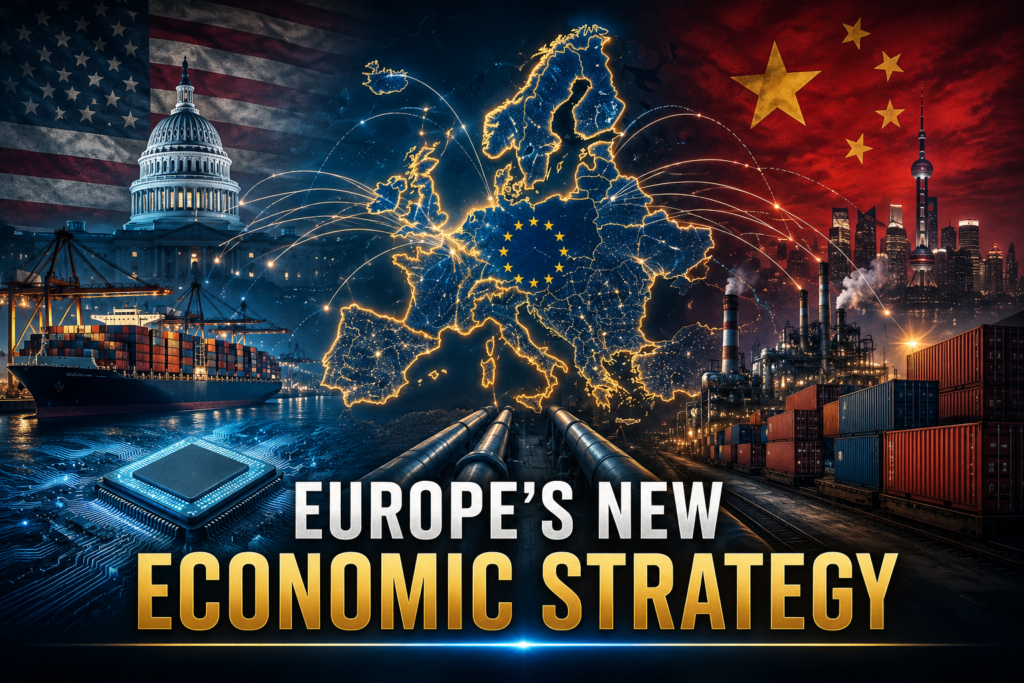
For years, Europe’s biggest economic concern was staying competitive in an increasingly globalized world.
Today, a different concern is taking priority: how much dependence is too much?
That question is quietly reshaping economic policy across the continent. It influences decisions about energy, technology, manufacturing, defense, supply chains, and even climate policy. Europe still supports international trade. It still welcomes foreign investment. It still benefits from global markets.
Yet the conversation has changed. For decades, European policymakers were largely focused on managing interdependence. Now they are increasingly focused on managing dependence.
At first glance, those ideas sound similar. They are not.
Interdependence suggests mutual reliance. Dependence raises questions about vulnerability, leverage, and control. One implies balance. The other forces governments to think about what happens when access to something critical is suddenly disrupted.
Perhaps the most important change is not a particular policy or investment program. It is a shift in mindset. European governments are looking at economic relationships differently than they did a decade ago.
For much of the globalization era, few policymakers spent much time worrying about these questions. The system seemed to work, and when a system appears to work, vulnerabilities often remain hidden.
Dependence is not a new phenomenon. Countries have always relied on foreign suppliers for important resources, technologies, and markets. What feels different today is the growing awareness of how quickly those relationships can become strategic questions.
When Efficiency Stopped Being Enough
For much of the past three decades, efficiency was the dominant objective.
Businesses built supply chains that stretched across continents. Manufacturers sourced components from wherever production was cheapest. Governments encouraged deeper economic integration because it reduced costs, improved competitiveness, and supported growth.
The logic was fairly easy to understand. Why produce something domestically if it could be produced more efficiently elsewhere?
The model delivered substantial benefits. Consumers gained access to cheaper goods. Companies improved profitability. International trade expanded rapidly.
Yet efficiency and resilience are not always the same thing.
The pandemic exposed that reality. Factory shutdowns, shipping disruptions, and shortages of essential goods revealed how fragile highly optimized supply chains could become during periods of stress. Suddenly, industries that had spent decades maximizing efficiency were forced to think about redundancy, inventory, and alternative suppliers.
Today, the importance of supply-chain resilience seems obvious.
A decade ago, it rarely occupied a central place in economic debates.
What is perhaps most striking is how rapidly these concerns spread beyond traditional security discussions. Concepts that once belonged largely to defense and foreign-policy circles began influencing conversations about pharmaceuticals, batteries, semiconductors, and industrial policy.
Ironically, Europe’s growing focus on economic independence is itself a product of globalization. Without decades of deep integration, many of the vulnerabilities attracting attention today would never have emerged in the first place.
The Events That Changed European Thinking
No single event caused Europe’s strategic shift. Several developments arrived close enough together to reinforce the same lesson.
The most dramatic was the energy crisis that followed Russia’s invasion of Ukraine.
Before the war, many European countries relied heavily on Russian natural gas. The arrangement was generally viewed as economically rational. Cheap energy supported industrial competitiveness and helped power some of Europe’s largest economies.
Then the assumptions behind that relationship changed.
What made the shock so significant was not simply the disruption itself. It was the realization that a relationship long viewed as economically sensible could suddenly appear strategically risky.
Cheap energy looked like an economic advantage until it became a geopolitical vulnerability.
In hindsight, the energy crisis may have done something even more important than exposing Europe’s reliance on Russian gas. It changed how policymakers think about dependence itself.
Once that lesson was absorbed, officials began looking at other sectors through the same lens. Semiconductors. Batteries. Cloud computing. Pharmaceuticals. Critical minerals.
The question was no longer whether these industries were efficient. The question was how exposed Europe might be if access to them became uncertain.
Yet energy was only part of the story. Around the same time, another concern was becoming increasingly difficult to ignore.
The growing rivalry between the United States and China introduced new uncertainties into the global economy. Trade disputes, export controls, technology restrictions, and geopolitical tensions increasingly forced governments and businesses to think about risks that previously seemed distant.
Europe found itself in an uncomfortable position. Its relationships with both powers remained essential, but many of the decisions shaping those relationships were being made elsewhere.
Strategic Autonomy: The Idea at the Center of Europe’s Strategy
If there is one concept that ties Europe’s response together, it is strategic autonomy.
The term appears constantly in policy discussions, yet it is often misunderstood.
Strategic autonomy is often described as an effort to reduce dependence. Yet that description may actually understate what policymakers are trying to achieve.
In practice, it functions more like an insurance policy.
Europe is not trying to eliminate dependence. That would be impossible in a global economy. Every major economy relies on imported resources, foreign investment, international trade, and global supply chains.
The concern is not dependence by itself.
The concern is concentrated dependence.
That distinction may sound subtle, but it sits at the center of much of Europe’s current economic strategy. Policymakers are less interested in severing ties than in ensuring alternatives exist when disruptions occur. Strategic autonomy is not really about closing doors. It is about avoiding situations where only one door remains open.
That sounds obvious now.
It did not sound obvious to many policymakers fifteen years ago.
What makes the shift noteworthy is that it extends far beyond traditional security concerns. Modern chips power everything from automobiles and industrial machinery to data centers and military systems. Cloud infrastructure supports financial services, businesses, and government operations. Critical minerals help determine how quickly electric vehicles, battery storage facilities, and renewable energy projects can be deployed.
Industries once viewed primarily through an economic lens are increasingly being viewed through a strategic one.
Not everyone agrees with this approach.
Supporters argue that Europe became too dependent on external suppliers in several critical sectors. Critics worry that excessive intervention could reduce competitiveness, increase costs, and encourage inefficient industrial policies.
Both concerns are legitimate.
The challenge is that resilience is rarely free. Building domestic manufacturing capacity often costs more. Diversifying suppliers can reduce efficiency. Maintaining strategic redundancy requires investment even when disruptions never occur.
European policymakers increasingly find themselves balancing two objectives that do not always move together: economic competitiveness and economic security.
Whether those goals can be reconciled without significant trade-offs remains uncertain.
Managing Dependence on America
The United States remains Europe’s closest strategic partner, and there is little indication that relationship is disappearing.
Europe’s desire for greater autonomy does not necessarily reflect declining trust in Washington. If anything, it reflects recognition that political priorities can change over time.
What concerns many European policymakers is not the current state of transatlantic relations.
It is the possibility that future administrations could prioritize different objectives.
That uncertainty has encouraged Europe to strengthen capabilities in areas where dependence on American support could become limiting.
Defense is one example. Many European governments have increased military spending and expanded domestic defense production. The objective is not to replace the alliance with the United States but to reduce the risks associated with relying too heavily on external support.
Technology presents a similar challenge.
Digital infrastructure is easy to overlook precisely because it works so well when everything is functioning normally. Yet cloud services, software platforms, and data networks increasingly form the foundation of modern economic activity.
The debate is not really about technology alone. It is about who controls the infrastructure that economies increasingly depend upon.
Managing Dependence on China
Europe’s relationship with China presents a different set of challenges.
China remains one of Europe’s largest trading partners and an essential part of many global supply chains. Access to Chinese markets remains valuable for many European firms.
That reality is unlikely to change anytime soon.
The challenge facing many companies is not deciding whether China matters.
It is deciding how much China should matter.
As a result, diversification has become the preferred strategy. Production is being spread across multiple locations, including India, Vietnam, Southeast Asia, and parts of Eastern Europe.
The goal is not necessarily to leave China. The goal is to avoid concentrating too much risk in a single place.
Critical minerals illustrate the dilemma particularly well.
Lithium, cobalt, and rare earth elements play essential roles in electric vehicles, battery production, renewable energy systems, and advanced manufacturing. A shortage of these materials can affect multiple industries simultaneously.
Reducing dependence, however, can produce its own complications.
As Europe expands battery manufacturing and renewable energy infrastructure, it remains heavily reliant on global supplies of critical minerals. Some vulnerabilities are being reduced. Others are simply taking different forms.
A Broader Transformation
India could emerge as one of the major beneficiaries of Europe’s diversification strategy. As companies seek alternative manufacturing locations and additional supply-chain capacity, India’s large workforce, expanding infrastructure, and growing industrial capabilities make it an increasingly attractive partner.
But the larger story extends beyond Europe and India.
What is happening across Europe reflects a broader transformation in how governments think about economic security.
A decade ago, many of these debates occupied a relatively small corner of policymaking. Today they influence decisions across multiple industries and ministries.
People often talk about semiconductors as a technology story. Governments increasingly treat them as strategic infrastructure. Modern chips power everything from vehicles and industrial equipment to data centers and defense systems.
Whether Europe’s strategy ultimately succeeds remains unclear. It is still too early to know how effective many of these initiatives will be over the long term.
What seems clearer is that the assumptions guiding economic policy are changing.
Europe’s leaders are not trying to reverse globalization. They are adapting to a version of globalization that feels less predictable than it once did.
Whether that adjustment ultimately produces greater security remains uncertain. But the shift in thinking is already underway, and it is likely to influence economic policy far beyond Europe for years to come.