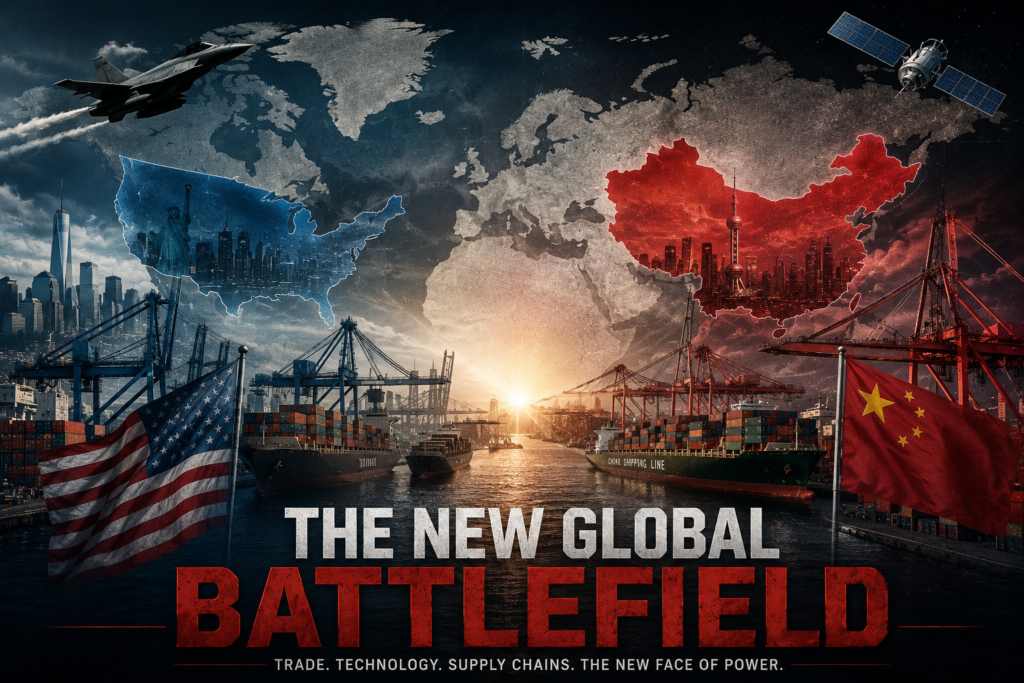
For most of modern history, national power was measured in visible terms. Countries counted soldiers, built larger navies, expanded air forces, and invested in increasingly sophisticated weapons. Military strength shaped alliances, deterred rivals, and, in many cases, determined who wrote the rules of the international order.
That understanding of power hasn’t disappeared. But it has become incomplete.
A different contest has been unfolding alongside traditional military competition—one that rarely resembles war in the conventional sense. Governments now restrict exports instead of blockading ports. They deny access to advanced technologies rather than seize territory. Financial sanctions can isolate an economy without firing a shot, while disruptions to supply chains can slow industrial growth thousands of miles away from any battlefield.
The methods look different. The objective does not.
States still compete for influence, security, and strategic advantage. Increasingly, however, they pursue those goals through the economic systems that globalization spent decades building.
That is perhaps the central paradox of the twenty-first century. The very networks that were expected to make conflict less likely—global trade, integrated supply chains, cross-border investment, and shared technological ecosystems—have become some of the most important arenas of geopolitical competition.
Globalization didn’t fail. It became strategically expensive.
For years, policymakers largely viewed economic interdependence as a stabilizing force. The logic seemed straightforward: countries deeply connected through trade and investment would have far more to lose from confrontation than from cooperation. Factories crossed borders. Capital moved freely. Production became international. Consumers benefited from lower prices, businesses gained access to larger markets, and governments generally encouraged greater integration.
That vision wasn’t entirely wrong. It helped generate decades of economic expansion and lifted millions of people into the global middle class.
But it also produced something less obvious.
As production dispersed across continents, countries became increasingly dependent on one another for technologies, energy, raw materials, logistics, finance, and manufacturing. Efficiency improved, yet resilience quietly declined. Many of those dependencies remained invisible until geopolitical tensions exposed them.
The result is a world where the same commercial relationships once celebrated as symbols of globalization are now examined through the lens of national security.
That change is subtle, but it alters almost everything.
A modern economy resembles a vast operating system rather than a collection of independent industries. Semiconductors support artificial intelligence. Artificial intelligence depends on computing infrastructure. Computing infrastructure relies on energy, critical minerals, telecommunications networks, and sophisticated manufacturing equipment. Finance connects every layer by directing capital toward the industries expected to dominate the future.
Control one important part of that system, and the influence extends much further than it first appears.
This is why recent geopolitical developments often seem disconnected when viewed individually.
The United States has tightened export controls on advanced semiconductor technologies. China has responded by restricting exports of strategically important minerals. Europe is investing heavily to reduce dependence on imported energy and critical manufacturing inputs. Governments from Japan to India are offering incentives to attract semiconductor fabrication, battery production, and advanced manufacturing.
At first glance, these appear to be separate policy decisions shaped by different national priorities.
Look more carefully, and they begin to resemble pieces of the same strategic puzzle.
Governments are no longer competing only to produce more goods or grow their economies faster. They are increasingly competing to control the bottlenecks—the technologies, resources, infrastructure, and financial networks that other economies cannot easily function without.
That represents a meaningful shift in how power itself is exercised.
During the Cold War, geopolitical competition was often understood through military alliances, nuclear deterrence, and ideological rivalry. Today’s competition is more dispersed. It runs through ports, semiconductor fabrication plants, cloud data centers, payment systems, shipping routes, and mineral processing facilities. Much of it unfolds quietly, through regulatory decisions or investment strategies rather than military deployments.
Because of that, the consequences are easy to underestimate.
A tariff can influence investment decisions years before it noticeably affects trade volumes. Export controls introduced today may shape technological leadership a decade from now. Industrial subsidies offered in one country can redirect global supply chains, attract skilled workers, reshape university research priorities, and gradually alter the geography of innovation itself.
Power now accumulates differently.
It is less about occupying territory than influencing the systems on which other countries depend.
That distinction helps explain why governments increasingly talk about “economic security” alongside national security. The two are becoming difficult to separate. A country that cannot secure advanced chips, reliable energy, trusted digital infrastructure, or resilient supply chains may discover that economic vulnerabilities eventually become strategic vulnerabilities.
The shift reaches well beyond government policy.
Corporate boards are redesigning manufacturing networks that once optimized almost exclusively for cost. Investors now evaluate geopolitical exposure alongside financial performance. Manufacturers increasingly consider political stability when deciding where to build the next factory. Even consumers experience the effects through higher prices, longer delivery times, or shortages of products that rely on globally distributed production.
Most people notice the symptoms before they recognize the underlying transformation.
That is why headlines about tariffs, export controls, sanctions, or industrial subsidies should no longer be viewed as isolated economic stories. They are usually signals of a broader competition over strategic leverage.
Understanding that competition requires looking beyond individual policy decisions.
It requires asking a more fundamental question.
If globalization connected the world’s economies into a single operating system, what happens when governments begin competing to control its most critical components?
The answer begins with how our understanding of power changed in the first place.
From Military Dominance to Economic Leverage
Power has never been static. Every era develops its own definition of what matters most.
For centuries, military capability sat at the center of that definition. Stronger armies protected borders, secured trade routes, and projected influence abroad. Industrial capacity certainly mattered, but largely because it supported military strength. The factories that produced steel, ships, aircraft, and ammunition ultimately reinforced the battlefield.
Today’s strategic landscape looks different.
Military power remains indispensable. The United States, China, Russia, India, and European nations continue to increase defense spending, modernize armed forces, and invest in new technologies. No serious government believes military capability has become irrelevant.
Yet military strength is no longer sufficient on its own.
The reason lies in how globalization reshaped the foundations of the global economy over the past four decades.
As trade expanded, production became increasingly specialized. Instead of manufacturing every component domestically, companies built global supply chains designed around efficiency. One country specialized in chip design, another in fabrication equipment, another in assembly, another in raw materials, and another in logistics. Capital flowed across borders with unprecedented speed, while businesses optimized operations on the assumption that markets would remain relatively open and predictable.
For businesses, the model made sense.
For governments, it eventually raised a different question.
What happens if one critical link in that chain suddenly becomes unavailable?
That question didn’t receive much attention during the height of globalization because the system appeared remarkably resilient. Goods moved efficiently across oceans. International investment expanded. Consumers benefited from lower prices. Political leaders often treated deeper economic integration as both an economic and diplomatic success.
History, however, has a habit of exposing assumptions.
The global financial crisis demonstrated how quickly problems in one part of the world could spread through interconnected markets. The COVID-19 pandemic revealed how vulnerable international supply chains had become after decades of optimization. Russia’s invasion of Ukraine reminded governments that energy dependence could rapidly become a geopolitical liability. Growing strategic competition between the United States and China highlighted similar risks in technology, manufacturing, and critical minerals.
Each event appeared different on the surface.
Together, they pointed toward the same conclusion.
Efficiency had quietly created dependence.
And dependence creates leverage.
That realization has transformed how governments think about economic policy.
For decades, policymakers generally asked how markets could become more efficient.
Today, they increasingly ask how economies can become more resilient.
Those are not always the same objective.
A factory located on the opposite side of the world may remain the lowest-cost supplier. It may also represent a strategic vulnerability if diplomatic relations deteriorate or transportation networks become disrupted. Companies are discovering that the cheapest option is not necessarily the safest one.
Ironically, globalization succeeded so well at connecting economies that it created entirely new ways for governments to influence one another.
The arteries of global commerce became potential pressure points.
That helps explain why economic policy has gradually moved out of finance ministries and into national security discussions. Decisions about semiconductor manufacturing, telecommunications infrastructure, battery production, shipping routes, or foreign investment are increasingly debated not only in terms of profitability, but also in terms of strategic resilience.
The vocabulary itself has changed.
Governments now speak about friendshoring, de-risking, strategic autonomy, economic security, and supply chain resilience. A decade ago, many of these phrases rarely appeared outside specialist policy circles. Today, they influence industrial planning across much of the developed world.
Language often reveals deeper shifts in thinking before statistics do.
This is also where the nature of power begins to evolve.
Traditional military power seeks to deter or defeat an opponent directly.
Economic leverage often works differently.
Instead of destroying an adversary’s capabilities, it shapes the environment in which those capabilities develop. Access to advanced technologies can be delayed. Investment flows can be redirected. Borrowing costs can rise. Industrial expansion can slow. None of these outcomes resemble conventional warfare, yet over time they may alter a country’s economic trajectory just as profoundly.
The effects are usually measured in years rather than weeks.
That slower pace sometimes makes economic competition appear less significant than military conflict. In reality, it often produces consequences that last much longer.
A country prevented from acquiring next-generation manufacturing equipment today may still feel the effects ten years later when domestic industries struggle to compete internationally. Universities produce fewer specialists. Private investment shifts elsewhere. Innovation ecosystems gradually weaken. By the time the consequences become obvious, reversing them can prove remarkably difficult.
This is where the discussion moves beyond tariffs or sanctions.
The more important question is what governments are actually trying to control.
Not trade itself.
But the strategic dependencies hidden within trade.
Because once dependence becomes visible, every critical technology, supply chain, financial network, shipping route, and industrial input starts to look different.
The contest is no longer simply about producing more.
It is increasingly about deciding who controls the systems that everyone else depends upon.
That is why semiconductors sit at the center of today’s geopolitical competition.
Not because they are valuable products in isolation.
Because they connect almost every other strategic industry that follows.
The New Arsenal: How Trade Became a Strategic Weapon
If globalization created a web of economic dependencies, the next question becomes unavoidable.
Which parts of that web matter most?
Not every industry carries the same strategic weight. Countries can usually replace one supplier of textiles or furniture without fundamentally altering their economic future. Replacing a supplier of advanced semiconductor equipment, critical minerals, or payment infrastructure is an entirely different challenge.
This is why governments have become increasingly focused on what might be called the modern arsenal of economic power.
Unlike traditional arsenals, these tools aren’t designed to destroy. They’re designed to influence, delay, redirect, and sometimes deny. They shape what competitors are able to build, finance, manufacture, or innovate over the long term.
The shift is subtle.
Military strategy traditionally aimed to control territory.
Economic strategy increasingly aims to control bottlenecks.
That distinction explains much of what has happened over the past several years.
Semiconductors: The Chokepoint of the Digital Economy
Every era has a technology that quietly underpins almost everything else.
During the Industrial Revolution, it was steam power. In the twentieth century, oil transformed economies and military logistics alike. Today, semiconductors occupy a similarly foundational role.
Nearly every advanced technology depends on them.
Artificial intelligence, cloud computing, smartphones, medical devices, industrial robots, satellites, telecommunications equipment, autonomous vehicles, modern aircraft, and sophisticated defense systems all begin with increasingly complex chips.
The chips themselves are microscopic.
The ecosystem required to produce them is anything but.
Design software, fabrication equipment, ultra-pure chemicals, precision manufacturing, specialized engineering talent, packaging, testing, and highly reliable electricity all come together in one of the most complex industrial processes humanity has ever built.
No country controls every stage.
For years, that specialization was considered one of globalization’s greatest strengths. Each participant focused on what it did best, allowing innovation to accelerate while costs gradually declined.
Governments now view the same system through a different lens.
If access to advanced chips determines future leadership in artificial intelligence, defense technologies, healthcare, advanced manufacturing, and scientific research, then controlling the semiconductor supply chain becomes about much more than electronics.
It becomes a question of national power.
This explains why semiconductor policy has moved from corporate boardrooms to presidential offices and cabinet meetings.
Countries are no longer competing only to manufacture chips.
They’re competing to influence who can manufacture the next generation of chips.
There’s an important difference.
One competition is commercial.
The other is strategic.
Artificial Intelligence: Competition Beyond Software
The race for artificial intelligence is often portrayed as a contest between technology companies.
That misses the larger picture.
Governments increasingly view AI as a general-purpose technology—one capable of reshaping productivity across almost every major sector of the economy.
Manufacturing becomes more efficient.
Drug discovery accelerates.
Financial systems become faster.
Military planning evolves.
Scientific research advances.
Public services become increasingly automated.
In previous industrial revolutions, countries competed to build factories.
Today they are also competing to build intelligence.
But artificial intelligence doesn’t exist independently.
Every major advance depends on powerful semiconductors, massive computing infrastructure, enormous energy consumption, sophisticated data centers, reliable cloud services, and highly skilled researchers.
One dependency quickly leads to another.
Restrict advanced chips, and AI development slows.
Limit computing infrastructure, and innovation becomes more expensive.
Reduce access to talent, and the ecosystem weakens further.
Economic competition has become remarkably interconnected.
One strategic bottleneck often influences several industries simultaneously.
Critical Minerals: The Resources Behind the Technology
Semiconductors and artificial intelligence naturally lead to another question.
What makes those technologies possible in the first place?
The answer lies underground.
Lithium, cobalt, nickel, graphite, gallium, germanium, rare earth elements, and several lesser-known minerals have become essential inputs for batteries, advanced electronics, renewable energy systems, military equipment, and semiconductor manufacturing.
Most consumers rarely think about these materials.
Governments do.
Unlike oil, many critical minerals are geographically concentrated, while processing capacity is often concentrated somewhere else. That creates two separate layers of dependency.
Owning natural resources is valuable.
Controlling the ability to refine them can be even more valuable.
Countries have begun recognizing that mining alone captures only part of the strategic advantage. Processing, chemical refinement, advanced manufacturing, and downstream industrial ecosystems often generate far greater economic influence.
That realization is reshaping industrial policy across multiple continents.
It’s also changing investment priorities.
Mining projects once viewed primarily through a commercial lens are increasingly evaluated for their geopolitical significance.
Resources have become strategy.
Energy: An Old Tool Taking on a New Role
Long before semiconductors or artificial intelligence dominated policy discussions, energy shaped international politics.
That hasn’t changed.
What has changed is the definition of energy security itself.
The oil shocks of the 1970s demonstrated how dependence on imported energy could disrupt entire economies almost overnight. Many governments responded by diversifying suppliers, building strategic reserves, and improving energy efficiency.
Today’s challenge is broader.
Energy now includes electricity grids, liquefied natural gas infrastructure, battery manufacturing, renewable technologies, hydrogen, and the power systems required to operate increasingly digital economies.
Data centers running advanced AI models consume enormous amounts of electricity.
Semiconductor fabrication plants require exceptionally stable power supplies.
Electric vehicles increase demand for batteries and charging infrastructure.
One strategic industry reinforces another.
Energy no longer sits beside technology policy.
It increasingly forms part of the same conversation.
Looking at semiconductors, artificial intelligence, critical minerals, and energy separately can make today’s geopolitical landscape seem fragmented.
Taken together, a different picture emerges.
Governments are no longer trying to control individual industries in isolation.
They are trying to strengthen—or weaken—the ecosystems that connect them.
And once those ecosystems become the focus, the competition extends beyond factories and natural resources.
It moves into something even less visible.
The financial systems, supply chains, and digital networks that allow the global economy to function in the first place.
Finance, Supply Chains, and the Quiet Infrastructure of Power
If semiconductors are the brains of the modern economy and energy is its fuel, finance is the system that keeps everything moving.
Money rarely attracts the same public attention as missiles or military alliances. Yet few governments possess a tool as powerful as access to global financial networks.
That influence is largely invisible until it is restricted.
International trade depends on payment systems, correspondent banking, reserve currencies, capital markets, insurance providers, and financial institutions that operate across borders. Most businesses treat these networks as ordinary infrastructure. Governments increasingly recognize them as strategic infrastructure.
The distinction matters.
A country doesn’t need to blockade another nation’s ports if it can make financing trade significantly more difficult. Restrict access to international banking, raise borrowing costs, reduce investor confidence, and commercial activity begins slowing long before factories close.
Economic pressure often works by changing incentives rather than creating immediate disruption.
Markets usually react before governments finish debating policy.
Investors reassess risk.
Banks tighten lending.
Insurance costs increase.
Companies postpone expansion plans.
Foreign capital quietly looks elsewhere.
None of these decisions make front-page news individually. Together, they can reshape an economy.
This is one reason financial sanctions have become a preferred instrument of statecraft. Their objective isn’t always immediate economic collapse. More often, they gradually reduce a country’s ability to finance growth, attract investment, or access international markets.
The effects accumulate.
That pattern appears repeatedly throughout economic competition.
The most effective tools often operate slowly enough that they are mistaken for ordinary market forces.
Supply Chains: The End of the Efficiency Era
For nearly four decades, businesses optimized supply chains around one central idea.
Efficiency.
Manufacturing moved wherever production costs were lowest. Components crossed multiple borders before becoming finished products. Companies reduced inventories, streamlined logistics, and relied on highly specialized suppliers scattered across different continents.
The model worked remarkably well.
Until it didn’t.
The pandemic exposed vulnerabilities that had been building quietly for years. Factory shutdowns in one region delayed production around the world. Shipping bottlenecks disrupted industries with no direct connection to the original problem. Businesses discovered that a single missing component could halt the assembly of products worth millions of dollars.
The lesson extended beyond COVID-19.
Russia’s invasion of Ukraine demonstrated similar vulnerabilities in energy and agricultural markets. Growing tensions between the United States and China raised questions about advanced manufacturing, electronics, and technology supply chains.
Different crises.
The same underlying problem.
Globalization had optimized for efficiency while assuming stability.
Once stability became less certain, the calculation changed.
Today, procurement executives are asking questions that rarely appeared on boardroom agendas fifteen years ago.
Can production continue if one supplier disappears?
Should critical components come from multiple countries even if costs increase?
How much redundancy is worth paying for?
These are no longer operational questions.
Increasingly, they are strategic ones.
That helps explain the rise of concepts such as China+1, friendshoring, nearshoring, and reshoring. They are often described as manufacturing strategies, but they are really responses to geopolitical uncertainty.
Businesses are not abandoning globalization.
They are redesigning it.
The objective is no longer to build the cheapest supply chain possible.
It is to build one that can survive disruption.
That shift may prove to be one of globalization’s biggest transformations.
For decades, resilience was treated as an unnecessary cost.
Now it is increasingly viewed as a competitive advantage.
The Return of Industrial Policy
This change has revived something many economists believed belonged to an earlier era.
Industrial policy.
For much of the late twentieth century, governments in advanced economies generally assumed markets would allocate capital more efficiently than the state. Direct intervention was often viewed with skepticism, if not outright criticism.
That consensus has weakened considerably.
Today, governments are offering tax incentives, subsidies, infrastructure support, and regulatory reforms to attract semiconductor fabrication plants, battery manufacturers, pharmaceutical production, clean-energy investment, and advanced research facilities.
This is happening across political systems that often disagree on almost everything else.
The United States, the European Union, Japan, South Korea, India, and several other economies have all expanded state support for industries they consider strategically important.
The motivation is revealing.
These policies are not aimed solely at increasing economic growth.
They are designed to reduce strategic dependence.
History offers an interesting parallel.
After the Second World War, governments invested heavily in rebuilding industrial capacity because manufacturing strength was considered essential for national security. The decades that followed gradually shifted toward market liberalization and deeper globalization.
Today, the pendulum is moving again.
Not toward isolation.
Toward selective self-reliance.
That distinction is easy to overlook.
Countries are not trying to produce everything domestically. Doing so would be prohibitively expensive and economically inefficient.
Instead, they are identifying a relatively small number of industries where dependence carries strategic risk and trying to secure greater control over them.
That is a much narrower—and arguably much more consequential—objective.
A Different Kind of Competition
Viewed individually, export controls, industrial subsidies, financial sanctions, investment screening, supply-chain diversification, and critical mineral policies appear to belong to different policy debates.
Viewed together, they tell a remarkably coherent story.
Governments are redefining national power around control of systems rather than control of territory.
The battlefield has not disappeared.
It has expanded.
Competition increasingly unfolds through factories, research laboratories, financial markets, logistics networks, cloud infrastructure, undersea data cables, and the regulatory decisions that shape them.
The remarkable part is how ordinary these developments often appear.
A subsidy here.
An export restriction there.
A new semiconductor facility announced in another country.
Each headline seems technical.
Collectively, they describe one of the most significant shifts in geopolitical strategy since the end of the Cold War.
Which raises an obvious question.
If governments, businesses, and investors are all adapting to this new reality, who stands to benefit—and what does it ultimately mean for the rest of us?
Who Benefits from the New Economic Order?
Periods of structural change rarely produce winners and losers immediately. The effects emerge gradually, often over years, as investment shifts, industries relocate, and new ecosystems begin to form.
The current transition is no exception.
As governments encourage companies to diversify production and reduce strategic dependence, countries that combine political stability, competitive manufacturing, reliable infrastructure, skilled labor, and policy consistency are positioned to attract a disproportionate share of global investment.
India is one of the clearest examples.
Its large domestic market, expanding digital economy, improving infrastructure, and relatively young workforce make it an attractive destination for businesses looking beyond traditional manufacturing hubs. Government initiatives aimed at electronics production, semiconductor manufacturing, and logistics modernization reflect a broader ambition: not simply to participate in global supply chains, but to occupy more valuable positions within them.
That distinction matters.
Assembling products generates economic activity. Designing technologies, refining critical materials, manufacturing advanced components, and building innovation ecosystems create far greater long-term influence.
Other countries are pursuing similar ambitions through different strengths.
Vietnam continues expanding its role in electronics manufacturing. Indonesia is leveraging its resource base to move deeper into battery and electric vehicle supply chains. Mexico benefits from geographic proximity to North American markets and an increasingly integrated manufacturing base. Malaysia remains an important player in semiconductor packaging and testing, while Poland has become a strategic manufacturing location within Europe’s evolving industrial landscape.
None of these countries is replacing globalization.
They are helping reshape it.
The larger pattern is becoming increasingly clear.
Investment is no longer flowing only toward the lowest-cost locations. It is flowing toward places that combine economic opportunity with strategic reliability.
That subtle change may influence global development for decades.
Why This Matters Beyond Governments
It is tempting to view these developments as concerns for diplomats, policymakers, or multinational corporations.
They are not.
Economic strategy eventually becomes everyday economics.
When governments restrict exports of critical technologies, manufacturers face higher costs or production delays. When supply chains become more fragmented, businesses often maintain additional inventories or duplicate production across multiple regions. Those decisions improve resilience—but they also increase expenses.
Consumers rarely see those strategic calculations.
They see higher prices.
The same pattern appears across energy markets.
Geopolitical disruptions influence fuel prices. Fuel prices affect transportation costs. Transportation costs feed into inflation. Central banks respond by adjusting interest rates. Higher interest rates influence mortgage payments, business investment, and employment.
One geopolitical decision can move through the economy in ways that few people initially recognize.
Investors have also changed the way they evaluate opportunity.
A decade ago, geopolitical stability was often treated as background context.
Today it sits much closer to the center of investment decisions.
Fund managers assess supply-chain exposure alongside profitability. Manufacturers examine political relationships before choosing production sites. Technology firms increasingly evaluate regulatory environments as carefully as labor costs.
Risk itself has been redefined.
The implications extend beyond financial markets.
Universities are expanding semiconductor engineering programs. Governments are funding research in artificial intelligence, cybersecurity, quantum computing, and advanced manufacturing. Companies compete aggressively for specialized talent because skilled engineers and researchers have become strategic assets in their own right.
Economic competition increasingly shapes education, migration, innovation, and labor markets—not just trade statistics.
Is Globalization Ending?
The popular answer is often yes.
The evidence suggests otherwise.
Global trade remains enormous. Cross-border investment continues. International supply chains still connect manufacturers, consumers, and financial markets across continents. Digital services move across borders every second.
The world has not become less interconnected.
It has become more selective about its interdependence.
This distinction is essential.
The first era of globalization largely pursued efficiency. The emerging era is balancing efficiency against resilience, strategic autonomy, and national security. Governments are becoming more deliberate about identifying which industries can remain globally integrated and which require greater domestic control.
That shift is unlikely to reverse.
History offers a useful perspective.
The Bretton Woods system helped build the post-war economic order around open markets and expanding international cooperation. The container shipping revolution dramatically lowered transportation costs and accelerated globalization. The rise of the internet connected businesses and consumers on an unprecedented scale.
Each transformation expanded economic integration.
Today’s transformation is different.
It is not dismantling those connections.
It is changing how governments manage them.
Globalization is entering a more strategic phase.
The Bigger Transformation
Throughout this article, one argument has quietly connected every section.
Semiconductors.
Artificial intelligence.
Critical minerals.
Energy.
Finance.
Supply chains.
Industrial policy.
At first glance, these appear to belong to separate policy debates.
They do not.
Each represents a different layer of the same operating system that supports the modern global economy.
The competition is no longer simply over products.
It is over the infrastructure that allows products, capital, information, and innovation to move.
That is why headlines about export controls, industrial subsidies, investment restrictions, sanctions, or tariffs should be interpreted differently than they were twenty years ago.
They are rarely just economic policies.
More often, they are attempts to shape the distribution of strategic leverage.
The countries that understand this earliest—and invest accordingly—are likely to exert disproportionate influence over the next phase of the international order.
Conclusion: A New Definition of Power
Military power will remain indispensable.
Nations will continue investing in armed forces, alliances, and deterrence because traditional security threats have not disappeared.
But military capability no longer tells the entire story of geopolitical influence.
The nature of power itself has evolved.
In an interconnected world, influence increasingly comes from shaping the systems that others rely upon: advanced technologies, financial networks, logistics infrastructure, critical minerals, energy systems, cloud computing, semiconductor manufacturing, and the digital architecture that binds modern economies together.
Globalization unintentionally created these strategic dependencies.
Governments are now learning to navigate—and increasingly to exploit—them.
That realization changes how we should interpret the headlines of the coming decade.
A tariff is no longer just a trade dispute.
An export control is rarely just a technology policy.
A subsidy for semiconductor manufacturing is about far more than industrial development.
These are all expressions of a broader competition over economic leverage.
The defining contests of the twenty-first century are unlikely to be decided solely by the strength of armies or the size of defense budgets.
They will increasingly be shaped by something less visible but no less consequential: who controls the networks, technologies, resources, and institutions that keep the global economy functioning.
Economic interdependence was never politically neutral.
It has become the terrain on which great-power competition now unfolds.
And that may prove to be globalization’s most unexpected legacy.