Pick up almost any modern product and its journey probably crosses several countries before it reaches your hands.
A smartphone assembled in India may contain chips packaged in Malaysia, battery materials processed in Indonesia, precision components from Vietnam, and specialized machinery sourced from China, Japan, or Europe. Even the cardboard box has its own supply chain.
Not long ago, much more of that journey would have been concentrated in one country.
For years, China wasn’t simply the world’s largest manufacturing base. It became the place where suppliers, logistics companies, ports, skilled workers, and factories evolved together. That concentration created extraordinary efficiency. It also created a level of dependence that many businesses didn’t fully appreciate until it was tested.
And it was tested.
Trade disputes, pandemic lockdowns, semiconductor shortages, shipping disruptions, and geopolitical tensions didn’t create weaknesses in global supply chains. They exposed weaknesses that had been building quietly for years. Efficiency had become so dominant that resilience was often treated as a secondary concern.
Before 2020, discussions about supply-chain resilience were largely confined to procurement teams and operations managers. Today they’re boardroom conversations. The question isn’t simply how to reduce costs anymore. It’s how to keep production running when the unexpected happens.
That’s a different way of thinking.
The conversation has also shifted beyond a familiar headline: Who is replacing China?
In reality, that’s the wrong question.
Manufacturing isn’t becoming less global. It’s becoming less concentrated.
Companies aren’t searching for a single successor capable of replacing the world’s largest manufacturing ecosystem. They’re spreading production across multiple countries, building supplier networks in different regions, and accepting that a little extra cost can sometimes buy a great deal of flexibility.
Ironically, globalization created the concentration that businesses are now trying to reduce.
That doesn’t mean China is fading from the manufacturing map. Far from it. It means companies are no longer comfortable placing too much of their production capacity in one location, regardless of how efficient that location may be.
The shift is gradual, expensive, and in many industries still incomplete.
Which is exactly why it’s worth paying attention to.
Why Global Supply Chains Are Changing
Factories don’t move as quickly as headlines do.
A major manufacturing facility can take years to build and billions of dollars to finance. Once companies establish supplier networks, train workers, and integrate production into global logistics systems, relocating isn’t something they do because of a single political event or one difficult year.
It usually takes several pressures building at once.
Higher labor costs have been one of them.
China’s remarkable manufacturing rise was supported by an enormous workforce and decades of industrial investment. As the economy developed, wages increased. That’s a natural consequence of economic growth, but it also changed the economics of labor-intensive industries such as apparel, footwear, furniture, and basic electronics. Production that once made obvious financial sense in China became more competitive elsewhere.
That alone wouldn’t have reshaped global manufacturing.
Politics became part of the equation.
Tariffs, export controls, restrictions on advanced technology, and growing strategic competition between the United States and China forced multinational companies to think about geopolitical exposure in a way they rarely had before. Manufacturing decisions were no longer driven solely by labor costs, productivity, or tax incentives. Government policy had become a variable that executives couldn’t afford to ignore.
Then COVID-19 exposed something even bigger.
When factories closed, ports became congested, and shipping schedules collapsed, companies discovered that many of their supply chains depended on the same regions, the same suppliers, and sometimes even the same transportation routes. A disruption in one place quickly became a disruption almost everywhere.
The lesson didn’t end when the pandemic eased.
Instability in the Red Sea, ongoing geopolitical tensions, and the economic consequences of the Russia-Ukraine war have continued to remind manufacturers that production doesn’t stop at the factory gate. A product still has to reach its customer, and increasingly that’s where some of the biggest risks emerge.
Ten years ago many executives focused on maximizing efficiency.
Today many are willing to sacrifice a small portion of that efficiency if it reduces the risk of a major disruption later.
That’s a significant shift in mindset.
Most companies aren’t abandoning China.
They’re adding options.
The strategy has become widely known as China+1—maintaining substantial operations in China while expanding manufacturing into at least one additional country. The objective isn’t to replace China’s industrial ecosystem. In most industries, that’s neither practical nor desirable.
It’s about reducing dependence.
Looking only at the factories leaving China misses the bigger story.
The more interesting question is where companies are building their next factories—and why those countries, rather than others, are beginning to attract long-term industrial investment.
What Makes a Manufacturing Hub Successful?
It’s tempting to think manufacturing simply follows the lowest wages.
That hasn’t been true for quite some time.
A modern factory is really the final piece of a much larger system. Before the first product rolls off an assembly line, companies need reliable electricity, efficient ports, capable suppliers, transport networks, customs processes that don’t create costly delays, and enough skilled workers to keep production running at scale. Weakness in any one area can ripple through the entire operation.
That’s why governments today compete for factories much the way previous generations competed for financial investment.
Tax incentives still matter, but they’re rarely enough on their own. Trade agreements, industrial parks, faster approvals, vocational training, digital infrastructure, and policy consistency increasingly shape investment decisions. Manufacturers don’t just compare labor costs anymore; they compare ecosystems.
Scale still matters.
So does predictability.
A company building a semiconductor facility or an automotive plant isn’t making a five-year bet. In many cases, it’s making a thirty-year one. Executives know they can adapt to moderate increases in labor costs. Adapting to unpredictable regulation, policy reversals, or chronic infrastructure bottlenecks is far more difficult.
Not every company is diversifying at the same pace—or for the same reasons.
A clothing manufacturer and a semiconductor company are solving very different problems. One is driven largely by labor economics. The other depends on engineering talent, specialized suppliers, clean-room infrastructure, and years of technical expertise.
That’s why there isn’t a single blueprint for becoming the next manufacturing hub.
Each successful country has built a different competitive advantage.
The Countries Leading the Manufacturing Shift
India
India’s manufacturing story is often framed around one question: Can it become the next China?
It’s an understandable comparison, but probably the wrong one.
India isn’t trying to replicate China’s industrial model from the early 2000s. It is entering a very different global economy—one where companies are deliberately spreading production across multiple countries rather than concentrating it in one.
That distinction matters.
The strongest argument for India isn’t low-cost manufacturing alone. It’s scale.
Few countries combine a workforce of this size with a rapidly expanding consumer market, improving infrastructure, and government policies aimed at attracting industrial investment. For many multinational companies, manufacturing in India isn’t just about exports. It’s also about producing closer to one of the world’s fastest-growing domestic markets.
Electronics has become the most visible example.
Government production-linked incentive (PLI) programs have encouraged investment in smartphone manufacturing, while suppliers have gradually followed. That’s how industrial ecosystems usually develop. Large manufacturers arrive first. Component suppliers, logistics providers, equipment companies, and specialized service firms often come later.
The process is slower than headlines suggest.
Building factories is one challenge. Building supplier depth takes considerably longer.
India is making progress on both, supported by investments in freight corridors, highways, ports, logistics parks, and industrial infrastructure. Some regions are moving faster than others, but the overall direction is becoming clearer with each passing year.
Challenges remain difficult to ignore.
Land acquisition can delay projects. Regulations still differ across states. Infrastructure quality isn’t consistent nationwide, and manufacturers continue to point to logistics costs as an area where further improvement is needed.
None of those issues are unique to India.
The question is whether they are improving quickly enough to keep pace with investment. So far, many global manufacturers appear to believe they are.
India’s opportunity isn’t simply to attract factories.
It’s to become a place where supplier networks, engineering talent, product development, and advanced manufacturing grow together over the next decade.
Vietnam
If one country has benefited most visibly from the China+1 strategy, it’s probably Vietnam.
Its rise didn’t happen overnight.
For years, Vietnam invested in export manufacturing, signed an extensive network of trade agreements, and built a reputation for producing efficiently at competitive costs. When companies began looking for additional manufacturing locations, much of that groundwork was already in place.
That preparation matters.
Factories rarely move into countries that have done nothing to prepare for them.
Global electronics companies have steadily expanded production, particularly in smartphones, consumer electronics, and computer hardware. Vietnam has become an important part of many technology supply chains—not because it replaced China, but because it complements it.
Growth, however, creates its own pressures.
Industrial land is becoming more competitive. Demand for skilled workers continues to rise, and infrastructure has to expand fast enough to support increasing production. Success can become difficult to manage if investment begins arriving faster than supporting capacity.
Vietnam’s advantage isn’t size.
It’s execution.
Mexico
Mexico’s biggest competitive advantage isn’t cheaper labor.
It’s geography.
For decades, manufacturers optimized supply chains around global efficiency, often accepting long shipping times in exchange for lower production costs. Recent disruptions have shifted that calculation. Being close to the customer has become valuable again.
That’s why nearshoring has gained so much attention.
For companies supplying the United States and Canada, producing in Mexico means products can often move by road or rail instead of spending weeks crossing oceans. Shorter transport times make inventory planning easier, reduce shipping costs, and allow businesses to respond more quickly when demand changes.
Geography has returned to manufacturing in a way few executives expected fifteen years ago.
The automotive industry illustrates that shift particularly well, but it extends beyond vehicles. Electronics, aerospace components, industrial machinery, medical devices, and household appliances have all attracted additional investment as manufacturers rethink how far products really need to travel before reaching their customers.
Mexico isn’t competing to become another Asian manufacturing hub.
It’s benefiting from a very different trend altogether.
Indonesia
In the race to attract manufacturing, Indonesia isn’t selling inexpensive labor as its main advantage.
It’s selling something far harder to replace.
Nickel.
As electric vehicles move from a niche product to a core part of the automotive industry, the conversation has shifted well beyond where cars are assembled. Batteries now sit at the center of strategic planning, and Indonesia holds one of the world’s largest nickel reserves—a resource that has become increasingly valuable for battery production.
In many ways, the battery has become the strategic heart of the electric vehicle industry.
Recognizing that, Indonesia has spent the past few years trying to move beyond exporting raw materials. Instead, policymakers have encouraged companies to invest in refining, battery processing, and downstream manufacturing. The objective is straightforward: capture more of the value chain instead of supplying only the raw inputs.
Resource wealth, however, only opens the door.
Turning minerals into a competitive manufacturing ecosystem requires reliable energy, transport infrastructure, environmental safeguards, technical expertise, and long-term investment. Countries don’t become industrial leaders simply because they possess valuable resources. They become industrial leaders by building industries around them.
Indonesia is still in the middle of that transition.
Malaysia
Malaysia rarely dominates conversations about global manufacturing.
That’s partly because some of its most important work happens in stages of production that consumers never see.
While much of the attention surrounding semiconductors focuses on advanced chip fabrication, packaging, testing, and precision engineering are equally essential parts of the supply chain. Those are areas where Malaysia has quietly built decades of expertise.
The chips themselves are tiny.
The industrial value attached to them is enormous.
As demand for artificial intelligence infrastructure, advanced computing, and data centers continues to rise, Malaysia’s role has become more significant. It occupies a specialized position that isn’t easily replicated through low labor costs alone.
That specialization matters.
Modern manufacturing rewards expertise as much as scale, and countries that dominate specific parts of a supply chain often become difficult to replace, even if they never produce the final product consumers recognize.
It’s one reason Malaysia continues attracting investment without generating the same headlines as some of its larger neighbors.
Thailand
Thailand tells a different story.
Unlike several emerging manufacturing destinations, it isn’t building an industrial base from scratch. It already has one.
For decades the country has been a major center for automotive manufacturing, supported by established supplier networks, experienced workers, and industrial clusters that have expanded gradually over time. Those advantages are difficult to recreate because supplier relationships usually develop over years, not months.
That experience gives Thailand a degree of resilience.
But experience alone isn’t enough.
Competition across Southeast Asia has intensified as governments offer new incentives to attract investment. Thailand’s challenge is no longer proving it can manufacture at scale. It’s proving it can continue moving into more advanced industries while protecting the strengths it has already built.
Bangladesh
Bangladesh remains one of the world’s most important garment manufacturing centers.
Its success has been built on competitive production costs, a large workforce, and decades of integration into global apparel supply chains. For international fashion brands, Bangladesh is already an established part of the sourcing map rather than an emerging destination.
The next chapter looks different.
Long-term competitiveness is increasingly tied to higher-value textiles, technical fabrics, automation, sustainability, and better logistics. Rising incomes eventually reshape every manufacturing economy, which means industries built purely on inexpensive labor rarely stand still forever.
Bangladesh now faces the challenge many successful manufacturing economies eventually encounter.
How do you move beyond the industry that created your success?
Poland
Poland’s rise reflects a broader shift taking place inside Europe.
As companies rethink long supply chains, manufacturing closer to European customers has become increasingly attractive. Poland combines a skilled industrial workforce with direct access to one of the world’s largest consumer markets, making it a logical choice for automotive components, machinery, electronics, and industrial equipment.
Its advantage isn’t that it’s Europe’s lowest-cost producer.
It’s that geography, infrastructure, and industrial capability increasingly work together.
For European manufacturers, reducing transport time and simplifying logistics can be just as valuable as reducing production costs.
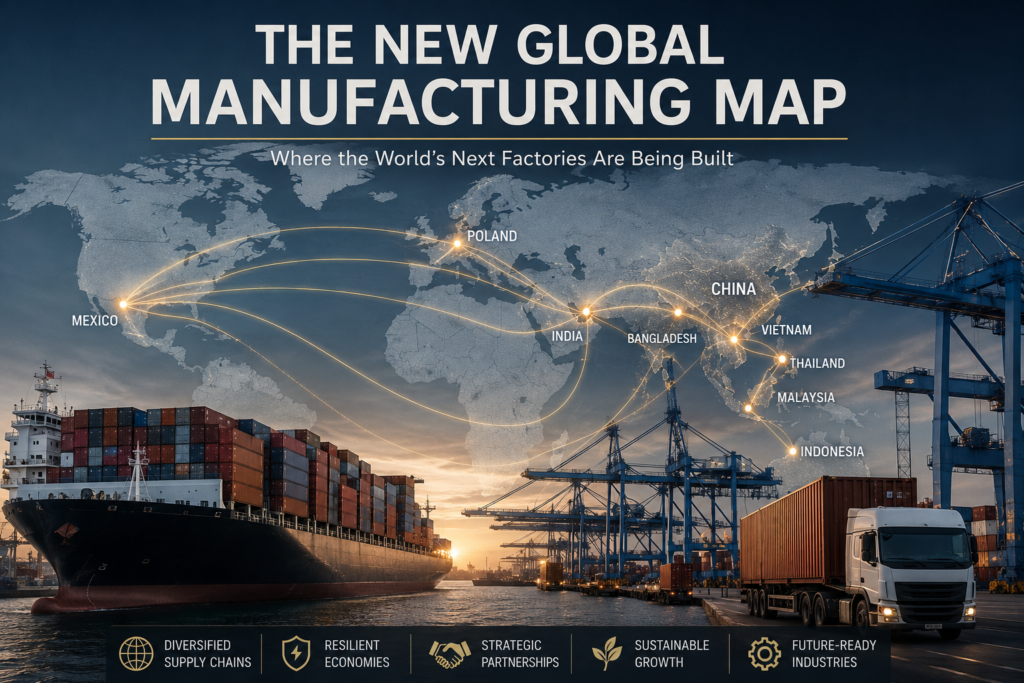
Looking across these countries, it’s tempting to assume the world is searching for a single replacement for China.
It isn’t.
That’s the biggest misconception surrounding today’s manufacturing shift.
Each country is solving a different problem.
Mexico offers proximity.
Indonesia offers critical minerals.
Malaysia specializes in advanced electronics.
Vietnam has built an efficient export platform.
India combines industrial scale with a vast domestic market.
No country is replacing China across every industry because no country offers the same combination of industrial depth, supplier networks, infrastructure, and manufacturing scale.
The world isn’t moving from one factory to another.
It’s moving from one dominant manufacturing center to a network of specialized ones.
That distinction explains much of what happens next.
Is China Really Losing Its Manufacturing Dominance?
This is where many headlines oversimplify a far more complicated reality.
China is not disappearing from global manufacturing.
If anything, it’s becoming more specialized.
Some labor-intensive industries have expanded into countries where operating costs are lower. That part of the story is real. But it sits alongside another trend that receives far less attention: China continues moving deeper into advanced manufacturing.
Electric vehicles.
Industrial robotics.
Renewable energy equipment.
Battery technology.
Aerospace.
Advanced electronics.
These are industries that depend on engineering capability, supplier depth, research investment, and manufacturing ecosystems built over decades. They’re considerably harder to relocate than apparel production or basic assembly operations.
That’s easy to underestimate.
People often talk about factories as though they operate independently. In reality, they’re connected to hundreds—sometimes thousands—of specialized suppliers. Building a smartphone, for example, isn’t simply about assembling components. It’s about having those components, precision machinery, technical expertise, testing facilities, logistics providers, and engineering support available at the right time and in the right place.
Industrial ecosystems are much harder to move than factory buildings.
That’s why companies aren’t choosing between China and everyone else.
Increasingly, they’re choosing China and someone else.
Industries Driving the Global Manufacturing Shift
One of the easiest mistakes to make is treating manufacturing as though every industry is following the same map.
It isn’t.
A company assembling T-shirts, a pharmaceutical manufacturer, and a semiconductor producer may all be diversifying their supply chains, but they’re solving completely different problems.
Electronics offers perhaps the clearest example.
Assembly has gradually expanded across India, Vietnam, and other parts of Southeast Asia, yet China remains deeply embedded in the industry’s supplier networks. Components still cross borders several times before a finished product reaches consumers. A smartphone assembled in one country may still depend on dozens of suppliers located somewhere else.
That’s why supply chains aren’t necessarily becoming shorter.
They’re becoming smarter.
Companies are placing different stages of production where they make the most strategic sense rather than concentrating everything in one location.
The electric vehicle industry has accelerated that shift.
For much of the automotive era, manufacturing discussions centered on vehicle assembly. Today the conversation often starts much earlier—with batteries, critical minerals, refining capacity, and chemical processing.
Control over these stages increasingly shapes industrial policy.
Countries with significant reserves of nickel, lithium, cobalt, graphite, or rare earth elements are no longer viewed simply as commodity exporters. Many are trying to move further into processing and manufacturing because that’s where considerably more value is created.
The race isn’t just for resources.
It’s for what happens after those resources leave the ground.
Semiconductors follow an entirely different logic.
The most advanced chip fabrication plants cost tens of billions of dollars and require years to build, making them among the most complex manufacturing facilities ever created. Very few countries possess the technical expertise, infrastructure, and supplier ecosystems needed to compete at that level.
That doesn’t mean other countries are excluded.
Packaging, testing, assembly, specialty materials, equipment manufacturing, and precision engineering are spreading across several economies, allowing companies to reduce bottlenecks without attempting to duplicate every stage of semiconductor production.
The industry isn’t becoming decentralized.
It’s becoming more distributed.
There’s an important difference.
Pharmaceuticals reveal another lesson.
For years, governments paid relatively little attention to where many essential medicines or active pharmaceutical ingredients originated, provided supply remained reliable. The pandemic changed that calculation almost overnight.
Health security became part of economic security.
Several countries have since encouraged domestic pharmaceutical production or sought to diversify overseas suppliers. That may raise costs in some cases, but policymakers increasingly view the trade-off as worthwhile.
Apparel manufacturing continues evolving as well.
Bangladesh, Vietnam, and several other economies remain central to global clothing production, yet brands are paying closer attention to delivery times, compliance standards, automation, and supply-chain resilience than they did a decade ago. Low labor costs still matter. They simply matter alongside a growing list of other considerations.
Different industries.
Different priorities.
Different maps.
That’s exactly what makes today’s manufacturing shift so much more complex than the relocation of factories from one country to another.
Who Wins and Who Faces Challenges?
Countries attracting the strongest manufacturing investment rarely succeed because of one advantage alone.
Reliable infrastructure matters.
So do political stability, logistics, skilled workers, trade access, supplier ecosystems, and the confidence that policy won’t change dramatically halfway through a major investment.
Those factors don’t always make headlines.
They often determine where factories are actually built.
India, Vietnam, Mexico, Indonesia, and Malaysia are frequently grouped together, but they’re succeeding for different reasons.
India offers scale.
Vietnam offers execution.
Mexico offers proximity.
Indonesia offers strategic resources.
Malaysia offers technical specialization.
Their competitive advantages overlap in some areas, yet they’re not competing for exactly the same projects.
That helps explain why investment continues flowing to several countries simultaneously rather than concentrating in one obvious winner.
Some economies face a more difficult challenge.
Low wages alone no longer guarantee manufacturing growth. Weak transport infrastructure, unreliable electricity, limited industrial capability, or policy uncertainty can outweigh labor-cost advantages surprisingly quickly. Manufacturers calculate the cost of delays as carefully as they calculate the cost of wages.
China, meanwhile, faces a different transition.
Rising labor costs have reduced its competitiveness in some labor-intensive sectors, but that’s only one part of a much larger story. The country continues investing heavily in advanced manufacturing, automation, robotics, electric vehicles, batteries, and high-value industrial production.
Viewed from that perspective, China’s manufacturing role isn’t shrinking so much as changing.
Manufacturing leadership itself is becoming more specialized.
Perhaps that’s the more important trend.
Countries no longer need to dominate every industry to become indispensable in one.
What This Means for the Global Economy
Manufacturing doesn’t move in isolation.
When factories move, investment follows. Suppliers expand. Logistics networks change. New ports become busier, while others lose some of the traffic they once relied on. Universities begin training different kinds of engineers. Governments rewrite industrial policies. Entire regional economies can shift over the course of a decade.
That’s why today’s manufacturing transition is about much more than where products are assembled.
It’s reshaping patterns of global investment.
Countries attracting new industrial projects often gain more than jobs. They gain technical knowledge, supplier ecosystems, infrastructure investment, export capacity, and, over time, a stronger industrial base. Manufacturing has a habit of creating other industries around it.
The reverse can also be true.
Countries that fail to modernize their industrial sectors may discover that investment becomes harder to attract as global supply chains evolve. Manufacturing rarely disappears overnight, but it can gradually become less competitive if infrastructure, policy, and workforce development fail to keep pace.
Consumers will probably notice both benefits and trade-offs.
A more diversified manufacturing system should make severe shortages less common because production is spread across multiple regions rather than concentrated in one. At the same time, resilience comes at a price. Building overlapping supply chains, duplicate facilities, and additional inventories is rarely the cheapest option.
For decades businesses optimized for efficiency.
Now they’re optimizing for resilience.
Those aren’t always the same thing.
The result may be a world where products are slightly more expensive but considerably less vulnerable to large-scale disruption. Many companies appear increasingly comfortable with that trade-off.
There’s another shift that’s easy to overlook.
Regional manufacturing is becoming more important without replacing global trade altogether.
North American supply chains are becoming more integrated through Mexico. Europe is investing more heavily within its own neighborhood. Across Asia, production is spreading through a wider network of economies instead of revolving around a single dominant center.
Globalization isn’t disappearing.
It’s reorganizing itself.
That may turn out to be one of the defining economic stories of this decade.
What This Means for India
For India, this moment represents an opportunity—but not a guarantee.
Global manufacturers are paying more attention to the country than they were a decade ago, largely because India now offers something that has become increasingly valuable: scale in a world that’s trying to reduce concentration.
That interest is already visible.
Electronics manufacturing has expanded rapidly, smartphone exports have increased, and investments in industrial corridors, logistics infrastructure, ports, airports, and digital connectivity are gradually strengthening the country’s manufacturing foundation. The changes are real, even if they don’t always happen at the pace public expectations demand.
Building a competitive manufacturing economy, however, isn’t measured by the number of factory announcements.
It’s measured by the factories that are still expanding ten years later.
That distinction matters because attracting investment is only the beginning. Long-term success depends on what develops around those factories: domestic suppliers, engineering capability, technical training, efficient logistics, contract enforcement, research, and product development.
The strongest manufacturing economies rarely rely on assembly alone.
They build ecosystems.
India’s competition also looks different from one industry to another.
Vietnam has established itself as a highly efficient export platform.
Mexico offers manufacturers direct access to North American markets.
Indonesia plays a strategic role in battery materials.
Malaysia has developed deep expertise in advanced electronics.
Trying to compete with each country on its own strengths would be the wrong approach.
India’s advantage lies in combining several strengths that relatively few economies possess at the same time—a large domestic market, a substantial workforce, expanding infrastructure, growing engineering talent, and increasing policy support for manufacturing.
Whether that becomes a lasting advantage depends on execution.
Infrastructure still needs to improve beyond major industrial corridors. Logistics costs remain higher than many manufacturers would like. Businesses continue looking for faster approvals, more predictable regulation, simpler land acquisition, and greater policy consistency across states.
These issues rarely generate headlines.
They often determine investment decisions.
There is another challenge that deserves equal attention.
India has an opportunity to move beyond becoming an assembly destination.
The larger prize is capturing more of the value chain—component manufacturing, industrial machinery, advanced materials, research, product design, and intellectual property. Those activities generate higher productivity, stronger exports, and greater long-term economic value than assembly alone.
That transition won’t happen quickly.
Industrial ecosystems rarely do.
China spent decades building supplier networks that are now extraordinarily difficult to replicate. South Korea, Taiwan, Japan, and Germany followed similarly long industrial journeys.
India’s path will be different.
But if current investments continue translating into deeper industrial capability rather than isolated production facilities, its role in global manufacturing could look very different by the early 2030s.
Success ultimately won’t be measured by how many factories move to India.
It will be measured by how many choose to stay, expand, and build the next generation of manufacturing there.
The Road to 2030
Will one country eventually replace China as the world’s factory?
Probably not.
That prediction made sense a decade ago, when manufacturing was largely viewed as a competition to find the next low-cost production base. The world looks different now.
Companies aren’t redesigning supply chains around a single destination. They’re redesigning them around flexibility.
That’s an important distinction.
North American manufacturers are deepening production networks through Mexico. European companies are investing more within or closer to the continent. Across Asia, countries such as India, Vietnam, Indonesia, Malaysia, and Thailand are attracting different kinds of manufacturing because each solves a different business problem.
The pattern is becoming increasingly clear.
Future supply chains are unlikely to be built around one dominant manufacturing center. They’ll be built around networks of specialized economies connected by trade, technology, logistics, and investment.
Resource-rich countries are becoming more valuable—not simply because they possess critical minerals, but because many now want to process, refine, and manufacture those resources domestically. That shift has the potential to redistribute more industrial value across the supply chain instead of concentrating it at the final assembly stage.
At the same time, advanced manufacturing is becoming more geographically selective.
Artificial intelligence hardware, semiconductors, industrial robotics, aerospace, biotechnology, and next-generation batteries demand deep industrial ecosystems that cannot be replicated quickly. These industries are likely to remain concentrated in relatively few locations, even as broader manufacturing becomes more distributed.
Not every company will diversify at the same pace.
Not every industry will make the same decisions.
And not every country currently attracting investment will maintain its momentum. Manufacturing leadership has always evolved over decades rather than election cycles. Countries that continue investing in infrastructure, education, industrial capability, and policy stability are far more likely to sustain their advantage than those relying on temporary incentives alone.
The next phase of globalization may look less dramatic than the last.
It may also prove more resilient.
Final Thoughts
Look closely at almost any product today and you’ll see a map of the global economy.
A smartphone assembled in India may contain chips packaged in Malaysia, battery materials processed in Indonesia, sensors manufactured in Japan, machinery sourced from Germany, software developed in the United States, and components supplied by factories across China and Vietnam.
That’s no longer unusual.
It’s increasingly becoming the norm.
The world’s manufacturing system isn’t breaking apart.
It’s reorganizing.
China remains one of its central pillars, supported by industrial scale, supplier depth, engineering capability, and decades of accumulated manufacturing expertise. Those strengths won’t disappear because some production shifts elsewhere.
At the same time, a broader group of countries is beginning to play larger and more specialized roles.
India is expanding electronics and industrial manufacturing.
Vietnam continues strengthening its export platform.
Mexico is reshaping North American supply chains through nearshoring.
Indonesia is building around critical minerals and battery production.
Malaysia has become an increasingly important link in advanced electronics.
Thailand continues building on decades of industrial experience.
Bangladesh is working to move beyond labor-intensive manufacturing.
Poland reflects Europe’s growing emphasis on regional industrial resilience.
Each country represents a different piece of a much larger picture.
That’s why the question was never really about finding “the next China.”
It was about understanding how globalization itself was changing.
For nearly three decades, businesses optimized supply chains for maximum efficiency. The next decade is likely to be defined by a different balance—one that weighs efficiency against resilience, cost against security, and scale against flexibility.
That shift won’t eliminate globalization.
It may actually produce a more mature version of it.
The next era of manufacturing is unlikely to belong to one country.
It will belong to the countries that combine competitiveness with resilience, specialization with adaptability, and long-term industrial strategy with the patience to build it over time.
Factories will continue moving.
Supply chains will continue evolving.
But perhaps the biggest change is this: globalization is no longer asking where products can be made most cheaply.
Increasingly, it’s asking where they can be made most reliably.
That may prove to be the defining question of global manufacturing in the decade ahead.