
The world’s fascination with artificial intelligence usually begins with software. Every few weeks, a new AI model dominates headlines, another technology company announces a multibillion-dollar investment, and another round of predictions promises to redefine work, productivity, or creativity.
That is the visible AI story.
The more consequential one is unfolding in places that rarely make front-page news: semiconductor fabrication plants, container ports, electronics factories, and the warehouse-sized data centers quietly appearing across the world.
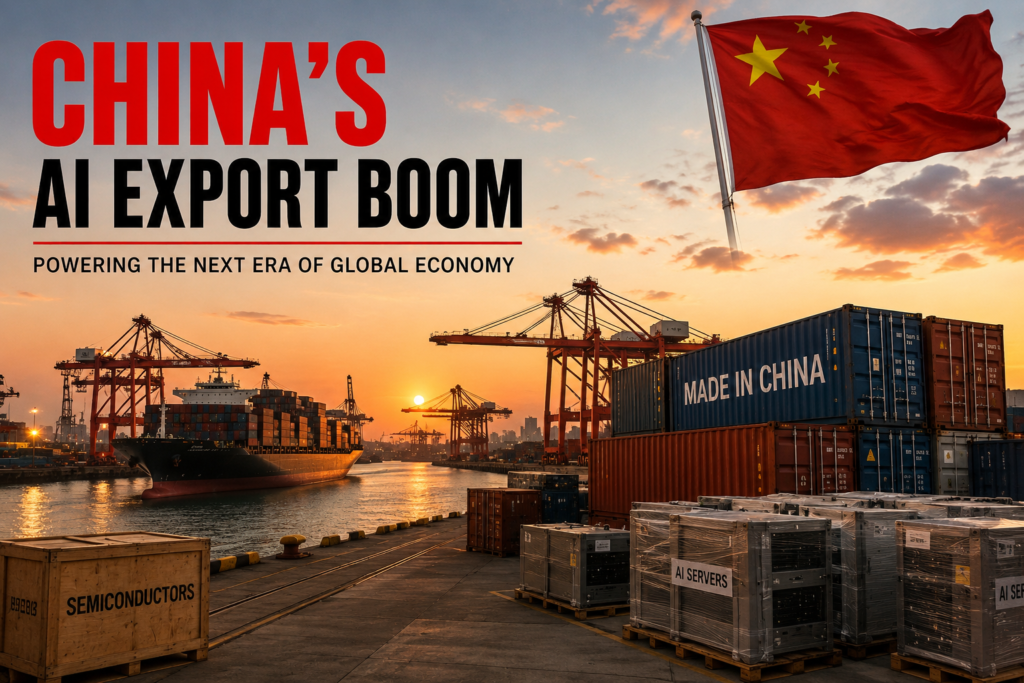
China’s latest trade figures offered another glimpse of that shift. Exports comfortably exceeded expectations, helped by strong global demand for semiconductors, AI-related hardware, and other advanced technology products. The timing is striking because it comes while China’s domestic economy continues to wrestle with weak consumer spending and a property sector that has yet to regain its footing.
At first glance, this looks like another encouraging month for the world’s largest manufacturing nation.
It is tempting to leave the story there.
That would miss what may be the more important development.
Artificial intelligence is no longer just changing software companies. It is beginning to reorder global trade by increasing the value of the physical infrastructure that makes AI possible. Countries able to design, manufacture, and export that infrastructure—from advanced semiconductor components to rack-scale GPU servers, industrial robots, and data-center equipment—are steadily becoming more influential in the global economy.
The irony is hard to ignore. For years, the digital economy was expected to reduce the importance of manufacturing. Instead, AI is making advanced manufacturing strategically valuable again.
Or put another way:
AI may run on algorithms, but it scales on factories.
The Export Numbers Tell a Bigger Story
Trade reports are often treated as snapshots of a single month. In reality, they sometimes reveal changes that have been building for years.
China’s latest customs data exceeded expectations despite slowing growth across much of the developed world and continuing geopolitical tensions. One of the strongest contributors was demand for AI-related products, particularly semiconductors, computing equipment, and other advanced technology exports. Semiconductor shipments reportedly almost doubled from a year earlier, while broader technology exports also posted robust gains.
The monthly figures matter.
The direction matters even more.
Not long ago, conversations about Chinese exports centered on furniture, toys, textiles, and household electronics. Those industries remain important, but they no longer dominate the narrative in quite the same way.
Listen to recent earnings calls from global technology companies or large cloud providers and a different vocabulary keeps appearing: GPU clusters, advanced packaging, high-bandwidth memory, AI servers, liquid cooling systems, data-center expansion.
That shift in language reflects a broader shift in trade.
More of China’s export growth is now coming from industries positioned much higher up the value chain—not simply semiconductor components, but also the machinery, electronics, precision manufacturing, and specialized suppliers that surround them.
People often describe semiconductors as a technology industry.
Governments increasingly treat them like strategic infrastructure.
The chips themselves are measured in nanometers.
Their influence is measured in geopolitical leverage.
Why AI Is Becoming the New Engine of Global Trade
Every major economic transformation has rested on infrastructure that was initially easy to overlook.
Railroads did not simply move freight; they reshaped national economies.
Electrification changed far more than lighting.
Container shipping quietly rewired global trade long before most consumers noticed.
Artificial intelligence may follow a similar pattern.
Public attention naturally gravitates toward chatbots and software because those are the products people interact with. Behind every AI model, however, sits an industrial system that is becoming just as important as the algorithms themselves.
Training a frontier AI model requires enormous computing capacity. That demand flows outward through an entire supply chain: advanced GPUs, high-bandwidth memory, rack-scale servers, networking switches, storage systems, cooling equipment, power management hardware, and increasingly massive data centers that consume as much electricity as small towns.
An investment in AI rarely ends with software.
It triggers new orders for semiconductor manufacturers, server builders, industrial equipment suppliers, electrical contractors, logistics companies, and construction firms. The ripple effects spread far beyond Silicon Valley.
Seen this way, the AI boom begins to resemble previous industrial revolutions more than previous software cycles.
That raises a more interesting question.
If AI increasingly rewards countries with deep manufacturing ecosystems rather than simply strong software industries, does the next phase of technological competition look less like the internet boom—and more like the race to build industrial capacity?
The answer is still unfolding.
But the trade data suggests that manufacturing has quietly moved back to the center of the story.
How China Built an AI Manufacturing Ecosystem
China’s position in today’s AI supply chain was not created by the AI boom.
It was built long before artificial intelligence became the world’s fastest-growing technology market.
For more than two decades, China invested heavily in manufacturing capacity, transport infrastructure, engineering education, industrial parks, ports, and supplier networks. Much of that investment attracted little international attention because it lacked the excitement of consumer technology or internet startups.
In hindsight, those quieter investments may prove just as important.
Take Shenzhen.
What began as a manufacturing hub evolved into one of the world’s most densely connected electronics ecosystems. A company developing new hardware can often source specialized components, redesign prototypes, test products, and begin small-scale production within days because suppliers, manufacturers, logistics providers, and engineering talent operate within the same industrial network.
That kind of speed is difficult to measure on a balance sheet.
It is even harder to replicate.
Manufacturing ecosystems do not emerge because governments build factories. They emerge because thousands of suppliers, skilled workers, research institutions, transport networks, equipment manufacturers, and financing channels gradually learn to operate together.
Industrial capability compounds much like knowledge does.
Once enough of the ecosystem exists, each new investment becomes easier than the last.
Government policy reinforced that process. Beijing consistently directed capital toward sectors such as semiconductors, robotics, advanced manufacturing, artificial intelligence, and industrial research. Some projects underperformed, others succeeded beyond expectations. Taken together, however, they steadily expanded China’s industrial base.
That helps explain why today’s AI boom feels less like the beginning of a new manufacturing story than the acceleration of one that has been developing for years.
Many countries are now announcing semiconductor strategies.
China entered the AI era with much of the underlying industrial machinery already in place.
—
Why US Restrictions Have Not Stopped China’s Momentum
Few economic relationships are scrutinized as closely as the technology rivalry between the United States and China.
Washington has imposed increasingly strict export controls on advanced AI chips, semiconductor manufacturing equipment, and related technologies in an effort to slow China’s progress at the cutting edge of computing. The restrictions target some of the most sophisticated parts of the semiconductor supply chain, including advanced lithography equipment and high-performance AI processors.
Those measures have undoubtedly created real constraints.
Chinese firms still face limited access to the world’s most advanced chip technologies, particularly those required to train frontier AI models at the highest level. No serious analysis should dismiss those challenges.
Yet concentrating only on what China cannot buy risks overlooking what it has been building.
External pressure has accelerated domestic investment in semiconductor research, chip design, advanced packaging, manufacturing equipment, and industrial self-reliance. Companies that once relied more heavily on imported technologies have been pushed to develop alternatives, even if those alternatives remain less advanced.
History offers an interesting parallel.
During the twentieth century, several countries responded to strategic resource constraints not simply by importing more efficiently, but by investing in domestic industrial capacity. The process was expensive, often inefficient, and sometimes slow.
It also reshaped industries for decades afterward.
Whether the current strategy ultimately succeeds remains uncertain.
Leading-edge semiconductor manufacturing is among the most difficult engineering challenges in the world. Success depends on far more than funding. It requires specialized machinery, decades of accumulated expertise, highly trained engineers, precision materials, and supplier networks that cannot be assembled overnight.
Even so, recent export performance suggests that China’s broader industrial sector has adapted more effectively than many observers expected.
Perhaps the more interesting lesson is this: supply chains rarely stand still.
When governments restrict technology flows, companies do not simply wait for conditions to improve. They redesign products, reorganize suppliers, relocate production, seek alternative partners, and invest where new opportunities emerge.
That adjustment is less dramatic than political headlines.
It is often more consequential.
Geopolitics may slow industrial change, but it rarely freezes it.
The Industries Driving China’s AI Export Growth
Artificial intelligence is often discussed as though it were a single industry.
It isn’t.
It is better understood as an industrial chain where one investment creates demand across dozens of others. A company deciding to build an AI model doesn’t just purchase computing power. It sets off a series of decisions that ripple through semiconductor manufacturers, server builders, cooling equipment suppliers, electrical contractors, logistics companies, and, eventually, construction firms.
That chain reaction is becoming increasingly visible in global trade.
Consider what happens when a cloud provider announces a new AI data center. The headline is usually about computing capacity. Behind it sits a much larger industrial story: advanced GPUs, high-bandwidth memory, rack-scale servers, networking switches, liquid-cooling systems, backup power equipment, transformers, fiber-optic infrastructure, and thousands of specialized components that rarely receive public attention.
One AI investment quietly becomes hundreds of manufacturing orders.
The same pattern extends well beyond data centers.
As factories adopt AI, demand grows for industrial robots equipped with machine vision, precision sensors, predictive maintenance software, automated inspection systems, and advanced control equipment. The goal is rarely to replace workers outright. More often, manufacturers are trying to reduce defects, minimize downtime, and improve consistency—small gains that become significant across millions of products.
Electric vehicles illustrate the same dynamic.
Most discussions focus on batteries or autonomous driving. Yet modern EV production increasingly depends on AI throughout the manufacturing process, from robotic assembly lines and battery quality inspection to predictive maintenance and supply-chain optimization. AI becomes embedded not only in the vehicle itself but in the factory that builds it.
One industry feeds another.
Demand for chips supports server manufacturers.
Server demand drives data-center construction.
Data centers increase demand for power equipment and cooling technologies.
Manufacturers then adopt AI to produce many of those same components more efficiently.
The cycle begins feeding itself.
That is one reason the AI economy increasingly resembles an industrial ecosystem rather than a conventional technology sector.
The software attracts attention. The supply chain captures much of the economic value.
—
The Global Winners—and Those Facing Greater Competition
Technological revolutions rarely produce equal winners.
The benefits tend to flow first toward countries that already possess the industrial capacity to absorb new demand.
For many developing economies, China’s manufacturing scale has lowered the cost of adopting advanced technologies. Governments across Southeast Asia, the Middle East, Latin America, and parts of Africa are investing in cloud infrastructure, industrial automation, smart manufacturing, and digital public services using equipment that has become more accessible than it would have been only a decade ago.
Lower costs do more than save money.
They accelerate adoption.
A manufacturer that can automate production sooner becomes more competitive. A logistics company that deploys AI-powered routing earlier operates more efficiently. Even public services—from ports to electricity grids—can modernize faster when digital infrastructure becomes more affordable.
For advanced economies, however, the picture is more complicated.
European manufacturers face growing competition in several high-value industrial sectors. The United States continues investing billions of dollars through initiatives such as the CHIPS and Science Act while encouraging domestic semiconductor production and closer coordination with allies. Japan, South Korea, and Taiwan are pursuing similar strategies, each trying to strengthen its role in critical technologies rather than rely entirely on global supply chains.
Ironically, globalization has not disappeared.
It has become more selective.
Companies are still building international supply chains, but resilience increasingly matters alongside efficiency. Boards now ask where products are manufactured, how quickly production can shift during disruptions, and whether critical suppliers are concentrated in one geography.
Those were once operational questions.
Today they have become strategic ones.
This marks an important change in how competitiveness is measured.
Labor costs still matter.
Innovation matters.
Manufacturing depth matters.
Increasingly, so does the ability to keep complex supply chains functioning during periods of geopolitical uncertainty.
What remains less certain is whether every country can realistically build a complete semiconductor ecosystem of its own.
History suggests otherwise.
The industries that shape global trade have often been concentrated in relatively few places, even during periods of rapid globalization. AI may ultimately reinforce that pattern rather than reverse it.
Why This Matters Beyond Economics
It is easy to read this as another story about exports.
It is something broader.
Countries that supply critical AI infrastructure do more than sell products. They shape technical standards, attract long-term investment, influence where companies build their next facilities, and become embedded in the digital infrastructure of other economies. Those relationships tend to last far longer than a typical trade cycle.
A server installed today may require software updates, replacement components, maintenance contracts, and future hardware upgrades for years. Supply chains create commercial relationships. Technology ecosystems create lasting dependencies.
That is why governments increasingly discuss AI infrastructure alongside energy security and defense.
The competition is no longer confined to building the best chatbot or releasing the most capable language model. Increasingly, it is about controlling the physical foundation on which the digital economy operates.
Seen this way, debates over semiconductors begin to resemble earlier debates over oil pipelines, shipping lanes, or undersea communication cables.
Infrastructure has always shaped influence.
AI simply introduces a new kind of infrastructure.
Chips may be measured in nanometers, but their influence is measured in geopolitical leverage.
What This Means for India
India occupies a distinctive position in this changing landscape.
Unlike China, it is not trying to defend an already dominant manufacturing ecosystem. Unlike many smaller economies, it also has the domestic market, engineering talent, and policy ambition to build one over time.
That combination creates an unusual opportunity.
Over the past few years, companies such as Apple have expanded manufacturing through partners including Foxconn and Tata Electronics, while major semiconductor proposals from firms like Micron signal growing confidence in India’s long-term industrial potential. Data-center investment has accelerated as demand for cloud services and AI computing continues to rise.
None of this guarantees success.
Announcements are easier than execution.
Manufacturing leadership depends on reliable electricity, efficient ports, specialized suppliers, logistics networks, technical education, regulatory consistency, and patient investment that continues long after the headlines fade.
China spent decades assembling those pieces.
India will almost certainly require years rather than months to do the same.
That may not be a weakness.
Many multinational companies are no longer looking for a single manufacturing center. They are building more diversified supply chains spread across several countries. For India, becoming an indispensable second pillar of global technology manufacturing may prove more valuable—and more realistic—than attempting to replace China outright.
The race is less about overtaking one country.
It is about becoming impossible to ignore.
The Risks Behind China’s AI Momentum
China’s recent export strength should not be mistaken for an uninterrupted trajectory.
The country’s domestic economy continues to face meaningful challenges. Consumer demand remains uneven, the property sector is still adjusting after years of excess, and demographic pressures will likely become more visible over the coming decade.
External risks remain just as significant.
Future tariffs, tighter export controls, restrictions on advanced manufacturing equipment, or renewed geopolitical tensions could once again alter investment decisions and reshape global supply chains.
There is another question that deserves more attention.
Can investment in AI infrastructure continue at today’s pace?
The enthusiasm surrounding artificial intelligence has drawn enormous amounts of capital into chips, data centers, networking equipment, and cloud infrastructure. History suggests that transformative technologies often experience periods of overinvestment before demand catches up. Railroads, telecommunications, and the internet all followed versions of that pattern.
That does not diminish their long-term importance.
It simply reminds us that technological revolutions rarely move in straight lines.
The real uncertainty is not whether AI will remain important.
It is whether today’s investment cycle proves sustainable.
Looking Toward 2030
Several futures remain plausible.
China may continue strengthening its position as one of the world’s largest exporters of AI infrastructure, supported by manufacturing scale, deep supplier networks, and continued industrial investment.
The United States is likely to expand domestic semiconductor production while maintaining tighter controls over strategically sensitive technologies.
India could emerge as a more significant manufacturing hub as companies diversify production across multiple geographies rather than concentrate it in one. Europe will probably continue pursuing greater technological autonomy through targeted investment, industrial partnerships, and selective support for strategic industries.
A decade ago, many analysts assumed globalization would continue concentrating production wherever costs were lowest.
The emerging AI economy suggests a more complicated picture.
Efficiency still matters.
So do resilience, political alignment, industrial capability, and supply-chain security.
The future may not belong to a single dominant technology ecosystem.
It may belong to several interconnected ones.
Final Thoughts
For much of modern history, economic power was closely tied to oil fields, shipping routes, steel mills, and industrial production.
Those foundations have not disappeared.
But another layer is being built on top of them.
Behind every breakthrough AI model sits an industrial system of chip designers, equipment manufacturers, precision engineering firms, logistics networks, construction projects, energy infrastructure, and data centers humming around the clock. The software is only the visible surface.
China’s recent export performance reflects that deeper transformation.
More than a strong month for trade, it signals how the center of economic competition is gradually shifting toward the industries that make artificial intelligence possible.
History rarely remembers technological revolutions solely for their inventions.
It remembers the countries that built the infrastructure everyone else came to depend on.
The next chapter of the AI economy may be written not only in research labs or software companies, but in factories, ports, fabrication plants, and supply chains that most people will never see.
By the time that shift becomes obvious, much of it may already have happened.