For decades, the Strait of Hormuz occupied a unique place in global financial markets. Few locations could move oil prices as quickly. A flare-up in the Gulf didn’t have to interrupt a single shipment to send traders scrambling. The possibility was often enough.
That instinct became deeply embedded over time. Political tensions rose, headlines multiplied, crude prices followed, and investors started pricing in the risk of tighter supply. It happened often enough that the sequence felt almost automatic.
The latest crisis began the same way.
Oil prices climbed as tensions escalated across the Middle East. Shipping insurers raised premiums. Analysts dusted off familiar scenarios about blocked sea lanes and disrupted exports. For a few days, it looked like another chapter in a well-rehearsed story.
Then the momentum faded.
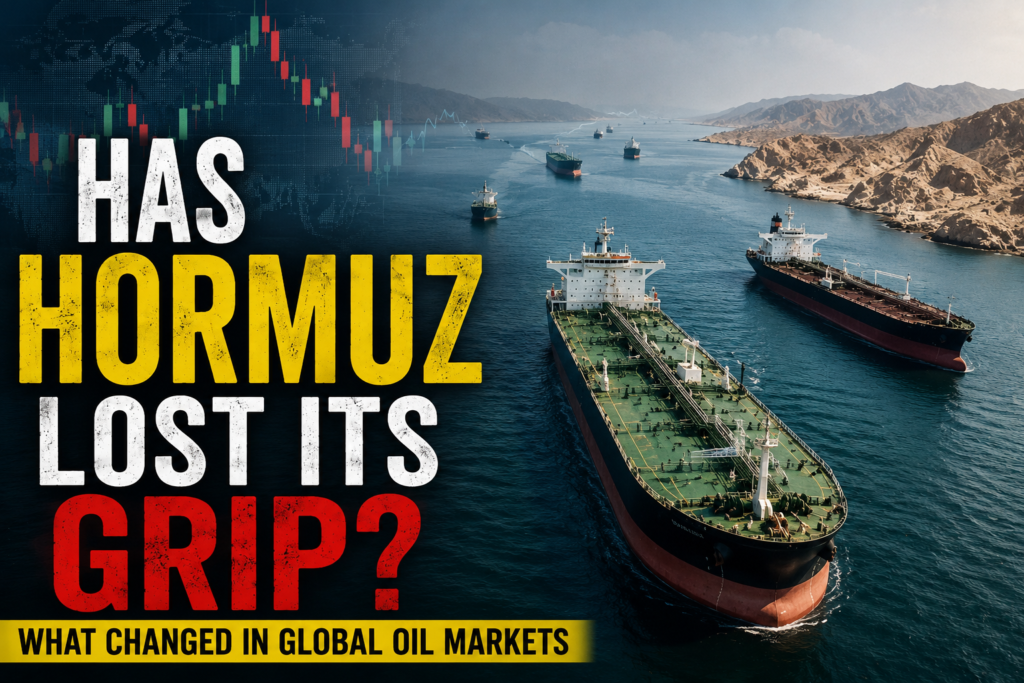
Tankers continued crossing the Strait. Export flows remained broadly intact. As fresh shipping data emerged, much of the geopolitical premium built into oil prices gradually disappeared.
That wasn’t because the Strait suddenly became less important. If anything, recent events reinforced how central it remains to the global energy system.
The more interesting change happened inside the market itself.
Investors no longer seem willing to treat every geopolitical shock as the beginning of a prolonged supply crisis. They still react quickly. They simply ask harder questions before deciding how long the reaction should last.
It’s a subtle shift, but an important one.
The Geography Hasn’t Changed
The Strait of Hormuz is still one of the world’s most important energy corridors. Around one-fifth of globally traded seaborne crude oil moves through this narrow waterway, along with a significant share of liquefied natural gas exports.
Saudi Arabia, Iraq, Kuwait, the United Arab Emirates and Qatar remain heavily dependent on it.
That’s why predictions about the Strait losing relevance miss the point. Geography doesn’t become less strategic because markets behave differently for a few weeks.
There are alternative pipelines, but they cannot fully replace the volume moving through Hormuz every day. A sustained disruption would still remove millions of barrels from international markets almost immediately.
None of that has changed.
What has changed is the market’s relationship with uncertainty.
For years, uncertainty carried its own price. Traders often responded to the possibility of disruption long before they had evidence that supplies were actually at risk.
That habit is beginning to soften.
Not disappear. Just soften.
Markets Have Learned From Recent Crises
At first glance, the calmer reaction looks like growing confidence.
It probably isn’t.
A better explanation is accumulated experience.
Over the past few years, investors have navigated a remarkable sequence of disruptions: the pandemic, Russia’s invasion of Ukraine, attacks on commercial shipping in the Red Sea, sanctions, production cuts and repeated military tensions across the Middle East.
Some events fundamentally reshaped energy markets.
Others generated dramatic headlines before fading surprisingly quickly.
Markets remembered both.
That’s easy to overlook. Financial markets don’t simply process information; they also remember how previous crises unfolded. Each episode quietly changes the way the next one is interpreted.
Investors still respond to geopolitical shocks. They just demand stronger evidence before assuming the worst.
That distinction doesn’t attract headlines, but it changes pricing behavior.
Information Became Part of the Market
For a long time, I thought diversification was the biggest reason oil markets reacted differently this time.
It probably isn’t.
The larger change may be information itself.
Twenty years ago, traders often had to work with delayed shipping reports, fragmented government statements and scattered intelligence. Rumors filled the gaps because there wasn’t much else available.
Today those gaps are much smaller.
Commercial satellite imagery tracks tanker movements almost continuously. Shipping databases update vessel locations in near real time. Export activity can often be estimated long before official figures are released.
That changes something deeper than market efficiency.
It changes market psychology.
When traders can actually see oil continuing to leave ports, speculation loses some of its influence. Political rhetoric still matters, but it has to compete with observable reality.
In a sense, uncertainty has become harder to manufacture.
Of course, better information doesn’t prevent wars or supply disruptions. It simply means investors spend less time guessing whether one is actually happening.
Diversification Helped—Within Limits
The structure of global oil production has changed as well.
A decade ago, dependence on Middle Eastern supply was considerably higher. Since then, output has expanded across the United States, Brazil, Guyana and Canada. American shale alone reshaped assumptions about where future supply could come from.
That broader production base gives the market more flexibility.
But flexibility isn’t the same as independence.
It’s tempting to conclude that because supply has become more diversified, the Strait matters less. Geography argues otherwise.
Oil may come from more places today, yet an enormous volume still leaves the Gulf through the same narrow corridor.
The market became more resilient.
The bottleneck didn’t disappear.
There’s Another Constraint Markets Understand
Closing the Strait would impose enormous costs on importing countries.
It would also hurt exporters.
Oil-producing governments depend heavily on export revenue. A prolonged interruption would damage their own economies alongside those buying their crude. That doesn’t make escalation impossible, but it does make a sustained closure less rational than political rhetoric sometimes suggests.
Markets increasingly price that reality.
History shows governments occasionally act against their own economic interests during conflicts. Investors know that too.
Still, when every major participant stands to lose from the same outcome, markets become less willing to assume it is inevitable.
A Brief Pause
Perhaps this is what makes the latest episode different.
The market didn’t stop respecting geopolitical risk.
It stopped treating every warning as equally credible.
There’s a difference between monitoring danger and immediately pricing catastrophe.
That difference has become more visible over the past few years.
What About Preparedness?
Preparedness rarely dominates headlines because successful preparation is mostly invisible.
Major oil-importing countries now maintain substantial strategic petroleum reserves. Governments coordinate more closely during supply disruptions than they once did, while energy companies have spent years diversifying suppliers, reviewing logistics and building contingency plans.
None of those measures could fully offset a prolonged closure of the Strait.
They were never designed to.
Their purpose is to buy time, reduce panic and give markets room to adjust. Judging by recent events, they seem to be doing exactly that.
Why This Matters for India
India’s position is slightly different because it experiences global oil prices as an economic reality rather than a trading signal.
The country imports most of the crude it consumes, so changes in international prices spread quickly through the broader economy. Higher import costs affect government finances, businesses, transport companies and, eventually, households.
But the consequences don’t arrive all at once.
Manufacturers first notice higher freight costs. Airlines begin adjusting operating expenses. Logistics firms revisit contracts. Consumers often feel the impact later, after those increases move through the supply chain.
That’s one reason policymakers watch oil prices so closely. Crude doesn’t influence inflation through a single channel; it filters into many parts of the economy over time.
Recent stability therefore offers more than cheaper fuel.
It provides breathing room.
Still, India’s exposure hasn’t fundamentally changed. A genuine interruption to exports through the Strait would almost certainly raise import costs regardless of how disciplined markets have become.
Some risks remain stubbornly geographical.
The Bigger Story Isn’t Really About Oil
Looking back, it’s tempting to describe the latest episode as another Middle East crisis.
That feels incomplete.
The more interesting story is how financial markets have evolved.
Better information reduced the space for speculation. Years of repeated geopolitical shocks changed investor expectations. More diversified production made supply chains somewhat more resilient. Governments improved emergency planning.
None of those developments explains the market’s behavior on its own.
Together, they do.
Markets today operate with more evidence and slightly less instinct than they did a decade ago.
That’s progress, although not immunity.
The Next Test Will Be Different
It’s worth resisting the temptation to draw sweeping conclusions from one episode.
The Strait of Hormuz remains one of the world’s most consequential energy chokepoints. A sustained military blockade, large-scale attacks on commercial shipping or prolonged disruption to Gulf exports would still send oil prices sharply higher.
Physical shortages always matter more than political speculation.
The market understands that perfectly well.
Which is why traders continue watching every development in the region so closely, even when prices appear calm.
They’re waiting for evidence.
Not reassurance.
A More Mature Market—Or Simply a More Careful One?
The Strait of Hormuz has not lost its strategic importance.
If anything, the latest crisis reminded investors just how much global trade still depends on this narrow waterway. Geography continues to impose the same constraints it always has.
The difference lies elsewhere.
Years ago, markets often treated possibility and probability as though they were interchangeable. Recent experience has made that distinction harder to ignore. Investors still react to geopolitical shocks, but increasingly reserve their strongest responses for disruptions they can actually observe.
Whether that reflects a permanently more disciplined market or simply the lessons of recent crises is impossible to know today.
The next major test will answer that question far more convincingly than this one did.
And when it arrives, traders won’t just be watching the Strait of Hormuz.
They’ll be deciding whether experience deserves more weight than instinct.