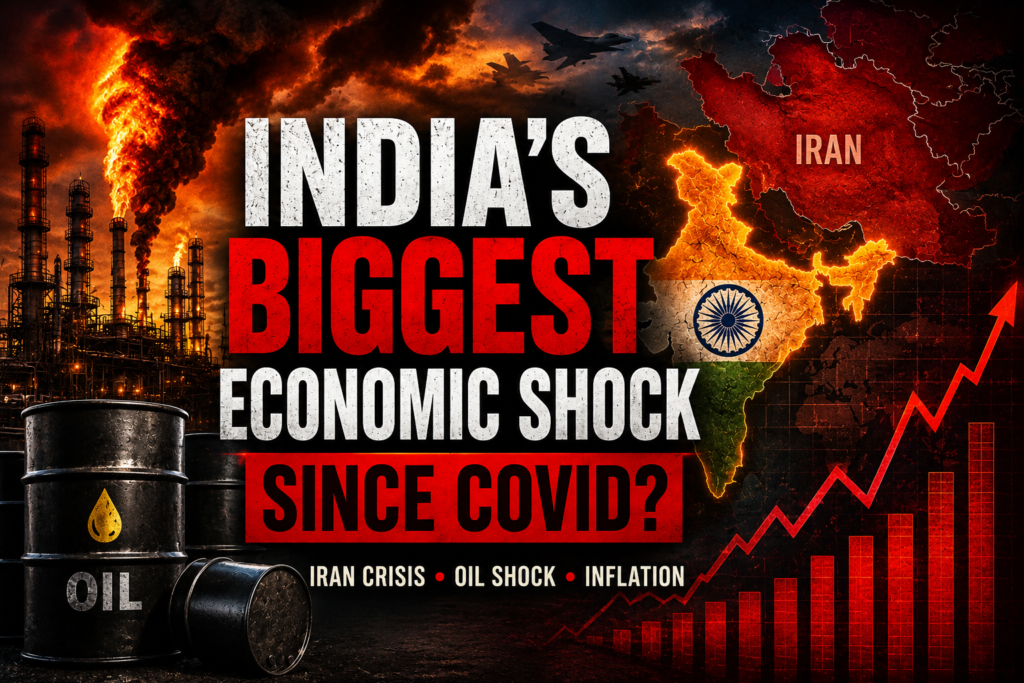
Most people assume economic crises begin in familiar places.
A stock market crashes. A major bank fails. A government struggles to pay its debts.
Sometimes that’s exactly what happens.
But global disruptions do not always start in financial centers. They can begin in places that rarely enter public conversation until something goes wrong.
One of those places sits between Iran and Oman.
It is called the Strait of Hormuz.
At first glance, there is nothing particularly remarkable about it. On a world map, it appears to be just another narrow stretch of water connecting one body of water to another. Yet this small corridor has become one of the most strategically important locations on Earth.
Every day, enormous volumes of oil and natural gas pass through it. Entire industries depend on it. National economies depend on it. When tensions rise in the Strait of Hormuz, the effects can travel far beyond the Middle East, influencing everything from energy prices and shipping costs to inflation and economic growth.
That is why governments, investors, and businesses pay such close attention whenever this narrow waterway becomes unstable.
The current crisis is not simply about oil.
It is about the vulnerabilities hidden inside a global economy that often appears far more resilient than it actually is.
Where Exactly Is the Strait of Hormuz?
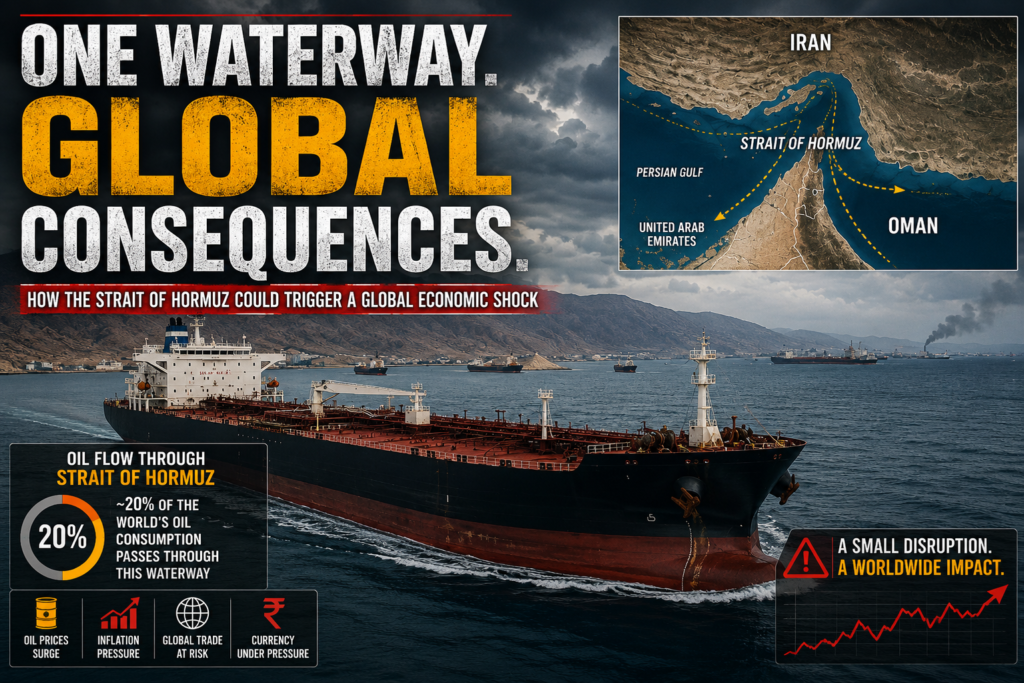
The Strait of Hormuz lies between Iran to the north and Oman to the south. It serves as the gateway between the Persian Gulf and the Gulf of Oman, connecting some of the world’s largest energy producers to international markets.
Geographically, it is surprisingly small.
At its narrowest point, the strait is only around 33 to 39 kilometers wide. Yet through this relatively narrow corridor flows an extraordinary amount of global energy trade.
Major oil exporters including Saudi Arabia, Iraq, Kuwait, Qatar, and the United Arab Emirates rely heavily on this route to move their energy supplies to customers around the world.
There are alternatives, but they are limited.
Pipelines can bypass parts of the route, and some exporters have invested in infrastructure designed to reduce dependence on Hormuz. However, those alternatives cannot fully replace the volume of oil and gas that normally passes through the strait.
For decades, energy analysts have referred to Hormuz as the world’s most important energy chokepoint.
It sounds like the sort of phrase that belongs in industry reports and policy papers. In reality, it affects far more people than most realize.
Why This Tiny Waterway Matters So Much
An estimated one-fifth of the world’s oil consumption passes through the Strait of Hormuz. Large quantities of liquefied natural gas, particularly from Qatar, move through the same route.
The numbers alone are striking, but they only tell part of the story.
What matters just as much is where that energy is going.
A significant portion heads toward Asia, where countries such as China, India, Japan, and South Korea depend heavily on imported energy supplies. For these economies, stable access to energy is not just a commercial concern. It is a foundation of industrial production, transportation, and economic growth.
People often think of oil as a commodity. Governments increasingly view it as strategic infrastructure.
Factories need it.
Shipping networks need it.
Airlines need it.
Agricultural systems depend on it indirectly through transportation, fertilizers, and logistics.
The modern economy runs on systems that require enormous amounts of energy. Most of the time, that reality fades into the background because supplies move smoothly and markets remain stable.
The moment uncertainty appears, however, the importance of places like the Strait of Hormuz becomes impossible to ignore.
What Actually Happened in 2026?
The current crisis emerged from escalating tensions involving Iran, Israel, and the United States.
What initially appeared to be another regional confrontation gradually developed into a broader concern for energy markets and global trade.
Reports of military activity, attacks on vessels, and increasing risks to commercial shipping began affecting behavior throughout the region.
Then came the response from the private sector.
Shipping companies reassessed routes. Insurance providers adjusted risk calculations. Tanker operators became more cautious about moving through areas where security conditions appeared increasingly uncertain.
Importantly, the concern was not necessarily that the strait would be completely closed.
In fact, one of the more counterintuitive aspects of energy markets is that complete disruption is often unnecessary. Even the perception that conditions could worsen can influence behavior.
A delayed shipment here. A canceled voyage there. Higher insurance costs. Longer transit times.
Small disruptions can accumulate surprisingly quickly.
That is often enough to capture the attention of financial markets.
Why Oil Prices React Before Actual Shortages Happen
One of the most common misconceptions about energy markets is that prices rise only after supply problems become obvious.
In reality, markets spend much of their time trying to anticipate future events.
If traders believe there is a meaningful chance that oil supplies could become harder to access, prices can move well before any actual shortage develops.
This is why uncertainty matters so much.
Shipping companies respond to uncertainty.
Insurers respond to uncertainty.
Investors respond to uncertainty.
The result is that expectations themselves become economically important.
Markets often behave as though they are trying to price tomorrow’s risks using today’s information. Sometimes that leads to overreactions. Sometimes it turns out to be entirely justified.
The difficult part is that nobody knows which outcome they are dealing with in real time.
Energy markets have seen versions of this story before.
The oil shocks of the 1970s demonstrated how disruptions in one region could quickly become economic problems for countries around the world. Today’s economy is very different, and energy markets are more diversified than they were decades ago.
Yet the basic vulnerability remains surprisingly familiar.
When confidence in energy supplies weakens, the effects can spread much faster than physical shortages themselves.
The Hidden Economic Impact Most People Miss
When discussions about oil disruptions appear in the news, attention usually focuses on fuel prices.
That makes sense. Fuel is visible.
The deeper story is what happens after energy costs begin moving through the rest of the economy.
Transportation becomes more expensive.
Shipping costs rise.
Manufacturers face higher operating expenses.
Businesses eventually pass at least some of those costs to customers.
The process is usually gradual rather than dramatic.
For many households, an oil shock does not arrive as a major headline. It arrives quietly through a series of small changes that may not seem connected at first.
A flight costs more than expected.
A delivery charge increases.
A grocery bill feels slightly larger than it did a few months earlier.
Most consumers never trace those changes back to a shipping corridor in the Middle East. Yet global supply chains have a way of turning distant events into local costs.
This is one reason policymakers worry about prolonged energy disruptions.
Inflation becomes harder to manage when higher costs begin spreading across multiple sectors simultaneously. What starts as an energy issue can eventually become a broader economic challenge.
Why India Is Especially Vulnerable
For India, developments in the Strait of Hormuz are not simply geopolitical news.
They carry direct economic implications.
India imports the majority of the crude oil it consumes, and much of that supply originates in the Middle East. As a result, disruptions affecting energy flows through Hormuz have the potential to influence everything from fuel prices to inflation.
The most obvious concern is higher oil prices.
The less obvious concern involves the currency.
When oil becomes more expensive, India needs more dollars to pay for imports. Increased demand for dollars can place pressure on the rupee, making imports more costly across the economy.
That creates a difficult balancing act.
Policymakers must try to manage inflation, support economic growth, maintain currency stability, and protect consumers from rising costs at the same time.
For manufacturers operating on tight margins, higher energy costs can alter investment decisions. For businesses dependent on transportation and logistics, rising fuel expenses can affect profitability. For households, the effects eventually appear through higher prices for a wide range of goods and services.
None of this guarantees a crisis.
But it does increase economic vulnerability during periods of prolonged uncertainty.
Why China and the Rest of Asia Are Watching Closely
China may be geographically distant from the Strait of Hormuz, but it remains deeply connected to what happens there.
The country is one of the largest buyers of oil moving through the region. Stable energy supplies play a critical role in supporting industrial production, exports, and long-term economic growth.
China has spent years thinking about this vulnerability. India faces a similar challenge, even if the circumstances are different.
More broadly, many Asian economies depend heavily on imported energy.
That dependence creates a reality that governments across the region increasingly recognize: energy security and economic security are often inseparable.
The more reliant a country becomes on imported energy, the harder it becomes to separate geopolitics from economic planning.
Events occurring thousands of kilometers away can have meaningful consequences at home.
The Bigger Geopolitical Lesson
The Strait of Hormuz crisis reveals something larger than the immediate confrontation.
Modern globalization is often described as a system that reduces the importance of geography. Yet events like these suggest the opposite may be true.
One of the more surprising lessons of globalization is that technological progress did not eliminate geography. In some ways, it made geography even more important.
The world became more connected, but many of those connections depend on a relatively small number of critical routes, ports, and transit corridors.
The Strait of Hormuz is one example.
The Suez Canal is another.
The Taiwan Strait plays a similar role in global trade and technology supply chains.
When these routes function normally, most people rarely think about them. Their importance becomes visible only when disruption appears.
There is an irony here.
For decades, businesses optimized supply chains around efficiency, speed, and cost reduction. The strategy delivered enormous economic benefits.
It also concentrated risk.
As a result, governments are increasingly focused on resilience alongside efficiency. Energy security, supply-chain diversification, industrial policy, and strategic infrastructure have moved closer to the center of economic planning.
The conversation is no longer just about growth.
It is also about vulnerability.
A Narrow Waterway With Global Consequences
Of course, predicting the long-term economic impact of geopolitical crises is notoriously difficult.
Markets sometimes overestimate risks. Disruptions that appear severe can fade surprisingly quickly. At other times, events that initially seem manageable evolve into something much larger.
The challenge is that those distinctions are usually obvious only in hindsight.
What is clear, however, is that the Strait of Hormuz occupies a disproportionately important place in the global economy.
It is a relatively small waterway connecting a relatively small region of the world to a much larger network of trade, energy, and finance. Yet its influence extends far beyond its geography.
A military confrontation in the Middle East can affect manufacturing decisions in Asia.
Shipping disruptions can influence inflation on another continent.
Higher insurance costs for tankers can eventually show up in consumer prices thousands of kilometers away.
Moments like this serve as a reminder that modern prosperity still depends on systems most people rarely think about until they come under pressure.
The world economy may be global, but some of its most important vulnerabilities remain remarkably local.