The world map is not changing on paper.
It is changing through shipping lanes, insurance pricing, fuel corridors, sanctions systems, and the quiet rerouting decisions made inside logistics offices most people will never hear about.
Wars still destroy cities and reshape borders. But some of the largest economic consequences now happen far away from the battlefield itself — out at sea, inside ports crowded with delayed containers, across oil routes, and through the systems that keep factories, retailers, and energy markets functioning on schedule.
A disruption in one narrow maritime corridor can affect refinery planning in India, freight pricing in Europe, manufacturing timelines in China, and inflation almost everywhere else within weeks.
That process has already started.
Trade routes that took decades to optimize are now being reconsidered because of geopolitical tension, sanctions pressure, piracy risks, regional wars, and the growing fear that too much of the global economy depends on a handful of vulnerable chokepoints.
For years, globalization prioritized efficiency above almost everything else. The shortest route. The cheapest labor base. The fastest delivery window. Companies built supply chains around stability assumptions that, in hindsight, look unusually optimistic.
Durability was often treated as a secondary concern.
The Strait of Hormuz: A Narrow Passage With Outsized Influence
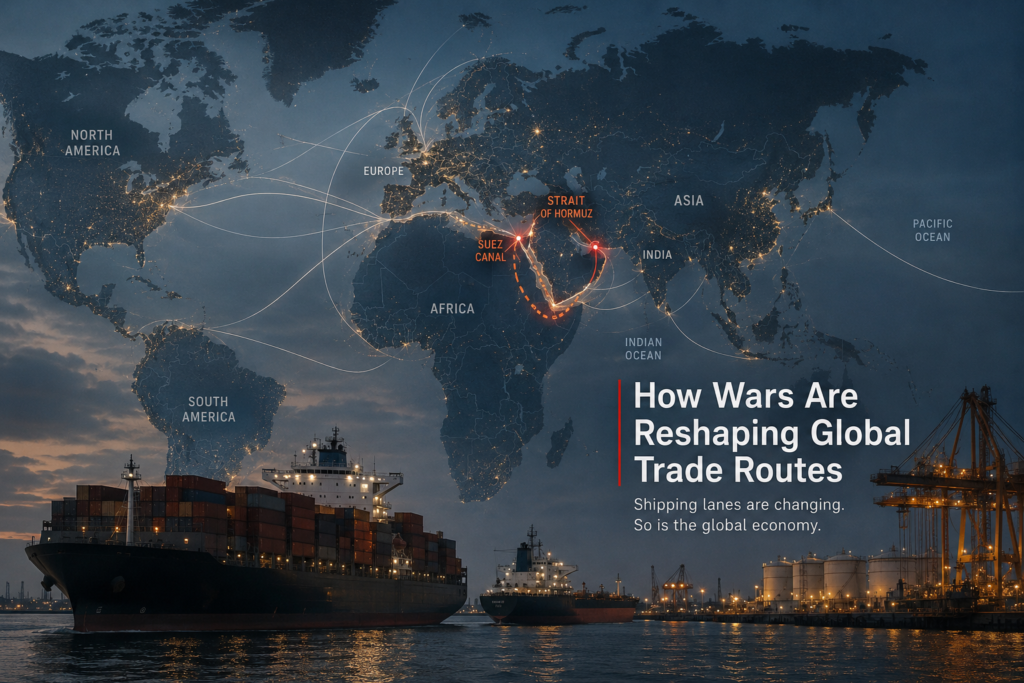
To understand why this matters, it helps to look at the Strait of Hormuz.
It is one of the world’s most strategically important maritime chokepoints — a narrow corridor connecting the Persian Gulf to the Arabian Sea. A large share of global oil exports moves through it, especially shipments heading toward Asian economies like India, China, Japan, and South Korea.
The dependency becomes slightly unsettling once you visualize it properly. A huge part of the industrial world relies on a relatively small stretch of water remaining stable every single day.
When tensions rise in the Middle East — involving Iran, regional militias, naval incidents, or even ambiguous threats — markets react quickly. Not always because oil production suddenly collapses, but because uncertainty changes behavior long before actual disruption happens.
Insurance markets usually react before governments do.
That part rarely receives much public attention even though insurers quietly shape global trade decisions in ways most political speeches do not. Once maritime risk premiums rise, shipping costs start moving almost immediately. Cargo operators recalculate routes. Importers increase buffer inventory. Energy buyers begin preparing for price volatility before supply is physically interrupted.
Inside major ports, schedules start slipping. Containers sit longer than expected. Freight managers revise timelines repeatedly because vessels are arriving out of sequence. Refineries begin adjusting intake planning. Warehouses that normally depend on precision timing suddenly build extra slack into the system.
For years, many executives treated supply chains almost like plumbing — invisible systems that only became interesting when something broke.
Consumers usually encounter the consequences later through fuel prices, airline costs, imported goods, or slower delivery timelines. By then the disruption has already traveled through multiple layers of the global economy.
Trade Routes Are Being Rebuilt Around Security
For decades, global trade followed a fairly simple logic: move goods through the fastest and cheapest routes available.
That logic shaped modern shipping infrastructure. The Suez Canal became economically indispensable because it reduced travel time between Asia and Europe so dramatically that entire manufacturing systems evolved around it.
War changes economic math very quickly.
Security concerns around the Red Sea have pushed many shipping firms to reconsider routes that were treated as routine for years. Some vessels now avoid high-risk areas altogether even when the alternative means significantly longer travel times and much higher fuel consumption.
What looks like a shipping adjustment on paper can alter pricing pressure across entire manufacturing sectors.
Countries increasingly prioritize:
– politically reliable partners
– supply chain redundancy
– domestic industrial capacity
– safer maritime routes
– strategic reserves
Not simply low cost.
Because a supply chain that appears highly efficient during stable periods can become fragile under geopolitical pressure with surprising speed.
Ironically, globalization did not reduce exposure to geopolitical competition as much as many policymakers expected. In some ways, it concentrated vulnerability.
Why Shipping Companies Are Taking Longer Routes
One visible example is the growing use of the Cape of Good Hope route.
Instead of moving through the Red Sea and Suez Canal, some cargo vessels are now traveling around southern Africa to reduce security exposure.
The economics shift quickly once routes become longer. More fuel is burned. Crews stay at sea for additional weeks. Insurance calculations change. Inventory cycles stretch out. Warehouses hold goods longer than planned.
At several ports, shipping backlogs have already created unusual operational pressure: temporary container overflow zones, constantly revised unloading schedules, freight managers negotiating for docking priority because downstream manufacturers are waiting on components that were supposed to arrive days earlier.
Modern supply chains operate on tighter timing margins than most consumers realize.
An automaker waiting for one delayed component can slow an entire production line. Retailers preparing seasonal inventory make purchasing decisions months ahead of demand. Electronics manufacturers often depend on synchronized deliveries arriving across multiple countries within very narrow windows.
Ports, rail links, semiconductor access, energy terminals — governments increasingly talk about infrastructure the way Cold War strategists once talked about military positioning.
That shift has happened surprisingly fast.
The Rise of Alternative Trade Corridors
As traditional shipping routes become less predictable, governments are accelerating plans for alternative economic corridors.
Some of these projects existed for years mostly as diplomatic announcements and infrastructure proposals. Geopolitical instability gave them urgency. Investors who once viewed certain corridor projects as overly ambitious are now revisiting them with a different mindset.
The India-Middle East-Europe Corridor
One of the most closely watched initiatives is the India-Middle East-Europe Economic Corridor, or IMEC.
The project reflects a broader attempt to create alternative trade connectivity linking India, the Middle East, and Europe while reducing dependence on vulnerable chokepoints and concentrated manufacturing routes.
Trade infrastructure is increasingly being treated as strategic insurance.
Ports are no longer viewed only as commercial assets. Rail corridors carry geopolitical significance. Pipeline access matters differently now. Governments still publicly defend globalization, but privately many are preparing for a world where trade becomes less predictable and far more political.
India sits in the middle of this restructuring in a way that could become economically significant over the next decade.
Wars do not only destroy systems. Sometimes they accelerate transitions that were already beginning underneath the surface.
Saudi Arabia’s Expanding Strategic Role
Saudi Arabia’s growing role in energy logistics reflects part of the same pattern.
Pipeline infrastructure connecting eastern oil-producing regions to western Red Sea ports allows some exports to bypass vulnerable maritime chokepoints altogether. Over time, infrastructure like this changes which regions become strategically central to the global economy and which become risk exposures.
Investors notice these shifts earlier than most public discussions do.
Port ownership. Refinery access. Shipping insurance markets. Pipeline control. Logistics hubs.
Not especially glamorous subjects. But geopolitical influence increasingly moves through these systems.
In some ways, global trade is rediscovering an older reality: major powers have always worried about securing routes for energy, food, and industrial materials. Modern economies simply became comfortable assuming those systems would remain permanently stable.
Russia, Iran, and Alternative Networks
At the same time, Russia and Iran have expanded interest in trade systems running through the Caspian region and other alternative corridors.
Part of this is driven by sanctions pressure. Part reflects a broader effort to reduce dependence on Western-controlled shipping and financial systems.
The larger pattern matters more than any individual route.
The global economy is becoming less unified than it appeared during the peak globalization era. Not fragmented beyond repair, but increasingly shaped by political alignment, strategic redundancy, and economic mistrust.
There is a noticeable psychological shift underneath all this too. Governments now openly discuss economic dependency in national security terms. Ten years ago that language was far less common outside specialist circles.
Why Ordinary Consumers Eventually Feel It
Geopolitical discussions often sound distant until they start appearing in household budgets.
Trade disruptions eventually affect consumers through:
– higher electronics prices
– rising transportation costs
– more expensive imported goods
– increased airline fares
– inflation pressure across manufacturing and retail supply chains
And once shipping systems become slower, riskier, and more expensive, those pressures spread through the economy surprisingly quickly.
Sometimes faster than policy responses.
Container timing now affects inflation in ways central banks did not worry about to the same extent twenty years ago. Delayed freight schedules, rerouted cargo traffic, unstable energy corridors — these eventually feed into pricing pressure across entire sectors.
Not immediately. Then suddenly.
Why India Faces Both Risk and Opportunity
India sits in a particularly complicated position in this environment.
The country remains heavily dependent on imported energy, much of which moves through strategically sensitive maritime corridors. Any serious disruption around the Strait of Hormuz can affect oil prices and import costs very quickly.
That vulnerability is real, especially for a fast-growing economy with expanding energy demand.
At the same time, India could benefit from the restructuring of global trade networks. Companies looking to diversify manufacturing exposure beyond China are increasingly exploring India as an alternative production base. Infrastructure projects involving ports, railways, industrial corridors, and logistics systems could gradually increase India’s strategic importance over the next decade.
India has also maintained working relationships across multiple geopolitical blocs simultaneously — including Western economies, Gulf states, and Russia. In a more fragmented global economy, that flexibility may become economically valuable in ways that were less obvious before.
Not every major country has that room to maneuver anymore.
Globalization Is Changing Shape
For decades, the world economy moved toward deeper integration.
The assumption was straightforward: interconnected trade would reduce conflict and maximize efficiency.
That assumption now looks less certain than it did fifteen years ago.
Countries are becoming increasingly cautious about depending too heavily on single suppliers, concentrated manufacturing hubs, or politically unstable trade corridors. Governments talk constantly about resilience, redundancy, industrial policy, and strategic autonomy.
Globalization is still here.
But it is becoming more regional in some sectors, more defensive in others, and increasingly shaped by security calculations that many economists once assumed would become less important over time.
The cheapest route no longer automatically feels like the safest one.
The Future May Look More Fragmented
If current trends continue, the coming years could bring:
– more regional trade blocs
– diversified shipping corridors
– higher long-term logistics costs
– increased investment in strategic infrastructure
– stronger energy nationalism
– reduced dependence on vulnerable chokepoints
That may permanently reshape how multinational companies design supply chains.
For decades, businesses optimized aggressively for efficiency. Inventory systems became leaner. Manufacturing spread across continents because the system appeared stable enough to support it.
Now survivability is entering the calculation again, sometimes awkwardly, because rebuilding resilience is expensive and often politically unpopular until a crisis exposes the weakness.
Some executives privately describe the current environment less as globalization ending and more as globalization becoming cautious.
That feels close to reality.
A Different Kind of Battlefield
Wars are no longer fought only through soldiers and missiles.
They increasingly move through sanctions systems, ports, pipelines, shipping lanes, semiconductors, energy networks, rare minerals, and supply chains. The battlefield has expanded into the infrastructure of global commerce itself.
And although many of these shifts happen quietly at first, the effects become difficult to ignore once enough pressure accumulates inside the system.
A delayed cargo route.
A refinery adjusting schedules because of maritime risk.
An insurance premium spike changing shipping decisions across an entire corridor.
An alternative trade route that suddenly matters far more than it did five years earlier.