The Invisible Foundation Beneath the Global Economy
Economic crises rarely announce themselves.
They don’t arrive with a single headline or a dramatic event that everyone recognizes immediately. More often, they begin quietly—hidden inside thousands of ordinary decisions made by businesses, investors and households that don’t seem connected at first.
A manufacturer postpones buying new machinery.
A logistics company quietly rewrites its freight contracts because diesel has become more expensive than expected.
An airline decides to hedge more of its fuel costs for next year instead of investing in additional routes.
Individually, none of these decisions suggests a recession is approaching.
Taken together, they can tell a different story.
One irony of modern economies is that we often notice problems only after they’ve become visible in the data. By the time economists begin debating whether growth is slowing, businesses have frequently been adjusting their behaviour for months.
Sometimes much longer.
During the months leading up to the 2008 financial crisis, for example, the first warning signs weren’t panicked stock markets. They appeared in places that attracted far less attention—mortgage delinquencies, tightening credit conditions and a gradual decline in confidence across parts of the banking system. Looking back, those signals seem obvious. At the time, most people viewed them as isolated issues rather than pieces of a larger pattern.
Energy shocks often unfold in a similar way.
They rarely begin with empty petrol stations or overnight shortages.
Instead, they start with uncertainty.
Will fuel remain affordable?
Will electricity prices keep rising?
Will shipping costs stay elevated long enough to change investment decisions?
No one can answer those questions immediately, so businesses do what they usually do when uncertainty increases: they become more cautious.
That caution has consequences of its own.
Factories delay expansion. Retailers reduce inventory. Construction firms review budgets more carefully. Companies postpone hiring until they have greater confidence about future costs.
None of those choices is dramatic.
Yet each one quietly removes a little momentum from the economy.
Why Economists Still Worry About Energy
At first glance, today’s concerns might seem exaggerated.
After all, the world isn’t the same as it was during the oil crises of the 1970s.
Renewable energy has expanded rapidly. Electric vehicles are becoming more common. Many countries have invested heavily in strategic petroleum reserves, while manufacturers generally use energy more efficiently than they did decades ago.
Those are meaningful changes.
They’ve made many economies more resilient than they once were.
But resilience shouldn’t be confused with immunity.
The global economy has also become more dependent on uninterrupted energy in ways that receive surprisingly little attention.
Cloud computing, artificial intelligence, advanced semiconductor manufacturing, automated warehouses and modern logistics networks all rely on enormous amounts of electricity. Much of that demand barely existed twenty years ago.
It’s easy to think of the digital economy as something separate from traditional energy markets.
It isn’t.
Behind every online payment, AI query, video stream or cloud backup sits a physical network of data centres, transmission lines and power generation that has to function every second of every day.
That dependence is growing, not shrinking.
What’s easy to miss is that an energy shock doesn’t need to create shortages to influence economic behaviour. Sometimes the expectation of higher costs is enough.
If a company believes electricity or fuel prices are likely to remain volatile for the next eighteen months, it may postpone building a new factory today.
The factory isn’t cancelled because energy disappeared.
It’s delayed because confidence did.
That distinction doesn’t usually make headlines.
It still matters.
Perhaps that’s why economists spend less time asking whether oil prices are rising and more time asking what businesses are doing because they believe those prices might continue rising.
Those aren’t always the same question.
When Energy Stops Being “Just Another Commodity”
Most people experience energy as a monthly bill.
Businesses experience it very differently.
For them, energy isn’t a separate expense that sits neatly on a spreadsheet. It runs through almost every decision they make. Fuel determines transport costs. Electricity influences production schedules. Natural gas shapes the economics of industries ranging from fertilizer to steel.
That’s why an energy shock rarely stays inside the energy sector.
It leaks into everything else.
Imagine a regional trucking company with contracts to move goods across several states. The company doesn’t wake up one morning and double its prices because diesel becomes more expensive. Existing contracts still have to be honoured. Drivers still need to be paid. Deliveries still have deadlines.
So the company absorbs the increase.
At least for a while.
Margins become thinner. Expansion plans are pushed back. Replacing older trucks suddenly looks less urgent. When contracts come up for renewal a few months later, freight rates quietly rise.
Retailers don’t notice the oil market first.
They notice the invoice.
It’s an ordinary sequence of events, and that’s precisely why it matters. Economic slowdowns are often built from decisions that appear entirely reasonable when viewed in isolation.
There’s another detail that’s easy to overlook.
Some industries can protect themselves better than others.
Large airlines, for example, often hedge a portion of their fuel purchases months—or even years—ahead. That doesn’t eliminate risk, but it softens sudden price swings. Smaller transport companies, independent logistics firms and many manufacturers usually have fewer options. They feel the pressure much sooner.
The same increase in fuel prices can produce very different outcomes depending on who is paying the bill.
The Ripple Effect Doesn’t Move in Straight Lines
There’s a tendency to imagine economic shocks like falling dominoes.
One event causes another, which causes the next.
Reality is usually messier.
Consider what happened after Russia’s full-scale invasion of Ukraine in 2022.
Much of the public discussion focused on natural gas prices in Europe. That was understandable. Yet one of the less-publicised consequences emerged inside the fertilizer industry. Natural gas isn’t simply used to generate electricity—it is also a key feedstock for producing ammonia, one of the building blocks of nitrogen fertilizer.
As gas prices surged, several European fertilizer producers reduced or temporarily halted production.
The effects travelled further than many people expected.
Higher fertilizer costs eventually reached farmers. Farmers faced tougher decisions about planting and input costs. Food producers encountered more expensive agricultural commodities. Supermarkets and consumers saw higher prices months after the original energy shock had begun.
The story wasn’t just about gas.
It became a story about food.
History offers similar examples.
During the oil shocks of the 1970s, advanced economies experienced a combination of weak growth and persistent inflation that many policymakers had believed couldn’t happen simultaneously. The term stagflation entered mainstream economic vocabulary because the traditional relationship between inflation and unemployment stopped behaving as expected.
That episode still shapes central-bank thinking today.
Not because economists expect history to repeat itself exactly, but because they know supply shocks have a habit of exposing assumptions that seemed perfectly reasonable beforehand.
One statistic illustrates how central energy remains to the global economy.
According to the International Energy Agency, oil still accounts for roughly 30% of the world’s total energy supply, despite rapid investment in renewable energy over the past decade.
That figure surprises many people.
The transition is real.
It’s also incomplete.
Perhaps surprisingly, the most vulnerable industries aren’t always the ones consuming the most fuel. They’re often the businesses operating on the thinnest margins, where even modest increases in transport or electricity costs can reshape investment decisions.
Sometimes an economic slowdown doesn’t begin with a collapse.
It begins with thousands of companies independently deciding that waiting another six months feels safer than moving forward.
Nobody coordinates those decisions.
Yet together, they can gradually change the direction of an entire economy.
A Different World, A Different Kind of Risk
Comparisons with the 1970s appear almost every time oil prices begin climbing.
Some of them are useful.
Many are too simplistic.
Back then, advanced economies relied far more heavily on crude oil, energy efficiency was lower and policymakers had relatively little experience dealing with large supply disruptions. Today’s world is different. Supply chains are broader, financial markets process information almost instantly and governments have more tools available than they did half a century ago.
That’s the encouraging part of the story.
The less comfortable part is that the global economy has also become far more complicated.
A semiconductor plant cannot simply pause for a few hours because electricity becomes unreliable. Modern chip fabrication requires extraordinarily stable operating conditions, and interruptions can damage production worth millions of dollars. Cloud providers and AI data centres face similar pressures. Their facilities run continuously, consuming enormous amounts of power that must remain available every hour of every day.
What’s interesting is that these industries rarely dominate discussions about energy security.
Yet they’re becoming increasingly important consumers of electricity.
The digital economy often feels weightless.
In reality, it’s supported by some of the most energy-intensive infrastructure ever built.
A New Set of Pressure Points
Energy itself isn’t the only concern.
The routes through which energy moves have become almost as important as the resources beneath the ground.
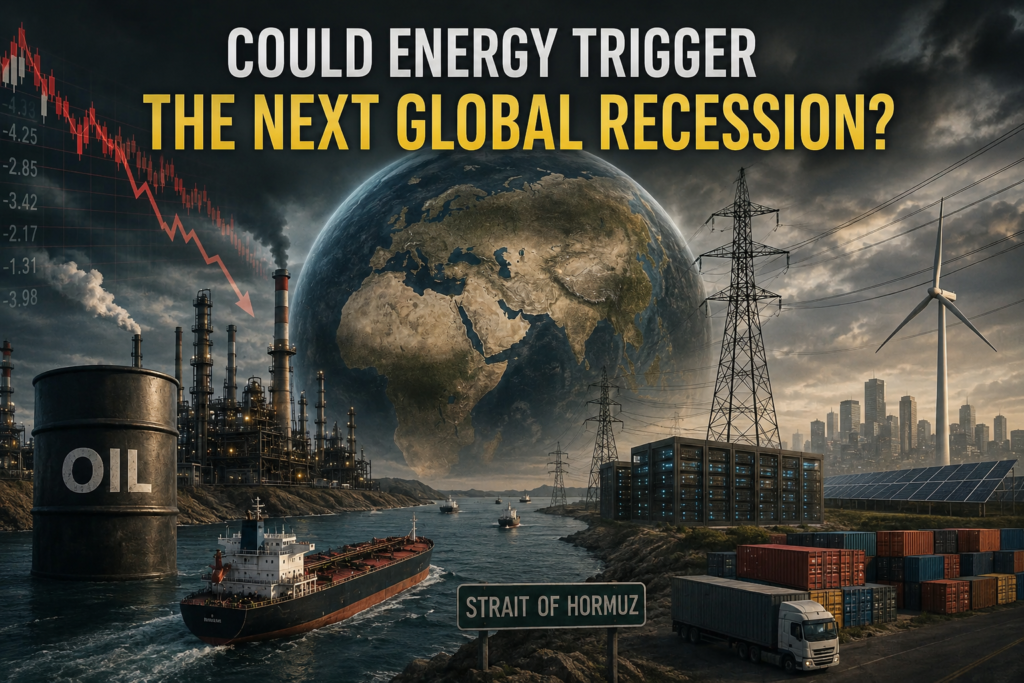
The Strait of Hormuz remains one of the world’s most strategically significant maritime chokepoints. A substantial share of globally traded crude oil passes through those waters every day. Even when shipping continues normally, periods of military tension are enough to make insurers, traders and commodity markets more cautious.
Notice what happens next.
Insurance premiums edge higher.
Shipping companies reassess routes.
Importers begin discussing alternative suppliers.
Oil prices may move before a single tanker changes course.
Markets don’t wait for shortages.
They react to uncertainty.
That behaviour isn’t irrational. It’s an attempt to price tomorrow’s risks before tomorrow arrives.
Countries Aren’t Facing the Same Problem
One mistake that often appears in public debate is treating the global economy as though every country experiences an energy shock in exactly the same way.
They don’t.
India provides a useful example.
As one of the world’s largest crude oil importers, India remains sensitive to sustained increases in global energy prices. Yet in recent years it has also demonstrated how flexible procurement strategies can soften external shocks. Increased purchases of discounted Russian crude helped reduce some of the pressure that many other import-dependent economies experienced after 2022.
That didn’t eliminate India’s exposure.
It simply changed the equation.
Germany faced a different challenge.
For decades, relatively affordable Russian natural gas supported parts of its industrial base, particularly energy-intensive sectors such as chemicals. When those supplies were disrupted, companies had to adjust quickly—finding alternative energy sources, reducing production or absorbing significantly higher costs.
The consequences extended well beyond Germany itself.
Chemical products sit near the beginning of countless industrial supply chains. Pharmaceuticals, plastics, automotive components, packaging materials and agricultural products all depend on them in one way or another.
A disruption in one sector gradually found its way into many others.
Then there are countries on the opposite side of the equation.
Higher oil prices can initially strengthen the finances of major exporters such as Saudi Arabia, the United Arab Emirates and Norway. Government revenues improve. Energy companies report stronger earnings. Investment plans often become easier to finance.
But even that advantage has limits.
If expensive energy eventually contributes to a broader global slowdown, demand for oil can weaken, reducing some of the benefits that high prices created in the first place.
It’s a reminder that there are very few permanent winners during periods of prolonged economic stress.
One sector’s opportunity can become another sector’s constraint—and sometimes those roles reverse before anyone has fully adjusted.
That’s one reason economists pay close attention to confidence as well as prices.
Confidence influences hiring.
It shapes investment.
And unlike oil, once confidence begins to weaken, restoring it is rarely quick.
What Economists Are Watching Now
If you ask ten economists whether the world is heading toward a recession, you’ll probably receive ten slightly different answers.
Not because they’re looking at different economies.
Because they’re looking at different signals.
Some focus on manufacturing activity. Others pay closer attention to employment, consumer spending, corporate earnings or credit markets. None of those indicators is decisive on its own, but together they begin to reveal whether businesses are becoming more optimistic or more cautious.
Energy prices fit into that picture.
They rarely tell the whole story by themselves.
Suppose oil climbs by 20% over several months.
That doesn’t automatically mean a recession is around the corner. If consumers are still spending confidently, companies continue investing and inflation remains under control, the economy can often absorb higher energy costs without major disruption.
There have been periods when exactly that happened.
The concern grows when several trends begin moving in the same direction.
Factories report weaker new orders.
Retail sales lose momentum.
Hiring slows.
Banks become more selective about lending.
At the same time, transport and electricity costs continue rising.
Each development may appear manageable in isolation.
Together, they begin telling a more coherent story.
Interestingly, economists often pay as much attention to business surveys as they do to official GDP figures. Purchasing managers, logistics firms and manufacturers frequently notice changes in demand before those changes become visible in quarterly economic reports.
By the time GDP confirms a slowdown, companies may already have been adjusting their plans for months.
Sometimes the official numbers are simply catching up.
The Problem Central Banks Can’t Easily Solve
There’s a common assumption that central banks can always step in when growth begins slowing.
Reality is less accommodating.
Imagine an economy where inflation has almost returned to target after a difficult few years.
Businesses are gradually regaining confidence. Financial markets expect interest-rate cuts in the coming months. Borrowing costs are beginning to look less restrictive.
Then a major geopolitical crisis disrupts energy supplies.
Oil prices rise sharply.
Natural gas follows.
Electricity becomes more expensive.
Inflation starts climbing again—not because consumers are spending excessively, but because a fundamental input across the economy has become more costly.
Central banks suddenly face an uncomfortable choice.
Reducing interest rates could support growth, but it might also allow inflation to become entrenched once again.
Keeping rates elevated could help contain inflation expectations, yet it also increases borrowing costs for households and businesses that are already becoming cautious.
Neither path is particularly attractive.
One detail often gets overlooked in discussions about inflation.
Higher interest rates cannot produce more crude oil.
They cannot reopen shipping lanes.
They cannot repair damaged pipelines or increase electricity generation overnight.
Monetary policy is designed primarily to influence demand.
Energy shocks usually begin on the supply side.
Those are very different problems.
That’s why policymakers often speak so carefully during periods of energy uncertainty. They know that reacting too quickly—or waiting too long—can create new difficulties of its own.
When Separate Problems Start Reinforcing Each Other
It’s tempting to search for a single cause whenever recessions occur.
History rarely cooperates.
The global financial crisis wasn’t only about housing.
The pandemic wasn’t only a public health emergency.
Likewise, the next recession—if one arrives—is unlikely to be caused solely by energy prices.
A more realistic concern is that higher energy costs could amplify weaknesses that already exist.
Government debt remains elevated in many advanced economies.
Interest rates are still considerably higher than they were for much of the previous decade.
Global trade has become more fragmented, while geopolitical tensions continue to influence investment decisions and supply chains.
None of those developments guarantees an economic downturn.
They’re simply part of the backdrop.
If energy prices were to remain elevated for only a few weeks, businesses would probably adapt.
If they stayed high for a year while inflation remained stubborn, borrowing costs stayed restrictive and consumer confidence weakened, the picture would begin to look very different.
That’s not a prediction.
It’s a scenario economists spend time thinking about because the ingredients already exist.
Perhaps surprisingly, the greatest risk isn’t always the initial shock itself.
It’s the possibility that businesses, consumers, investors and policymakers all become more cautious at roughly the same time.
Economic momentum has a habit of fading gradually before anyone is willing to describe it as a recession.
And by the time that word enters everyday conversation, much of the adjustment has often taken place already.
The Infrastructure We Almost Never Think About
Spend a day without opening a banking app, streaming a video or ordering something online, and life would probably feel inconvenient.
Spend a day without reliable electricity or affordable fuel, and entire economies begin to behave differently.
That’s an important distinction.
We often talk about technology as though it has replaced the industrial economy. In practice, it has been layered on top of it.
Every cloud service depends on data centres. Those data centres depend on electricity. Electricity depends on power plants, transmission networks and fuel supplies that most people never see. Goods bought with a single click still travel through ports, warehouses, trucks and delivery networks before they reach a customer’s doorstep.
The digital economy may appear intangible.
Its foundations are anything but.
Perhaps that’s why energy has an unusual place in public discussion. When prices are stable and supplies are reliable, it fades into the background. Attention shifts to inflation reports, stock markets, artificial intelligence or the latest technology breakthrough.
Energy becomes interesting only when it stops being predictable.
By then, businesses have often been adapting for weeks.
Beyond Oil: The Transition Is Changing the Question
There’s a tendency to frame the future as a choice between fossil fuels and renewable energy.
The reality is more complicated.
The world isn’t switching from one system to another overnight. For years—perhaps decades—both systems will operate side by side.
Building wind farms requires steel, cement and transport.
Manufacturing solar panels depends on mining, processing and global supply chains.
Electric vehicles reduce demand for gasoline, but they increase demand for electricity, battery minerals and modern grid infrastructure.
In other words, the energy transition doesn’t eliminate complexity.
In many respects, it introduces new forms of it.
What’s interesting is that this transition changes the conversation from how much energy the world needs to how reliably that energy can be produced, stored and delivered.
Countries are beginning to compete not only for oil and natural gas, but also for lithium, copper, rare earth elements, advanced battery technologies and the manufacturing capacity needed to process them.
Energy security is evolving.
It isn’t disappearing.
The Quiet Link Between Energy and National Security
Not long ago, energy policy was often discussed separately from defence strategy or industrial policy.
Those boundaries have become increasingly blurred.
Governments now invest in strategic petroleum reserves, critical mineral supply chains, semiconductor manufacturing and electricity grids for reasons that extend well beyond economics.
A modern economy depends on all of them.
An interruption to electricity can affect hospitals.
A shortage of semiconductor components can delay automotive production.
Disruptions to shipping routes can ripple through manufacturing, food distribution and retail inventories.
These systems don’t operate independently.
They reinforce one another.
That doesn’t mean they’re fragile.
In many ways they’re stronger than they were twenty years ago. Supply chains are more diversified, companies hold greater awareness of operational risk and governments have spent years preparing for disruptions that once seemed unlikely.
Even so, resilience isn’t something that can be built once and forgotten.
It’s a process of constant adaptation.
Businesses change suppliers.
Governments review contingency plans.
Investors reassess risks.
Most of that work happens quietly, long before it becomes visible in headlines.
And perhaps that’s exactly how resilience is supposed to look.
If preparations succeed, the public rarely notices them.
If they fail, everyone does.
Looking Beyond the Next Oil Price
So, could the next global recession begin with an energy shock?
It could.
It could also begin somewhere else entirely.
Financial markets might stumble first. A debt crisis could spread through the banking system. Trade disputes might intensify. A technological disruption could reshape industries faster than businesses are able to adapt.
History rarely repeats the same sequence twice.
That’s one reason economists are cautious about drawing straight lines from today’s headlines to tomorrow’s outcomes.
Even so, energy deserves attention for a simple reason: it has an unusual ability to amplify whatever is already happening elsewhere.
When borrowing costs are low, consumers are confident and businesses are investing, higher fuel prices can often be absorbed.
When confidence is already weakening, the very same increase may have much larger consequences.
The price itself hasn’t changed.
The environment around it has.
That’s why discussions about energy are rarely just discussions about oil, natural gas or electricity. They’re conversations about resilience, productivity, inflation, geopolitics, investment and confidence—all moving at different speeds, often pulling in different directions.
There isn’t a single indicator that tells us when those forces are becoming dangerous.
If there were, recessions would be much easier to avoid.
Instead, policymakers, businesses and investors spend their time assembling fragments of information that never arrive in perfect order. Manufacturing surveys hint at one trend. Freight costs suggest another. Consumer confidence moves in a different direction. Commodity markets react to events that haven’t fully unfolded yet.
Only later does the pattern become clear.
Sometimes, much later.
One lesson appears repeatedly across modern economic history.
Major crises rarely emerge because one system fails in isolation. They become serious when separate systems begin placing pressure on one another at the same time.
That’s what makes energy different from many other economic variables.
It touches almost everything without usually becoming the centre of attention.
The irony is that successful energy systems are almost invisible.
Nobody celebrates a power grid that functions normally.
Few people think about shipping lanes when supermarket shelves are full.
Factories running on schedule don’t make front-page news.
Reliable electricity is almost never discussed until it isn’t reliable anymore.
Perhaps that’s unavoidable.
Societies tend to notice the systems they depend on only after those systems become uncertain.
The same is true of economic resilience.
It’s difficult to measure while everything is working.
It’s impossible to ignore once it isn’t.
Whether the next global recession begins with an energy shock or not, the larger question will remain the same: how prepared are governments, businesses and households for a world where disruptions travel faster, spread further and interact in increasingly unpredictable ways?
The answer won’t be found in a single oil-price chart or one quarterly GDP report.
It will emerge gradually—in investment decisions that aren’t made, expansion plans that are quietly postponed, supply chains that are redesigned, and confidence that shifts long before official statistics acknowledge it.
Those changes rarely attract much attention in real time.
Then, one day, they become the story everyone is trying to explain.