
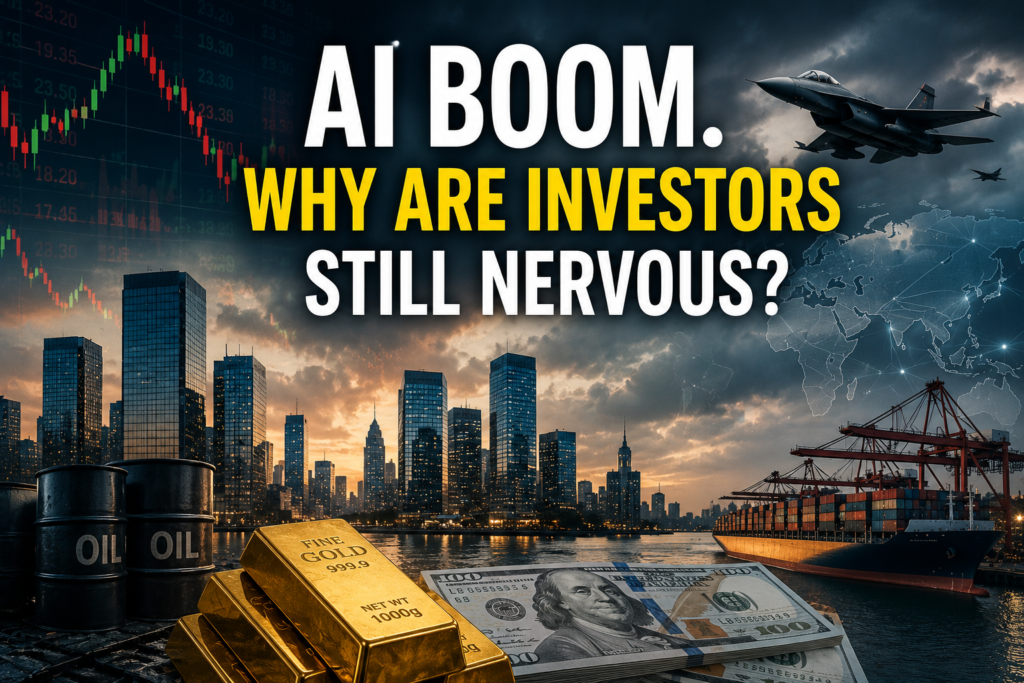
There is an unusual contradiction at the heart of today’s financial markets.
Some of the world’s largest technology companies are reaching record valuations because of artificial intelligence. Yet many of the same investors buying into that story are also increasing their exposure to gold, government bonds, and other traditional safe havens. Optimism is driving one part of the market while caution quietly shapes another.
That isn’t as contradictory as it first appears.
It says something important about how experienced investors think. They may believe AI will transform the global economy over the next decade, but they’re far less certain about what happens over the next six or twelve months. Long-term conviction and short-term caution can exist in the same portfolio.
That distinction explains much of the market today.
Artificial intelligence has become the defining investment theme of this decade. Capital spending on AI infrastructure is accelerating, demand for advanced semiconductors continues to surge, and companies across almost every major industry are trying to determine how the technology can improve productivity or create new revenue streams.
The scale of investment is difficult to ignore.
Businesses are committing hundreds of billions of dollars to data centres, cloud computing infrastructure, networking equipment, specialised chips, and software. What began as enthusiasm around generative AI has expanded into something much broader. Increasingly, executives see AI less as an optional technology initiative and more as infrastructure that businesses will eventually need, much like cloud computing or the internet itself.
Still, markets haven’t embraced that future without hesitation.
Volatility remains elevated. Central banks continue to emphasise inflation risks. Oil prices can swing sharply after a single geopolitical headline. Investors react just as quickly to an employment report or an earnings miss as they do to the latest AI breakthrough.
If artificial intelligence represents one of the most significant technological shifts in decades, why hasn’t confidence become equally widespread?
The answer lies outside the technology sector.
Financial markets rarely move because of one story alone. Even during major technological revolutions, investors are constantly balancing opportunity against uncertainty. The stronger the long-term opportunity appears, the more carefully they examine everything that could prevent it from unfolding as expected.
History offers plenty of examples.
The internet reshaped the global economy, but internet stocks still experienced painful corrections. Smartphones transformed industries, yet they developed against the backdrop of financial crises, recessions, and shifting monetary policy. Breakthrough technologies don’t replace economic cycles. They become part of them.
AI appears to be following the same pattern.
AI Has Become the Biggest Market Story
Few innovations have reshaped investor expectations as quickly as artificial intelligence.
Only a few years ago, discussions around AI largely centred on research laboratories and specialist software. Today, earnings calls across industries routinely include conversations about AI strategy, infrastructure spending, automation, and productivity gains. In many cases, investors expect management teams to explain not only what they’re doing with AI, but why they’re moving fast enough.
That shift in expectations happened remarkably quickly.
Technology companies remain at the centre of this investment wave, though each is approaching it from a different angle.
Nvidia has become the dominant supplier of graphics processing units needed to train advanced AI models. Microsoft is embedding AI into enterprise software while expanding Azure’s AI capabilities. Alphabet is integrating AI across search, cloud services, and workplace products. Amazon continues investing heavily through AWS, and Meta is spending billions developing increasingly capable AI systems of its own.
Competition isn’t limited to building better software.
Behind the scenes, companies are racing to secure computing power, electricity, specialised talent, and semiconductor capacity. The AI models receive most of the public attention, but the physical infrastructure supporting them may ultimately prove just as strategically important. Data centres don’t appear overnight, and neither do advanced chip fabrication facilities.
Outside Big Tech, adoption is spreading in quieter ways.
Healthcare companies are using AI to shorten parts of the drug discovery process. Manufacturers are improving quality control and predictive maintenance. Financial institutions continue expanding fraud detection and risk modelling, while logistics firms are finding more efficient ways to manage complex supply chains. Much of this work rarely becomes headline news, yet it may have a greater long-term economic impact than many of the product launches that dominate headlines.
That’s one reason investors remain so enthusiastic.
They’re no longer evaluating AI as a single industry. They’re evaluating it as a technology capable of reshaping many industries simultaneously.
Few opportunities carry that kind of potential.
Then Why Are Investors Still Nervous?
Because markets rarely have the luxury of focusing on only one idea.
Every trading day brings a fresh stream of information. Inflation reports. Central bank commentary. Corporate earnings. Employment data. Oil prices. Elections. Trade negotiations. Military conflicts. Any one of those can influence investor sentiment long before AI’s long-term economic benefits fully materialise.
That’s why market psychology often looks contradictory from the outside.
An investor can believe AI will fundamentally change the economy over the next decade while still reducing exposure to risk this quarter. Those positions aren’t inconsistent. They simply operate on different time horizons.
There’s another behavioural factor at work.
Professional investors spend much of their time thinking about probabilities rather than predictions. They don’t ask whether AI will succeed or fail. They ask what happens if adoption slows, if inflation returns, if interest rates stay higher for longer, or if geopolitical tensions disrupt global growth. Every portfolio reflects a collection of scenarios rather than a single forecast.
That mindset often surprises individual investors.
Retail investors are naturally drawn toward the biggest opportunity. Institutional investors are usually more focused on what could damage that opportunity, even if they believe in it.
It’s one reason market rallies often feel less confident than the headlines suggest.
The excitement surrounding AI is genuine.
So is the caution sitting just beneath it.
Risk One: Geopolitical Uncertainty
A new AI model can dominate headlines in the morning. By afternoon, markets may be reacting to an oil tanker, a trade announcement, or a military exercise thousands of miles away.
That isn’t a distraction from the investment story. It is the investment story.
Technology has become increasingly global, and so have the risks surrounding it. AI may be built on algorithms, but those algorithms depend on supply chains that stretch across continents, semiconductor factories that require years to build, shipping routes that remain politically sensitive, and vast amounts of reliable energy.
The chips themselves are tiny. The industrial ecosystem behind them is enormous.
Over the past three decades, businesses optimised their operations for efficiency. Components crossed borders several times before becoming finished products, and companies rarely questioned whether those supply chains would remain stable. That assumption has weakened considerably.
The war in Ukraine exposed Europe’s dependence on energy imports. Tensions in the Middle East continue to affect global oil markets. Taiwan remains central to advanced semiconductor manufacturing, making developments in the region far more significant than a typical geopolitical dispute. Add ongoing trade frictions between major economies, export controls on advanced technology, and competition over critical minerals, and investors are looking at a world that feels noticeably less predictable than it did a decade ago.
Markets don’t need a crisis to become cautious.
Sometimes the possibility of disruption is enough.
That’s particularly true in energy markets. Oil prices often move before any physical shortage appears because traders are pricing future risk rather than current conditions. If conflict threatens a major shipping route or producing region, the market quickly begins asking what could happen next—not what has already happened.
The consequences spread well beyond the energy sector.
Higher fuel costs raise transportation expenses. Manufacturers face higher input costs. Airlines, shipping companies, and logistics providers adjust pricing. Eventually, consumers begin paying more for everyday goods, even if they never follow geopolitical news themselves.
Then another chain reaction begins.
Persistent energy inflation can complicate central bank policy. Higher borrowing costs weigh on business investment. Companies become more selective about expansion plans, and investors reassess earnings expectations across sectors that have little direct connection to oil.
Notice how far we’ve moved from AI.
That’s precisely the point.
Markets rarely separate technology from the wider economic environment. Investors don’t either.
Risk Two: Inflation Isn’t Fully Gone
The inflation shock that dominated recent years has eased, but it hasn’t disappeared from investors’ thinking.
That’s because inflation doesn’t need to return to previous highs to influence markets. It only needs to remain stubborn enough to keep central banks cautious.
The conversation has changed.
A year or two ago, investors were asking how quickly inflation would fall. Now the question is whether it can settle comfortably near central bank targets without another unexpected surge. That may sound like a subtle shift, but it changes how markets interpret almost every major economic report.
One stronger-than-expected wage number.
A jump in energy prices.
Unexpected resilience in consumer spending.
Suddenly, investors begin adjusting expectations for interest rates all over again.
This is where AI enthusiasm meets economic reality.
Most leading AI companies are valued not only on today’s earnings but on profits investors expect years into the future. Higher interest rates reduce the present value of those future cash flows, which helps explain why technology stocks can react sharply to inflation data even when nothing has changed inside the business itself.
That’s often misunderstood.
People sometimes assume markets are responding to the inflation report itself. In reality, they’re responding to what that report might mean for monetary policy, financing costs, corporate investment, and future valuations.
The chain of reasoning is longer than it appears.
Businesses notice it too.
After years of exceptionally cheap capital, many executives are approaching expansion plans more carefully. Few announce dramatic changes publicly. More often, projects are delayed, hiring slows gradually, or investment budgets become more selective. Those decisions accumulate quietly across the economy.
None of this suggests inflation is out of control.
It suggests investors have learned not to declare victory too early.
Risk Three: Corporate Earnings Still Matter
Eventually, every investment narrative reaches the same test.
Can the numbers support it?
Financial markets are willing to reward ambition, particularly when transformative technologies emerge. But enthusiasm alone rarely sustains premium valuations indefinitely. At some point, investors expect evidence that spending is producing measurable business results.
The AI sector has reached that stage.
Companies are investing extraordinary amounts in infrastructure, research, specialised talent, and computing capacity. Those investments are widely understood. The harder question is how quickly they translate into stronger revenue, healthier profit margins, or durable competitive advantages.
Not every answer will arrive this quarter.
Even so, markets remain impatient.
Listen closely to earnings calls and a pattern emerges. Analysts increasingly ask less about whether companies have an AI strategy and more about customer adoption, pricing power, returns on investment, and when those returns begin appearing in financial statements.
That shift matters.
The market’s attention is gradually moving from possibility to execution.
For companies with elevated valuations, execution becomes unforgiving. A business can report growing revenue, expanding profits, and strong customer demand yet still disappoint investors if those results fall short of expectations that had become almost impossible to satisfy.
This happens regularly during major technology cycles.
The companies may still be performing exceptionally well.
The expectations simply moved faster than the businesses themselves.
Risk Four: Expensive Valuations
Success creates its own challenges.
The stronger a company’s share price performs, the more future success investors begin pricing into today’s valuation. That dynamic has become particularly visible across many AI-related businesses.
High valuations are not necessarily a warning sign.
Sometimes they accurately reflect extraordinary businesses with exceptional long-term prospects.
The difficulty lies elsewhere.
When expectations become exceptionally optimistic, the margin for disappointment becomes remarkably thin.
A slight slowdown in cloud demand.
Management offering more cautious guidance.
Customers taking longer than expected to adopt new AI products.
None of these developments automatically changes the long-term investment case. Yet markets can erase billions in market value within hours because investors are repricing expectations rather than judging the underlying business.
That’s an important distinction.
Stock prices don’t simply reflect what companies are worth today. They reflect what investors collectively believe those companies will become tomorrow.
And expectations have a habit of running ahead of reality during periods of technological excitement.
History has shown that more than once.
Why Money Is Moving Into Safe Assets
One of the more revealing signals in today’s market isn’t coming from AI stocks at all.
It’s coming from what investors are buying alongside them.
Demand for companies tied to artificial intelligence remains strong, yet money continues flowing into gold, U.S. Treasury bonds, cash, and traditionally defensive sectors such as healthcare and consumer staples. On the surface, those decisions appear to point in opposite directions.
They don’t.
They reflect two different questions.
The first is: Where could long-term growth come from?
The second is: What happens if the next twelve months become more difficult than expected?
Professional investors rarely answer only one of those questions.
Much of portfolio management is about surviving uncertainty rather than predicting the future with perfect accuracy. Investors know they won’t anticipate every geopolitical event, policy decision, or economic surprise. Instead, they try to avoid becoming overly dependent on a single outcome.
That’s why portfolios often look more cautious than market headlines suggest.
A fund manager may increase exposure to AI because the structural opportunity appears compelling, while simultaneously buying government bonds because recession risks haven’t completely disappeared. Those aren’t conflicting decisions. They’re different forms of risk management operating over different time horizons.
Investor positioning often tells a more nuanced story than investor commentary.
Confidence doesn’t always look like concentration.
Sometimes it looks like diversification.
What This Means for the Global Economy
Financial markets are usually the first place uncertainty becomes visible.
The broader economy tends to respond more slowly.
When executives become less certain about demand or borrowing costs, they rarely announce sweeping changes overnight. Expansion plans are adjusted quietly. Hiring slows through attrition rather than layoffs. New factories remain on the drawing board for another quarter. Capital spending is reviewed more carefully.
From the outside, those decisions barely register.
Collectively, they shape economic momentum.
That’s one reason economists pay close attention to business investment. Consumer spending often dominates headlines, but long-term growth also depends on companies continuing to build factories, modernise equipment, develop technology, and expand productive capacity. When that investment slows, the effects usually appear months later rather than immediately.
Consumers respond differently.
Most households don’t follow bond yields or central bank statements. They notice mortgage rates, fuel prices, grocery bills, and employment conditions. If those pressures begin to build at the same time, discretionary spending is often the first area to weaken.
The effects spread gradually.
Retailers become more cautious with inventory. Manufacturers adjust production schedules. Service industries see softer demand. None of these developments necessarily point to recession, but together they influence the pace of economic growth.
Governments are adapting as well.
Across many advanced economies, spending priorities have shifted in recent years. Energy security, domestic semiconductor production, supply-chain resilience, and defence have moved higher on policy agendas. Some of those investments support long-term growth. Others reflect a world that policymakers increasingly view as less stable than it once appeared.
There’s an interesting irony here.
Globalisation encouraged companies to build the most efficient supply chains possible. Today’s geopolitical environment is encouraging many of those same businesses to sacrifice some efficiency in exchange for greater resilience.
That transition is unlikely to happen quickly.
Supply chains measured in decades are not rebuilt in a few quarters.
How Different Regions Are Responding
The AI investment cycle is global, but no two economies are approaching it in exactly the same way.
Their opportunities—and their constraints—are different.
United States
The United States remains at the centre of the AI ecosystem.
Its advantages extend beyond the world’s largest technology companies. Deep capital markets, a mature venture capital network, leading universities, specialised semiconductor firms, cloud infrastructure providers, and a culture that has historically rewarded innovation all reinforce one another. That ecosystem is difficult to replicate.
The challenge now is less about technological leadership than economic balance.
Policymakers are trying to contain inflation without unnecessarily slowing growth. Investors, meanwhile, are asking a different question: can AI-driven productivity arrive quickly enough to justify the enormous level of investment already underway?
No one knows the answer yet.
Which is why every earnings season attracts so much attention.
Europe
Europe’s position is more complex.
AI adoption continues to expand, but investment decisions are taking place against a backdrop of slower economic growth, higher energy costs in parts of the region, and increased defence spending. Businesses are investing in AI while also navigating structural challenges that many American technology firms face to a lesser extent.
As a result, Europe’s investment story is less about speed and more about balance.
Innovation remains important, but so do fiscal discipline, industrial policy, and energy security.
China
China continues treating advanced technology as a strategic priority rather than simply a commercial opportunity.
Investment in artificial intelligence, semiconductor manufacturing, robotics, and advanced industrial capabilities remains substantial. At the same time, export restrictions, trade tensions, demographic pressures, and challenges within the property sector have created a more complicated economic backdrop than existed several years ago.
That combination has reshaped investor expectations.
China is still viewed as one of the world’s largest technology markets. It’s also viewed as one where policy decisions can alter the investment landscape with unusual speed.
Opportunity and uncertainty continue to exist side by side.
India
India occupies a different position altogether.
Rather than competing directly with every aspect of the global AI ecosystem, it has the opportunity to benefit from several long-term shifts occurring simultaneously. A large technology services sector, expanding digital infrastructure, government support for semiconductor manufacturing, and a growing engineering workforce have strengthened the country’s role in the global technology economy.
Supply-chain diversification may become just as important.
As multinational companies reduce dependence on single-country manufacturing strategies, India has gradually emerged as one of several destinations attracting greater attention for electronics production, digital infrastructure, and advanced manufacturing investment.
That creates meaningful opportunities.
It doesn’t eliminate exposure to global risks.
India remains a major energy importer, making oil prices an important variable for inflation and trade balances. Slower global growth can affect exports and foreign investment flows. Financial markets respond quickly when international investors become more risk-averse, regardless of domestic fundamentals.
In other words, India’s growth story is becoming stronger.
Its connection to the global economy is becoming stronger too.
Those two developments are unfolding together.
Could AI Alone Keep Markets Rising?
The temptation is understandable.
Every major market cycle eventually develops a story so compelling that it begins to overshadow everything else. During the late 1990s, it was the internet. More recently, it was the era of ultra-low interest rates and abundant liquidity. Today, that story is artificial intelligence.
The difference is that markets never stop paying attention to everything outside the headline.
AI may become one of the defining technologies of the century. That doesn’t mean economic cycles disappear or that investors suddenly stop caring about inflation, interest rates, consumer demand, or corporate profits. If anything, transformative technologies often raise expectations so quickly that the surrounding economic environment matters even more.
There’s another pattern worth remembering.
Major technological revolutions rarely unfold in a straight line. They typically begin with genuine innovation, attract enormous amounts of capital, encourage periods of overinvestment, and eventually settle into a more sustainable phase where the real productivity gains become visible.
Railways followed that pattern.
The internet did too.
Even cloud computing experienced years in which market expectations moved faster than business adoption before becoming an essential part of the global economy.
AI is unlikely to escape that cycle.
That shouldn’t be mistaken for pessimism.
Periods of reassessment don’t invalidate technological progress. In many cases, they help distinguish companies with durable competitive advantages from those benefiting primarily from investor excitement.
Markets have a way of forcing that distinction over time.
For long-term investors, the important question isn’t whether AI will matter.
It’s where the lasting economic value will ultimately be created—and whether today’s prices already assume too much of tomorrow’s success.
What Investors Are Watching Next
Every market has its scoreboard.
Right now, it isn’t measuring hype. It’s measuring proof.
Corporate earnings remain the clearest test of whether AI investment is translating into stronger businesses. Investors already know companies are spending heavily. What they’re increasingly looking for is evidence that those investments are improving revenue growth, strengthening margins, attracting customers, or creating efficiencies that competitors will struggle to replicate.
That shift in focus has been gradual, but unmistakable.
Only a year ago, announcing an ambitious AI strategy often generated enthusiasm on its own. Increasingly, investors want management teams to explain what those initiatives are actually delivering. CEOs have noticed the change as well. Earnings calls today sound noticeably more measured than they did during the first wave of AI excitement, with executives spending more time discussing execution than vision.
Markets tend to reward credibility.
Promises eventually become forecasts.
Forecasts eventually become numbers.
Inflation data will remain equally important, though for a different reason.
Markets aren’t simply reacting to consumer prices. They’re trying to anticipate how central banks will interpret those numbers. A modest change in interest-rate expectations can have an outsized impact on growth-stock valuations, financing costs, and overall market sentiment.
That’s why seemingly ordinary economic reports often produce surprisingly large market moves.
Employment data follows the same pattern.
A strong labour market can signal economic resilience, but it can also suggest persistent wage pressures. Weak employment data may support the case for lower interest rates while simultaneously raising concerns about slowing demand. The same economic release can produce two competing narratives, which explains why market reactions sometimes appear inconsistent.
Then there is energy.
Oil prices remain one of the fastest ways geopolitical events find their way into financial markets. A conflict affecting a shipping route or major producer doesn’t only change expectations for energy companies. It influences transportation costs, manufacturing expenses, inflation forecasts, airline profitability, consumer spending, and eventually central bank thinking.
The connections aren’t always obvious.
Markets make them anyway.
Investors are also watching for something less visible.
Will AI adoption broaden beyond a relatively small group of technology leaders?
The long-term investment case becomes considerably stronger if productivity gains begin appearing across manufacturing, healthcare, financial services, logistics, retail, and other sectors. A technology creates lasting economic value when it spreads beyond its original creators. Electricity, personal computers, and the internet all followed that path.
AI will ultimately be judged by the same standard.
International developments remain impossible to ignore.
Trade negotiations, elections, sanctions, export controls, fiscal policy, and geopolitical conflicts all have the potential to reshape market expectations with very little warning. The global economy has become so interconnected that investors can no longer separate technology from diplomacy, or corporate strategy from public policy.
That may be one of the defining characteristics of modern markets.
Innovation is advancing rapidly.
So is uncertainty.
Investors are learning to price both at the same time.
The Bigger Picture
It’s tempting to view today’s market through a single lens.
If you’re following technology news, it can seem as though artificial intelligence explains almost everything happening in financial markets. If you’re focused on macroeconomics, inflation and interest rates appear to dominate every conversation. Watch geopolitical developments for a week, and it becomes easy to believe global politics is the only story that matters.
The reality is less tidy.
Markets are trying to absorb all of those forces at once.
That’s what makes this period unusually difficult to interpret. Strong corporate earnings can lift sentiment, only for a central bank statement to erase those gains a day later. A breakthrough AI announcement may push technology stocks higher, while rising oil prices quietly revive inflation concerns. Investors aren’t constantly changing their minds. They’re constantly weighing new information against what they already believe.
Expectations shift faster than fundamentals.
That’s one reason markets often look confusing in real time.
The most valuable companies in the world are investing unprecedented sums in artificial intelligence. Governments are competing to secure semiconductor supply chains and attract advanced manufacturing. Businesses are redesigning products, workflows, and long-term strategies around technologies that barely entered mainstream discussion a few years ago.
Those are meaningful changes.
They also exist alongside an economy still adjusting to higher borrowing costs, persistent geopolitical tensions, changing trade relationships, and a less predictable policy environment than many businesses became accustomed to during the previous decade.
The interaction between those forces is what matters.
Artificial intelligence doesn’t operate separately from the economy. It depends on access to capital, stable energy supplies, skilled labour, global trade, reliable infrastructure, and customers willing to invest. If any of those conditions weaken, adoption may continue—but the pace often changes.
That’s easy to overlook during periods of excitement.
History suggests that transformative technologies usually create two different stories.
The first is about innovation itself. New products emerge, investment accelerates, and expectations rise rapidly. The second story unfolds more slowly. Businesses learn where the technology genuinely creates value, where it was oversold, and which companies can consistently turn innovation into durable profits.
The second story is usually the more important one.
It is also the one markets spend years trying to understand.
That helps explain another apparent contradiction.
Many investors genuinely believe AI will reshape the global economy over the next decade. The same investors continue holding defensive assets, paying close attention to inflation reports, and scrutinising every earnings season.
They’re not contradicting themselves.
They’re acknowledging that technological conviction doesn’t eliminate economic uncertainty.
There’s a behavioural lesson in that.
Individual investors often feel pressure to choose a single narrative—either become enthusiastic about AI or worry about the economy. Institutional investors rarely think that way. Their job isn’t to predict one future with complete confidence. It’s to prepare for several plausible futures at the same time.
That difference in mindset is visible across today’s markets.
The enthusiasm surrounding AI is real.
So is the caution beneath it.
Both are rational.
Perhaps that’s the broader lesson from this moment.
Every technological revolution eventually collides with the realities of economics. Capital becomes more expensive. Supply chains face disruption. Governments intervene. Consumer demand changes. Expectations overshoot. Some companies exceed them, others don’t. None of that diminishes the importance of the technology itself.
It simply determines how—and how quickly—its promise becomes economic reality.
Artificial intelligence may well become one of the defining technologies of the twenty-first century. There is already compelling evidence that it will reshape industries, influence productivity, and alter competitive dynamics across the global economy.
But financial markets are not pricing the future of AI alone.
They’re pricing inflation alongside innovation.
Interest rates alongside investment.
Geopolitics alongside productivity.
Confidence alongside caution.
That balancing act is unlikely to disappear anytime soon. In fact, it may become the defining feature of this stage of the AI era. The biggest opportunities often emerge when technology advances faster than certainty—but they also demand a level of patience that markets don’t always possess.
In the years ahead, investors probably won’t remember this period simply as the beginning of the AI boom.
They may remember it as the moment when one of the most powerful technological revolutions in modern history collided with an equally complicated global economy—and revealed that progress is rarely shaped by innovation alone.