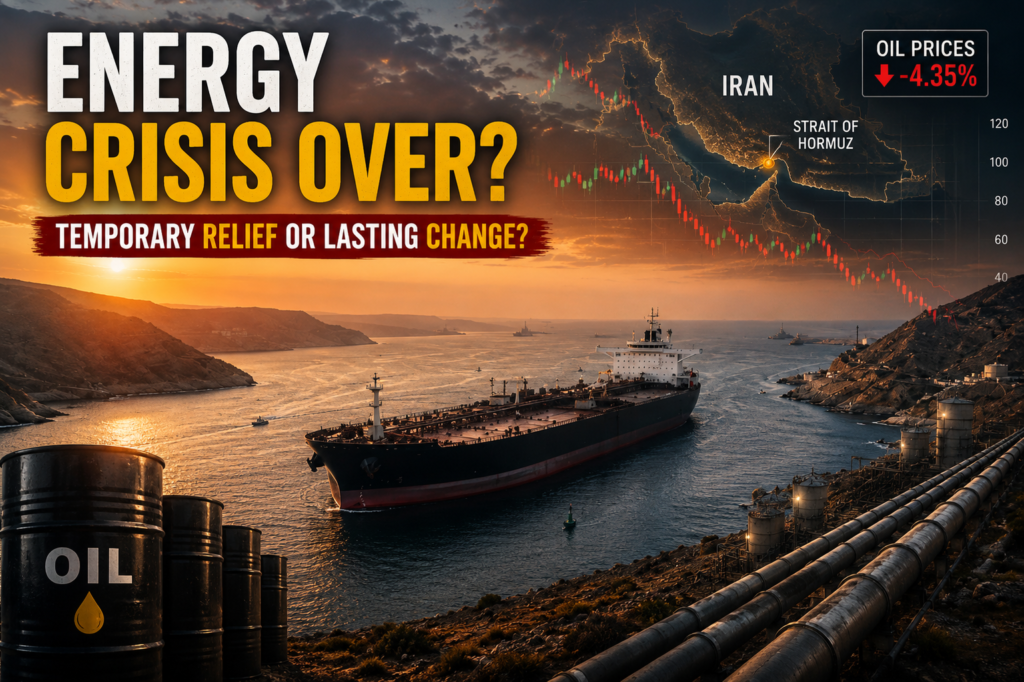
Oil markets reacted almost immediately.
Prices fell. Investors relaxed. Governments welcomed signs that one of the world’s most sensitive energy flashpoints might avoid a deeper confrontation.
After months of tension involving Iran and growing concern about oil shipments through the Strait of Hormuz, the diplomatic breakthrough appeared to deliver something markets had been waiting for: fewer reasons to worry.
At least for now.
That response raises a larger question than the headline itself.
Not whether the global energy crisis is over.
But why markets—and sometimes policymakers—so often assume that energy crises end when prices begin falling.
The latest agreement may ultimately prove significant. It may not. Energy markets have a long history of making pivotal moments look less pivotal in hindsight.
Why Relief Arrived So Quickly
One thing energy markets have repeatedly demonstrated over the past several decades is how quickly confidence can return once immediate threats begin to fade.
The moment traders began assigning a lower probability to military escalation or disruptions to tanker traffic through the Strait of Hormuz, oil prices started moving lower. A meaningful share of recent price volatility reflected fears about what could happen rather than actual supply losses.
That is not unusual.
Financial markets spend much of their time trying to price uncertainty. When uncertainty declines, even temporarily, prices often adjust before underlying conditions have materially changed.
There is a temptation to view this as evidence that the danger has passed. Sometimes that turns out to be true. Sometimes it doesn’t.
Markets tend to prefer certainty. The challenge is that geopolitical systems rarely provide it for very long.
A Narrow Waterway With A Remarkably Long Shadow
The Strait of Hormuz is not particularly large.
Its influence is.
A substantial share of the world’s seaborne oil trade still passes through this narrow corridor connecting the Persian Gulf to international markets. Oil produced in Saudi Arabia, Iraq, Kuwait, the United Arab Emirates, and Iran continues to depend heavily on routes that pass through it.
What makes Hormuz important is not merely the volume of oil that moves through it.
It is concentration.
For all the discussion about diversification and resilience, the global economy still relies on a surprisingly small number of strategic chokepoints. Remove one of them from the system and the effects can travel much farther than most people expect.
Most people never think about tanker routes through the Gulf.
Why would they?
The consequences usually appear somewhere else. A logistics company faces higher transport costs. Airlines rethink fuel assumptions. Manufacturers revisit budgets. Households notice prices climbing a few weeks later without necessarily knowing why.
In some respects, the biggest beneficiaries of stable energy markets are the people who never think about energy at all.
Energy markets have seen this pattern before. During the oil shocks of the 1970s, relatively localized geopolitical events produced economic consequences that spread far beyond the regions where they began. The mechanics have changed since then. The dependence on interconnected systems has not.
The Problem With Declaring Victory Too Early
There is a tendency to view geopolitical risk as something that switches on and off.
The real world is usually messier.
Regional rivalries do not disappear because a diplomatic agreement is signed. Export terminals, storage facilities, pipelines, LNG import terminals, and refining networks remain vulnerable to disruptions that rarely receive attention until they become impossible to ignore.
One reason energy markets repeatedly surprise investors is that vulnerabilities often become less visible before they become less important.
That distinction matters more than it might seem.
The irony is that lower oil prices can sometimes reduce the urgency to address the weaknesses that created concern in the first place. Governments feel less pressure. Businesses feel less urgency. Voters move on to other issues.
Whether that ultimately improves energy security or weakens it is not entirely clear.
The answer probably depends on what happens next.
It Is Worth Remembering How Invisible Energy Systems Are
Most people could not identify the shipping routes, storage terminals, refining hubs, export facilities, or pipeline networks that support daily life.
Yet modern economies depend on them in much the same way they depend on electricity.
People notice them most when they stop working.
There is nothing particularly strategic about filling a car with fuel, receiving a package, booking a flight, or buying groceries. Yet all of those activities depend on systems that stretch across oceans, ports, pipelines, refineries, warehouses, and transportation corridors.
The infrastructure itself rarely becomes a public conversation.
Until it does.
Energy Policy Is Quietly Becoming Security Policy
For decades, energy policy was largely viewed as an economic challenge.
Secure supply.
Keep costs manageable.
Support growth.
Today those boundaries are becoming harder to separate.
The rapid expansion of LNG import capacity across Europe after 2022 illustrates how seriously governments continue to view energy security. Similar investments in storage capacity, grid resilience, strategic reserves, and supply diversification can be found across Asia and elsewhere.
Policymakers increasingly treat energy systems the way they treat defense infrastructure or critical technology.
In many ways, that shift reflects a broader realization.
Cheap energy is useful.
Dependable energy is strategic.
Inflation Is Where Everything Connects
Energy costs rarely remain confined to energy markets.
A rise in crude prices eventually influences transportation companies, airlines, logistics firms, manufacturers, retailers, agricultural producers, and consumers. The effects move through the economy at different speeds, but they move.
When Russia’s invasion of Ukraine disrupted energy markets in 2022, several European economies experienced some of the highest energy-driven inflation rates seen in decades. The consequences extended far beyond utility bills.
What begins as an oil-market issue often becomes a broader economic issue.
That is one reason central banks continue paying close attention to energy markets even when inflation appears to be moving in the right direction.
What Markets Often Get Wrong About Energy Crises
Energy crises are often discussed as though they begin and end with oil prices.
In reality, prices are usually among the last indicators to move.
The underlying vulnerabilities often appear elsewhere first—in shipping routes, storage constraints, export infrastructure, insurance markets, financing conditions, political tensions, or supply-chain bottlenecks that seem manageable until they are not.
By the time oil prices begin making headlines, many of the conditions that created the problem are already in place.
That is partly why governments and industry executives often focus on details that attract little public attention.
For a tanker operator, the question is not always whether a conflict occurs. It is whether insurance premiums begin rising before it does.
For commodity traders, a small increase in uncertainty can matter long before an actual disruption takes place.
The headline may be oil.
The story often starts somewhere else.
A Counterargument Worth Considering
Some analysts argue that concerns surrounding the Strait of Hormuz are occasionally overstated.
There is truth to that argument.
Major producers have spent years investing in alternative export routes and infrastructure designed to reduce dependence on the strait. Saudi Arabia and the UAE have expanded options that allow some exports to bypass Hormuz entirely.
Those investments matter.
At the same time, the continued effort to build alternatives may be the strongest evidence that policymakers still view the corridor as a vulnerability.
The contradiction remains unresolved.
A route does not need to be irreplaceable to be strategically important.
What This Means For India
For India, lower oil prices provide meaningful short-term relief.
As one of the world’s largest crude importers, India benefits when energy costs decline. Lower import bills can ease pressure on inflation, support economic activity, and improve external balances.
But India’s energy position is more complex than a simple importer-benefits narrative.
The country’s refining sector has expanded significantly in recent years. Purchases of discounted Russian crude provided flexibility during periods of market disruption. Yet India remains deeply connected to global energy markets, particularly through trade routes and imported supply.
Oil prices continue to influence the current account deficit, transportation costs, industrial activity, fiscal planning, and the rupee.
That exposure is one reason India continues investing heavily in renewable energy, strategic reserves, refining capacity, and supply diversification.
Not because a crisis is guaranteed.
Because uncertainty is.
So Is The Global Energy Crisis Really Over?
Perhaps that is the wrong question.
The more useful question may be why people keep assuming energy crises end when prices fall.
Lower prices certainly matter. Reduced tensions matter. Diplomatic progress matters.
But energy systems are not judged solely by how they perform during calm periods.
They are judged by how they respond when conditions deteriorate.
And that test has not disappeared.
A Temporary Pause Or A Lasting Shift?
The latest Iran agreement has given markets something valuable.
Time.
Investors have adjusted expectations. Governments have gained breathing room. Consumers have benefited from lower prices than many feared possible during periods of heightened tension.
Those developments should not be dismissed.
Still, the deeper lesson may have less to do with Iran itself than with how modern energy systems function.
They often appear stable right before their vulnerabilities become visible.
Shipping routes remain open. Tankers arrive on schedule. Refineries operate normally. Supply chains function. Most people never think about them.
That is precisely the point.
The systems that matter most are often the ones nobody notices when they are working.
For now, markets seem comfortable with the direction of events.
Whether that confidence reflects genuine resilience or simply a temporary absence of anxiety is much harder to know.
And that uncertainty, more than the agreement itself, may be the real story.