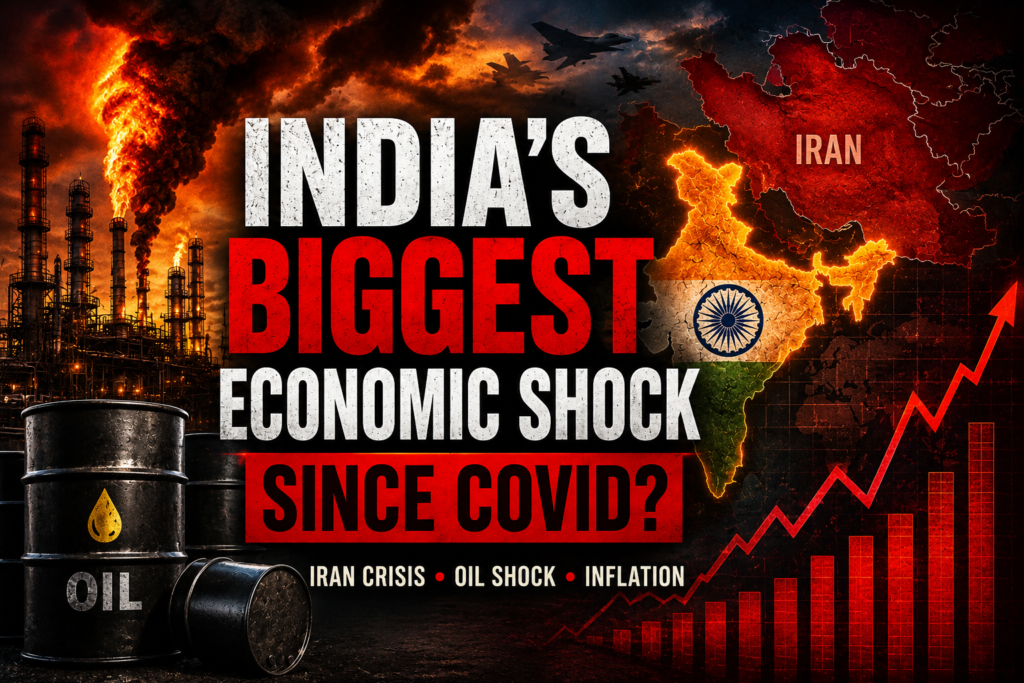
For much of the past decade, conversations among the world’s largest economies seemed to be heading in a different direction.
Artificial intelligence became a strategic race. Semiconductor manufacturing turned into a geopolitical battleground. Climate targets increasingly influenced industrial policy and investment decisions. Governments spent years discussing the technologies expected to shape the future economy.
Energy security never disappeared from those conversations, but it gradually lost its place at the center of them.
Recent events have changed that.
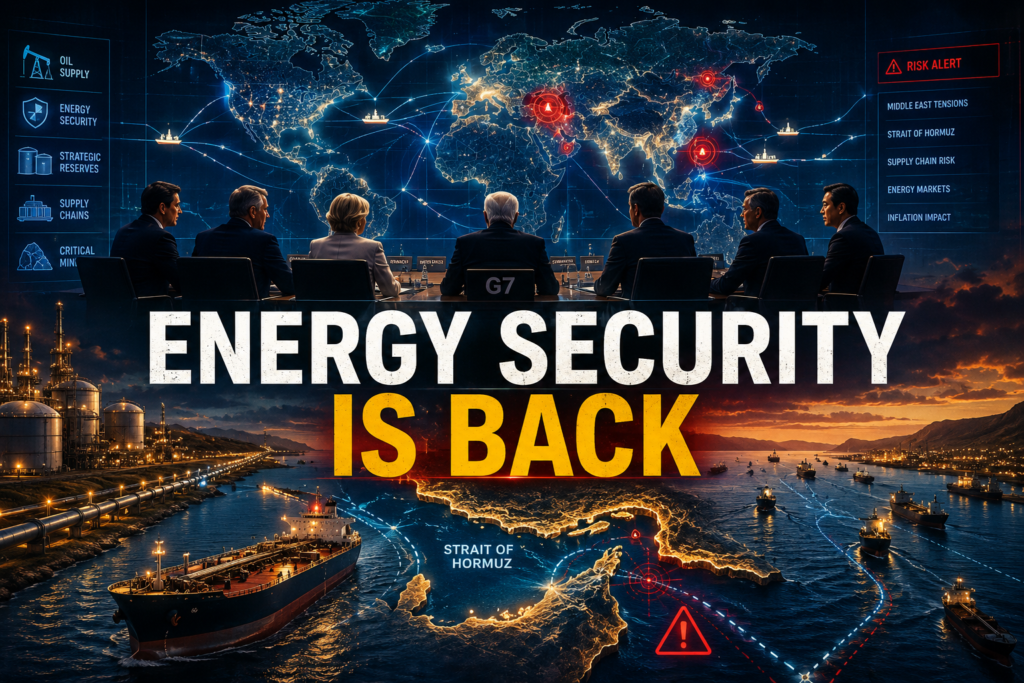
At recent G7 meetings, leaders once again found themselves discussing oil supplies, shipping routes, strategic reserves, energy infrastructure, and supply-chain vulnerabilities. The immediate trigger was rising tension in the Middle East, but the discussion quickly broadened into something larger.
Modern economies depend on systems that are easy to take for granted when they function normally. Shipping lanes remain open. Fuel arrives where it is needed. Electricity flows. Goods move across borders. Most of the time, these systems barely attract attention.
Until they do.
In many respects, the renewed focus on energy security reflects a growing awareness that some of the foundations of globalization remain more fragile than they appear.
What Changed? The Middle East Shock
The latest concerns emerged from tensions involving Iran and the Strait of Hormuz, one of the world’s most important energy corridors.
Around 20 percent of globally traded oil passes through the strait. Even in an energy market that is more diversified than it was decades ago, that is enough to command attention.
What often surprises people is how quickly uncertainty travels.
Long before an actual disruption occurs, traders adjust expectations, insurers reassess risk, shipping companies review alternative routes, and governments begin looking at contingency plans. Energy markets are particularly sensitive because interruptions can be difficult to replace quickly.
To be fair, today’s energy system is considerably broader and more flexible than it was during the oil shocks of the 1970s. More suppliers participate in global markets, new export hubs have emerged, and many countries have built safeguards that did not exist a generation ago.
Yet some vulnerabilities have proven remarkably persistent.
One of globalization’s contradictions is that a system often described as decentralized still depends heavily on a handful of geographic bottlenecks. Most of the time those chokepoints operate quietly in the background. During periods of tension, they suddenly become impossible to ignore.
A Few Narrow Waterways Still Carry Outsized Influence
Global trade can look remarkably flexible from a distance.
Ships move between continents. Supply chains stretch across dozens of countries. Manufacturers source components from multiple regions.
The reality is somewhat narrower.
The Strait of Hormuz remains central to energy markets. The Bab el-Mandeb Strait links key shipping routes between Asia, the Middle East, and Europe. The Suez Canal continues to handle a substantial share of global trade.
The Ever Given incident in 2021 remains one of the clearest illustrations of how these systems work. A single vessel became lodged across the Suez Canal and, for several days, disrupted shipping schedules around the world.
The incident attracted attention because it was unusual. The lesson behind it was not.
Supply-chain specialists had spent years pointing out that complexity does not always create flexibility. Sometimes it simply hides concentrations of risk until pressure reveals them.
For years, policymakers often viewed redundancy as a cost. Excess capacity, strategic stockpiles, backup suppliers, and duplicated infrastructure were frequently seen as signs of inefficiency.
That view has softened.
In recent years, a growing number of governments have started treating redundancy less as waste and more as insurance.
Why Energy Shocks Travel So Far
Energy disruptions rarely remain confined to energy markets.
Higher fuel costs eventually affect transportation networks, manufacturing expenses, logistics systems, and household budgets. Inflation can become more persistent. Central banks may hesitate to ease policy. Investment decisions are postponed. Growth slows.
The effects tend to unfold gradually rather than all at once.
Europe’s experience following Russia’s invasion of Ukraine offered a useful example. Concerns initially centered on energy supplies, but the discussion soon expanded to industrial competitiveness, inflation, public finances, and long-term economic performance.
A problem that began in one sector quickly became a problem for many others.
Energy has a way of connecting issues that governments often prefer to manage separately.
There is also a simpler reality.
Most people do not follow commodity markets closely. They do notice fuel prices and electricity bills. Political pressure often arrives faster than economic analysis.
Energy Security Is No Longer Just About Oil
For decades, energy security was largely understood through the lens of oil.
That definition still matters, but the conversation has expanded.
Natural gas now plays a more prominent role. Electricity systems have become increasingly important as economies digitize. Cybersecurity concerns overlap with energy infrastructure. Supply chains have become part of the discussion as well.
The transition toward cleaner energy has added another layer.
Electric vehicles require critical minerals such as lithium and nickel. Wind turbines rely on rare earth elements. Solar panels, batteries, and grid infrastructure depend on complex manufacturing networks that span multiple countries.
A few years ago, Europe’s concern was securing natural gas. Today, many governments are also discussing lithium processing, battery manufacturing, and access to critical minerals.
The subject matter has changed.
The underlying concern feels familiar.
Some policymakers have started looking at energy through a wider lens that includes manufacturing capacity, logistics networks, critical resources, and advanced technologies. The categories remain different, but they increasingly appear in the same policy conversations.
How Governments Are Responding
That shift is already visible across much of the G7.
Governments are expanding supplier networks, investing in domestic energy production, strengthening critical-mineral partnerships, and encouraging investment in industries considered strategically important.
Some of these initiatives are expensive.
Diversified supply chains are rarely the lowest-cost option. Maintaining reserves requires capital. Additional infrastructure takes time to build and maintain.
Recent disruptions have changed how those costs are viewed.
Diversification provides alternatives when disruptions occur, while reserves and domestic capacity give governments more room to respond before a crisis begins dictating decisions.
None of these measures eliminate risk. They simply reduce the likelihood that a single disruption can create outsized consequences.
That shift in thinking appears in areas well beyond energy.
Why India’s Position Matters
India offers an interesting example because several major trends converge there.
The country imports roughly 85 percent of its crude oil requirements, making stable energy markets important for inflation, industrial competitiveness, and long-term economic growth.
At the same time, India is expected to remain one of the largest future sources of energy demand. Decisions made in New Delhi increasingly influence markets beyond India’s borders.
India is also trying to balance two priorities at once.
The country continues expanding renewable energy capacity while strengthening energy security through supplier diversification, strategic petroleum reserves, and infrastructure investment. Those objectives can reinforce one another, although they do not always move at the same pace.
Geography adds another dimension.
Positioned between major Middle Eastern suppliers and growing Asian demand centers, India occupies a place that becomes increasingly relevant as trade routes, energy flows, and supply chains continue evolving.
Its importance stems from both what it consumes and where it sits.
Energy Security and the New Logic of Geopolitics
A broader shift is taking place beneath the headlines.
For years, governments largely organized economic policy around efficiency. Supply chains expanded internationally, production concentrated where it was most cost-effective, and businesses optimized around speed and scale.
That approach delivered enormous benefits.
It also left some systems more exposed than many policymakers realized.
What seems to be changing is not the importance of energy itself. The more significant shift is how governments define economic security. Energy is increasingly being viewed as one piece of a larger resilience puzzle that includes technology, manufacturing, logistics, infrastructure, and critical resources.
Perhaps that is why energy security has returned to the center of policy discussions so quickly.
It touches all of those areas at once.
Over the past several years, governments have repeatedly encountered disruptions that originated in different places but exposed similar weaknesses. A pandemic strained supply chains. A war disrupted energy markets. Shipping bottlenecks affected trade flows.
The details varied.
The lesson was often the same.
Markets reward efficiency during stable periods. Periods of instability reveal the value of resilience.
The tensions that brought energy security back into focus will eventually fade from the headlines. Markets will stabilize. Trade routes will continue operating.
The broader debate is likely to remain.
Governments are still trying to determine how much redundancy, flexibility, and preparedness are enough in a world where disruptions have become harder to dismiss as isolated events.
Energy security has become one of the clearest places where that question is being tested.