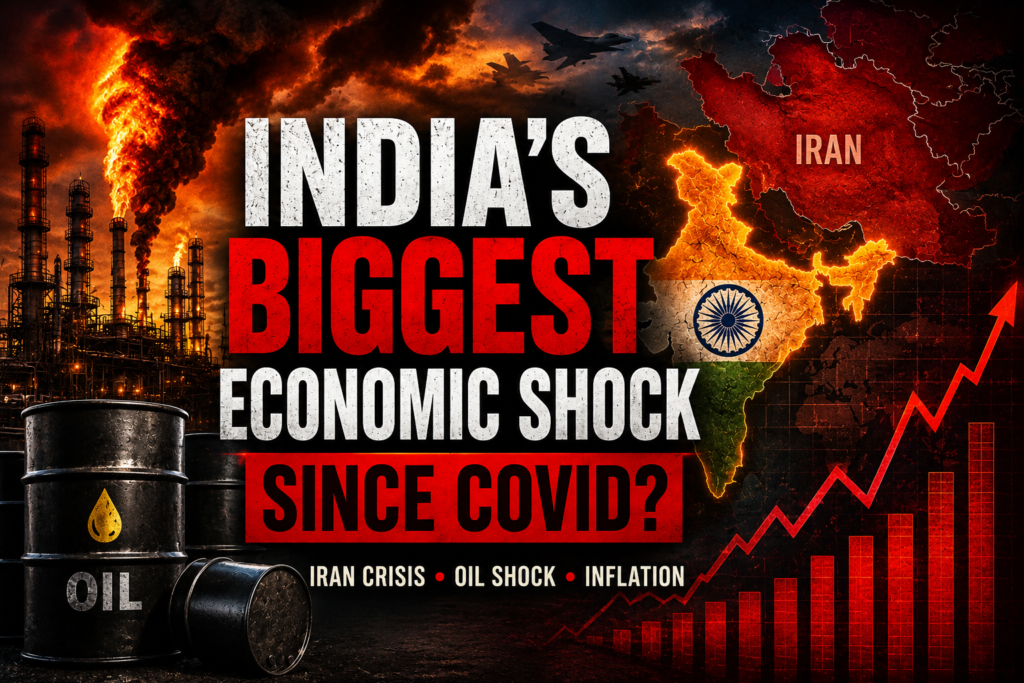
A cargo vessel rerouting around the Red Sea can raise shipping costs for businesses in Europe. A semiconductor export restriction announced in Washington can influence manufacturing decisions in Asia. A conflict thousands of kilometers away can affect fuel prices in Indian cities within weeks.
The modern economy is deeply interconnected. Yet at the same time, the political foundations supporting that interconnectedness appear to be shifting.
For much of the post-Cold War era, the international system revolved around a relatively clear center of gravity. The United States possessed unmatched influence across military, financial, and diplomatic domains. Globalization expanded rapidly under that framework, and many governments operated on the assumption that deeper economic integration would gradually reduce geopolitical tensions.
Things have not unfolded quite that way.
China’s rise has altered the global balance of power. Russia’s confrontation with the West has exposed vulnerabilities in energy markets and supply chains. Regional powers are asserting themselves more confidently. Strategic competition is spreading into technology, manufacturing, finance, critical minerals, and infrastructure.
The result is a world that feels simultaneously connected and fragmented.
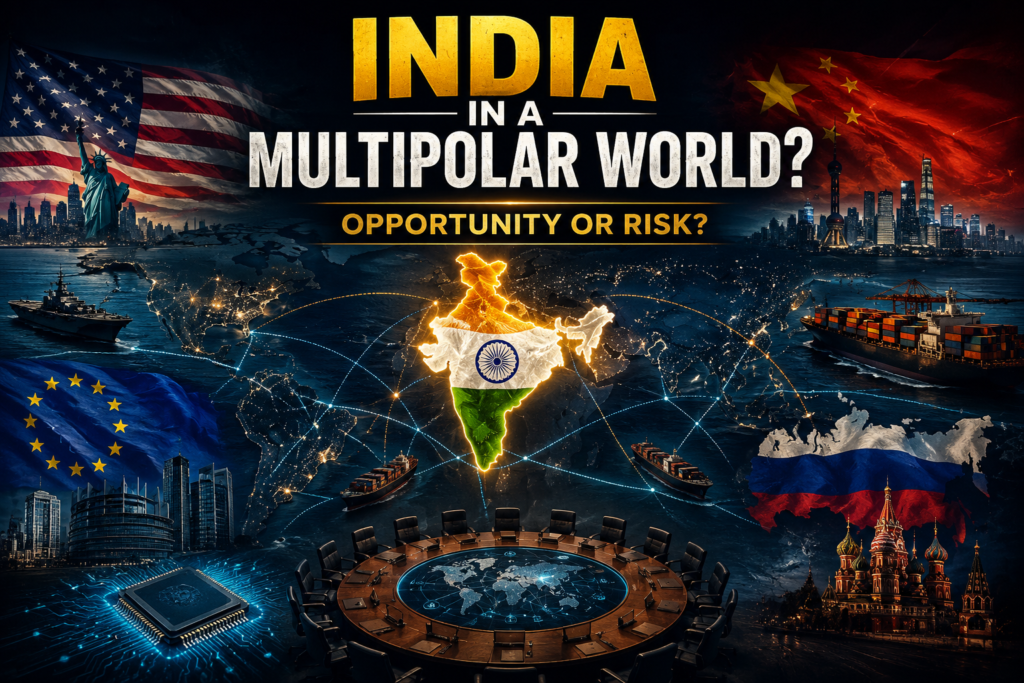
Many analysts describe this transition as the emergence of a multipolar world order.
For India, the shift may represent one of the most significant geopolitical opportunities of the twenty-first century. It may also present challenges that are easier to underestimate than to solve.
What Is a Multipolar World Order?
The concept itself is fairly straightforward.
A unipolar world is dominated by a single power. Following the collapse of the Soviet Union, many observers described the international system as unipolar because the United States possessed unmatched military, economic, and diplomatic reach.
A bipolar system revolves around two major powers. The Cold War remains the classic example.
A multipolar system distributes influence across several major actors simultaneously. The United States, China, India, Russia, the European Union, and a growing number of influential regional powers all become important parts of the equation.
The practical significance is often overlooked.
Countries gain more room to maneuver. Trade relationships become more diversified. Diplomatic alignments become less rigid. Governments have greater freedom to pursue their own interests rather than operating within fixed blocs.
India has pursued versions of strategic autonomy for decades, dating back to the Non-Aligned Movement era. The circumstances are different today, but the instinct remains familiar.
Yet there is another side to the story.
Multipolarity is often portrayed as inherently positive, especially by countries seeking greater influence. History suggests the reality is more complicated. Periods with several competing power centers have not always been especially stable. Sometimes they have been more unpredictable than systems dominated by a single superpower.
That does not mean multipolarity is undesirable.
It simply means opportunity and uncertainty tend to arrive together.
Why the Global Order Is Changing
The shift toward multipolarity is not the result of a single event. Several developments have been moving in the same direction for years.
US-China Strategic Competition
The relationship between the United States and China has evolved from deep economic engagement into broad strategic competition.
Trade disputes were only the beginning.
Today the rivalry extends into artificial intelligence, advanced manufacturing, telecommunications, semiconductor production, military modernization, and control over critical technologies.
People often talk about semiconductors as a technology story.
Governments increasingly treat them as strategic infrastructure.
Restrictions on advanced chip exports, efforts to build domestic manufacturing capacity, and investment screening measures all reflect the same reality: economic policy and national security are becoming harder to separate.
Russia-West Confrontation
The war in Ukraine accelerated another major transformation.
Sanctions, asset freezes, financial restrictions, and energy disruptions demonstrated how quickly geopolitics can reshape economic relationships.
The effects extended far beyond Europe.
India’s continued purchase of discounted Russian crude became one of the most discussed examples of how countries increasingly make pragmatic calculations based on national interest rather than rigid geopolitical alignment.
Interestingly, this may be one of the defining characteristics of the emerging order. Countries are becoming less willing to view international relationships through a simple ally-versus-rival framework.
Middle East Instability
The Middle East remains central to global trade and energy systems.
Recent disruptions in Red Sea shipping routes forced many vessels to take longer journeys around Africa. That increased costs, extended delivery times, and added pressure to already fragile supply chains.
Most consumers never follow maritime trade routes.
They still pay for their disruption.
The Rise of Regional Powers
India, Saudi Arabia, Indonesia, Brazil, Turkey, and several other countries now play a larger role in shaping regional and sometimes global outcomes than they did two decades ago.
Their influence comes from different sources. Population. Energy resources. Geography. Economic scale.
Whatever the source, the trend is difficult to ignore.
Power is becoming more distributed.
Not equally distributed. But more distributed than before.
The Paradox of Multipolarity
Multipolarity is often described as a world of greater flexibility.
In many respects, that is true.
Countries gain more options. They can diversify trade relationships, pursue independent diplomatic strategies, and avoid excessive dependence on a single power center.
Yet there is a paradox here.
Ironically, a more multipolar world may require countries to become more selective about partnerships rather than less. As strategic competition intensifies, governments must think more carefully about technology dependencies, energy supplies, investment relationships, and security arrangements.
The number of choices may increase.
So does the complexity of managing them.
What makes the current transition particularly unusual is that economic integration and geopolitical competition are expanding at the same time. Historically, those forces often moved in opposite directions.
That tension sits at the center of many global debates today.
Why India Is Gaining Global Importance
India’s growing relevance is not simply the product of global instability. Several structural factors are working in its favor.
A Fast-Growing Economy
India is now one of the world’s largest and fastest-growing major economies.
Its ambitions extend well beyond growth statistics. Policymakers are attempting to expand manufacturing, improve infrastructure, strengthen exports, and deepen integration with global supply chains.
India’s digital transformation has attracted particular attention from investors and policymakers abroad.
There is another reason international businesses increasingly focus on India.
Scale.
Very few countries offer a combination of market size, workforce potential, technological capability, and long-term growth prospects comparable to India’s.
Strategic Geography
Strategic Geography
Geography still matters.
Perhaps more than many expected.
India occupies a position near some of the world’s most important maritime corridors connecting East Asia, the Middle East, Africa, and Europe.
As competition intensifies across the Indo-Pacific, location itself becomes a strategic asset.
Demographics
India’s demographic profile is frequently described as one of its greatest advantages.
Whether that advantage ultimately materializes is a different question altogether.
Diplomatic Flexibility
Of all the opportunities associated with a multipolar world, India’s diplomatic flexibility may ultimately prove the most valuable.
India works closely with the United States on several strategic issues. It maintains longstanding ties with Russia. It engages extensively with Europe while deepening relationships across the Gulf.
Strategic autonomy is frequently described as an advantage.
Yet strategic autonomy can become harder to maintain precisely when it becomes most valuable.
Few governments openly say they want to choose sides. Most would prefer to keep as many options available as possible.
India may be among the few major powers positioned to maintain productive relationships across nearly every significant geopolitical camp.
Its G20 presidency reinforced that perception. The event demonstrated not only diplomatic visibility but also India’s growing ability to convene countries with very different interests around the same table.
Five Ways India Could Benefit
1. Diversified Trade Opportunities
A more fragmented global economy encourages countries and businesses to spread risk across multiple markets.
For India, this could translate into broader commercial relationships and greater resilience during geopolitical shocks.
Economic resilience is rarely built on concentration.
2. Supply Chain Relocation
Many multinational companies are actively seeking alternatives to highly concentrated manufacturing networks.
Apple’s gradual expansion of manufacturing operations in India is frequently cited as one example.
The broader trend matters more than any single company.
Still, the assumption that manufacturing will naturally flow to India deserves caution. Vietnam, Mexico, Indonesia, and several others are competing for the same investments.
Opportunity alone does not determine outcomes.
Execution does.
3. Greater Diplomatic Influence
Countries capable of maintaining relationships across competing blocs often gain influence during periods of geopolitical tension.
India increasingly finds itself in that position.
Whether the issue is trade, climate policy, technology governance, or security cooperation, more governments are paying attention to New Delhi than they were a decade ago.
4. Stronger Energy Partnerships
Energy security remains central to India’s development ambitions.
A multipolar environment provides greater flexibility in sourcing energy from different regions while improving negotiating leverage.
5. Leadership in the Global South
India has invested significant diplomatic capital in presenting itself as a voice for developing countries.
That effort appears to be gaining traction.
Many nations across Asia, Africa, and Latin America are seeking greater influence within institutions designed for a very different geopolitical era.
A Thought Worth Considering
There is a tendency to view multipolarity as an inevitable destination.
The reality may be less straightforward.
International systems rarely move in straight lines. Periods of fragmentation can be followed by renewed concentration of power. Alliances shift. Economic priorities change. Unexpected crises reshape assumptions.
It remains unclear whether current geopolitical tensions represent a temporary adjustment or the early stages of a much longer structural transformation.
The future may be more fluid than many current debates assume.
The Challenges India Cannot Ignore
The opportunities are substantial.
So are the constraints.
Border security concerns remain significant. Energy dependence continues to create vulnerabilities. Infrastructure gaps, workforce development, regulatory efficiency, and manufacturing competitiveness still require sustained attention.
External conditions can create favorable openings.
Internal performance determines whether those openings become lasting advantages.
Many countries have enjoyed favorable geopolitical moments.
Far fewer have successfully converted those moments into long-term economic transformation.
Can India Become One of the Leading Powers of the Multipolar Era?
This debate often swings between excessive optimism and excessive skepticism.
Reality usually occupies less dramatic territory.
India possesses genuine strengths: economic scale, demographic weight, technological capabilities, diplomatic reach, and increasing strategic relevance.
It also faces real obstacles.
The more useful question is not whether India becomes the next superpower.
It is whether India becomes indispensable.
Imagine a decade from now if India succeeds in attracting larger shares of global manufacturing investment, strengthens its technological base, expands infrastructure networks, and continues building influence across competing geopolitical blocs.
Its leverage in international negotiations would look very different from today.
So would its economic position.
What This Means for Ordinary Indians
Geopolitics often sounds distant until it begins affecting daily life.
New manufacturing investment can create jobs in industrial corridors. Expanding technology sectors can generate opportunities for engineers, technicians, and entrepreneurs. Infrastructure spending can support local businesses and regional growth.
A stronger global position can influence employment opportunities, wage growth, investment flows, and business expansion in ways that rarely make headlines.
The reverse is also true.
Few people think about shipping lanes while filling their fuel tanks. Few think about semiconductor restrictions when buying a smartphone. Yet decisions made in distant capitals increasingly shape both.
Higher energy prices affect household budgets. Supply chain disruptions influence product costs. Global uncertainty can affect investment decisions that eventually influence hiring.
The connection is indirect.
But it is real.
There is also something less tangible at stake.
Countries with greater influence have a larger role in shaping the rules governing trade, technology, investment, security, and development. Those decisions may seem abstract today. Over time, they help determine the opportunities available to businesses, workers, and future generations.
Most people rarely connect those dots.
That does not make them any less important.
Conclusion
For decades, globalization encouraged countries to assume that economic efficiency and geopolitical stability would reinforce one another.
Increasingly, governments are discovering that the relationship is more complicated.
Efficiency can create dependence.
Dependence can create vulnerability.
Vulnerability can become strategy.
The world is moving toward a more complex distribution of power. For India, that creates opportunities that did not exist in a more rigid international system. It also creates new responsibilities and new risks.
The country’s future influence will depend less on rhetoric and more on its ability to strengthen institutions, expand economic capacity, improve competitiveness, and maintain strategic flexibility in an increasingly fragmented world.
The real test of a multipolar era may not be which country becomes dominant.
It may be which countries learn to remain indispensable in a system where dominance itself becomes harder to sustain.
India has a chance to be one of those countries.