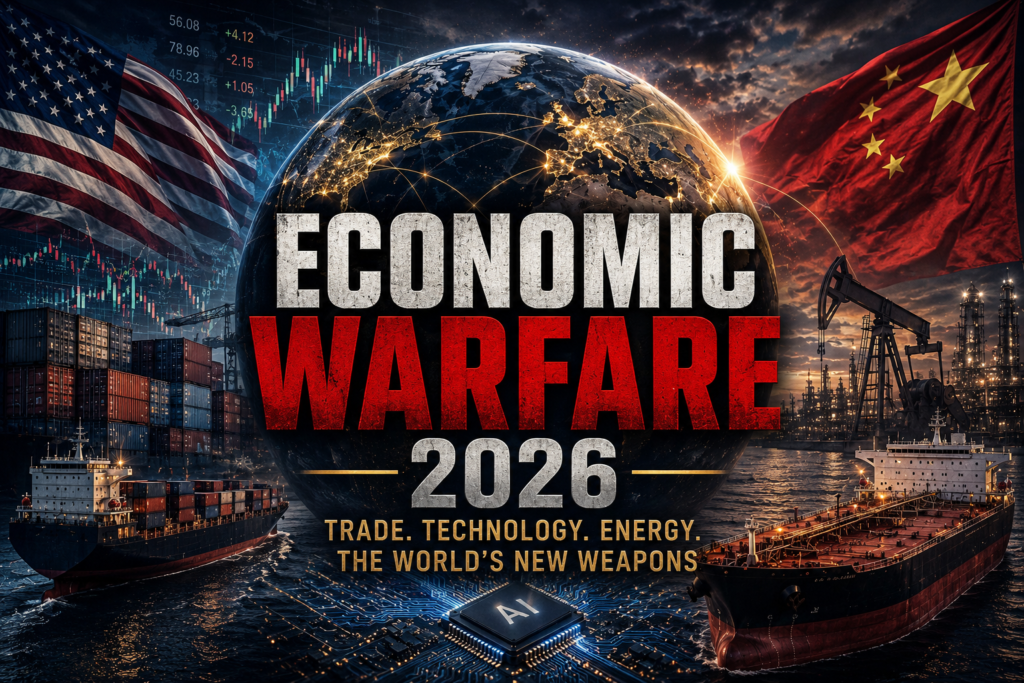
For most of modern history, discussions about conflict revolved around military power. Countries measured strength through armies, missiles, aircraft carriers, and defense budgets.
That picture is changing.
Some of the most consequential confrontations between major powers now unfold far from conventional battlefields. Tariffs can disrupt industries. Sanctions can isolate economies. Technology restrictions can slow innovation. Energy exports can become tools of influence.
Even global supply chains—once celebrated as evidence that economic integration would make the world more stable—are increasingly viewed through a national security lens.
A growing number of policymakers and analysts believe the world may be entering a new phase of competition, one in which countries attempt to weaken rivals financially, technologically, and strategically long before military confrontation becomes necessary.
Economic pressure is not new. Great powers have used trade restrictions, financial leverage, and resource control for centuries. What appears different today is how central these tools have become. In previous eras, they often supported broader geopolitical strategies. Increasingly, they are becoming the strategy itself.
What Is Economic Warfare?
Economic warfare refers to the use of economic tools to influence, pressure, constrain, or weaken another country.
These tools can include:
– Economic sanctions
– Tariffs and trade barriers
– Export restrictions
– Financial controls
– Technology bans
– Energy supply restrictions
– Supply chain disruptions
The objective is usually political rather than economic. Governments are attempting to gain leverage, change behavior, or limit a rival’s strategic options.
Traditional wars target territory and infrastructure. Economic warfare targets the systems that support national power: finance, technology, industry, trade networks, investment flows, and access to critical resources.
The appeal is obvious. Economic pressure can often be deployed without the costs, uncertainty, and domestic political risks that accompany military action.
Whether it reliably achieves its objectives is another matter.
Why Economic Warfare Is Becoming More Common
The modern global economy is more interconnected than at any point in history.
Countries depend on one another for energy, manufacturing, transportation, technology, and investment capital. These connections helped drive decades of growth following the expansion of globalization after World War II.
But interconnected systems create dependencies.
One of globalization’s greatest achievements may also have become one of its greatest vulnerabilities. The same networks that made products cheaper and economies more productive also created choke points that governments now worry could be exploited during periods of crisis.
There is a paradox at the center of this story. Economic integration was supposed to reduce conflict by making countries more dependent on one another. In some ways, it did. Yet those same dependencies created new forms of leverage. The world became more connected, but it also became more vulnerable to pressure.
A decade ago, many of these concerns would have sounded overly cautious. Today they sit at the center of policy debates in Washington, Beijing, Brussels, New Delhi, and elsewhere.
Some countries rely heavily on imported energy. Others depend on overseas semiconductor manufacturing. Certain nations dominate the processing of critical minerals needed for batteries, electronics, and advanced industrial production.
As those dependencies became more visible, policymakers started viewing economic relationships differently. What once looked like ordinary commerce increasingly began to look like a national security issue.
The Major Economic Warfare Examples Shaping 2026
The phrase “economic warfare” can sound abstract until it appears in real-world policy decisions.
Several developments are helping define what it looks like in practice.
US-China Technology Restrictions
Competition between the United States and China increasingly revolves around technology rather than trade alone.
Advanced semiconductors have become one of the most strategically important resources in the global economy. They power artificial intelligence systems, military applications, telecommunications infrastructure, cloud computing networks, and advanced manufacturing.
A generation ago, policymakers often viewed oil as the foundation of geopolitical power. Today, advanced computing capability is beginning to occupy a similar position.
People often describe semiconductors as a technology story. Governments increasingly treat them as a strategic one.
Perhaps the most important shift is conceptual. Modern power is no longer measured only by what a country can produce. It is increasingly influenced by what it can restrict, deny, or control.
In the twentieth century, strategic competition often focused on physical territory. If current trends continue, the twenty-first century may be remembered less for battles over territory and more for competition over networks.
Russia-West Sanctions Battle
The economic confrontation between Russia and Western countries remains one of the largest sanctions campaigns in modern history.
Financial restrictions, trade barriers, banking limitations, and energy-related measures have reshaped economic relationships that existed for decades.
At the same time, Russia adapted. Trade routes shifted. New partnerships emerged. Alternative payment systems attracted greater attention.
One lesson from this episode is easy to overlook.
Economic warfare rarely imposes costs on only one side.
When energy markets, commodity supplies, and financial systems are deeply interconnected, pressure tends to spread beyond its intended target. Consumers pay more. Businesses adjust. Governments absorb unexpected costs.
Sanctions can be powerful, but they are rarely precise instruments. They often reshape economic behavior in ways that policymakers cannot fully predict.
History offers a useful reminder here. During the Cold War, economic pressure frequently accompanied geopolitical rivalry rather than replacing it. The same may prove true today.
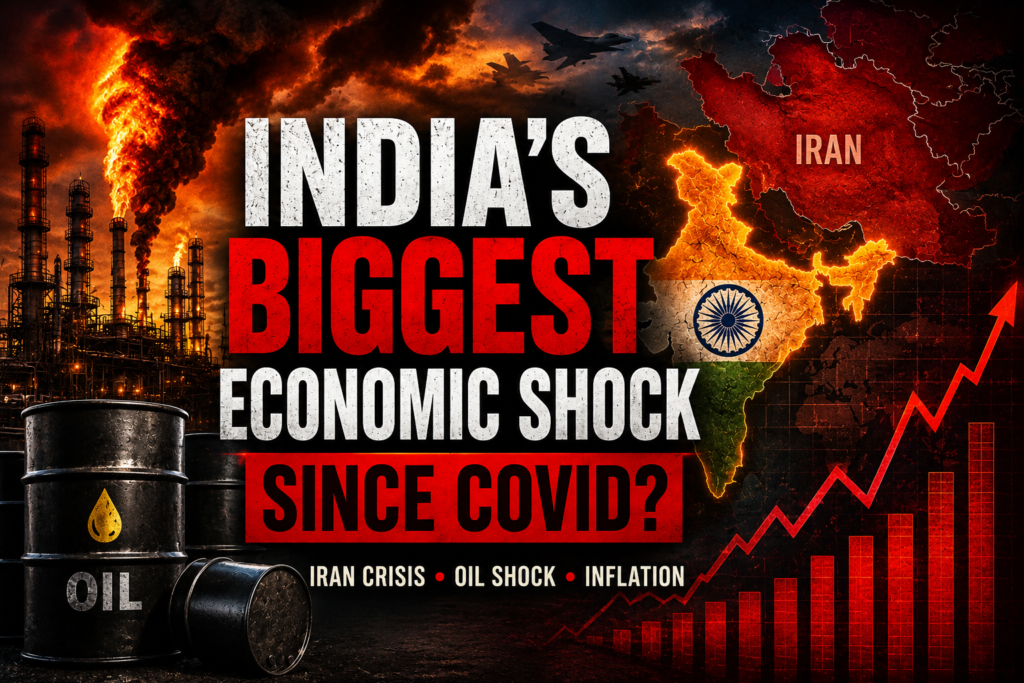
Iran, Oil Markets, and Energy Pressure
Energy remains one of the most powerful instruments of economic influence.
Iran’s location near the Strait of Hormuz helps explain why.
Roughly one-fifth of global oil consumption is linked to shipments moving through this narrow waterway. That helps explain why even the possibility of disruption attracts worldwide attention.
What matters is not simply the volume of oil.
It is the concentration of risk.
The modern economy often appears vast and decentralized. Yet surprisingly large portions of global commerce still depend on a handful of geographic chokepoints. A shipping route, a canal, a pipeline, or a narrow strait can suddenly become a matter of international concern.
The oil shocks of the 1970s demonstrated how quickly energy disruptions can ripple through the global economy. The technologies may have changed since then, but the underlying vulnerability has not disappeared.
Tariff Wars Are Returning
Tariffs are hardly new.
What is unusual is their return after decades in which many policymakers assumed economic integration would continue expanding rather than reversing.
Today, governments increasingly justify tariffs through arguments involving national security, industrial policy, manufacturing resilience, and strategic competition.
Whether this trend proves temporary or long-lasting remains unclear. Political priorities change. Economic realities change.
Still, protectionism has undeniably regained political relevance in parts of the world where many assumed it was in long-term decline.
The language surrounding trade policy has changed as well. Measures once framed primarily as economic tools are increasingly presented as strategic tools.
That shift affects how governments think about trade-offs.
Supply Chains Have Become Strategic Assets
When car dealerships struggled to obtain new inventory during the pandemic, most consumers never connected the shortage to a global semiconductor bottleneck.
Yet that disruption revealed something important.
Modern industries had become dependent on a surprisingly small number of suppliers.
For years, supply chains were discussed largely in terms of efficiency. Companies focused on reducing costs, accelerating production, and optimizing logistics.
Then the pandemic arrived.
In hindsight, it is striking how quickly conversations about supply chains moved from logistics departments into national security discussions.
Governments began asking questions that would have sounded unusual only a few years earlier.
What happens if critical medicines become difficult to source?
What if semiconductor production remains concentrated in only a handful of locations?
What if access to key minerals becomes restricted during a geopolitical crisis?
Economic warfare is not fundamentally a contest over territory.
It is a contest over dependence.
The side that needs something less often possesses more leverage.
That idea now shapes decisions involving semiconductors, pharmaceuticals, batteries, telecommunications equipment, and rare earth minerals.
How Economic Warfare Affects Ordinary People
Geopolitical competition can feel distant until it begins affecting household budgets.
Economic warfare has a way of shortening that distance.
Higher energy prices increase transportation costs. Imported goods become more expensive. Inflation pressures rise. Financial markets react to uncertainty.
Even products as ordinary as smartphones, appliances, and automobiles depend on supply chains that stretch across multiple countries.
Most consumers never notice those networks when they function smoothly.
They notice them when they stop functioning smoothly.
Why India Is Watching These Developments Closely
Few major economies sit as directly at the intersection of these trends as India.
The country stands to benefit when multinational companies diversify supply chains and seek alternatives to concentrated manufacturing hubs. At the same time, India remains exposed to many of the energy and trade disruptions that intensifying economic competition can create.
That creates an unusual position.
The forces generating opportunity are often the same forces generating risk.
India is pursuing ambitious goals in manufacturing, semiconductor development, digital infrastructure, and industrial expansion. Success in those areas could make the country a major beneficiary of changing global supply chains.
Yet maintaining strategic flexibility may become just as important as attracting investment.
India’s challenge is not simply choosing between competing blocs. It is navigating a world in which economics, technology, trade, and security are becoming increasingly intertwined.
Could Economic Warfare Replace Traditional Wars?
Some observers argue that economic pressure may reduce the need for military conflict.
The argument sounds persuasive on the surface.
If governments can influence rivals through sanctions, technology controls, financial restrictions, and trade barriers, armed confrontation may become less attractive.
There is certainly some merit to that view.
But history offers reasons for caution.
The paradox is that globalization may have made military conflict less attractive while simultaneously making economic coercion more effective. Countries became less willing to fight one another directly, but they also became more dependent on systems that could be pressured, restricted, or disrupted.
Economic pressure can generate compliance.
It can also generate resistance.
Countries facing restrictions often seek new alliances, alternative markets, and alternative financial arrangements. Competition does not necessarily disappear because its methods change.
Sometimes it simply evolves.
Are We Moving Toward a Fragmented Global Economy?
One of the most significant questions facing policymakers today concerns the future of globalization itself.
For decades, the dominant trend was integration. Companies expanded internationally. Supply chains stretched across continents. Trade barriers generally moved lower.
Now a different vocabulary is becoming common.
Friend-shoring.
Reshoring.
Regional manufacturing hubs.
Economic security partnerships.
Strategic trade alliances.
The shift suggests that efficiency is no longer the only objective.
Resilience has moved much higher on the list.
Building redundant supply chains, relocating production, and diversifying suppliers can improve security. It can also reduce some of the efficiencies that made globalization attractive in the first place.
There is also a risk of overstating the trend.
Headlines often create the impression that globalization is collapsing. Yet international trade volumes remain enormous, multinational investment continues to flow across borders, and major economies remain deeply interconnected.
The world may not be abandoning globalization so much as redefining it.
That distinction matters.
Why This Moment Feels Different
Economic pressure is not new.
Sanctions, trade restrictions, resource competition, and financial leverage have existed for generations.
What appears different today is the degree to which these tools are moving toward the center of geopolitical competition.
The most valuable assets in the modern economy may not be the things countries own.
They may be the things other countries cannot function without.
That observation helps explain why semiconductors, energy infrastructure, critical minerals, payment systems, and supply chains have become strategic concerns.
Whether this shift ultimately reduces conflict or creates new forms of instability remains uncertain.
But the boundaries between economics and geopolitics are becoming harder to separate.
Some of the most consequential contests between nations are no longer unfolding primarily on battlefields. They are playing out through technology systems, energy networks, trade relationships, financial infrastructure, and the invisible connections that keep the global economy functioning.
Most people will never see those contests directly.
They will simply experience the consequences.