For a brief period, it looked as though global trade had found its balance again.
Not because the world had become calmer. Wars were still being fought, inflation remained a concern in many economies, and political tensions between major powers hadn’t disappeared. Yet businesses had learned to live with uncertainty. Shipping routes had been redesigned after the pandemic, inventories had been rebuilt, and manufacturers had spent years adjusting to a world where supply chains no longer stretched as effortlessly across continents as they once did.
Then Washington changed the conversation again.
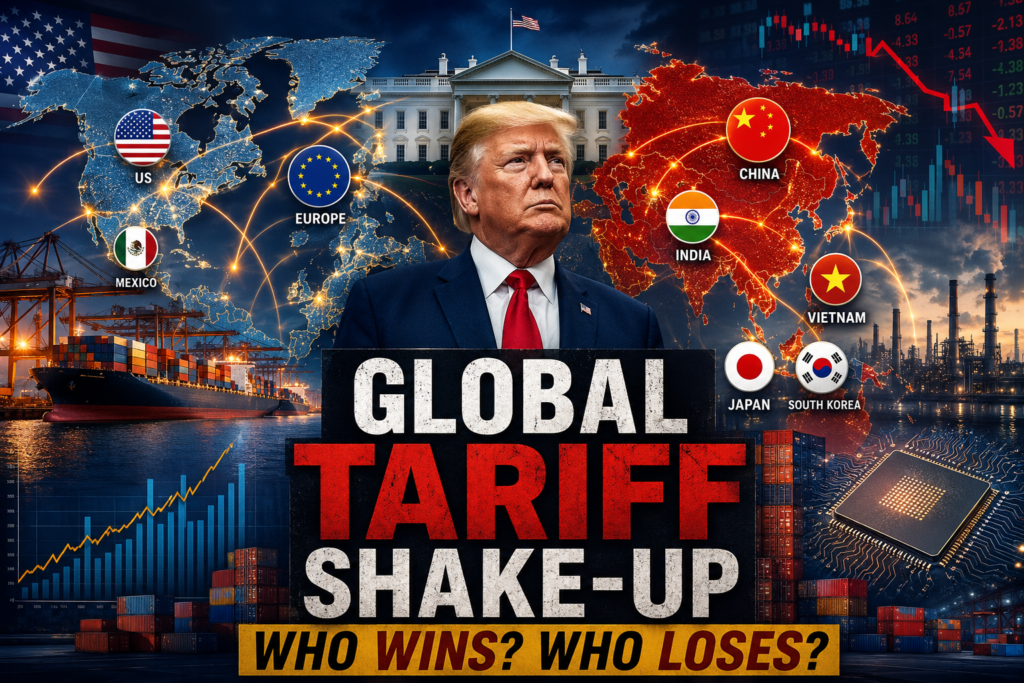
President Donald Trump’s latest tariffs affect dozens of America’s trading partners, but the announcement is about more than the percentage attached to imported goods. It reflects a broader shift in how governments increasingly think about economic power.
For most of the past three decades, trade policy was largely shaped by one question: Where can goods be produced most efficiently?
Today a different question is beginning to matter.
Where can they be produced without becoming a strategic vulnerability?
That change doesn’t make headlines in the same way tariff rates do. It unfolds quietly—in investment committees, factory planning meetings and procurement offices where executives decide where the next billion dollars will be spent.
Consider something as ordinary as a family car.
By the time it reaches a dealership in North America, some of its electronic systems may have been designed in California, its memory chips produced in South Korea, sensors manufactured in Japan, wiring assembled in Mexico, steel processed in Canada, and dozens of smaller components shipped through ports thousands of kilometres apart before final assembly.
That production model wasn’t built because companies wanted complexity.
It was built because, for years, efficiency rewarded complexity.
Every additional supplier, every cheaper component, every shorter production cycle helped lower costs. Businesses became exceptionally good at building supply chains that stretched across borders with remarkable precision.
The same system now looks rather different.
A disruption in one country can delay production somewhere else. A political disagreement can affect factories that have no direct connection to the dispute. What once looked like efficiency increasingly looks like concentration risk.
The tariffs announced by the Trump administration arrive against that backdrop.
They will certainly influence prices for some products. They may alter trade flows in certain industries. But the more important consequence could emerge much later, when companies begin deciding where to build their next factory rather than where to buy their next shipment.
That distinction is easy to miss.
Factories are long-term bets.
A semiconductor fabrication plant can take four or five years to become operational and may remain in service for several decades. Executives approving investments of that scale are rarely making decisions based solely on today’s tariff schedule. They’re trying to imagine what the geopolitical map might look like ten years from now.
No spreadsheet can answer that.
Which helps explain why trade has become harder to separate from politics than at any point since the Cold War.
What Exactly Did Trump Announce?
The latest measures impose new tariffs on imports from dozens of major U.S. trading partners, with rates generally ranging between 10% and 12.5%, while certain strategically important products remain exempt.
On the surface, tariffs appear straightforward. Imported goods become more expensive, domestic producers receive greater protection, and foreign exporters lose some price advantage.
Actual trade rarely behaves so neatly.
A manufacturer importing industrial components may pay more. Another business producing similar goods inside the United States may suddenly find itself competing under more favourable conditions. A retailer may absorb part of the additional cost for months before passing the rest on to consumers. Another may look for an entirely new supplier.
The same policy can create four different outcomes before the customer notices anything.
The administration has justified the tariffs under Section 301 of the Trade Act of 1974, arguing that stronger action is needed against trade practices it considers unfair, while also addressing concerns linked to forced labour and supply-chain security.
Those explanations are part of the picture.
Domestic politics is another.
Trade policy has always carried economic consequences, but it has also carried electoral consequences. Manufacturing employment remains deeply symbolic in many parts of the United States, even where factories have become far more automated than they were a generation ago. Announcing support for domestic industry often resonates well beyond the communities directly affected.
Whether tariffs alone can rebuild manufacturing is another question entirely.
Economists have argued about that for decades, and there is still remarkably little consensus. Some view tariffs as useful breathing space for industries facing unfair competition. Others see them as costs that eventually ripple through the wider economy.
Neither side lacks evidence.
They simply weigh different evidence more heavily.
The historical record is equally mixed.
The Smoot-Hawley Tariff Act of 1930 is frequently cited as a warning about protectionism, although historians continue debating how much it contributed to the Great Depression compared with broader financial failures already underway. More recently, the U.S.-China trade dispute that escalated in 2018 showed that tariffs could alter investment decisions without fundamentally reversing globalization.
Production didn’t suddenly return home.
Much of it simply moved somewhere else.
That’s an important distinction because today’s debate isn’t taking place in the same economic environment.
In 2018, diversification was becoming attractive.
By 2026, for many multinational companies, it has become part of routine risk management.
Trade policy hasn’t changed that direction.
It has accelerated a conversation that had already begun behind closed boardroom doors.
Why Is Trump Doing This?
There isn’t a single answer.
Trade policy is one of the few areas where economics, national security, domestic politics and foreign policy routinely overlap. The same tariff can be presented as protection for manufacturers, leverage in negotiations, a response to unfair competition and a national security measure—all at once.
That doesn’t necessarily make those explanations contradictory.
It simply reflects how trade has changed.
For years, governments largely viewed global commerce as a way to increase prosperity. Increasingly, they also see it as a way to reduce dependence.
That shift has been gradual.
The pandemic exposed how easily medical supplies and essential components could become difficult to obtain. The semiconductor shortage forced car manufacturers to idle production lines because a tiny chip—often costing less than a restaurant meal—was suddenly unavailable. Russia’s invasion of Ukraine demonstrated how quickly energy markets could become geopolitical pressure points.
None of those events created the current approach to trade.
They reinforced it.
The Trump administration argues that higher tariffs can encourage more production inside the United States while reducing reliance on countries considered strategic competitors. Supporters believe the country accepted too much industrial decline in exchange for lower prices over several decades.
Critics respond that manufacturing is far more difficult to rebuild than political speeches sometimes suggest.
Building a factory is expensive.
Building the network around that factory is even harder.
A modern manufacturing plant depends on suppliers, transport links, skilled labour, financing, maintenance companies, quality-control systems and often universities that produce specialised talent. Those relationships usually develop over decades, not election cycles.
That helps explain why many businesses don’t react dramatically to tariff announcements.
They recalculate.
A company planning a new production facility might compare labour costs, electricity prices, port capacity, taxation, local regulations and political stability across five or six countries before making a decision. Tariffs become one variable among many.
Sometimes they tip the balance.
Often they don’t.
Trump has also argued for years that persistent trade deficits illustrate structural weaknesses in America’s trading relationships.
Whether tariffs can substantially reduce those deficits remains disputed. Trade balances are influenced by exchange rates, investment flows, consumer demand and productivity alongside import duties. Raising tariffs doesn’t automatically change those fundamentals.
Yet governments don’t always pursue policies because economists unanimously approve of them.
Political objectives and economic objectives frequently travel together, even when they don’t point in exactly the same direction.
That has become increasingly visible across much of the developed world.
The United States is not the only country investing heavily in semiconductor production. The European Union has launched its own industrial initiatives. Japan has expanded support for advanced manufacturing. South Korea continues strengthening domestic chip production. India has introduced production-linked incentive schemes to attract investment.
Different governments.
A surprisingly similar direction.
The competition is no longer simply about exporting more goods than your neighbour.
It’s increasingly about ensuring that certain industries never become impossible to build at home.
Which Countries Are Most Affected?
The headlines naturally focus on China.
The reality is broader.
The tariffs affect dozens of trading partners, but their impact depends less on geography than on what each country actually exports and how deeply those industries are tied to American demand.
China
China remains the central figure for an obvious reason.
It is not only one of America’s largest trading partners; it is also the world’s largest manufacturing economy.
That distinction matters because China’s advantage isn’t based on inexpensive labour alone, as it often was decades ago. The country now possesses industrial depth that few others can match. Entire supply networks—from raw materials to precision manufacturing and final assembly—often exist within the same region.
Replacing that capability is extraordinarily difficult.
Many companies discovered this after the first round of U.S.-China tariffs in 2018.
Some shifted production.
Many shifted only part of it.
Rather than abandoning China altogether, businesses began adding factories elsewhere while continuing to rely on Chinese suppliers for components, machinery or specialised manufacturing. Consultants eventually gave the strategy a name: China Plus One.
The phrase became popular because it reflected what companies were actually doing.
Not leaving China.
Avoiding dependence on only China.
That distinction is likely to remain important regardless of future tariff levels.
European Union
Europe’s exposure looks different.
The European Union exports high-value manufactured goods to the United States, including automobiles, pharmaceuticals, industrial machinery and luxury products. These industries compete less on price than on technology, quality and engineering.
For European manufacturers, the bigger concern may not be today’s tariffs but tomorrow’s uncertainty.
Large industrial investments often begin years before production starts. If executives believe trade rules are becoming more volatile, they may postpone expansion until the outlook becomes clearer.
Those decisions rarely appear in official trade statistics.
An investment that never happens leaves remarkably little evidence behind.
Japan and South Korea
Japan and South Korea occupy another category altogether.
Both economies play outsized roles in industries that have become strategically important: semiconductors, batteries, advanced electronics and precision manufacturing.
The issue isn’t simply whether exports become slightly more expensive.
It’s whether future production continues flowing through the same countries.
Semiconductor manufacturing offers a useful example.
Constructing a leading-edge fabrication facility can cost tens of billions of dollars. Once operational, it is expected to serve customers for decades. Companies making investments of that magnitude spend far more time evaluating long-term policy stability than short-term tariff announcements.
A single election rarely determines those decisions.
Repeated policy shifts can.
Canada and Mexico
North America’s manufacturing system is unusually integrated.
An engine block might cross the U.S.-Canada border more than once before becoming part of a finished vehicle. Electronic components assembled in Mexico may return to American factories for final integration before the completed product is exported again.
Trade within North America often resembles production inside one large industrial region rather than commerce between separate economies.
That interconnectedness makes broad trade measures especially complicated.
Policies designed to strengthen one part of the supply chain can unintentionally increase costs somewhere else within the same production network.
Vietnam
Vietnam’s rise has been one of the most closely watched developments in global manufacturing over the past decade.
Electronics companies, furniture manufacturers and apparel brands have expanded production there as businesses searched for additional manufacturing bases beyond China.
The attraction wasn’t built on tariffs.
It rested on demographics, improving infrastructure, competitive labour costs and a government eager to attract export-oriented investment.
Trade tensions simply accelerated interest that already existed.
India
India enters this conversation from a different position.
Unlike many export-driven economies, India combines a vast domestic market with growing manufacturing ambitions. That combination gives companies something they increasingly value: the ability to produce for exports while also serving local demand.
It doesn’t guarantee investment.
It does change the calculation.
A business considering a factory in India isn’t only evaluating production costs. It’s also looking at one of the world’s largest consumer markets, a rapidly expanding engineering workforce and a government actively encouraging domestic manufacturing.
Whether that opportunity is fully realised depends on execution more than announcements.
Ports have to move goods efficiently.
Roads have to connect industrial corridors.
Power has to remain reliable.
Regulations have to become more predictable.
Investors usually forgive high costs.
They struggle with uncertainty.
Who Actually Wins—and Who Doesn’t?
Trade debates often create the impression that tariffs produce two neat camps: winners and losers.
Reality is considerably messier.
The same policy that benefits one manufacturer can raise costs for another operating only a few kilometres away. A company making steel may welcome higher import barriers. A company buying steel to manufacture farm equipment or construction machinery may suddenly face higher production costs.
Both businesses can be right.
They’re simply standing on different sides of the same supply chain.
That complexity is one reason tariff debates rarely end with clear consensus.
American Manufacturers
Some domestic manufacturers are likely to gain, particularly those competing directly against imported goods.
Higher tariffs narrow the price advantage foreign producers once enjoyed. In industries where American factories already possess spare capacity, that can translate into stronger orders and improved profitability.
But even that comes with conditions.
Very few modern factories operate in complete isolation. Machinery, specialised components, industrial software and raw materials frequently arrive from overseas suppliers. Protection at one stage of production can become an additional expense at another.
Manufacturing has become so interconnected that drawing a clean line between “domestic” and “foreign” production is increasingly difficult.
Export-Driven Economies
For countries that rely heavily on selling manufactured goods into the United States, the immediate concern isn’t necessarily collapsing demand.
It’s hesitation.
Importers may delay placing orders while assessing new costs. Businesses may renegotiate contracts. Investment plans that looked sensible six months ago may suddenly require another review.
In boardrooms, waiting is often treated as a decision in itself.
That rarely shows up in headline economic data, but it influences hiring, factory expansion and capital spending long before trade figures begin to change.
Consumers
Consumers usually arrive late to the story.
Businesses often absorb part of the additional cost, negotiate with suppliers or draw down existing inventory before adjusting prices. Retailers are reluctant to increase prices unless they believe competitors will be forced to do the same.
That’s why tariff-related inflation tends to appear unevenly.
Some products become noticeably more expensive.
Others barely change.
Some never change at all because companies redesign their supply chains before customers notice anything different.
The public conversation tends to focus on whether tariffs raise prices.
Businesses spend far more time deciding whose prices rise.
Investors
Financial markets view the same announcement through an entirely different lens.
Investors don’t ask whether tariffs are good or bad in absolute terms.
They ask which companies are positioned to adapt faster than everyone else.
A logistics company might benefit as supply chains shift towards new trade routes. An industrial automation business could see stronger demand if manufacturers decide to modernise domestic factories. A retailer dependent on low-cost imports may face a more difficult environment.
The answer changes from sector to sector.
That is why broad market reactions after major trade announcements often conceal very different stories beneath the surface.
Global Trade Was Already Changing
It’s tempting to describe these tariffs as the beginning of a new era.
They aren’t.
They are arriving in the middle of one.
Long before this announcement, multinational companies had started rethinking how they built global supply chains. The pandemic exposed the dangers of relying too heavily on a single manufacturing hub. Shipping disruptions forced businesses to rethink inventory. Geopolitical tensions added another layer of uncertainty.
The direction of travel had already changed.
Trump’s tariffs are better understood as an accelerant than a starting point.
One of the clearest examples is the evolution of the China Plus One strategy.
Initially, it wasn’t a geopolitical slogan.
It was an insurance policy.
Companies realised that concentrating production in one country—regardless of which country it happened to be—created risks that spreadsheets had never fully captured. The solution wasn’t to abandon China. It was to ensure production could continue if one location became difficult to operate from.
That logic is now spreading beyond China.
Businesses are increasingly asking whether critical suppliers should be spread across multiple regions rather than concentrated in a single one. The calculation is no longer based purely on labour costs or shipping expenses.
Political stability, infrastructure, workforce availability and regulatory consistency all carry more weight than they once did.
Globalisation isn’t disappearing.
It’s becoming less absolute.
For much of the 1990s and early 2000s, companies chased efficiency wherever they could find it. Today many are willing to accept slightly higher operating costs if it reduces the chance of major disruption later.
That isn’t ideological.
It’s simply another form of risk management.
Could Tariffs Push Inflation Higher?
They could.
Whether they do—and by how much—depends on a long list of decisions made after the tariffs are announced.
Importers decide whether to absorb additional costs.
Suppliers decide whether to reduce margins.
Retailers decide whether customers are willing to pay higher prices.
Consumers decide whether to keep buying.
Every step influences the final outcome.
This is one reason economists continue disagreeing over the inflationary effects of tariffs. The answer varies across industries, across countries and across time.
Products built from globally sourced components are generally more exposed.
Electronics.
Industrial machinery.
Vehicles.
Construction equipment.
Consumer appliances.
Goods produced largely within domestic supply chains may experience little direct impact.
Timing also matters.
Many businesses carry months of inventory. Goods already sitting in warehouses were purchased before new tariffs came into effect. Price changes often emerge gradually as older stock is replaced.
That lag can create a misleading impression.
Consumers sometimes assume tariffs had little effect because prices remain stable immediately after an announcement. Businesses know the adjustment process has only just begun.
Central banks watch these developments closely, but not simply because individual products may become more expensive.
Their larger concern is inflation expectations.
If businesses begin assuming costs will continue rising, they often adjust prices more aggressively. Workers seek higher wages. Companies revise long-term contracts. Expectations start influencing behaviour.
Inflation has a habit of feeding on itself.
What Do Financial Markets See?
Markets tend to react within minutes.
Factories cannot.
That difference explains why stock prices sometimes move sharply even when nothing has yet changed in the real economy.
Investors are constantly trying to estimate the future.
A tariff announcement alters assumptions about corporate earnings, consumer spending, inflation, interest rates and economic growth—all at once. Some assumptions will eventually prove wrong.
Markets adjust anyway.
Export-oriented companies often face early pressure because investors anticipate weaker demand or lower margins. Businesses with significant domestic production, infrastructure exposure or industrial automation capabilities may benefit if investors expect reshoring to accelerate.
Currency markets respond differently.
Bond markets focus on inflation.
Commodity markets pay attention to demand.
Gold often attracts attention whenever geopolitical uncertainty increases.
Each market is responding to the same event.
Each is asking a different question.
That’s worth remembering whenever financial headlines appear contradictory.
One market may be pricing inflation.
Another may be pricing slower growth.
A third may simply be pricing uncertainty.
Those aren’t mutually exclusive outcomes.
In fact, they often occur together.
Where the Biggest Changes May Be Felt
Trade policies are announced by governments.
Their consequences usually emerge industry by industry.
Technology is an obvious starting point.
Modern electronics rely on supply chains that span continents. A processor may be designed in the United States, fabricated in Taiwan, packaged in Malaysia, paired with memory from South Korea and assembled into a finished product somewhere else entirely. That system evolved over decades because every participant specialised in something different.
Recreating it elsewhere isn’t impossible.
It is expensive, slow and, in many cases, unnecessary.
That’s why most companies aren’t trying to rebuild entire supply chains inside one country. They’re trying to make sure they have alternatives if one link becomes unreliable.
The automotive industry faces a similar challenge.
A finished vehicle contains thousands of components, many of which cross national borders several times before final assembly. North America’s manufacturing network illustrates this particularly well. A transmission assembled in one country may be installed in another before the completed vehicle returns across the border for sale.
The map inside the car has become almost as complicated as the map outside it.
Agriculture could again become an area of pressure if trading partners choose to respond with their own tariffs. Farmers often become exposed because agricultural products are politically visible and relatively easy targets during trade disputes.
Then there are industries that receive less attention.
Shipping companies.
Warehouse operators.
Freight rail networks.
Container ports.
Insurance firms.
None of them manufacture the products being taxed, yet every shift in global trade eventually passes through their businesses.
A factory moving from one country to another changes more than employment statistics. It changes shipping routes, investment patterns, insurance contracts and port traffic. Thousands of smaller commercial decisions quietly follow.
How Other Countries Are Likely to Respond
Retaliation is one possibility.
Negotiation is another.
History suggests governments usually attempt both.
Some countries may seek exemptions through bilateral talks. Others could introduce tariffs of their own on politically sensitive American exports. Legal challenges through international institutions remain possible, although those processes tend to move more slowly than business decisions.
There is another response that receives far less attention.
Governments can deepen trade with everyone except the country imposing tariffs.
Regional trade agreements have expanded steadily over the past decade, partly because countries increasingly recognise the value of having multiple export markets rather than depending too heavily on one. The more diversified those relationships become, the less disruptive any single trade dispute tends to be.
Businesses have been following a similar logic.
Governments appear to be catching up.
What This Means for India
For India, the opportunity is real.
So is the competition.
Global manufacturers looking to diversify production are not choosing between India and China alone. They are comparing India with Vietnam, Indonesia, Mexico, Thailand, Malaysia and several other economies that are also investing heavily in industrial capacity.
No country is standing still.
That makes execution far more important than announcements.
India has several advantages that are difficult to replicate. Its domestic market continues to expand. It produces large numbers of engineers and technical graduates each year. Manufacturing incentives have attracted new investment in electronics, mobile phones and semiconductor assembly, while infrastructure spending has accelerated in many parts of the country.
Those strengths explain why global companies continue paying close attention to India.
They do not eliminate the work that remains.
A manufacturer deciding where to build its next facility rarely asks which country offers the lowest wages.
It asks which country is least likely to create unexpected problems over the next twenty years.
Reliable electricity.
Efficient ports.
Faster customs clearance.
Consistent regulation.
Skilled workers.
The list is remarkably practical.
Countries often compete by announcing ambitious industrial strategies.
Investors usually compare how long it takes to move a shipping container from the factory gate to a cargo vessel.
That difference is worth remembering.
The global race for manufacturing will probably be decided less by speeches than by execution.
Could This Become a Larger Trade War?
It could.
But trade disputes don’t always follow the same path.
Some fade after negotiations produce revised agreements. Others broaden into restrictions on technology, investment and strategic industries. The direction depends as much on political choices over the coming months as on today’s tariff rates.
One lesson from recent history is difficult to ignore.
Economic competition is no longer confined to trade.
Semiconductors, artificial intelligence, critical minerals, batteries and advanced manufacturing have all become areas where governments are increasingly willing to intervene. Markets still matter, but they are operating alongside a much more active industrial policy than many businesses became accustomed to during the era of rapid globalisation.
The language of global commerce has changed.
Efficiency still matters.
So do resilience, security and domestic capability.
Those priorities are unlikely to disappear even if individual tariffs eventually do.
The Bigger Picture
It is easy to read this story as another chapter in the long debate over free trade versus protectionism.
That is probably too narrow.
The more significant change is how governments now define economic strength.
For much of the last generation, countries competed by making supply chains faster, cheaper and more efficient. Success was measured by how seamlessly production could move across borders.
Today, the calculation has become more complicated.
Governments are asking how much manufacturing should remain at home.
Businesses are asking how much political risk belongs in a supply chain.
Investors are asking which companies can adapt if the rules change again.
Those are different questions from the ones that shaped the global economy twenty years ago.
The answers will not be the same either.
The tariffs announced today may be revised, negotiated away or replaced by future administrations. Trade policy has always evolved with politics.
The assumptions behind those tariffs are more durable.
Around the world, countries are placing a higher value on industrial capacity than they did a decade ago. Companies are redesigning supply chains to withstand disruption rather than simply minimise cost. Capital is increasingly flowing toward places that offer reliability as much as efficiency.
That shift extends well beyond Washington.
Looking back years from now, historians may not remember the precise tariff rate applied to a particular category of imports.
They are more likely to remember this period as the moment when governments, businesses and investors all stopped assuming that economic efficiency and geopolitical stability would naturally move in the same direction.
For a generation, those two ideas reinforced one another.
Now they have begun to pull apart.
And that may prove to be the development that shapes global trade long after today’s tariff schedules have been forgotten.