
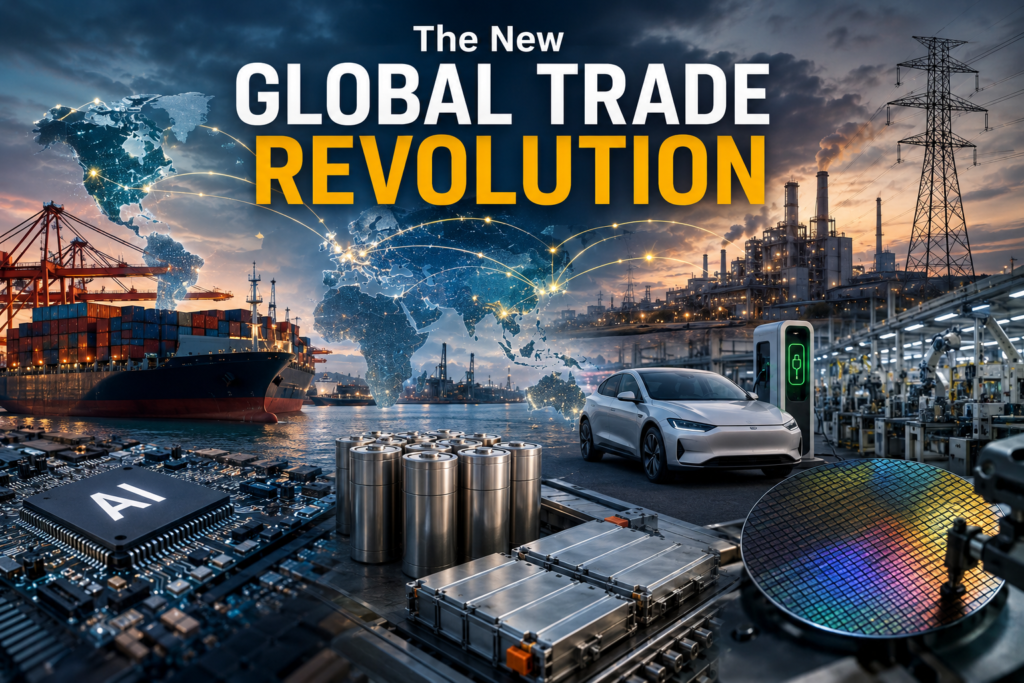
The Trade Revolution Almost Nobody Noticed
For a while, it looked like the world’s biggest economic problem was a missing chip.
Car dealerships filled with unfinished vehicles. Game consoles disappeared from shelves. Manufacturers delayed production schedules that had worked almost flawlessly for decades.
The shortage itself wasn’t unprecedented.
What surprised economists was what it revealed.
A tiny semiconductor—often invisible to the consumer and inexpensive compared to the products it powered—managed to disrupt industries worth trillions of dollars. Entire assembly lines waited for components smaller than a fingernail.
It felt backwards.
For generations, global trade had been built around visible things. Oil tankers crossing oceans. Steel pouring out of blast furnaces. Shipping containers stacked like giant building blocks in ports from Shanghai to Rotterdam. Countries competed to produce more clothes, more cars, more televisions, more appliances.
Then something changed.
The products creating the greatest economic value became harder to see.
Not because they were smaller.
Because they were buried inside everything else.
The AI assistant answering a question depends on advanced processors, networking hardware, cooling systems, and enormous data centres spread across continents. An electric vehicle owes as much to battery chemistry, software, and semiconductor engineering as it does to mechanical design.
AI may look like software.
Economically, it might be the most hardware-dependent digital technology ever created.
That’s an odd sentence to write in 2026. Yet it’s becoming increasingly difficult to argue otherwise.
Twenty years ago, conversations about globalization sounded remarkably similar.
Find the cheapest labour.
Build the factory.
Ship the product.
Repeat.
It wasn’t a perfect strategy, but it was an extraordinarily successful one. After China’s accession to the World Trade Organization in 2001, manufacturers expanded across Asia at breathtaking speed. Container shipping became cheaper, supply chains stretched across multiple continents, and consumers benefited from products that became both more sophisticated and more affordable.
Efficiency became almost an economic religion.
Businesses knew exactly where to manufacture. Investors rewarded companies that squeezed another percentage point out of production costs. Governments, for the most part, stepped aside and let markets decide where factories should go.
Looking back, that era now feels unusually predictable.
Today’s version of globalization doesn’t.
A company designing AI chips may rely on software engineers in California, manufacturing facilities in Taiwan, precision machinery from the Netherlands, specialty chemicals from Japan, advanced memory from South Korea, and rare minerals processed thousands of kilometres away.
That’s not one supply chain.
It’s an ecosystem.
And ecosystems behave differently. They’re harder to replace, harder to move, and considerably harder to predict when something goes wrong.
One misconception deserves retiring.
People often assume the next global trade boom will simply involve selling more AI software or more electric cars.
That’s too narrow.
The bigger story sits underneath.
Every AI breakthrough triggers demand for specialised chips. Those chips require advanced manufacturing equipment. The factories producing them consume enormous amounts of electricity and ultra-pure water. Data centres need cooling infrastructure, fibre-optic networks, transformers, and increasingly, entirely new power generation.
Software has become surprisingly physical.
Electric vehicles reveal the same pattern.
Buying an EV isn’t just buying a car. It’s indirectly creating demand for lithium mines in Australia, nickel projects in Indonesia, battery factories in China and South Korea, charging equipment in Europe, power electronics, copper wiring, and smarter electricity grids.
The final product attracts the headlines.
The supporting industries quietly capture much of the value.
History offers an interesting comparison.
During the Industrial Revolution, railways transformed economies. But fortunes were often made not only by railway operators, but by the companies producing steel rails, locomotives, signalling systems and industrial machinery.
Technology revolutions have always created winners behind the scenes.
The AI era appears to be following the same script.
The numbers increasingly reflect that shift.
According to recent United Nations trade data, exports connected to semiconductors, batteries, renewable-energy equipment and other advanced technology products have continued expanding even as parts of traditional manufacturing slowed under higher interest rates and weaker consumer demand.
That doesn’t mean textiles, machinery or conventional automobiles suddenly became irrelevant.
Far from it.
It means global growth is finding new engines.
And those engines don’t necessarily resemble the industries that powered globalization over the past forty years.
Which raises a more interesting question.
If AI chips, battery technology and advanced manufacturing equipment are becoming the foundations of international trade, who actually controls those foundations—and why are governments suddenly willing to spend hundreds of billions of dollars trying to build them at home?
The Invisible Economy Behind AI
Ask someone to name the world’s most valuable AI company and there’s a good chance they’ll mention OpenAI, Google, Microsoft, or NVIDIA.
It’s a reasonable answer.
It also misses half the story.
The AI boom isn’t being built by software companies alone. It’s being assembled—quite literally—inside factories, clean rooms, research labs and data centres scattered across the globe.
That distinction matters.
Because every time an AI model becomes more powerful, someone, somewhere, has to manufacture the hardware capable of running it. Intelligence may be digital. The infrastructure behind it certainly isn’t.
Walk into a semiconductor fabrication plant and the atmosphere feels strangely quiet. Engineers move through spotless corridors wearing protective suits. Machines costing hundreds of millions of dollars operate with microscopic precision. Dust particles too small for the human eye can ruin an entire production process.
It’s less like a factory.
More like a scientific laboratory that happens to manufacture chips.
That image alone says something about how manufacturing has changed.
For much of the twentieth century, industrial power was measured by blast furnaces, shipyards and automobile plants. Today’s industrial champions often produce objects so small they disappear beneath a fingertip.
Yet their economic influence has never been larger.
Consider NVIDIA.
For years, the company was known mostly among gamers. Its graphics processors made video games look better and run faster. Few people imagined those same chips would become the computational engine behind artificial intelligence.
Even NVIDIA probably didn’t expect the transformation to happen this quickly.
As companies rushed to build increasingly capable AI models, demand for high-performance processors exploded. Waiting lists grew. Prices climbed. Governments began discussing semiconductors in the same meetings where they once debated oil security.
That would have sounded absurd fifteen years ago.
Today, it barely raises an eyebrow.
But here’s the interesting part.
NVIDIA designs many of the world’s most sought-after AI chips.
It doesn’t manufacture most of them.
That responsibility falls largely to Taiwan Semiconductor Manufacturing Company—TSMC.
On paper, TSMC is simply a contract manufacturer.
In practice, it has become one of the most strategically important companies in the global economy.
Think about that for a moment.
Some of the world’s most influential technology firms depend on factories located on an island roughly 180 kilometres from mainland China.
That’s no longer just a business story.
It’s a geopolitical reality.
There’s another company that receives even less public attention.
ASML.
Outside technology circles, the name rarely appears in everyday conversation. Yet if modern AI has an unsung hero, this Dutch company is a remarkably strong candidate.
ASML builds extreme ultraviolet lithography machines—known simply as EUV systems.
Calling them machines almost understates the engineering involved.
Each one contains well over 100,000 individual components, weighs hundreds of tonnes once installed, and costs more than many commercial aircraft. Mirrors are polished with astonishing precision. Laser systems generate temperatures hotter than the surface of the sun for fractions of a second to produce the light needed for advanced chip manufacturing.
It’s almost ridiculous.
And that’s precisely why competitors haven’t been able to replicate it easily.
One observation keeps resurfacing throughout this new trade landscape.
The companies making the tools are increasingly becoming as important as the companies making the products.
Sometimes, even more important.
History has seen this pattern before.
During the California Gold Rush, many prospectors returned home empty-handed. Businesses selling shovels, equipment and supplies often built more reliable fortunes than the miners themselves.
AI has created its own version of that dynamic.
Then came the political response.
The United States passed the CHIPS and Science Act, committing roughly US$52 billion to strengthen domestic semiconductor manufacturing and research. Europe launched its own Chips Act. Japan expanded incentives. South Korea accelerated investment. India entered the race with semiconductor initiatives aimed at building long-term manufacturing capacity.
Governments don’t usually spend sums like these unless they believe something fundamental has changed.
Perhaps it has.
Twenty years ago, policymakers worried about where factories created jobs.
Today, they’re also asking where factories create strategic influence.
There’s a difference.
One strengthens an economy.
The other shapes global power.
Still, it’s worth resisting an easy conclusion.
Industrial policy has a mixed history. Some government-backed industries become global champions. Others quietly consume billions before fading into obscurity. No subsidy can manufacture innovation on demand.
The outcome isn’t guaranteed.
That’s what makes this period so fascinating.
We’re watching countries place enormous bets on technologies whose long-term winners haven’t been fully decided.
The factories are already being built.
Whether they’ll define the next generation of global trade is a question history hasn’t answered yet.
Battery supply chains suggest the answer may arrive sooner than many expect.
The Battery Race Nobody Saw Coming
The transition to electric vehicles is often described as a battle between old cars and new cars.
It isn’t.
It’s a competition between two industrial systems.
That distinction changes almost everything.
Walk through a modern battery factory and you won’t find rows of engines waiting to be assembled. Instead, you’ll see robotic arms moving with almost mechanical choreography, enormous drying chambers, bright stacks of battery cells, automated inspection systems and technicians monitoring production from digital control rooms.
The factory feels closer to a semiconductor plant than the automobile factories many people picture.
That isn’t a coincidence.
Cars are becoming technology platforms on wheels.
One of the biggest misconceptions surrounding electric vehicles is that companies are competing primarily to build better cars.
The car is almost the final chapter.
The real contest begins much earlier.
Long before an EV reaches a showroom, lithium may have been extracted in Australia, nickel mined in Indonesia, graphite processed in China, battery chemicals refined in South Korea, electronic components produced in Japan, and software written somewhere entirely different.
A single vehicle quietly carries the work of multiple continents.
Globalization hasn’t disappeared.
It’s simply become harder to see.
China understood this surprisingly early.
Years before electric vehicles became mainstream, Beijing was investing across the entire battery ecosystem. Not just car manufacturing.
Mining.
Chemical processing.
Battery production.
Charging infrastructure.
Supply chains.
At the time, some observers questioned whether the investment was excessive.
Looking back, the strategy appears remarkably patient.
Today, companies like BYD and CATL are no longer regional success stories. They’ve become central players in the global EV industry, exporting vehicles and batteries to markets that once assumed traditional automakers would remain dominant.
Scale created momentum.
Momentum attracted investment.
Investment accelerated innovation.
It’s difficult to separate where one ended and the next began.
There’s an irony here.
Electric vehicles are often presented as environmentally cleaner.
Their supply chains, however, remain intensely physical.
Every additional battery requires more minerals.
More refining.
More shipping.
More electricity.
More factories.
AI may be digital.
The EV revolution is anything but.
This has quietly transformed the value of resources that received relatively little public attention a decade ago.
Lithium wasn’t a household word.
Neither was graphite.
Today, governments discuss critical minerals with the same seriousness once reserved for oil.
History doesn’t repeat itself exactly.
But it does have favourite themes.
During the twentieth century, access to oil shaped diplomacy, military strategy and economic alliances. In the twenty-first, access to advanced semiconductors and battery materials is beginning to influence many of the same conversations.
Different resources.
Remarkably similar stakes.
There’s another change that’s easy to overlook.
Yesterday’s automobile industry was judged largely by horsepower, fuel efficiency and mechanical engineering.
Tomorrow’s may be judged by battery chemistry, software updates, semiconductor performance and charging speed.
That’s an extraordinary shift for an industry more than a century old.
It also explains why technology companies and car manufacturers increasingly find themselves solving similar problems.
The boundaries between industries are fading.
Not every country will benefit equally.
Battery production demands reliable electricity, advanced manufacturing capabilities, skilled workers and long-term policy consistency.
Those aren’t built overnight.
Nor can they simply be imported.
A battery plant can transform an entire region. Thousands of direct jobs appear almost immediately. Suppliers follow. Logistics companies expand. Universities begin developing specialised engineering programmes because local industries suddenly need different skills.
One factory rarely stays just one factory.
It becomes an ecosystem.
That’s one reason governments are competing so aggressively to attract these investments.
They’re not only chasing exports.
They’re trying to reshape regional economies.
This also exposes a weakness in the old way of thinking about manufacturing.
For decades, businesses searched relentlessly for the lowest labour costs.
That logic still matters.
Just not as much.
An unreliable electricity grid can erase labour-cost advantages remarkably quickly. So can geopolitical uncertainty. So can fragile supply chains stretched across too many borders.
Cheap has acquired competition.
Reliable.
Predictable.
Resilient.
Those qualities rarely topped investment presentations twenty years ago.
Now they’re becoming decisive.
Which brings us to perhaps the biggest surprise of all.
Many people assume globalization is retreating because companies are diversifying supply chains away from a handful of countries.
The evidence points somewhere more interesting.
Global trade isn’t shrinking.
It’s reorganising itself around technology, resilience and strategic capability instead of pure efficiency.
That’s a very different story.
And it changes the list of countries most likely to benefit over the next decade.
A New Map of Economic Power
Global trade used to have a fairly simple geography.
Raw materials came from one place.
Factories sat somewhere else.
Consumers lived somewhere else again.
That map is becoming obsolete.
Today’s economic landscape looks less like a chain and more like a network, with different countries controlling different pieces of the puzzle.
No single nation owns the future.
But some have positioned themselves unusually well.
Take Taiwan.
From a distance, it’s a relatively small island.
From inside the technology industry, it looks enormous.
A surprising share of the world’s most advanced semiconductors is manufactured there. Inside Hsinchu Science Park, highly automated fabrication plants operate almost continuously, producing chips that eventually power smartphones, AI servers, medical equipment, cloud infrastructure and advanced defence systems.
It’s easy to focus on the finished chip.
The more interesting question is why so few companies can manufacture it.
Building a cutting-edge semiconductor fabrication plant isn’t simply expensive. It requires decades of accumulated expertise, specialised suppliers, engineering talent and production experience that can’t be assembled overnight—even with unlimited money.
Some advantages can be purchased.
Others have to be built slowly.
The Netherlands tells a similar story.
On paper, it isn’t one of the world’s largest economies.
Yet a single company—ASML—has become indispensable to advanced semiconductor manufacturing.
That’s an unusual kind of influence.
Countries have traditionally gained economic power through natural resources, industrial scale or large domestic markets.
The Netherlands found another route.
Master one technology that nobody else can easily reproduce.
The leverage that creates is remarkable.
Japan followed a different path.
For years, discussions about technology shifted toward Silicon Valley, Shenzhen and Taipei, giving some people the impression that Japan had lost its edge.
It hadn’t.
It had simply become less visible.
Many of the precision chemicals, silicon wafers, industrial materials and specialised manufacturing equipment used throughout the semiconductor industry still originate from Japanese companies. They’re rarely consumer brands. They don’t need to be.
The digital economy depends on them regardless.
It’s another reminder that supply chains reward expertise as much as scale.
Then there’s the United States.
Much of today’s AI revolution is being imagined there.
The algorithms.
The software.
The venture capital.
The research laboratories.
Some of the world’s most influential technology companies remain American.
Yet there’s an irony hiding beneath that success.
For years, many of those companies designed the world’s most advanced chips while relying on overseas manufacturing to produce them.
That arrangement made perfect economic sense when efficiency was the overriding priority.
It looks more fragile today.
That’s one reason Washington has begun investing heavily in domestic semiconductor production.
The objective isn’t complete self-sufficiency.
That’s unrealistic.
It’s about reducing dependence where dependence carries strategic risk.
There’s a difference.
China presents perhaps the most complicated picture.
Predictions that the country would quickly lose its manufacturing dominance have repeatedly underestimated just how difficult it is to replace decades of industrial development.
Visit Shenzhen and the scale becomes easier to understand.
Prototype designers, electronics suppliers, precision manufacturers, logistics providers and exporters often operate within a short drive of one another. A product idea can become a physical prototype in days rather than weeks because nearly every supplier already exists nearby.
Industrial ecosystems create their own momentum.
Once they reach sufficient scale, they become extraordinarily difficult to replicate elsewhere.
China also spent years investing in batteries, solar technology and critical mineral processing—industries that many governments now consider strategically important.
Trade restrictions may slow parts of that progress.
They don’t erase it.
Which brings us to India.
For years, India’s global reputation rested largely on software services and information technology.
That story is beginning to expand.
Electronics manufacturing has accelerated. Smartphone production has grown rapidly. Multinational companies are gradually diversifying parts of their supply chains, and India is increasingly part of those conversations.
It’s an encouraging start.
But manufacturing leadership isn’t measured by assembly alone.
The real prize lies further up the value chain.
Semiconductor packaging.
Advanced components.
Battery manufacturing.
Industrial automation.
Materials engineering.
Original research.
Those industries create deeper expertise, stronger supplier networks and higher-value exports.
India has another advantage that receives surprisingly little attention.
Scale.
A domestic market of more than 1.4 billion people allows companies to build for local demand while preparing for global markets. That’s a luxury many export-driven economies never had.
Still, opportunities have a habit of sounding easier than they are.
Reliable electricity.
Efficient logistics.
Modern ports.
Technical education.
Policy stability.
None of these generate dramatic headlines.
All of them determine whether manufacturing investments stay for decades or move elsewhere.
History is full of countries that announced ambitious industrial strategies.
Far fewer successfully executed them.
India’s next chapter won’t be decided by policy announcements alone.
It will be written on factory floors, inside engineering labs, across freight corridors and in classrooms training the next generation of technicians.
Because in the new trade economy, competitive advantage isn’t just built.
It’s maintained.
And that may be the hardest part of all.
The Next Great Trade Boom Won’t Look Like the Last One
For most of the modern global economy, success had a surprisingly simple formula.
Make products more cheaply.
Ship them more efficiently.
Sell them almost everywhere.
That model isn’t disappearing.
It’s just no longer enough.
The countries shaping the next decade of global trade are chasing something different. They’re trying to secure semiconductor capacity before someone else does. They’re investing in battery plants years before demand fully arrives. They’re signing agreements for lithium, copper and rare earth minerals with an urgency that would have been difficult to imagine a decade ago.
On paper, these look like industrial investments.
In practice, they’re strategic bets.
One consequence is already becoming impossible to ignore.
Electricity has quietly become an economic resource again.
A single hyperscale AI data centre can consume as much electricity as a small city. Battery manufacturing plants require stable, uninterrupted power. Semiconductor fabrication facilities cannot afford frequent outages because even a brief interruption can destroy millions of dollars’ worth of production.
That creates an unexpected twist.
For years, people assumed artificial intelligence would be limited mainly by algorithms and computing power.
It may also be limited by power grids.
Few predicted that one of the world’s most advanced digital industries would end up depending so heavily on something as traditional as electricity generation.
History enjoys these little ironies.
The workforce is changing too.
Not dramatically overnight.
Quietly.
The technician maintaining robotic equipment inside a battery plant, the engineer designing cooling systems for AI data centres, the specialist producing advanced semiconductor materials—these jobs barely featured in discussions about globalization twenty years ago.
Today they’re among the fastest-growing areas of advanced manufacturing.
Meanwhile, workers in more traditional industries face a different challenge.
The question isn’t simply whether jobs disappear.
It’s whether skills evolve quickly enough.
Every major industrial transition has created uncertainty before creating opportunity. The move from agriculture to manufacturing did. The computer revolution did. This one probably won’t be any different.
Some communities will attract new investment and flourish.
Others may spend years trying to replace industries that quietly moved elsewhere.
Economic transitions always look cleaner in reports than they do in real life.
There’s another misconception worth challenging.
People often ask which country will “win” the AI race or the EV race.
That’s probably the wrong question.
Modern supply chains are too interconnected for simple winners and losers.
An AI chip might be designed in one country, manufactured in another, assembled with equipment from a third, powered by minerals extracted from a fourth and installed inside products sold around the world.
Success increasingly belongs to networks.
Not isolation.
That doesn’t eliminate competition.
If anything, it intensifies it.
Countries are no longer competing only to export more goods.
They’re competing to become indispensable.
There’s a difference.
A nation that manufactures products can be replaced.
A nation that controls a critical technology, an irreplaceable material, or a unique industrial capability becomes much harder to bypass.
That’s why supply chains have become part of foreign policy.
It’s also why trade ministers, technology executives and national security advisers increasingly find themselves discussing the same issues around the same tables.
Twenty years ago, that overlap would have seemed unusual.
Today, it feels inevitable.
Perhaps the most remarkable aspect of this transformation is how quietly it unfolded.
There wasn’t a single moment when the world collectively announced that globalization had entered a new chapter.
There was no ceremony.
No clear dividing line.
Just thousands of decisions.
A new chip factory breaking ground in Arizona.
Another battery plant opening in Hungary.
A lithium project expanding in Australia.
An AI data centre rising outside Bengaluru.
A semiconductor equipment manufacturer increasing production in the Netherlands.
Individually, each investment looked like another business announcement.
Together, they describe something much larger.
A different map of global trade.
Future historians may not remember this period simply as the beginning of the AI age.
They may remember it as the moment the foundations of international commerce quietly shifted beneath our feet.
The headlines celebrated intelligent software and sleek electric vehicles.
The deeper story unfolded somewhere else.
Inside spotless semiconductor clean rooms where engineers worked with machines of astonishing precision.
Across vast battery factories where robotic arms assembled the technology powering tomorrow’s transport.
In ports where containers carried not just finished products, but the components of an entirely new industrial economy.
And beneath all of it, in power grids, mines, research laboratories and manufacturing ecosystems that most consumers will never see.
That may ultimately be the defining lesson of this era.
The future of global trade isn’t being built by a single invention, a single country or even a single industry.
It’s being built by the invisible infrastructure that makes every visible breakthrough possible.
And decades from now, that invisible revolution may prove to have been the biggest story of all.