There was a time when sanctions were expected to produce dramatic moments.
A government announced new restrictions, markets reacted sharply, headlines predicted economic collapse, and the world waited for immediate consequences. That rhythm shaped much of the public conversation during the early months of Russia’s invasion of Ukraine.
The latest European sanctions don’t fit that pattern.
Oil didn’t suddenly disappear from global markets. Tankers didn’t stop sailing. Energy companies didn’t wake up to an entirely different commercial landscape. In fact, the absence of immediate disruption is precisely why this latest package deserves closer attention.
The interesting question is no longer whether Europe can sanction Russia.
It has demonstrated that repeatedly.
The more revealing question is whether sanctions have quietly changed purpose.
That sounds like a subtle distinction, but it marks an important shift. In 2022, European governments were responding to an emergency. The objective was straightforward: reduce dependence on Russian energy quickly enough to avoid financing Moscow’s war while preventing an economic crisis at home.
Today’s sanctions come from a different place.
Europe has already replaced much of the Russian pipeline gas it once depended on. LNG terminals have expanded. Utilities have signed new supply contracts. Industries that survived the energy shock have largely adapted to higher costs or redesigned their operations around them.
The immediate crisis has faded.
The long-term redesign has not.
What is striking isn’t simply that Europe continues announcing sanctions. It’s how quietly the objective has evolved. The focus has shifted from blocking trade to making certain forms of trade progressively more expensive, more complicated and less attractive over time.
That is a very different strategy.
It also reflects something larger than the war itself.
For more than three decades after the Cold War, most advanced economies operated under a remarkably simple assumption: efficiency deserved priority. Supply chains stretched across continents because lower costs mattered more than geographic proximity. Russian gas heated European homes because it was abundant, relatively cheap and delivered through infrastructure that appeared politically stable.
In hindsight, stability turned out to be one of the assumptions rather than one of the guarantees.
History offers a useful reminder here.
The oil shocks of the 1970s changed how governments thought about energy security. Strategic petroleum reserves expanded, producing countries gained geopolitical influence and importing nations spent years reducing vulnerability to supply disruptions. Those crises reshaped policy long after oil prices eventually stabilised.
The current transition feels different.
The concern today is not that the world is running out of energy. It clearly is not. Oil continues to flow. Natural gas continues to move. New suppliers have emerged. Renewable capacity keeps expanding.
The anxiety comes from something less visible.
Modern economies increasingly worry about who controls the routes, the finance, the insurance, the technology and the political relationships that allow energy to move. Those questions barely registered in boardrooms twenty years ago. They now sit alongside price when companies evaluate long-term supply.
That change is unlikely to disappear even if the geopolitical climate improves.
A refinery planning crude purchases for next year isn’t only comparing suppliers on cost anymore. Procurement teams increasingly ask different questions. What happens if another sanctions package appears halfway through a contract? Which shipping routes carry the lowest regulatory risk? Could insurance become unavailable? Is paying a little more today preferable to renegotiating an entire supply chain six months from now?
Those are operational decisions.
Collectively, they become geopolitical outcomes.
And that may prove to be one of the least appreciated consequences of the sanctions era. The biggest transformation isn’t necessarily happening in government ministries or diplomatic negotiations. It is happening inside procurement departments, risk committees and investment meetings where companies quietly redesign how they buy, transport and finance energy.
Those conversations rarely make headlines.
Yet they may outlast the sanctions themselves.
Europe’s latest package should be viewed through that lens.
Most commentary still asks whether these measures will significantly reduce Russian revenues. That is a reasonable question, but perhaps not the most interesting one. A more revealing way to think about the issue is to ask what kind of global energy market governments are gradually creating through years of cumulative restrictions, adaptations and counter-adaptations.
The answer is beginning to emerge, although not in the way many expected.
The assumption behind many sanctions is straightforward: make it harder for a country to sell something, and eventually it will sell less of it.
Energy has never behaved quite so neatly.
Take crude oil. A cargo loaded at a Russian port does not carry a political label that prevents it from finding another buyer. It carries a price. If one customer leaves the market, another may step in—especially if the discount is large enough. That has been one of the defining characteristics of the past few years. Russian oil did not vanish. It travelled farther.
Distance, however, is rarely free.
A tanker leaving the Baltic for Rotterdam follows a very different commercial logic from one sailing to India’s west coast. The voyage is longer. Financing arrangements may be different. Insurance becomes more complicated. A trader who once relied on established European banks may now work through unfamiliar intermediaries. None of these changes is dramatic on its own. Together, they alter the economics of moving energy around the world.
This is where sanctions become more interesting than they first appear.
For decades, economists tended to think of globalisation as a machine that relentlessly removed friction. Faster shipping. Cheaper finance. Fewer barriers. Lower costs.
The sanctions era has introduced the opposite tendency.
Not deglobalisation, as it is often described.
Friction.
That distinction matters because friction compounds. A few extra days at sea. Additional legal reviews before a cargo changes ownership. Higher insurance premiums. More expensive financing. Each cost is manageable. Hundreds of similar decisions, repeated across thousands of shipments, slowly reshape the market.
One consequence is already visible.
The cost of moving energy has become increasingly detached from the cost of producing it.
That may sound technical, but it represents a quiet shift. Discussions about oil usually focus on production—how much Russia pumps, how much OPEC produces, whether US shale output rises or falls. Increasingly, the bottleneck lies elsewhere. The challenge is not extracting energy. It is moving it through a world where commercial networks are becoming more politically selective.
That is a different problem.
And different problems attract different investments.
A shipping operator deciding where to position its fleet now weighs more than fuel prices and seasonal demand. Regulatory uncertainty matters. Insurance availability matters. Even the nationality of a vessel’s ownership structure can influence commercial decisions in ways that barely existed a decade ago.
None of this makes global trade impossible.
It simply makes it more expensive.
History offers an interesting comparison. After the Suez Crisis in 1956, shipping companies adjusted routes because a vital trade corridor had become unreliable. The immediate disruption eventually passed, but it accelerated investment in larger tankers capable of sailing around the Cape of Good Hope more efficiently. A geopolitical event ended up changing commercial infrastructure.
Today’s transition feels similar in one respect.
Businesses are not merely responding to sanctions. They are adapting to the possibility that sanctions—or something like them—could become a recurring feature of international commerce.
That expectation changes behaviour long before regulations require it.
Walk into the risk committee of a large European utility today and the discussion is unlikely to revolve around finding the cheapest long-term gas supplier. Executives are just as likely to ask how exposed the company would be if diplomatic relations deteriorated again. They are effectively pricing uncertainty.
Not because they know another crisis is coming.
Because they no longer assume one won’t.
This helps explain why Europe’s latest sanctions appear less dramatic than those introduced in 2022.
Back then, policymakers were racing to replace lost energy supplies before households and factories felt the full impact. Speed mattered more than efficiency.
Now the focus is different.
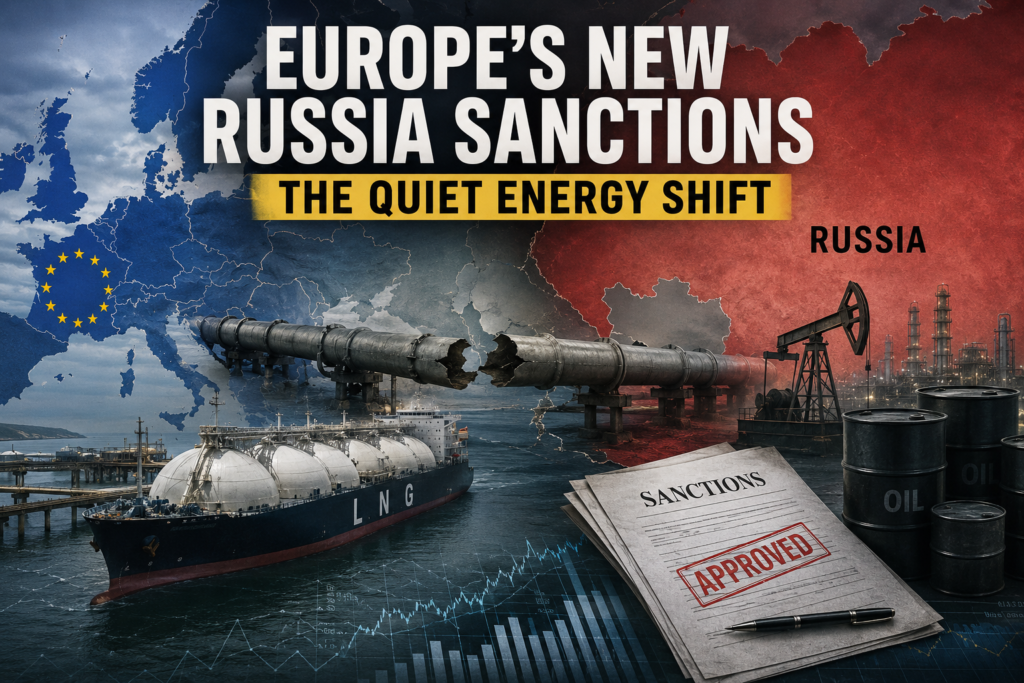
The European Commission is increasingly trying to close loopholes that emerged after earlier sanctions. The attention has shifted toward financial institutions, technology exports, and the so-called shadow fleet that has helped keep Russian oil moving despite successive restrictions.
At first glance, these measures can seem technical—even bureaucratic.
In reality, they acknowledge something policymakers were initially reluctant to admit: markets adapt remarkably quickly.
The challenge is no longer introducing sanctions.
It is keeping pace with the ways businesses respond to them.
That makes this latest package feel less like a new chapter than a continuation of an argument that neither side has managed to settle.
Russia adapts.
Europe tightens enforcement.
Businesses adjust again.
The cycle repeats, although never in quite the same way.
And with each cycle, the architecture of global energy trade shifts almost imperceptibly.
Almost.
Russia, meanwhile, has spent the past few years proving something that many early forecasts underestimated.
Large commodity exporters are surprisingly difficult to isolate.
That does not mean sanctions have failed.
It means success depends on what policymakers were trying to achieve in the first place.
If the objective had been to remove Russian oil from the global market entirely, the evidence is hard to ignore. Russian crude continues to reach international buyers, although often through longer routes, discounted prices and increasingly complex trading networks.
If the objective was different—to reduce revenues, complicate financing, restrict access to advanced technology and steadily increase the cost of doing business—the picture becomes far less straightforward.
Those are two different conversations.
Public debate often treats them as one.
There is another reason simple conclusions have been elusive.
Russia was not the only country adapting.
India expanded imports of discounted Russian crude because it made commercial sense. Chinese buyers continued prioritising energy security over geopolitical alignment. New insurers appeared. Alternative payment arrangements developed. Tanker ownership became less transparent. Commodity traders, whose business has always depended on navigating political risk, adjusted with remarkable speed.
Markets dislike uncertainty.
Traders, on the other hand, tend to treat it as another variable.
That difference is worth remembering whenever geopolitical events trigger predictions of lasting disruption. Financial headlines often move faster than commercial reality.
A refinery cannot redesign its supply chain because of a single press conference. It negotiates contracts months in advance. Cargoes already at sea continue their journey regardless of what was announced yesterday. Infrastructure has its own timetable, and it is usually much slower than politics.
Sometimes that lag creates misleading impressions.
Sanctions are declared ineffective because exports continue.
Months later, financing costs rise. Insurance becomes harder to secure. Certain technologies become unavailable. Investment decisions are postponed. None of these developments generates the same attention as a spike in oil prices, yet they often matter more over time.
Economic pressure rarely arrives all at once.
It accumulates in places that rarely appear on market charts.
That may explain why Russia has increasingly focused on preserving export capacity even while accepting lower margins in some markets. Selling discounted crude is preferable to shutting in production. Oil fields are not ordinary factories. Once production stops, restarting it can be expensive, technically difficult and, in some cases, damaging to the reservoir itself.
Keeping barrels moving carries its own strategic value.
Europe faces a different calculation.
The emergency measures of 2022 have gradually become long-term policy.
That transition deserves more attention than it usually receives.
Building LNG terminals can be justified during an energy crisis. Continuing to expand infrastructure after the immediate emergency has eased reflects something else entirely. It suggests governments are planning for a world in which geopolitical disruptions are no longer treated as exceptional events but as recurring risks.
There is an irony here.
For years, Europe argued that deeper economic integration would reduce geopolitical tensions because countries with extensive trade relationships would have stronger incentives to avoid conflict. That assumption shaped everything from energy policy to industrial strategy.
Recent years have not entirely disproved that idea.
They have exposed its limits.
Trade can create interdependence.
It cannot eliminate strategic rivalry.
That recognition is quietly reshaping investment decisions across the continent.
A chemicals manufacturer considering a new plant may still calculate labour costs, electricity prices and tax incentives. Increasingly, another question appears on the spreadsheet: How resilient is the supply chain if the geopolitical environment deteriorates?
Ten years ago, that question might have been confined to defence contractors.
Now it reaches industries that have little obvious connection to national security.
This is where the conversation begins to move beyond Russia.
The sanctions themselves are important. But they are also becoming part of a broader change in economic thinking. Governments are no longer asking only how to make markets more efficient. They are asking how to make them more durable.
Those objectives sound similar.
They are not.
An efficient system removes redundancy because redundancy costs money. A resilient system often does the opposite. It accepts duplicate suppliers, spare capacity and higher operating expenses because those become valuable when disruption occurs.
The shift is subtle enough that it can be mistaken for temporary crisis management.
It probably isn’t.
Even if relations between Russia and Europe eventually improve, few governments are likely to rebuild the kind of energy dependence that existed before 2022. Once strategic vulnerabilities become visible, they are difficult to ignore.
History suggests this pattern is common.
Countries rarely redesign critical infrastructure because everything is working well. They do it after discovering where the weaknesses are.
The current sanctions package matters for that reason as much as any immediate economic effect.
It is another step in a longer process—one that is changing not just who buys energy, but how governments think about dependence itself.
The effects are becoming visible well beyond Europe.
India is perhaps the clearest example, although not always for the reasons headlines suggest.
Much of the discussion has centred on India’s purchases of discounted Russian crude. That is certainly part of the story. Less attention has been paid to what happens after those cargoes arrive.
A refinery does not buy oil because it wants Russian barrels. It buys crude because it needs feedstock that fits its equipment, arrives on schedule and protects its margins. If discounted supplies satisfy those conditions, procurement managers have an obvious commercial incentive to take them.
The crude is processed.
Diesel, aviation fuel and other refined products then enter international markets, sometimes ending up in countries that no longer purchase Russian crude directly.
Global trade has always contained these kinds of indirect relationships. They simply attract more scrutiny during geopolitical crises.
China has followed its own path.
Beijing’s approach has generally been less about exploiting discounts than about avoiding excessive dependence on any single supplier or political relationship. Energy security has become intertwined with industrial policy, strategic reserves and long-term infrastructure planning. Those priorities existed before the current conflict, but recent events have reinforced them.
The United States occupies a different position altogether.
A decade ago, few would have predicted that American LNG exporters would become so central to Europe’s energy strategy. That transformation owes as much to technological advances in shale production as it does to geopolitics. History rarely moves in straight lines. A hydraulic fracturing boom that initially reshaped North American energy markets eventually altered Europe’s strategic options as well.
One development influences another.
Sometimes years later.
It is tempting to see these shifts as evidence that globalisation is retreating.
That interpretation misses something important.
Trade volumes remain enormous. Energy continues crossing oceans in quantities that would have seemed extraordinary a generation ago. Multinational companies still rely on suppliers spread across several continents.
The world has not become less connected.
It has become more selective about those connections.
That difference sounds semantic until it begins influencing investment.
A manufacturer expanding production in Southeast Asia may now maintain secondary suppliers in another country despite higher costs. A European utility negotiating a fifteen-year LNG agreement may value political stability almost as highly as pricing formulas. A shipping company might reject an otherwise profitable contract because the compliance burden outweighs the expected return.
None of these decisions makes international headlines.
Together they shape the next decade of global commerce.
There is another consequence that deserves more attention.
For years, businesses optimised supply chains to reduce costs measured in dollars or euros. Increasingly, they are trying to reduce costs measured in uncertainty.
That is a much harder calculation.
No financial model can accurately predict the next sanctions package, the next conflict affecting a shipping lane or the next diplomatic breakdown between major economies. Companies are therefore paying for optionality. Spare capacity. Alternative suppliers. Longer inventories.
Economists usually describe those choices as inefficiencies.
Executives increasingly describe them as insurance.
That change in mindset may outlast the current geopolitical environment.
It also helps explain why inflation remains part of the conversation even when energy prices appear relatively stable.
Inflation does not always begin with a commodity shortage.
Sometimes it begins with a world that has quietly become more expensive to operate.
A cargo taking a longer route.
Additional legal reviews before financing is approved.
Duplicate suppliers maintained as a precaution.
Warehouses carrying more inventory than efficiency alone would justify.
None of those costs is dramatic.
None appears on a petrol station sign.
Yet businesses absorb them every day, deciding which expenses they can carry and which eventually have to be passed to customers.
The process is gradual enough that consumers rarely connect higher prices to geopolitical decisions made years earlier.
That delay creates an interesting political dynamic.
Governments often receive immediate credit—or criticism—for announcing sanctions.
The economic consequences emerge slowly, sometimes under entirely different political leadership.
There is no obvious headline to mark the moment when resilience becomes more expensive than efficiency.
It simply happens.
Investors have noticed.
Not because they spend every day predicting diplomatic developments, but because geopolitics increasingly influences assumptions that were once considered stable. Energy prices, infrastructure spending, shipping costs, defence budgets, industrial policy and sovereign borrowing are no longer separate conversations. They overlap far more than they once did.
That overlap is changing capital allocation.
Money follows expectations.
If governments are likely to invest heavily in electricity grids, LNG terminals, domestic manufacturing, strategic minerals or defence-related infrastructure for the next decade, investors begin positioning for that world long before every project receives final approval.
Markets are often criticised for focusing on the next quarter.
In reality, many of their largest decisions are built around expectations that stretch years into the future.
That may be why recent sanctions have produced relatively muted reactions.
Markets have started treating geopolitical fragmentation less as an extraordinary event and more as part of the operating environment.
That is a remarkable adjustment in itself.
Only a few years ago, disruptions of this scale were widely described as temporary.
Increasingly, businesses are planning as though they are permanent.
There is a temptation to judge every sanctions package by the same question: Did it work?
It sounds simple.
It rarely is.
Sanctions are not single events. They resemble long campaigns in which the objectives, methods and expectations evolve. The first rounds after Russia’s invasion were designed to respond to an immediate crisis. Today’s measures are increasingly about shaping incentives over many years rather than producing dramatic results over many weeks.
That shift is easy to miss because it lacks spectacle.
No government announces a sanctions package by saying it hopes to make global commerce slightly less efficient over the next decade. Yet that may be one of the most enduring consequences.
The lasting story may not be the volume of Russian oil that leaves the market.
It may be the permanent increase in the cost of moving energy through it.
History suggests these moments matter more than they initially appear.
The oil crises of the 1970s did more than trigger price spikes. They transformed energy policy, encouraged strategic petroleum reserves and altered the relationship between producing and consuming nations for decades. Likewise, the end of the Cold War reshaped trade by convincing businesses that geopolitical barriers would continue to fall. Companies built supply chains around that assumption.
Now another assumption is being reconsidered.
Not because globalization has ended.
Because predictability has.
There is a subtle but important difference between an economy built for maximum efficiency and one built to withstand disruption. For years, governments encouraged businesses to eliminate redundancy. Multiple suppliers were expensive. Spare inventory tied up capital. Backup infrastructure was difficult to justify.
Today, those same features are increasingly presented as strategic advantages.
That reversal extends well beyond energy.
Semiconductor manufacturing, critical minerals, pharmaceuticals, telecommunications and defence industries are all being viewed through a similar lens. The common thread is not ideology. It is vulnerability.
Countries have begun asking a question that barely surfaced in economic policy discussions twenty years ago: Which dependencies are acceptable, and which could become strategic liabilities?
There is no universal answer.
Different governments will reach different conclusions, just as businesses will continue balancing cost against resilience in different ways. Some may conclude that the additional expense is justified. Others may decide the pendulum has swung too far and that excessive fragmentation risks creating a slower, more inflationary global economy.
That debate is only beginning.
It is also why Europe’s latest sanctions deserve attention even if they produce few dramatic headlines.
Viewed in isolation, they may appear incremental.
Viewed as part of a longer timeline, they tell a different story.
Each package closes another loophole. Companies redesign another supply chain. Investors adjust another risk model. Governments approve another LNG terminal, another electricity interconnector, another industrial subsidy or another strategic partnership.
None of those decisions transforms the global economy overnight.
Collectively, they already are.
Perhaps that is the most revealing feature of this period.
The biggest geopolitical changes are no longer always announced with historic speeches or landmark treaties. Increasingly, they emerge through procurement contracts, insurance policies, infrastructure approvals and boardroom discussions that attract little public attention.
By the time those quiet decisions become visible in trade statistics or investment flows, the direction of travel has often been set.
Europe’s latest sanctions are therefore less important as a standalone policy than as another signal of where that direction leads.
The world is not entering an era without global trade.
Nor is it returning to the one that existed before 2022.
Instead, it is moving toward something more complicated: an international economy where political trust carries a measurable economic value, where resilience commands a premium, and where the price of energy is shaped not only by geology and demand, but increasingly by strategy.
That transition will almost certainly outlast this sanctions package.
It may even outlast the conflict that inspired it.