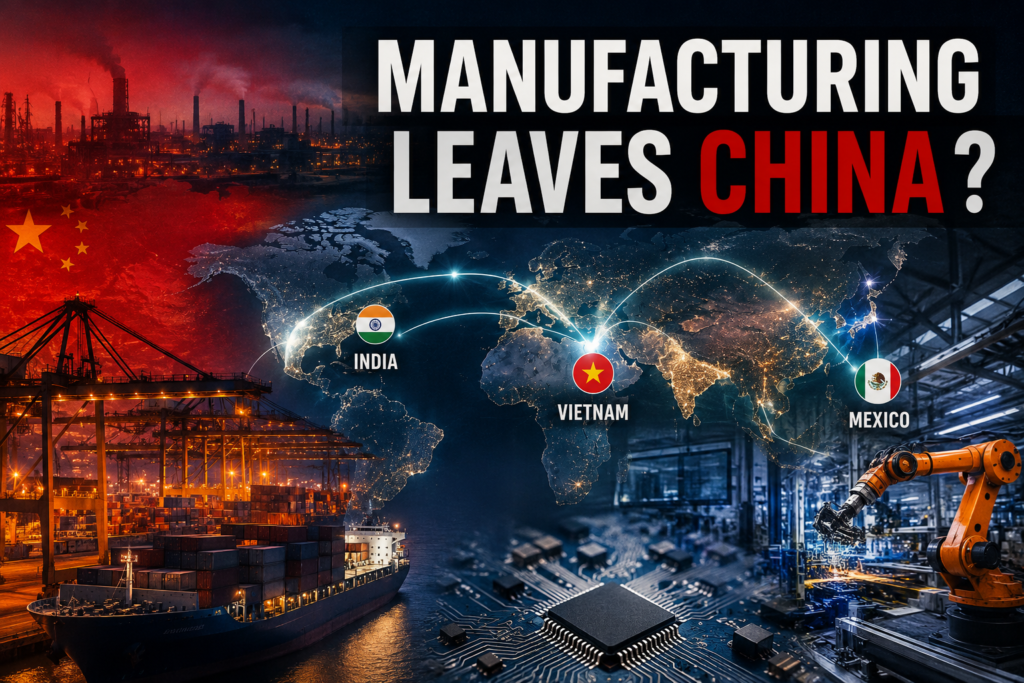
One of the most important assumptions in modern business was that if a product needed to be manufactured at scale, China would almost certainly be involved somewhere in the process.
For decades, that assumption held true.
From smartphones and laptops to furniture, machinery, clothing, and solar panels, an enormous share of global manufacturing flowed through Chinese factories. Supply chains were built around China. Investors treated its industrial dominance as a given. Consumers rarely thought about where products came from because products appeared on shelves when they were needed and usually at prices people could afford.
Today, that assumption is being tested.
More companies are building factories outside China. Yet the idea that manufacturing is simply “leaving China” is probably one of the least useful ways to describe what is actually happening.
Factories can move.
Industrial ecosystems are harder to move.
That distinction sits at the center of almost everything happening in global manufacturing today.
It is tempting to view this as a story about countries competing for factories. In reality, it may be more accurate to view it as a story about companies competing for flexibility.
Why China Became So Difficult to Replace
Most explanations begin with labor costs.
That was certainly part of the story. But labor alone does not explain why China became the world’s manufacturing center, nor does it explain why replacing China has proven so difficult.
China’s real advantage was the ecosystem it built around manufacturing.
Perhaps the most remarkable thing about China’s manufacturing model is not that factories were built. Factories can be built almost anywhere with enough investment. What proved much harder to replicate was the network that formed around them: suppliers, engineers, logistics providers, machine-tool manufacturers, technical specialists, and thousands of smaller firms that rarely appear in headlines.
A factory manager in southern China who suddenly needed a specialized component could often find a supplier nearby and have the part delivered the same day. Problems that might take weeks to solve elsewhere could sometimes be solved before the workday ended.
That kind of density reduces friction.
It also creates a powerful advantage that becomes difficult to measure until it is missing.
Companies such as Apple, Tesla, Samsung, and thousands of suppliers benefited from this environment. Products could move from design to assembly to export through networks refined over decades.
Discussions about manufacturing often focus on where factories are located. Far less attention is paid to where suppliers, engineers, and industrial expertise remain concentrated.
That may be the more important question.
China still accounts for roughly a quarter of global manufacturing output. For all the discussion about diversification, the world’s industrial map remains heavily shaped by decisions made inside Chinese factories and industrial parks.
It is easy to forget how unusual China’s rise actually was. Many countries have pursued industrialization. Very few have managed to build supplier networks, infrastructure, labor pools, export capacity, and manufacturing expertise at the same speed and scale.
Why Companies Are Diversifying
The reasons companies are diversifying production are relatively easy to identify.
Rising labor costs played a role.
Trade tensions between the United States and China played a role.
The pandemic played a role.
So did growing geopolitical uncertainty.
Yet even that explanation leaves something out.
Perhaps the most striking aspect of this shift is how differently companies now talk about supply chains.
A decade ago, efficiency dominated the conversation. Companies wanted lower costs, lean inventories, and faster production cycles.
Today, resilience appears almost everywhere.
Looking back, it is remarkable how quickly assumptions changed. Not long ago, executives treated global supply chains almost like utilities. Components arrived when needed. Containers moved on schedule. Inventories remained lean.
Then the system stopped behaving the way people expected.
During 2021 and 2022, some manufacturers found themselves paying several times normal shipping rates simply to secure container space. Others discovered that a missing component worth only a few dollars could delay products worth millions.
Those experiences changed how many executives thought about risk.
The assumption that diversification automatically creates resilience deserves some scrutiny, however.
Diversification reduces dependence on a single country. It can also introduce new layers of complexity. A company that once coordinated production through one manufacturing hub may now be managing suppliers, assembly facilities, shipping routes, and regulatory environments across several countries.
Risk falls in one area.
It can quietly increase in another.
Whether that trade-off proves worthwhile is something businesses are still trying to answer.
The Real Story: China Plus One
This is where the conversation becomes more interesting.
The phrase “China Plus One” probably describes what is happening better than most headlines about companies leaving China.
Under this approach, businesses maintain significant operations in China while expanding production elsewhere.
Apple provides a useful example. Over the past several years, the company and its suppliers have expanded manufacturing capacity in India. Yet China remains central to Apple’s production network.
That pattern appears repeatedly across industries.
Companies want alternatives.
Whether they can build those alternatives without becoming dependent on a different set of risks is a more complicated question.
Over the past few years, one theme has appeared repeatedly in discussions about manufacturing strategy: companies want options, but very few want complete separation.
There is another possibility worth considering.
The narrative that manufacturing is moving out of China may eventually prove less important than the narrative that manufacturing is becoming more distributed.
Those are not necessarily the same thing.
A factory may move from China to Vietnam.
The machinery may still come from China.
The suppliers may still be in China.
The engineering expertise may still originate in China.
The financing may even come from China.
One of the paradoxes of supply-chain diversification is that it can strengthen Chinese influence even as companies reduce their dependence on Chinese factories.
In some cases, Chinese companies may benefit from manufacturing leaving China more than foreign competitors do.
That sounds counterintuitive at first.
Yet if a Chinese supplier follows customers into Southeast Asia, if a Chinese machinery producer equips a new factory abroad, or if a Chinese company invests directly in overseas manufacturing, part of the value created by diversification still flows through Chinese industrial networks.
The factory moves.
The ecosystem often travels with it.
That rarely makes headlines. But it may turn out to be one of the most important aspects of the entire story.
It is easy to forget how recently multinational companies were competing for access to China rather than searching for alternatives. Two decades ago, diversification was rarely the primary concern.
Expansion was.
Who Benefits Most?
India has emerged as one of the most closely watched manufacturing destinations in the world, although it remains difficult to know how much of today’s momentum will translate into the industrial depth China spent decades building.
The country’s appeal extends beyond labor costs.
Unlike many export-oriented manufacturing economies, India also offers access to one of the world’s largest consumer markets. Companies investing in India are not simply building factories for export. They are positioning themselves for future domestic demand as well.
The growth of iPhone production illustrates the trend. Suppliers such as Foxconn have expanded operations in India as electronics companies seek greater geographic diversification. India’s electronics exports have also grown rapidly in recent years, reflecting broader investment in the sector.
The more interesting question is whether India can gradually build the surrounding ecosystem that turns manufacturing growth into manufacturing dominance.
Factories matter.
Ecosystems matter more.
Vietnam presents a different story.
Its success has been remarkable. Samsung’s manufacturing footprint helped establish the country as a major electronics production hub, and investment continues to flow into export-oriented industries.
Yet Vietnam’s challenge is not attracting factories.
It is scale.
The country may continue growing rapidly without ever becoming another China. That observation is not a criticism. It simply reflects how unusual China’s manufacturing ecosystem became.
Mexico’s advantage looks different again.
Geography.
For companies serving the United States market, proximity can reduce shipping times, lower transportation costs, and improve responsiveness. The automotive sector provides one of the clearest examples.
But even here there is tension.
Shorter supply chains can improve resilience. They can also create new dependencies on regional suppliers, labor markets, and political environments.
The search for resilience does not eliminate risk.
It often redistributes it.
What Happens Next?
An open question is whether diversification ultimately creates stronger supply chains or merely more complicated ones.
The answer may vary by industry.
There is a tendency to discuss manufacturing as though factories can simply be moved from one country to another. The reality is usually much messier. Factories are visible. Ecosystems are not. Yet ecosystems are often what determine whether manufacturing investments succeed or struggle.
That idea keeps resurfacing because it may be the key insight behind the entire shift.
Governments can offer incentives.
Companies can build factories.
Infrastructure can improve.
Those things matter.
But manufacturing ecosystems tend to emerge gradually through thousands of relationships, investments, skills, and accumulated experience. They are difficult to build quickly and surprisingly difficult to copy.
Which brings us back to the central question.
The biggest challenge may no longer be whether companies can reduce their dependence on China.
It may be whether any country—or combination of countries—can recreate the industrial ecosystem China spent decades building.
So far, no clear answer has emerged.
The world appears increasingly confident that manufacturing should become more distributed.
It remains far less certain about what a successful alternative ultimately looks like.