Most Indians will never travel through the Red Sea.
Many probably never think about it.
Yet a security crisis unfolding thousands of kilometers away has become a growing concern for Indian exporters, manufacturers, logistics providers, and businesses that depend on global trade. Containers that once moved relatively smoothly between India and Europe are now taking longer routes. Freight costs have risen. Delivery schedules have become harder to predict.
For many companies, the challenge is no longer just moving goods from one continent to another. It is making business decisions when the assumptions behind those movements keep changing.
That sounds abstract until it starts affecting contracts, inventory plans, and cash flow.
What Is the Red Sea Shipping Crisis?
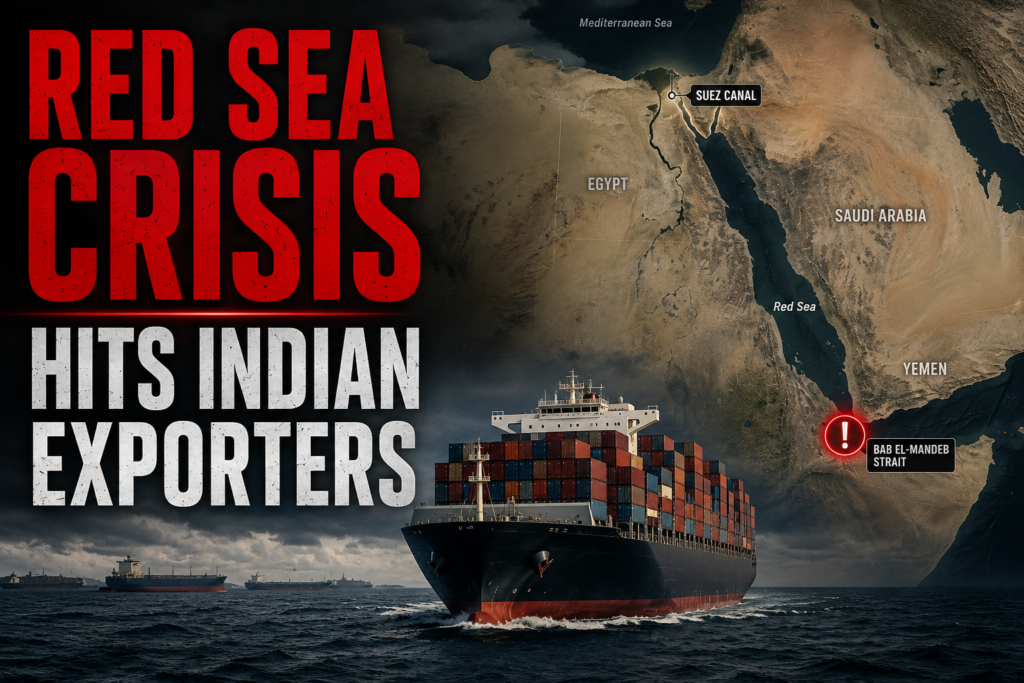
The Red Sea is one of the world’s most important trade corridors.
Together with the Suez Canal, it provides the fastest maritime connection between Asia and Europe. Roughly 10–15% of global trade normally passes through this route.
For Indian exporters, the path has long been straightforward:
India → Red Sea → Suez Canal → Europe
When vessels avoid the region, many are forced to travel around the Cape of Good Hope in South Africa instead.
That detour can add anywhere from 10 to 20 days to a voyage.
At first glance, a couple of extra weeks at sea may not seem particularly dramatic. Most consumers are unlikely to notice whether a container reaches Europe in 25 days or 40 days.
Businesses notice.
A disruption at sea eventually finds its way into production schedules, warehouse planning, financing decisions, and customer conversations.
Modern trade runs on assumptions. The Red Sea crisis is exposing what happens when those assumptions stop holding.
Why Are Shipping Companies Changing Routes?
The crisis emerged after attacks on commercial vessels increased security concerns in the region.
As risks grew, shipping companies, insurers, cargo owners, and traders were forced to reassess the route.
Many vessels were rerouted.
The decision itself was straightforward. The consequences were not.
A longer voyage means more fuel consumption, higher operating expenses, additional insurance costs, and more time at sea. It also means ships complete fewer journeys over a given period, reducing available capacity across parts of the shipping network.
People often imagine trade disruptions as dramatic events where goods stop moving altogether.
Most disruptions are less visible than that.
Goods continue moving. They simply move less efficiently.
Costs rise.
Schedules stretch.
Buffers disappear.
The pattern may feel familiar. During the pandemic, businesses discovered how quickly problems in one part of the world could affect companies thousands of kilometers away. The causes are different this time, but the lesson is similar: global supply chains are often more interconnected than they appear.
How Indian Exporters Are Feeling the Impact
The most visible effect has been higher freight costs.
Longer routes require more resources, and shipping companies pass part of those costs through the supply chain.
For exporters operating in competitive markets, even modest increases can create pressure.
A textile exporter in Tiruppur shipping garments to Germany, for example, may face higher logistics expenses at the same moment European buyers are demanding tighter pricing. The numbers do not have to be dramatic for margins to come under strain.
Not every exporter faces the same challenge.
Larger companies with diversified customer bases and stronger balance sheets can often absorb temporary disruptions more easily. Smaller firms may have less flexibility.
That distinction sometimes gets lost in discussions about exports.
There is also a practical issue that rarely appears in trade statistics: communication.
Some exporters report spending more time updating customers, revising delivery expectations, and responding to scheduling questions. None of that appears on a freight invoice, but it still consumes time and resources.
The impact extends beyond transportation costs.
Delivery Delays And The Problem With Planning
An extra ten days at sea is inconvenient.
The bigger issue is that businesses often do not know exactly how long the delay will be.
Manufacturers schedule production runs. Retailers plan seasonal inventory. Warehouses allocate storage space. Importers arrange transportation before cargo arrives.
Most of those decisions happen weeks or months before a shipment reaches its destination.
A retailer expecting summer inventory does not necessarily need perfect timing. What they need is confidence in the timeline.
A shipment that arrives ten days late creates one set of problems.
A shipment that could arrive ten days late, or twenty days late, creates another.
The cost of disruption is often measured in freight rates. Its impact is often measured in decisions businesses no longer feel comfortable making.
That distinction matters.
Cash Flow Pressure
One of the less visible consequences involves working capital.
Many exporters receive payment only after goods reach certain milestones or after documentation processes are completed.
When shipments take longer, payments often take longer too.
An engineering company exporting industrial equipment to Europe may still have to pay suppliers, employees, utility bills, and lenders while waiting for customer payments to arrive.
One delayed shipment is manageable.
Several delayed shipments at the same time can create a different situation.
Trade disruptions rarely show up immediately on financial statements. They accumulate gradually, sometimes quietly enough that the pressure is underestimated in the early stages.
Which Industries Are Most Exposed?
Not every sector experiences the disruption in the same way.
Textiles: Timing Matters More Than It May Appear
The textile sector is particularly exposed because it combines intense price competition with time-sensitive demand.
A garment arriving late does not suddenly lose all value. Business is rarely that simple.
But timing influences value more than many people realize.
European retailers often work around seasonal calendars. A delayed shipment may still be sold, though perhaps under less favorable conditions. Discounts become more likely. Inventory planning becomes more complicated. Future orders may be reconsidered.
There is another layer to this.
Textile exporters have spent years adapting to changing demand patterns, inflation concerns, and shifting consumer behavior in overseas markets. The Red Sea disruption arrives on top of those existing pressures rather than replacing them.
That is often how business challenges appear in reality. Problems rarely arrive one at a time.
Engineering And Industrial Goods
Engineering exporters face a different calculation.
Many operate through longer-term contracts where customer relationships matter as much as pricing. A delayed shipment can affect installation schedules, project timelines, and coordination with other suppliers.
The financial impact may not be immediate.
The planning impact often is.
Auto Components
Automotive supply chains depend heavily on coordination.
A supplier in Pune shipping components to a European manufacturer may discover that a relatively modest delay creates scheduling challenges elsewhere in the production process.
Sometimes the disruption is visible.
Sometimes it is simply another adjustment someone further down the supply chain has to make.
Chemicals And Agriculture
Chemical exporters face pressure because transportation costs often represent a meaningful share of total shipment economics.
Agricultural exporters face a different challenge. Longer transit times can complicate logistics planning and inventory management, particularly for products where timing affects commercial value.
What Does This Mean For India’s Economy?
The effects extend beyond individual exporters.
Higher logistics costs can weigh on export growth. Businesses may face additional financing needs. Imported inputs can become more expensive.
Over time, these pressures can influence competitiveness.
At the same time, the picture is not entirely one-sided.
Some larger exporters may emerge relatively stronger if they are better positioned to absorb disruptions than smaller competitors. Market share sometimes shifts during periods of uncertainty rather than disappearing altogether.
Reality tends to be more complicated than simple winner-and-loser narratives.
Could There Be Opportunities?
Possibly.
Periods of disruption often reveal weaknesses that remain hidden during stable periods.
The pandemic exposed vulnerabilities in global supply chains. Trade tensions exposed others.
The Red Sea crisis is drawing attention to logistics infrastructure, port efficiency, inventory management, and supply-chain resilience.
None of these topics are particularly exciting. They rarely dominate headlines.
Yet they often determine competitiveness over the long run.
Some of the investments and reforms being discussed today might have happened eventually anyway. Disruptions simply have a way of accelerating priorities.
Final Thoughts
The Red Sea crisis may appear distant from India.
For exporters, it is not.
A security problem near a major shipping corridor has become a business issue affecting costs, planning, customer relationships, and cash flow across multiple industries.
Whether the disruption eases in the coming months or persists for longer remains unclear.
What already seems clear is that global trade depends on more than ships, ports, and infrastructure. It depends on confidence that goods will move roughly when and how businesses expect them to.
Most of the time, that confidence is invisible.
People rarely think about shipping schedules when everything is working.
They start thinking about them when it isn’t.
And reliability, once taken for granted, has a way of becoming valuable only after it becomes harder to find.