Global trade rarely feels personal. Most people do not spend much time thinking about tariffs, customs duties, or supply-chain strategy. Yet decisions made in Washington can eventually affect factory orders in Gujarat, electronics production in Tamil Nadu, and the prices consumers pay around the world.
Consider a smartphone assembled in India using components sourced from several countries before being sold in the United States. A tariff imposed thousands of miles away can change the economics of that entire chain. Suppliers may be replaced, sourcing contracts renegotiated, and investment plans delayed. What begins as a policy announcement in one country can eventually influence hiring decisions, factory expansion plans, and production schedules somewhere else entirely.
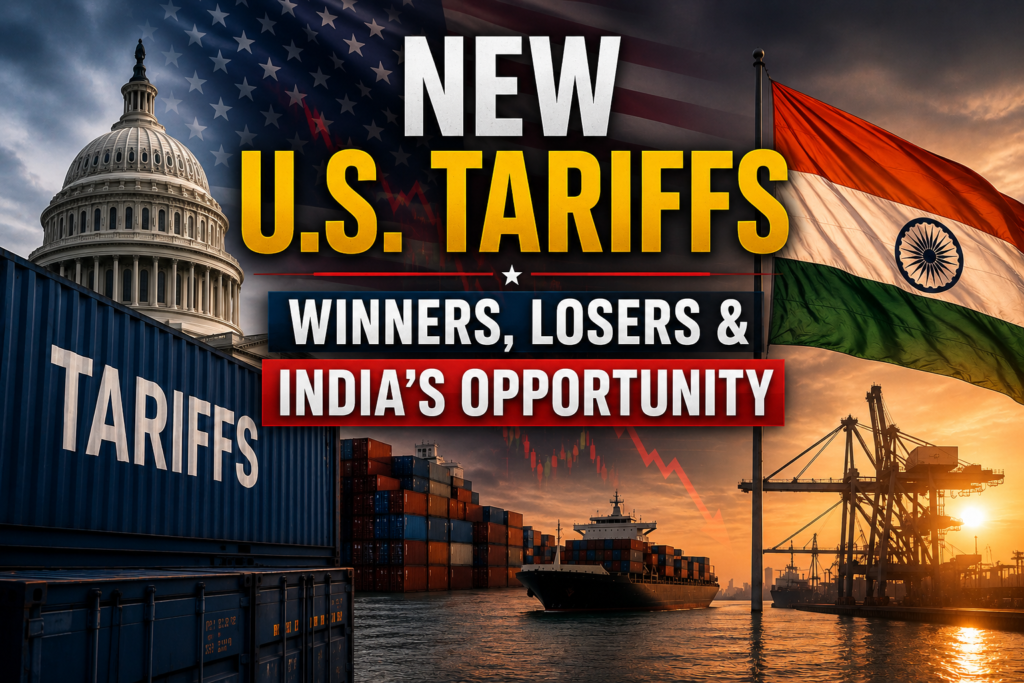
That helps explain why the latest U.S. proposal to impose new tariffs on imports from dozens of countries has attracted so much attention.
The debate is no longer simply about imports and exports. Increasingly, it is about who controls critical technologies, manufacturing capacity, raw materials, and the industrial foundations of future economic power.
For businesses, governments, and investors alike, the conversation has become much larger than trade.
What Are the New U.S. Tariffs?
A tariff is a tax on imported goods. When tariffs rise, foreign products become more expensive, giving domestic producers a potential advantage.
The latest U.S. tariff proposals cover imports from a broad range of countries and sectors. While the details vary, the overall direction is clear: encourage more production within the United States and reduce dependence on overseas manufacturing networks that policymakers consider strategically risky.
Certain industries sit at the center of this effort. Advanced manufacturing, industrial equipment, critical minerals, batteries, and strategic technologies appear repeatedly in trade discussions.
That shift did not emerge overnight.
For decades, lower costs and greater efficiency often guided trade policy. Today, governments are asking a different set of questions. If a geopolitical crisis disrupts a major supplier, how quickly can production recover? If access to critical materials becomes restricted, what happens to domestic industries?
In some ways, this resembles earlier periods when governments placed industrial security ahead of pure economic efficiency. The difference is scale. Modern supply chains stretch across dozens of countries, linking ports, factories, suppliers, and logistics networks in ways that would have been difficult to imagine a generation ago.
Why Is the U.S. Increasing Tariffs Now?
Several developments have pushed trade policy in this direction.
Over the past few years, disruptions exposed weaknesses in supply chains that many companies had long assumed were reliable. Efficiency delivered lower costs, but it did not always deliver resilience.
Strategic competition with China accelerated the reassessment.
Technologies once viewed primarily through a commercial lens are increasingly treated as strategic assets. Semiconductors are perhaps the clearest example. People often describe them as a technology story. Governments increasingly view them as a national capability story.
The chips themselves are tiny, but the industrial power attached to them is enormous.
Politics matters too. Manufacturing remains an important economic and political issue across large parts of the United States. Policies that promise investment and production tend to attract support.
Still, tariffs alone do not create competitive industries.
Factories require skilled workers. Supplier networks take years to develop. Infrastructure cannot be built overnight. Trade barriers may influence investment decisions, but industrial strength usually comes from a much longer process.
Winners, Losers, and the Real Cost of Adjustment
Trade disputes rarely produce clean winners and losers.
American manufacturers may benefit if imported products become less competitive. Some firms could expand domestic production or increase investment in local facilities.
Outside the United States, alternative manufacturing destinations may also gain.
Over the past several years, global electronics companies have gradually expanded production beyond China. Smartphone assembly, consumer electronics manufacturing, and certain component supply chains have increasingly spread across countries such as India and Vietnam. Not because companies suddenly abandoned globalization, but because concentrating too much production in one place began to look risky.
That trend was already underway. Additional tariffs may reinforce it.
The costs, however, are often less visible.
Export-oriented economies face uncertainty when access to major markets becomes less predictable. Consumers may encounter higher prices. Businesses can find themselves managing more regulations, more paperwork, and more complicated sourcing requirements.
The hardest part is often the transition itself.
Modern manufacturing depends on dense ecosystems of suppliers, transport networks, warehouses, specialized workers, and supporting industries. Relocating a factory is difficult. Recreating an entire industrial ecosystem is far harder.
How Markets Are Looking at the Situation
The usual explanation is that markets dislike uncertainty.
True, but that only explains part of what is happening.
Trade policy has an unusual characteristic. Markets often react immediately, while the economic consequences unfold over years.
Investors are not trying to predict next quarter alone. They are trying to estimate how businesses will respond over the next several years. Will companies build new factories? Expand existing facilities? Shift sourcing strategies? Delay major investments?
Those decisions rarely happen quickly.
A manufacturing plant announced today may not reach full production for years. A supplier relationship established this year may shape business performance long after the political debate has moved on.
A decade ago, many boardroom discussions revolved around cost, efficiency, and growth projections. Today, geopolitical risk frequently appears alongside those priorities.
That shift may outlast any individual tariff announcement.
What Do the New U.S. Tariffs Mean for India?
For India, the situation is more complicated than a simple story of opportunity or risk.
The United States remains one of India’s most important export markets. Pharmaceuticals, engineering goods, chemicals, textiles, electronics, and automotive components all depend, to varying degrees, on access to international demand.
A slowdown in global trade would create challenges. Rising protectionism can increase costs, complicate compliance requirements, and make long-term planning more difficult for exporters.
Yet much of the discussion around India focuses on a different question: where will future manufacturing investment go?
Many multinational companies are no longer evaluating production locations using cost alone. Reliability, logistics, market access, infrastructure quality, and policy stability increasingly shape those decisions.
When a company considers where to assemble smartphones, produce electric-vehicle components, or manufacture industrial machinery, it is not simply choosing a country. It is choosing an ecosystem of suppliers, ports, transport links, warehouses, skilled workers, and regulatory institutions.
That is why supply-chain diversification has become such a significant trend.
India is not competing only with China. It is also competing with Vietnam, Mexico, Indonesia, and other countries seeking to attract manufacturing investment.
Its strongest advantage may be scale.
Few countries combine a large labor force, expanding infrastructure, and a massive domestic consumer market. For multinational firms, that combination can be difficult to ignore. A factory built in India is not only a platform for exports. It can also serve one of the world’s largest and fastest-growing consumer markets.
This helps explain why global manufacturers across sectors such as electronics, automotive production, and industrial equipment continue expanding their presence in the country.
There is another factor that receives less attention.
The real competition may not be between countries that produce the most goods. It may be between countries that can offer the most predictable business environment in an increasingly unpredictable world.
For long-term investors, predictability often matters as much as cost.
Where India Could Benefit
Electronics manufacturing remains one of the most closely watched opportunities.
As companies diversify production networks, India could attract additional investment not only in assembly operations but also in component manufacturing and supplier ecosystems.
Specialty chemicals and auto components also stand out. Both sectors have developed significant capabilities over time and already occupy important positions within global supply chains.
Renewable-energy equipment and defense manufacturing could become additional areas of growth as countries place greater emphasis on trusted industrial partnerships.
The most important decisions may not be visible immediately. They are being made in boardrooms, investment committees, and long-term planning meetings today, even if their effects do not appear for several years.
The Challenges India Cannot Ignore
The opportunity story is compelling. It is also incomplete.
Attracting investment announcements is one thing. Turning those announcements into thriving industrial ecosystems is another.
Investors can announce projects relatively quickly. Building supplier networks, training workers, improving logistics connections, and scaling production often takes much longer.
Infrastructure still matters. Ports matter. Freight corridors matter. Reliable power supply matters.
Countries that successfully become manufacturing hubs usually spend years strengthening those foundations before the results become fully visible.
India has made progress, but execution remains as important as ambition.
A Different Phase of Globalization
The global economy is not necessarily becoming less connected.
What seems to be changing is the way those connections are organized.
Terms such as “friend-shoring” and “near-shoring” have become common because businesses and governments are increasingly willing to sacrifice some efficiency in exchange for greater resilience.
Interestingly, many companies are not reducing international exposure altogether. They are spreading it across more countries.
That distinction matters.
This is not necessarily a retreat from globalization. It may be a reconfiguration of globalization.
The era of building supply chains solely around efficiency may be giving way to an era of building them around resilience, flexibility, and strategic trust.
India’s Position in a Changing Trade Landscape
Trade policy is becoming an extension of geopolitical strategy.
Manufacturing capacity, critical technologies, and industrial supply chains are increasingly viewed as strategic assets rather than purely commercial ones. Tariffs are only one tool within a broader competition over economic influence and industrial capability.
For India, that creates both pressure and possibility.
Trade tensions can create uncertainty. They can also create openings for countries capable of attracting investment, strengthening industrial ecosystems, and earning the confidence of global manufacturers.
Whether India fully captures that opportunity will depend less on tariff announcements abroad and more on decisions made at home.
The next phase of globalization may not be defined by how cheaply goods move across borders.
The paradox is that globalization may survive not by making countries more dependent on one another, but by giving them more choices about who they depend on.