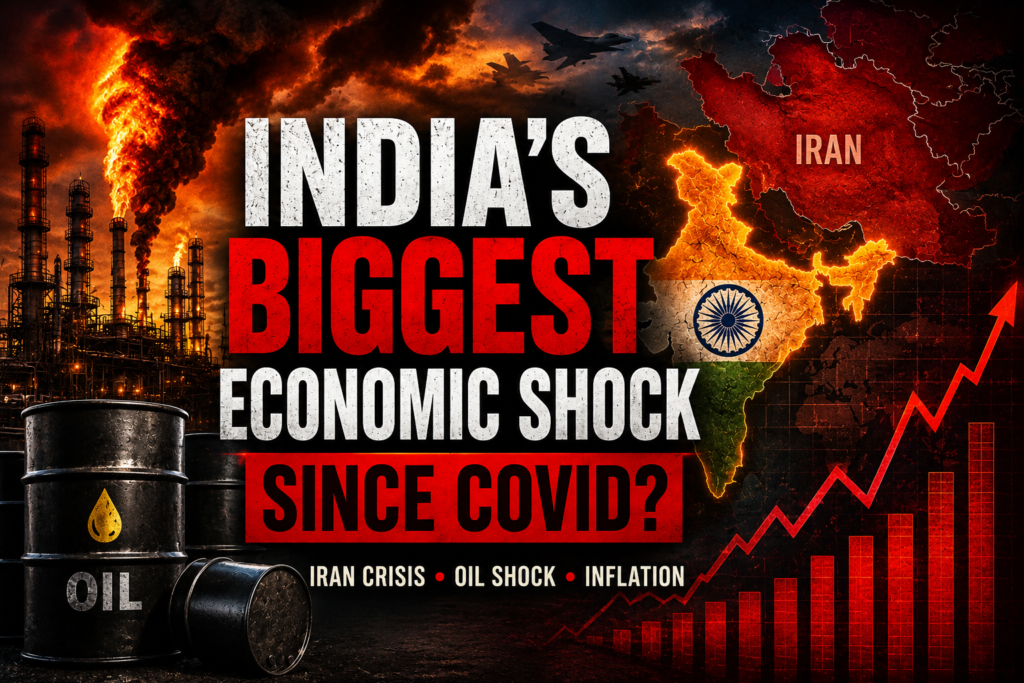
The Middle East is once again at the center of global attention.
Rising tensions across the region have revived concerns about energy security, shipping disruptions, and the stability of some of the world’s most important trade routes. Oil markets have reacted cautiously. Shipping companies are reassessing risk. Governments are watching closely because even localized instability can create consequences far beyond the region itself.
Most headlines focus on military developments and diplomatic maneuvering. A quieter story is unfolding alongside them.
It revolves around Haifa Port.
For India, Haifa is far more than an overseas investment. It sits at the intersection of trade, diplomacy, logistics, and long-term economic strategy. What looked a few years ago like a commercial acquisition increasingly appears tied to a much larger shift in how countries think about economic security.
That shift did not begin with the current crisis.
The crisis simply made it easier to see.
What Is Haifa Port?
Haifa Port sits on Israel’s Mediterranean coast and serves as one of the country’s most important maritime gateways.
Its location provides access to European markets while connecting trade flows moving across the Mediterranean and the wider Middle East. For decades, it has handled a significant share of Israel’s imports and exports.
Geography explains much of its value.
One reason ports attract so much strategic attention is that geography creates advantages that politics cannot easily replicate. Governments change. Trade policies change. A well-positioned harbor remains where it is.
Placed between Europe, Asia, and the eastern Mediterranean, Haifa occupies a location that logistics planners tend to notice quickly.
Most people never think about ports until supply chains break down. Yet some of the most consequential economic decisions in the world pass through them every day. Factories depend on them. Retailers depend on them. Entire export industries depend on them.
Ironically, infrastructure often becomes most visible when it stops working.
Why Does India Care About Haifa Port?
India’s interest became more visible when the Adani Group, together with Israel’s Gadot Group, acquired control of the port.
At first glance, it looked like a straightforward infrastructure deal.
But major port investments are rarely evaluated solely on current cargo volumes. Countries increasingly view them as long-term positions within larger trade networks.
The acquisition gave India a stake in an asset located near routes that could become more important over time. That matters because governments are becoming less comfortable relying on a small number of trade pathways.
Diversifying trade routes is not very different from diversifying investments. The goal is not to abandon existing assets. The goal is to avoid relying entirely on one option.
India wants stronger commercial links with Europe, deeper engagement with the Middle East, and a place within trade corridors that may look very different a decade from now.
Part of the reason Haifa received limited attention in India is that infrastructure stories rarely attract the same coverage as diplomatic visits, elections, or military developments.
Yet infrastructure often has a longer shelf life than any of them.
The Bigger Vision Behind Haifa
To understand why Haifa matters, it helps to look beyond the port itself.
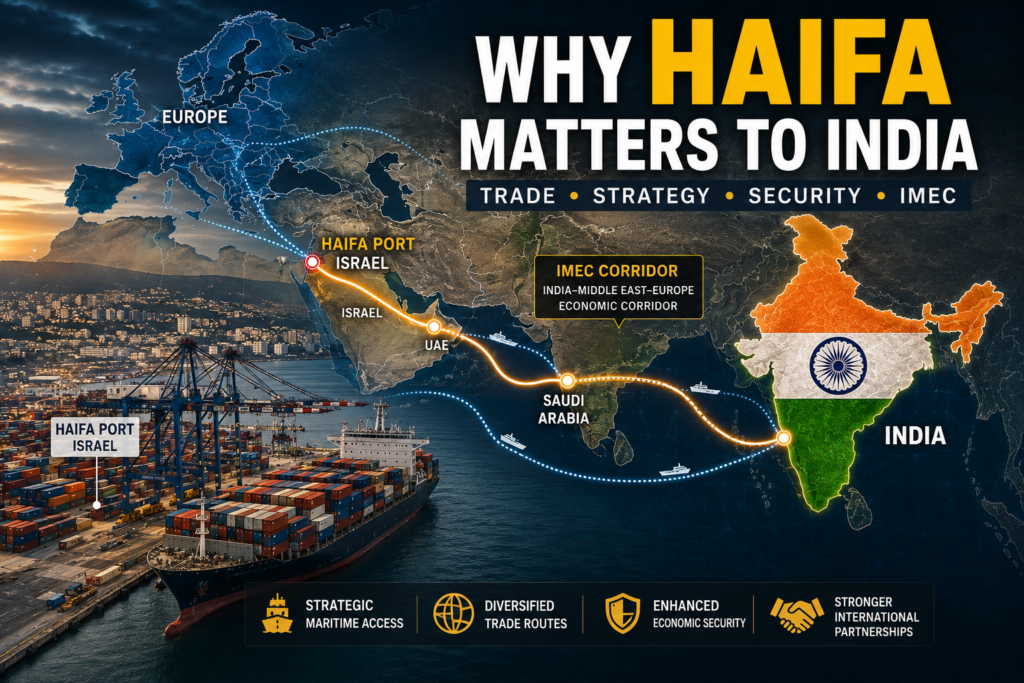
The larger story is the proposed India-Middle East-Europe Economic Corridor, or IMEC.
The idea is relatively straightforward. Goods would move between India, Gulf countries, Israel, and Europe through a combination of maritime transport, rail links, and logistics hubs.
India → UAE → Saudi Arabia → Israel → Europe
Much of today’s India-Europe trade moves through traditional maritime routes that include the Suez Canal.
That route remains essential.
But recent years have reminded governments and businesses of something they already knew but perhaps underestimated: efficiency and resilience are not always the same thing.
A route can be highly efficient and still become vulnerable.
The Suez Canal blockage in 2021 lasted only days, yet its effects were felt across global supply chains. The incident became a useful reminder of how much economic activity can depend on a handful of geographic chokepoints.
Infrastructure projects like IMEC are partly a response to that reality.
Of course, there is a risk of overstating what projects like IMEC can achieve. Large cross-border infrastructure initiatives often take years, sometimes decades, to develop fully. Political priorities shift. Governments change. Economic conditions change.
The history of global trade is filled with projects that took much longer than originally expected.
Still, the direction of travel is difficult to miss.
Countries want options.
Haifa matters because it could become one of those options.
Why The Current Crisis Changed The Conversation
Until recently, discussions about Haifa were mostly framed around future opportunity.
Now they are increasingly about present-day strategic value.
Periods of instability have a habit of exposing vulnerabilities that remain hidden during calmer times.
A shipping company does not wait for a crisis to fully unfold before adjusting risk calculations. Often the first signs appear through insurance pricing, route reviews, contingency planning, and conversations happening quietly inside logistics departments.
Long before consumers notice anything, businesses begin preparing.
The value of alternative routes rarely becomes obvious during normal periods.
It becomes obvious when something goes wrong.
History offers plenty of examples. Rail networks, canals, and deep-water ports have repeatedly shifted from commercial assets to strategic assets when trade routes came under pressure.
There is a tendency to view logistics infrastructure as background scenery for the global economy.
That perspective is becoming harder to sustain.
The Economic Impact For India
For many Indians, developments around Haifa may feel distant.
They are not necessarily distant in economic terms.
India remains heavily dependent on imported energy, and the Middle East continues to play a central role in that equation. Even when physical supplies remain stable, uncertainty can influence transportation costs, insurance pricing, and market expectations.
Shipping costs provide another example.
Geopolitical risk tends to make shipping more expensive. Freight rates fluctuate. Insurance premiums rise. Delivery schedules become harder to predict.
Imagine a machinery manufacturer in western India exporting products to Europe. A delay of several days may not sound dramatic, but it can affect inventory planning, customer commitments, transportation costs, and production schedules.
Small disruptions have a habit of becoming larger business problems.
The same logic applies to supply chains more broadly.
Since the pandemic, companies have become less focused on finding the absolute cheapest route and more focused on ensuring they have alternatives when disruptions occur.
That shift may sound subtle.
It is not.
For decades, efficiency dominated supply-chain thinking. Increasingly, resilience carries equal weight.
Haifa Is About More Than Trade
Ports have always been economic assets.
Today they are increasingly becoming strategic assets as well.
One interesting feature of modern geopolitics is that trade routes rarely stay just trade routes. Economic influence has a habit of spilling into political influence over time.
Around the world, governments are investing in ports, rail links, energy infrastructure, and logistics networks because they understand that commerce and strategy are becoming more intertwined.
Cargo volumes are only part of the story.
Haifa gives India a place within an evolving network of relationships, trade flows, and transportation links stretching across multiple regions.
Infrastructure rarely generates excitement when it is built.
Its importance usually becomes obvious only when alternatives are needed.
Risks India Still Faces
The strategy is not without challenges.
Regional instability remains the most obvious risk.
Large international corridors also depend on sustained cooperation between multiple governments. That sounds straightforward in theory. In practice, regional politics rarely move in straight lines.
There is another point worth keeping in mind.
Strategic importance does not automatically translate into commercial success.
Some projects become geopolitically significant long before they become economically significant. Others generate political enthusiasm that eventually proves difficult to justify commercially.
The reality is likely more complicated than either supporters or critics suggest.
It would also be premature to assume IMEC develops exactly as originally envisioned.
Major infrastructure projects almost never do.
Why Haifa Also Fits Into The Bigger India-China Story
Any discussion about global infrastructure eventually leads to China.
Over the past decade, Beijing has expanded its international footprint through ports, railways, industrial zones, and transportation corridors associated with the Belt and Road Initiative.
India’s approach is different.
It is more selective, more targeted, and considerably smaller in scale.
This does not necessarily mean the two countries are engaged in a direct contest over every project.
But it reflects a broader reality.
Trade routes rarely remain purely economic assets for long.
Countries that help shape how goods move often gain influence that extends well beyond commerce itself.
What Happens Next?
Much depends on how regional developments unfold.
If tensions ease, infrastructure initiatives such as IMEC could regain momentum.
If uncertainty persists, investment decisions may slow while businesses continue looking for alternatives and contingency plans.
If instability expands, governments and companies are likely to accelerate efforts to diversify trade routes and reduce dependence on vulnerable chokepoints.
Counterintuitively, the strategic value of infrastructure is often highest before it becomes heavily used.
People tend to notice infrastructure once it is busy.
Governments often value it because of what it might allow them to do in the future.
That distinction is easy to miss.
A Port That Represents Something Bigger
The story of Haifa is not really about a single port.
It reflects a broader shift in how countries think about economic security.
For years, efficiency was often the primary goal. Increasingly, reliability, flexibility, and optionality are becoming just as important.
Infrastructure projects rarely generate the attention that military developments or diplomatic summits do. They are slower, less dramatic, and often difficult to explain in a headline.
Yet their effects can last much longer.
Whether IMEC ultimately develops as originally envisioned remains uncertain.
What is becoming harder to ignore is the growing importance of infrastructure in geopolitical competition. Ports, railways, logistics hubs, and energy networks are quietly shaping relationships between countries in ways that traditional diplomacy alone cannot.
In that context, Haifa looks less like an isolated investment and more like one piece of a much larger strategic puzzle.
The current Middle East crisis did not create Haifa’s importance.
It simply made more people notice it.