While the United States openly backs its allies and Iran openly challenges Western pressure, one major global power has chosen a noticeably different approach.
China has largely stayed quiet.
Beijing has avoided dramatic military statements, direct intervention, and public confrontation. Its public messaging has been predictable: calls for restraint, support for diplomacy, and concern about regional stability.
At first glance, that restraint can seem unusual.
China is no longer a distant observer in the Middle East. It is the largest trading partner of several countries in the region, one of the world’s biggest energy importers, and an increasingly influential economic actor stretching from the Gulf to North Africa.
Yet Beijing has shown little desire to become the loudest voice in the room.
That silence has led many observers to ask a simple question: what does China actually want?
The answer becomes clearer when you stop looking at the battlefield and start looking at the balance sheet.
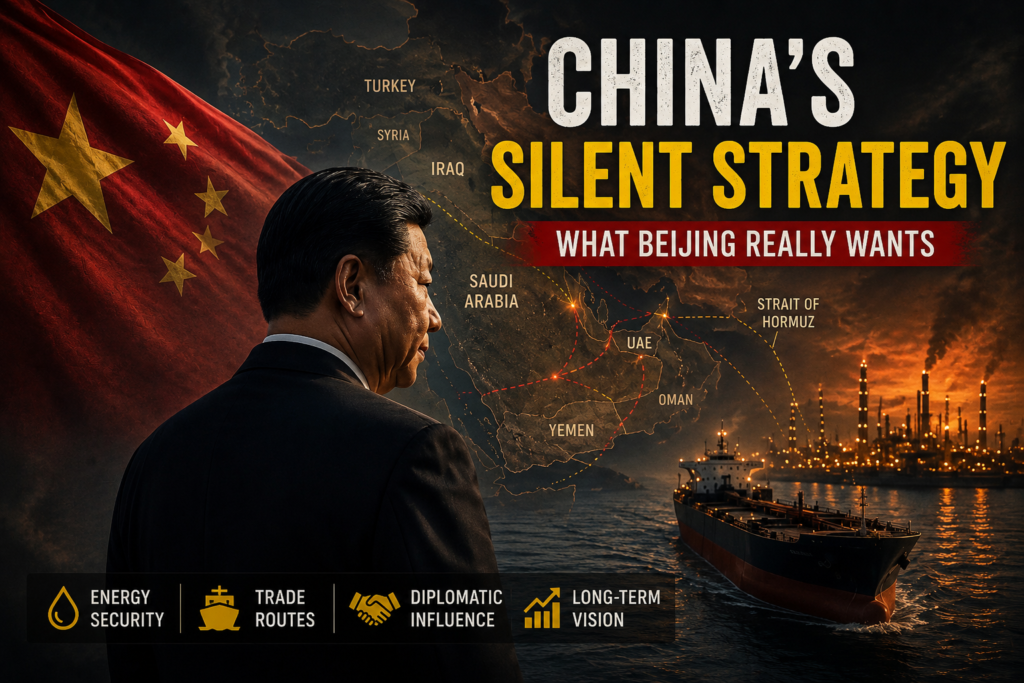
China’s response to the Iran conflict appears less focused on the immediate crisis and more focused on the world that exists after the crisis. Military exchanges may dominate headlines, but Beijing’s concerns are often longer-term: energy security, trade routes, supply chains, and influence.
In many ways, the conflict reveals how differently China thinks about power.
Why Iran Matters More Than Many People Realize
Most discussions about China and Iran begin with oil, and for good reason.
China imports millions of barrels of crude oil every day and remains heavily dependent on overseas energy supplies despite years of investment in renewables and domestic production. Iran possesses some of the world’s largest oil and natural gas reserves, making it difficult for any Chinese government to ignore.
But reducing the relationship to oil misses part of the story.
Iran sits in a strategically important position between Asia, the Middle East, and Europe. For decades, globalization encouraged the belief that geography mattered less than it once did. Reality has moved in the opposite direction. Shipping lanes, energy corridors, ports, rail networks, and strategic chokepoints have become increasingly important.
The Strait of Hormuz is a good example.
Roughly a fifth of the world’s oil supply passes through that narrow waterway. Whenever tensions rise in the region, energy markets react almost immediately. Traders do not wait for disruption to occur. The possibility alone can move prices.
Beijing watches those developments carefully.
Iran also occupies an important place in China’s broader Belt and Road ambitions. Not because Tehran is uniquely powerful, but because connectivity remains central to China’s long-term economic vision. Infrastructure projects often look unremarkable when viewed individually. A railway here. A port expansion there.
Over time, however, those projects create networks.
And networks create influence.
That does not mean China and Iran are natural allies.
This is where many analyses become too simplistic.
The relationship is better understood as a partnership of overlapping interests rather than deep ideological alignment. Both countries have reasons to push back against aspects of a Western-led international system, but their priorities are not always the same.
China’s primary concern is economic growth and stability.
Iran’s priorities are often shaped by security pressures and regional politics.
Those objectives overlap sometimes. Not always.
Why Beijing Is Being So Careful
Many people assume China should openly support Iran because of their economic relationship.
The reality is much messier.
China has spent years building ties not only with Iran but across the Gulf. Saudi Arabia has become one of China’s largest crude oil suppliers. The United Arab Emirates has emerged as an important trade and logistics hub for Chinese companies. Qatar remains a major energy partner.
The problem for Beijing is that these relationships matter simultaneously.
Supporting Tehran too aggressively could create friction elsewhere. Distancing itself from Iran entirely would carry costs of its own.
As a result, China has largely chosen the middle path.
This approach sometimes gets described as neutrality, but that word can be misleading. Beijing is not neutral in the sense of having no interests. It has enormous interests in the region.
What it prefers is flexibility.
One irony of China’s rise is that much of its growing influence comes from avoiding the traditional great-power playbook. Historically, major powers expanded their influence through military alliances, troop deployments, and security commitments.
China’s model has been different.
Trade agreements.
Infrastructure investment.
Industrial partnerships.
Energy deals.
The irony is that Beijing may be benefiting precisely because it refuses to play the traditional great-power role.
Whether that remains possible as its interests continue to expand is another question entirely.
The larger China’s footprint becomes, the harder it may be to avoid political and security entanglements.
History is not especially kind to powers that believe they can enjoy influence without responsibility forever.
The Quiet Advantages Beijing May Be Seeing
China’s public position has been cautious, but that does not mean the crisis offers no opportunities.
Energy is the most obvious example.
Countries facing sanctions often have fewer buyers and less bargaining power. For major importers, that can create favorable purchasing conditions and diversified supply options.
Yet price may not be Beijing’s biggest concern.
Uncertainty is.
Modern industrial economies can often absorb higher costs. They struggle much more with unpredictability. Manufacturers can plan around expensive energy. Planning becomes far more difficult when nobody knows whether supplies will remain stable next month.
This is one reason Chinese policymakers focus so heavily on supply security.
There is another dimension that receives less attention.
When policymakers in Washington are consumed by one crisis, they inevitably devote less attention to something else. That does not automatically create Chinese gains. International politics rarely works that neatly.
Still, strategic attention is a finite resource.
Governments cannot focus on everything at once.
Chinese leaders understand this reality, although whether it ultimately translates into lasting geopolitical advantages remains far less clear than some commentators suggest.
There is also a risk of overstating China’s influence.
Economic presence does not automatically translate into political leverage. Countries often welcome Chinese investment while resisting Chinese influence. The two are not the same thing.
Several Middle Eastern governments have become increasingly skilled at balancing relationships with multiple powers simultaneously. They buy weapons from one country, attract investment from another, and cooperate diplomatically with a third.
That limits everyone’s influence, including China’s.
The Oil Question Is Really About Predictability
Much of the discussion surrounding the conflict focuses on oil prices.
That matters.
But Beijing is probably watching something more specific: volatility.
A sudden spike in prices can be painful. Constant uncertainty can be worse.
For an economy as large as China’s, volatility creates problems throughout the system. Transportation costs become harder to forecast. Manufacturers struggle to plan. Investors become cautious. Supply chains become more fragile.
The issue is not simply whether oil becomes expensive.
It is whether energy markets remain predictable.
China has spent years expanding strategic petroleum reserves and diversifying suppliers partly because policymakers understand this vulnerability. Energy security is not just about access. It is about resilience.
That distinction often gets lost in public debate.
A Diplomatic Opportunity — Or Maybe Not
A decade ago, the idea of China emerging as a significant diplomatic player in the Middle East would have sounded ambitious.
Today it sounds plausible.
Beijing helped facilitate the 2023 Saudi-Iran rapprochement, a development that surprised many observers who viewed China primarily as an economic actor. The agreement did not resolve every disagreement between the two countries, but it demonstrated something important.
China wanted a larger diplomatic role.
Whether regional powers want the same thing remains less certain.
There is often a tendency to assume economic influence naturally becomes diplomatic influence. History suggests otherwise. Trade relationships can create access. They do not automatically create trust.
In international politics, influence is often easier to measure after a crisis than during one.
China’s true diplomatic weight may not become clear until it is tested by a situation where economic interests alone are insufficient.
What This Means for India
For India, the implications extend beyond oil prices.
Energy remains the immediate concern, of course. Significant disruptions in the Middle East eventually affect fuel costs, inflation, transportation, and economic growth.
But India’s challenge differs from China’s.
Beijing is trying to expand influence across the region.
New Delhi often finds itself managing relationships with partners that are increasingly connected to one another.
India maintains ties with the United States, Gulf countries, Israel, and Iran. That flexibility has long been an advantage. During periods of regional tension, however, balancing those relationships becomes more complicated.
The competition with China also looks different than it did a decade ago.
Increasingly, influence is being measured through ports, logistics networks, industrial investment, technology partnerships, and trade corridors. Military power still matters. But economic connectivity has become a major arena of competition in its own right.
That trend is unlikely to disappear when the current crisis ends.
The Bigger Picture
Looking only at daily headlines can make China’s behavior appear passive.
Viewed over a longer horizon, it looks more deliberate.
Beijing’s priorities extend beyond any single conflict. Energy security, trade connectivity, industrial competitiveness, technological advancement, and diplomatic influence are objectives measured in decades rather than news cycles.
That does not guarantee success.
China faces real constraints. It remains heavily dependent on imported energy. Its economic relationships do not always translate into political influence. Regional instability threatens many of the same trade networks Beijing hopes to strengthen.
There are risks on every side.
Still, the broader logic behind China’s approach is becoming easier to see.
While others focus on the immediate crisis, Beijing appears focused on positioning itself for what comes next.
The most important consequences of this conflict may ultimately emerge far from any battlefield.
History suggests trade routes tend to outlive headlines. Energy networks often matter long after military exchanges are forgotten. Economic influence accumulates gradually, then suddenly becomes impossible to ignore.
That may be the real story China is betting on.
And if Beijing is right, the decisions shaping the region’s future will not be made only by generals and diplomats. They will also be made by energy traders, shipping companies, infrastructure planners, investors, and governments quietly deciding where the next decade of economic influence will flow.