Wars don’t have to spread across borders to unsettle the global economy. Sometimes the expectation that they might is enough.
That is where the latest US-Iran confrontation now stands.
For a brief period, it appeared the latest chapter in one of the world’s longest-running geopolitical rivalries might finally be cooling. Diplomatic contacts resumed, military activity slowed, and financial markets cautiously welcomed the possibility that another regional crisis had been contained before it escalated further.
The optimism proved short-lived.
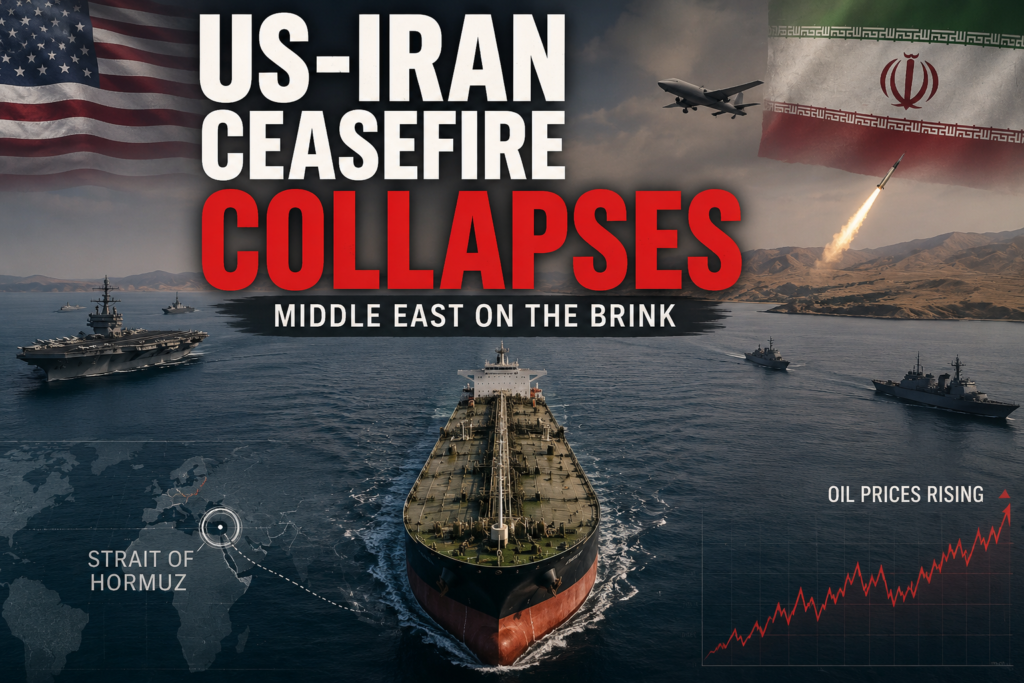
The ceasefire has effectively collapsed following renewed military strikes, retaliatory attacks, and rising tensions around the Strait of Hormuz. The immediate concern is military. The broader concern is economic. Shipping companies are reassessing routes, insurers are recalculating risk, and energy markets are reacting to uncertainty long before any meaningful disruption to oil supplies has occurred.
That’s often how modern geopolitical crises unfold. Businesses and investors rarely wait for governments to declare an emergency.
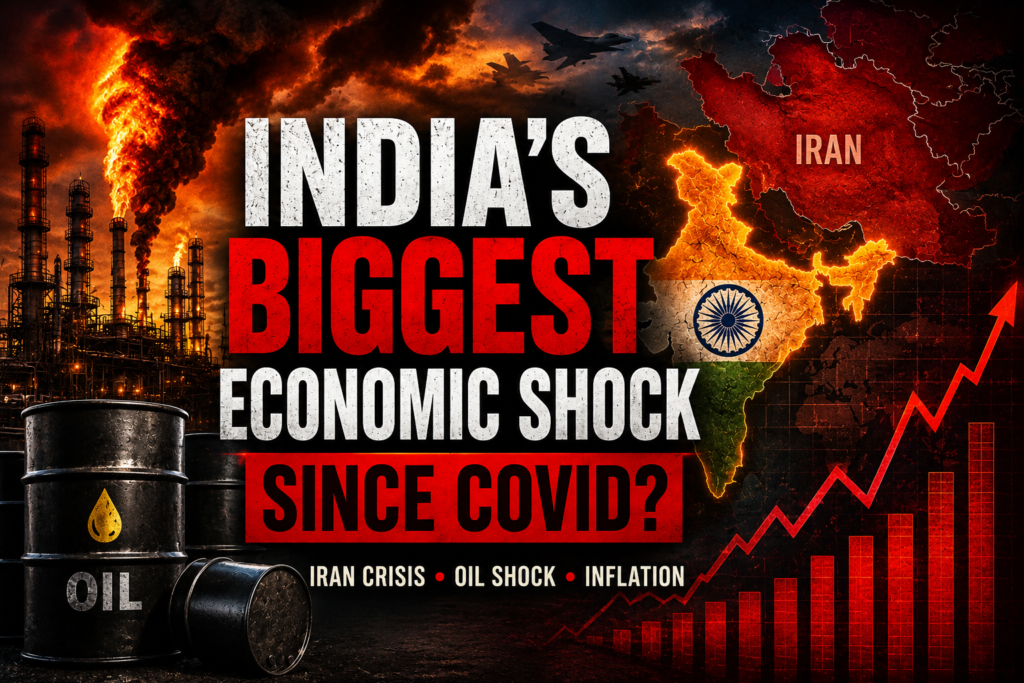
For countries that depend heavily on Middle Eastern energy, including India, the implications are difficult to ignore. A conflict confined to one region can still influence fuel prices, freight costs, inflation, and investment decisions thousands of miles away. Globalization has made supply chains remarkably efficient. It has also made them more sensitive to geopolitical shocks.
At first glance, this may look like another familiar cycle of retaliation between Washington and Tehran. The reality is more complicated.
The ceasefire did not collapse because of a single military strike or one diplomatic disagreement. It unraveled because the issues that produced it—regional influence, nuclear negotiations, maritime security, and domestic political pressures—never really disappeared. The agreement paused hostilities, but it did little to change the incentives driving either side.
That distinction matters.
Ceasefires can interrupt violence. They rarely resolve the strategic rivalry that caused it in the first place.
What Happened? A Timeline of the Ceasefire Collapse
The ceasefire emerged after months of military confrontation and behind-the-scenes diplomacy aimed at preventing a broader regional conflict. Publicly, both Washington and Tehran signaled a willingness to step back while discussions continued over security arrangements and wider political disagreements.
Initially, there were signs of progress. Direct military exchanges declined, diplomatic channels reopened, and markets responded with cautious optimism. For shipping companies and energy traders, even a temporary reduction in tensions was enough to ease some immediate concerns.
The calm, however, rested on fragile foundations.
Reports of ceasefire violations began surfacing as tensions returned around the Strait of Hormuz. Commercial vessels faced renewed security threats, both governments accused the other of breaching the agreement, and confidence deteriorated quickly. In confrontations shaped by years of mistrust, disputes rarely stay confined to the incident that triggered them.
The United States responded with fresh strikes against Iranian military targets, arguing that protecting international shipping and regional security required a direct response. Iran answered with missile and drone attacks targeting American interests and regional partners while increasing pressure across Gulf waters.
What often gets overlooked is that military escalation and diplomacy are not always separate tracks. In long-running rivalries, they frequently unfold at the same time. Public rhetoric hardens even as private communication continues through intermediaries.
Today, the ceasefire survives largely as a diplomatic label rather than a functioning agreement.
Military operations have resumed. Political trust has eroded. Commercial shipping has become a growing concern again, and energy markets are once more watching the Strait of Hormuz as closely as the battlefield itself.
The harder question isn’t whether the ceasefire has collapsed.
It’s whether either side still believes a negotiated settlement can deliver more than another round of escalation.
Why Did the Ceasefire Fail?
At first glance, the renewed military strikes appear to explain the collapse of the ceasefire.
They don’t.
The strikes accelerated a process that was already underway. The agreement itself was built on unresolved disputes that neither Washington nor Tehran was prepared to compromise on. It reduced violence for a time, but it never reduced the strategic competition beneath it.
That distinction is easy to miss during periods of rapid escalation. Ceasefires are often judged by whether the shooting stops. They are less often judged by whether the incentives to resume fighting have actually changed.
In this case, they hadn’t.
Mutual Distrust
Few international rivalries carry as much historical baggage as the relationship between the United States and Iran.
Decades of sanctions, proxy conflicts, intelligence operations, failed negotiations, and military confrontations have created an environment where intentions are routinely questioned before actions are even understood. Both governments tend to interpret the other’s moves through the assumption of hostile intent.
That has practical consequences.
A naval patrol becomes more than a patrol. A missile test becomes more than a demonstration. Even a limited incident risks being viewed as preparation for something larger.
Once that mindset takes hold, restraint becomes politically difficult.
Different Strategic Objectives
The disagreement is not simply about tactics. It is about what each side ultimately wants from the region.
Washington’s priorities remain broadly consistent: protect regional allies, deter Iranian military activity, preserve freedom of navigation through strategic waterways, and prevent further nuclear proliferation.
Iran’s priorities are built around a different calculation. Its regional partnerships, military capabilities, and influence across neighboring countries are viewed in Tehran as part of its security architecture rather than instruments of expansion alone. External military pressure, from that perspective, reinforces rather than weakens the argument for maintaining those capabilities.
Neither side believes it is acting irrationally.
That is precisely the problem.
The Nuclear Question
Although the immediate headlines focus on missiles and military operations, Iran’s nuclear program continues to shape almost every major diplomatic calculation.
Negotiations over uranium enrichment, sanctions relief, inspection regimes, and verification mechanisms have repeatedly stalled because progress in one area usually depends on concessions in another. What appears to be a technical dispute is, in reality, a negotiation over leverage.
The nuclear issue has gradually become larger than the program itself. It now influences regional security planning, alliance politics, sanctions policy, and the broader balance of power across the Middle East.
That helps explain why even temporary diplomatic breakthroughs have proved so difficult to sustain.
Regional Proxy Networks
The conflict extends well beyond Washington and Tehran.
Armed groups operating across Iraq, Syria, Lebanon, and Yemen have become part of the region’s broader security landscape. Their decisions can alter the trajectory of a crisis regardless of whether either government is actively seeking direct confrontation.
What often gets overlooked is that proxy networks create multiple points where escalation can occur independently. A localized attack, a miscalculation, or an unexpected retaliation can quickly reshape the diplomatic environment before national leaders have much opportunity to respond.
This is one reason Middle Eastern ceasefires tend to remain fragile. The number of actors involved makes them inherently difficult to control.
The Strait of Hormuz
The Strait of Hormuz represents more than a shipping route.
For Iran, it remains one of the few areas where it can exert meaningful strategic pressure despite years of economic sanctions and military constraints. For the United States and its partners, keeping that corridor open is treated as a principle of international commerce and maritime security.
Neither position has shifted in any meaningful way over the years.
Which means incidents at sea rarely remain just maritime incidents.
Domestic Political Pressure
Foreign policy is rarely shaped by external events alone.
Political leaders also negotiate with domestic audiences.
In both countries, periods of heightened tension narrow the political space for compromise. Concessions that might appear reasonable at the negotiating table can quickly be portrayed as weakness at home. Governments therefore face two negotiations simultaneously—one with their rivals and another with their own public.
Diplomacy becomes considerably harder under those conditions.
No Strong Enforcement Mechanism
There was also a structural weakness that became increasingly difficult to ignore.
The ceasefire depended largely on political commitments rather than an independent system capable of monitoring compliance or investigating alleged violations. Once accusations began to circulate, there was no widely trusted mechanism to establish what had actually occurred.
Reality became secondary to perception.
That matters because modern conflicts are fought as much through competing narratives as military operations. Once both sides become convinced the other has abandoned the agreement, the ceasefire begins to lose value even before it officially collapses.
Ironically, the absence of trust often makes verification more important, not less.
The ceasefire ultimately failed because it attempted to manage the symptoms of the rivalry without resolving its underlying logic. Military escalation was the visible outcome. The strategic disagreements beneath it never went away.
The Strait of Hormuz Is Once Again the World’s Biggest Flashpoint
Few places illustrate the connection between geopolitics and the global economy more clearly than the Strait of Hormuz.
The waterway is narrow. Its influence is not.
Roughly one-fifth of the world’s oil consumption passes through this corridor, along with significant volumes of liquefied natural gas from Gulf producers. Every day, tankers carrying energy supplies move through one of the most strategically sensitive stretches of water on the planet.
It helps to think of the Strait of Hormuz less as a pipeline and more as a valve. The global economy doesn’t require it to be completely closed before pressure begins to build. Even the possibility that access could become more difficult is enough to change behavior across financial markets and supply chains.
That distinction is often overlooked.
For Iran, the strait represents one of its most important sources of strategic leverage. It offers a way to exert pressure without directly confronting larger military powers on conventional terms.
For the United States and its allies, the calculation is very different. The issue is not simply about protecting a shipping lane; it is about preserving confidence in one of the world’s most important trade corridors. If commercial routes are seen as vulnerable, the economic consequences can spread well beyond the Gulf.
Recent attacks on merchant vessels, warnings issued to commercial shipping, and increased naval deployments have reinforced that concern. None of those developments necessarily stop oil from moving.
They make everyone involved in moving it more cautious.
How the Latest Escalation Could Affect Global Oil Prices
Oil markets rarely wait for shortages.
They react to expectations.
That is why geopolitical crises often move prices before production changes at all. Traders, insurers, shipping companies, and commodity markets are constantly trying to anticipate tomorrow’s risks rather than respond to yesterday’s events.
Shipping insurance is a good example. Premiums can rise within days of heightened tensions, sometimes before oil prices make their largest moves. Those higher costs eventually work their way through the supply chain, influencing freight rates, manufacturing costs, airline operations, and consumer prices.
The biggest economic impact, ironically, may arrive even if oil continues flowing normally.
A refinery in India, an airline in Europe, and an electronics importer in Southeast Asia can all end up paying more before a single barrel of crude is actually lost. The disruption begins with risk, not scarcity.
Markets understand that.
Businesses do too.
Large companies don’t wait for governments to declare a crisis before adjusting procurement plans, shipping schedules, or inventory levels. In many cases, corporate decision-making changes well before official policy does.
What Does This Mean for the Global Economy?
The consequences extend far beyond energy markets.
Countries that rely heavily on imported fuel are naturally the most exposed, but the effects rarely stop there. Energy feeds into transport, manufacturing, agriculture, chemicals, aviation, and countless industrial processes. A sustained increase in energy costs gradually filters through the broader economy, although not always at the same speed.
Central bankers are unlikely to welcome another energy shock.
Many have spent the past few years trying to bring inflation under control. Rising fuel prices would complicate that task by increasing business costs across multiple sectors, forcing policymakers to balance inflation risks against slowing economic growth. Reality, however, is rarely that straightforward. The scale of the impact will depend on both the duration of the crisis and how markets judge the likelihood of further escalation.
Global shipping faces a similar challenge.
The industry has only recently begun recovering from years marked by pandemic disruptions, supply-chain bottlenecks, and security concerns in several major maritime routes. Fresh instability around the Strait of Hormuz adds another layer of uncertainty. Shipping companies may reroute vessels, purchase additional insurance, or absorb higher operating costs. None of those decisions attract much public attention individually. Collectively, they shape the price of goods traded around the world.
Financial markets tend to respond even faster.
Periods of geopolitical tension usually encourage investors to reduce exposure to riskier assets while seeking relative safety elsewhere. Volatility often increases not because investors know what will happen next, but because they don’t.
That uncertainty also influences corporate investment.
Major expansion plans, new manufacturing facilities, and large capital projects are easier to justify when businesses have confidence in future costs. Persistent geopolitical instability makes those calculations more difficult. Companies rarely cancel investments overnight, but they often postpone them until the outlook becomes clearer.
Why India Is Watching the Crisis Closely
For India, the developments are not simply a foreign policy concern.
They are an economic one.
A substantial share of India’s crude oil imports comes from the Gulf, making stability around the Strait of Hormuz particularly important. Even if supplies remain uninterrupted, higher shipping costs and rising global crude prices can increase import bills, widen the trade deficit, and place additional pressure on inflation.
The effects would not stop at fuel stations.
Industries that depend on petrochemicals, fertilizers, plastics, and energy-intensive manufacturing would also face higher costs. Some of those increases would eventually reach consumers. Others would be absorbed by businesses, affecting profitability and future investment decisions.
There’s another reason this matters.
Millions of Indians live and work across Gulf countries. During periods of heightened regional tension, concerns extend beyond trade and energy to include worker safety, remittances, aviation links, and, if conditions deteriorate significantly, evacuation planning.
India’s diplomatic position adds another layer of complexity.
New Delhi has steadily strengthened its partnership with the United States while maintaining working relationships with Iran, Saudi Arabia, the UAE, Israel, and other regional players. That balanced approach has served India’s interests well, but it also requires careful navigation whenever tensions escalate.
The harder challenge is not choosing sides.
It is protecting national interests while preserving relationships across a region where strategic alignments are becoming increasingly fluid.
How Major Global Powers Are Responding
The renewed crisis is not producing a single international response.
Different governments are approaching it through very different strategic priorities. Some are primarily concerned with security, others with energy markets, and still others with preserving diplomatic space before the confrontation becomes harder to contain.
The Security Calculus
For Washington, the immediate objective remains familiar: deter further Iranian military activity, reassure regional allies, and protect freedom of navigation through the Strait of Hormuz. Military strikes are presented as defensive measures, but the broader strategy also seeks to reinforce credibility. In deterrence, perception often matters almost as much as capability.
Tehran is working from a different set of assumptions.
Iran argues that its actions are defensive and necessary to protect national sovereignty. At the same time, demonstrating military resolve strengthens its bargaining position in future negotiations over sanctions, security guarantees, and its nuclear program. Public confrontation and private diplomacy are not necessarily contradictory; in this region, they have often existed side by side.
Israel’s position is shaped by a longer strategic horizon. Preventing Iran from expanding its military capabilities and regional influence remains a core security objective, regardless of whether the current crisis eventually subsides.
The Economic Stakeholders
For Saudi Arabia and the United Arab Emirates, prolonged instability threatens more than oil production.
Both countries have spent years trying to diversify their economies, attract foreign investment, and build global financial and tourism hubs. Investors generally accept political risk. What they dislike is prolonged uncertainty.
A conflict that disrupts shipping lanes or raises concerns about regional stability could slow investment decisions even without causing direct damage to energy infrastructure.
That is one reason Gulf governments have consistently emphasized de-escalation despite maintaining strong security partnerships.
The Mediators
Qatar continues to occupy a distinctive position.
Its relationships with a wide range of regional actors have allowed it to act as an intermediary during previous crises, and there is every reason to expect similar efforts if diplomatic momentum returns.
European governments are pursuing a comparable objective through different means. While supporting maritime security and expressing concern over Iran’s actions, they continue to argue that diplomacy offers the only realistic path to a durable settlement.
The harder question is not whether negotiations should resume.
It is whether sufficient political trust still exists to make them meaningful.
The Great-Power Perspective
Russia and China view the crisis through a broader strategic lens.
Both oppose an expanded Western military presence in the region, yet neither benefits from prolonged instability that threatens energy supplies, trade routes, or wider economic growth. Their interests are shaped as much by commerce as by geopolitics.
The United Nations, meanwhile, continues to call for restraint and renewed dialogue. Its diplomatic influence remains limited by the competing interests of major powers, but it still provides one of the few international forums where all sides can engage, however indirectly.
Could This Become a Wider Middle East War?
The possibility cannot be dismissed.
Yet a full-scale regional war is not the most likely outcome.
A more probable scenario is a continuation of carefully calibrated retaliation. Both Washington and Tehran appear determined to avoid appearing weak, while also recognizing the enormous costs of a direct war. That creates an uneasy middle ground where limited military exchanges continue without either side deliberately crossing a much larger threshold.
History suggests that this is often how regional crises evolve.
The greater danger may lie elsewhere.
Proxy groups operating across Iraq, Syria, Lebanon, and Yemen introduce additional actors, additional calculations, and additional opportunities for miscalculation. A localized incident can quickly reshape the diplomatic landscape before national leaders have the opportunity to respond.
Shipping remains another obvious pressure point.
Commercial vessels have increasingly become instruments of strategic signaling. Every attack, interception, or warning forces shipping companies, insurers, and energy traders to reassess risk. Markets do not require certainty to react. They require possibility.
At first glance, this appears to increase the likelihood of a broader conflict.
Not entirely.
Periods of military escalation have, on more than one occasion, preceded serious diplomatic engagement. Political leaders sometimes negotiate most actively immediately after demonstrating military resolve, not before. That does not guarantee another diplomatic breakthrough, but it does caution against assuming that public confrontation tells the whole story.
What Happens Next?
Attention will now shift to a handful of indicators.
Not just military activity, but tanker movements through the Strait of Hormuz, shipping insurance premiums, oil futures, diplomatic visits, sanctions announcements, and the language used by political leaders. Together, they often reveal where a crisis is heading before official declarations do.
Diplomatic intermediaries are likely to continue working behind the scenes, even if progress remains invisible to the public. Additional sanctions remain possible, and further military exchanges cannot be ruled out.
The answer, in other words, is unlikely to come from a single event.
It will emerge gradually through a series of decisions, reactions, and signals that together determine whether the confrontation stabilizes or deepens.
Key Questions the World Is Asking
Is the US officially at war with Iran?
The two countries have engaged in direct military exchanges, but the situation has not been formally defined as a declared war. Legally and politically, those distinctions still matter, even if the practical risks have increased.
Why is the Strait of Hormuz so important?
It remains one of the world’s most important energy transit corridors, carrying a substantial share of globally traded crude oil and liquefied natural gas. Even limited disruptions can influence shipping costs, energy markets, and investor sentiment.
Will oil prices continue rising?
That depends less on today’s supply than on tomorrow’s expectations.
If shipping remains largely uninterrupted and tensions ease, markets could stabilize. If risks around maritime transport continue to grow, volatility is almost certain to remain elevated.
Can diplomacy still work?
Yes.
Rebuilding trust will be far more difficult than negotiating another ceasefire. Yet history offers repeated examples of rivals returning to the negotiating table after periods of military confrontation.
Could other countries become involved?
Many already are, diplomatically, economically, or through long-standing security partnerships.
Most have little interest in seeing the crisis expand, but prolonged instability inevitably increases the risk that additional actors become drawn into events, whether deliberately or through circumstance.
Conclusion
The collapse of the ceasefire is not simply the story of another failed diplomatic agreement.
It reflects a deeper reality: the strategic incentives driving the United States and Iran have changed far less than the headlines sometimes suggest.
That is why the consequences extend well beyond the battlefield.
Energy markets are reacting to risk before shortages. Businesses are adjusting plans before governments announce new policies. Investors are watching shipping routes as closely as military developments. The economic story and the security story are unfolding together.
There is a temptation to view every escalation as the beginning of a larger war or every diplomatic initiative as the start of a lasting peace. The region’s recent history suggests neither assumption is especially reliable.
Ceasefires can pause violence.
They cannot, by themselves, resolve the political incentives that produced it.
Until those incentives begin to shift, periods of confrontation and negotiation are likely to continue side by side—leaving the Middle East, and much of the global economy, living with a level of uncertainty that has become increasingly familiar.