For a few tense days, the global economy became unusually fixated on a narrow stretch of water most people normally never think about.
Oil traders were tracking tanker movements almost hour by hour. Shipping firms started quietly calculating alternative routes around the Gulf. Some Asian refiners reportedly began hedging fuel purchases earlier than usual, worried that even a short disruption could push prices sharply higher.
Financial markets reacted before political messaging fully caught up.
Then came the ceasefire announcement.
The immediate panic eased. Oil prices cooled somewhat. Markets stabilized enough for headlines to move on to other things.
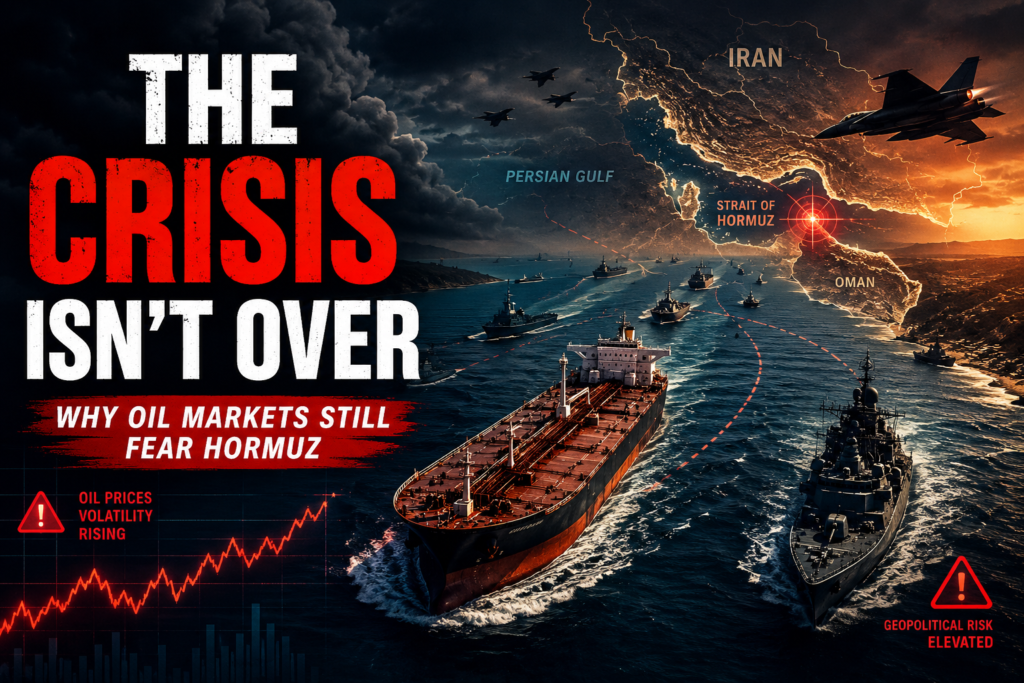
But the Strait of Hormuz crisis may not actually be over.
That is the part sitting underneath the diplomatic pause. The ceasefire lowered the risk of immediate escalation, yes. It did not resolve the deeper tensions that made markets nervous in the first place.
And for countries deeply dependent on imported energy — especially across Asia — that distinction matters more than it may initially seem.
Why the Strait of Hormuz Still Matters So Much
The Strait of Hormuz is not just another shipping route.
It is one of the world’s most exposed economic chokepoints. Roughly one-fifth of global oil supply passes through this narrow corridor between Iran and the Gulf states, along with massive volumes of liquefied natural gas.
The geography is part of the problem.
At its narrowest point, the Strait is only a few dozen kilometers wide. That leaves very little margin when military tensions rise or commercial shipping starts feeling exposed.
Sometimes markets react to actual disruption. Sometimes they react to the possibility of disruption. In energy markets, the difference is not always large.
And the consequences rarely stay regional for long.
Countries like India, China, Japan, and several European economies rely heavily on Gulf energy exports moving through this route. Most consumers never directly think about Hormuz when filling fuel tanks or booking flights, but the dependency shows up quietly through transportation costs, electricity pricing, freight expenses, fertilizer costs.
People tend to notice these things later, once inflation starts surfacing in ordinary places.
What Triggered the Latest Tensions
The recent crisis did not emerge from one isolated flashpoint. Pressure had been building for months through regional escalation, shipping security fears, and rising uncertainty around Iran.
Once concerns spread that commercial tankers or shipping infrastructure could become targets, markets reacted quickly.
Shipping companies reassessed Gulf routes. Insurance costs for vessels moving through the region started climbing. Energy traders began pricing in possible supply interruptions before any major disruption had even happened.
Oil markets do this constantly. Fear gets priced early.
There was also another concern underneath all of it. Many economies are already dealing with stubborn inflation, slowing growth, and fragile consumer demand. Governments had little appetite for another energy-driven shock while central banks are still trying to stabilize prices after the inflation waves of the last few years.
India remembers this problem fairly well from 2022. Fuel inflation has a way of spreading outward into almost everything.
The Ceasefire Reduced Pressure — Temporarily
The ceasefire framework that followed was mainly designed to create breathing room.
Diplomatic discussions reportedly focused on reducing immediate military tensions while reopening negotiations tied to regional security and Iran’s nuclear dispute. Financial markets responded positively because the alternative looked worse.
Still, this is not a permanent settlement.
The current arrangement functions more like a pause than a resolution. Immediate escalation became less likely. The underlying disputes did not disappear.
Investors seem aware of that. Markets calmed down, but the broader nervousness never fully left.
You could see it in oil volatility. You could see it in shipping insurance behavior too.
Why The Underlying Risk Hasn’t Gone Away
This is where some coverage becomes slightly misleading.
The visible tension faded after the ceasefire announcement. The structural vulnerability did not.
The nuclear dispute involving Iran remains unresolved. Regional rivalries across the Middle East continue shaping military calculations. Proxy conflicts still influence security decisions in ways outsiders often underestimate.
And the shipping vulnerability itself is permanent geography.
That narrow corridor still carries an enormous share of global energy flows. One serious escalation — even temporary — could trigger another round of panic across energy markets, shipping networks, and financial systems.
People often assume geopolitical crises end once headlines quiet down. Usually they just become less visible for a while.
Oil Markets Still Look Uneasy
One reason traders remain cautious is because energy markets can reverse direction very quickly.
A single tanker incident. A failed negotiation. A military miscalculation near a shipping corridor.
Sometimes that is enough.
Higher oil prices eventually spread into transportation, logistics, manufacturing, aviation, agriculture. Airlines start monitoring jet fuel exposure more aggressively. Import-heavy economies become more sensitive to currency pressure. Central banks become reluctant to cut interest rates too quickly.
Even shipping insurance has become part of the broader economic story now.
When insurers see elevated geopolitical risk, premiums rise for commercial vessels operating through vulnerable zones. Those costs slowly move outward through supply chains. Consumers may not notice immediately, but businesses usually do.
This is one of the stranger side effects of globalization. A security problem inside one narrow waterway can eventually influence grocery bills thousands of kilometers away.
Why India and China Have More at Stake Than Most
For major Asian economies, the Strait of Hormuz is not an abstract geopolitical issue discussed only by foreign policy analysts.
It is tied directly to economic stability.
India imports a large share of its crude oil requirements, much of it connected to Gulf suppliers. If oil prices rise sharply or shipping becomes more expensive, the effects move through the economy fairly quickly:
fuel inflation
transportation cost increases
pressure on the rupee
higher fertilizer expenses
rising costs across everyday essentials
There is also a labor dimension that often receives less attention.
Millions of Indian workers remain connected to Gulf economies through employment and remittance flows. Prolonged instability in the region could eventually affect labor markets, remittances, and domestic economic confidence in subtle ways.
China faces a different version of the same vulnerability.
Its industrial economy depends heavily on stable energy imports and uninterrupted shipping routes. Rising oil prices increase manufacturing costs. Shipping disruptions complicate exports and supply chain planning.
And China’s factories do not operate comfortably in unpredictable energy environments.
For both countries, stability in the Gulf is ultimately about predictability more than anything else.
Businesses can usually adapt to high prices over time. Constant uncertainty is harder to manage.
Could The Crisis Return After 60 Days?
Possibly.
That depends largely on whether diplomacy produces something more durable than temporary de-escalation. If negotiations fail, tensions could rise again surprisingly fast even if global attention has already drifted elsewhere.
Future risks could include:
renewed regional escalation
tanker security incidents
tougher sanctions
shipping disruptions
sudden oil price spikes
Still, it is important not to drift into exaggerated predictions. The global economy has strong incentives to avoid a serious disruption in the Strait of Hormuz. Major powers understand how damaging that scenario could become while growth remains fragile in many regions.
That shared economic interest probably lowers the odds of the worst-case outcome.
Probably.
But it does not remove the vulnerability itself.
The ceasefire may have paused the immediate crisis. The deeper dependence on the Strait of Hormuz — and the instability surrounding it — remains unresolved.