As tensions rise in the Middle East, one of the world’s most important maritime chokepoints is back in the headlines. Military developments naturally draw immediate attention. Markets, however, tend to focus on something else entirely: whether the flow of energy through the Strait of Hormuz can continue without interruption.
That question reaches far beyond the Gulf.
Imagine filling your car one morning and finding fuel prices noticeably higher than they were only days earlier. A week later, airline tickets cost more. Food prices begin edging upward. Stock markets turn volatile, and central bankers suddenly sound more cautious than they did a month ago.
On the surface, those events don’t appear connected.
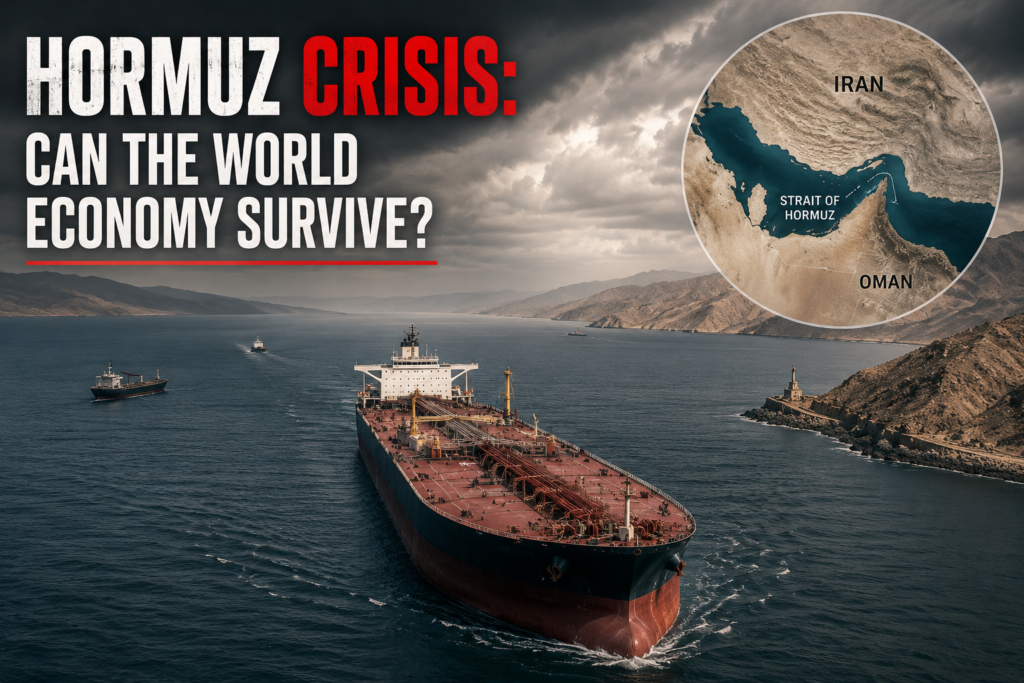
In reality, they can all begin with the same narrow waterway separating Iran from Oman.
The Strait of Hormuz is only a few dozen kilometers wide at its narrowest point, yet it remains one of the most strategically important shipping corridors in the global economy. Every day, a significant share of the world’s oil and liquefied natural gas (LNG) passes through it before reaching refineries, factories, power plants and consumers across Asia, Europe and beyond.
It’s a reminder that modern globalization still depends on a handful of physical locations. Supply chains may stretch across continents, financial markets operate in milliseconds, and energy is traded through sophisticated digital platforms. But much of that system still relies on ships passing through narrow waterways that cannot easily be replaced.
History has made that point more than once.
During the 1973 oil embargo, the shock came from political decisions rather than a blocked shipping lane, but the result was similar: energy prices surged, inflation accelerated and economies around the world struggled to adjust. Decades later, the Iran-Iraq “Tanker War” demonstrated how quickly attacks on commercial shipping could unsettle energy markets. More recently, tanker incidents near the Strait in 2019 reminded governments that even limited disruptions can send insurance costs and oil prices higher before any meaningful supply shortage develops.
Markets have long memories.
Perhaps that’s the biggest misconception about oil crises. People often assume the economic damage begins when supplies stop flowing. In practice, uncertainty usually arrives first. Traders start repricing risk, insurers adjust premiums, shipping companies reconsider routes and businesses begin preparing for scenarios they hope never materialize.
By the time consumers notice higher prices at the fuel pump, financial markets have often been responding for days—or even weeks.
That’s why discussions about the Strait of Hormuz rarely revolve around geography alone. They quickly become conversations about inflation, interest rates, government budgets, corporate earnings and household spending.
The waterway itself hasn’t changed.
The world around it has. Global supply chains are more interconnected than they were a generation ago, energy demand has shifted increasingly toward Asia, and recent geopolitical shocks—from the pandemic to the war in Ukraine—have left governments more conscious of how quickly disruptions can spread through the global economy.
That also raises a broader question.
The world has spent years trying to make energy markets more resilient through larger strategic reserves, diversified suppliers and alternative transport routes. Yet the Strait of Hormuz continues to handle an extraordinary share of global energy trade.
So if another major crisis were to emerge there, would those safeguards be enough?
Or have the disruptions of recent years quietly reduced the world’s ability to absorb another serious shock?
Why the Strait of Hormuz Matters So Much
Some places shape the global economy because of their size.
Others do so because the world has quietly become dependent on them.
The Strait of Hormuz belongs firmly in the second category.
Positioned between the Persian Gulf and the Gulf of Oman, it serves as the primary maritime gateway for energy exports from Saudi Arabia, the United Arab Emirates, Kuwait, Iraq, Qatar and Iran. Roughly one-fifth of global oil consumption and around a quarter of global liquefied natural gas (LNG) trade normally passes through this narrow corridor.
For something that occupies such a small space on the map, the concentration of economic importance is remarkable.
That dependence did not emerge overnight. It developed over decades as Gulf producers expanded output, Asian economies became increasingly energy-hungry and global shipping networks evolved around the most efficient trade routes. Once that infrastructure was built—from ports and pipelines to refineries and tanker fleets—the Strait became deeply embedded in the global energy system.
One detail often overlooked is that the vulnerability isn’t simply about oil.
The Strait connects producers with customers operating on carefully planned schedules. Refineries don’t just need crude oil; they need it to arrive at predictable intervals. A shipping delay of several days can force refiners to adjust production plans, traders to seek alternative cargoes and manufacturers to rethink inventory levels. Modern supply chains are efficient partly because they carry very little slack.
That efficiency has a trade-off.
Even modest disruptions can create uncertainty well beyond the energy sector.
Pipelines do provide alternatives, but only to a point. Saudi Arabia and the UAE have invested in routes that bypass parts of the Strait, reducing some exposure to maritime risk. Even so, their combined capacity falls well short of replacing the enormous volumes that normally move through Hormuz.
Geography still wins.
This is why governments monitor the Strait so closely, even during periods when shipping continues uninterrupted. The objective isn’t merely to keep vessels moving today. It’s to preserve confidence that they will continue moving tomorrow.
Confidence, after all, is one of the least visible yet most valuable assets in global markets.
What Is Happening Right Now?
The latest tensions surrounding the Strait of Hormuz have not resulted in a complete disruption of shipping. Tankers continue to transit the waterway, and global energy supplies remain broadly intact.
Yet markets have become noticeably more cautious.
Commercial shipping companies are reassessing security conditions before entering the region. Marine insurers have raised premiums for some voyages, reflecting the higher level of geopolitical risk. Naval forces from several countries continue to monitor the area closely, aware that even isolated incidents can have consequences well beyond the Gulf.
We’ve seen this pattern before.
In 2019, a series of attacks on commercial tankers near the Strait did not halt global oil flows. Even so, insurance costs climbed, shipping operators became more cautious and oil prices responded almost immediately. The physical disruption was limited. The financial reaction was not.
That’s a recurring feature of energy markets.
They don’t wait for certainty.
Perhaps the most important development isn’t whether every tanker reaches its destination without incident. It’s whether businesses begin changing their behaviour because they believe the risks are increasing.
A shipping company may decide to reroute vessels or delay departures. An importer could purchase additional inventory earlier than planned. A refinery might secure supplies from a different producer, even at a higher price, simply to reduce uncertainty.
None of those decisions signals a crisis on its own.
Taken together, however, they can reshape markets surprisingly quickly.
Ironically, the greatest economic cost of geopolitical tension often appears before the worst-case scenario ever materialises. Businesses price uncertainty into contracts. Investors rebalance portfolios. Commodity traders demand higher premiums for future deliveries.
The ships may still be sailing.
But the economics surrounding those voyages have already changed.
Why Markets React Before Oil Actually Stops Flowing
A common assumption is that oil prices rise only when supplies begin running short.
History suggests otherwise.
In commodity markets, expectations often move faster than physical events. By the time shortages become visible, traders have usually spent days—or even weeks—trying to price in the possibility that they might occur.
That’s because oil isn’t traded solely on today’s supply.
It is traded on tomorrow’s expectations.
The Strait of Hormuz illustrates that dynamic particularly well. A single military incident doesn’t have to block shipping to influence prices. If market participants believe future deliveries could become less reliable, the value of oil futures can rise almost immediately.
Economists refer to this as a risk premium—the additional price buyers are willing to pay because uncertainty itself has become more valuable.
The idea isn’t unique to energy markets.
Before a major storm, airlines cancel flights, supermarkets increase emergency stock and insurers reassess potential claims. Most of those decisions happen before the storm arrives. Businesses aren’t reacting to damage; they’re reacting to risk.
Financial markets operate in much the same way.
Shipping companies recalculate operating costs. Marine insurers increase premiums. Investors rotate toward assets traditionally viewed as defensive, while energy producers often receive renewed attention from equity markets. Currencies of major oil-importing economies can also come under pressure as traders anticipate higher import bills.
One detail is easy to miss.
Markets rarely ask, “Has supply been disrupted?”
They ask, “How likely is disruption becoming?”
That distinction explains why headlines about military activity around the Strait can move prices even when tankers continue sailing normally.
Ironically, if an actual supply crisis develops, part of the financial adjustment has often already taken place. Fear tends to be priced in before shortages are.
The IMF’s Warning: Why Global Oil Buffers Are Shrinking
The question isn’t simply whether another disruption could occur.
It’s whether the global economy would cope with it as effectively as it did in the past.
According to the International Monetary Fund (IMF), there are reasons to think the margin for error has become smaller.
Earlier episodes of market stress were softened by a combination of factors: stronger oil production outside the Gulf, relatively subdued demand, the release of commercial inventories and, in some cases, strategic petroleum reserves built up specifically for emergencies. Together, those buffers prevented temporary disruptions from turning into far more severe economic shocks.
Today, some of those cushions are thinner than they once were.
Commercial inventories in many regions have declined from the unusually high levels seen after previous disruptions. Spare production capacity has become more concentrated among a smaller number of producers, and strategic reserves, once released, are not quickly replenished. Rebuilding them can take months, particularly if prices remain elevated.
The IMF’s broader point is not that the world is running out of oil.
It’s that flexibility has become more limited.
That matters because the duration of a disruption often determines its economic impact more than the disruption itself.
A brief interruption lasting several days may cause volatility but remain manageable. Governments can release reserves, shipping companies can absorb temporary delays and businesses may continue operating with existing inventories.
Weeks are different.
Manufacturers begin reviewing production schedules. Airlines reconsider fuel strategies. Importers renegotiate contracts. Companies that rely on just-in-time delivery discover that efficiency leaves little room for prolonged uncertainty.
The longer disruption lasts, the fewer easy solutions remain.
Curiously, the global energy market has become more diversified over the past decade. New producers have emerged, renewable energy has expanded and many countries have invested in greater energy security.
Yet one narrow shipping corridor continues to occupy an outsized role in the system.
That’s one of the defining contradictions of today’s energy market. The world has reduced its dependence in some areas while remaining remarkably dependent in others.
What Happens If Shipping Through Hormuz Slows Down?
Economic disruptions rarely arrive as a single dramatic event.
More often, they spread quietly through systems that most people never think about until something stops working.
A slowdown in the Strait of Hormuz would probably unfold that way.
The first reaction wouldn’t be empty fuel stations or widespread shortages. It would be visible on trading screens. Oil futures would begin moving, insurers would reassess risk and shipping companies would calculate whether existing routes still made commercial sense.
Businesses make these decisions long before consumers notice anything has changed.
Within days, freight costs could begin climbing as higher insurance premiums and operational risks are built into shipping contracts. Importers would face higher transport costs for crude oil and refined fuels, while companies dependent on predictable delivery schedules would start reviewing inventory levels.
Some firms would simply pay more.
Others might delay purchases altogether, hoping prices stabilize.
Neither decision is ideal.
By the second or third week, the effects would begin filtering into the broader economy. Airlines could adjust ticket prices to reflect higher fuel costs. Logistics companies might renegotiate transport contracts. Manufacturers that depend heavily on imported raw materials would face rising production expenses.
The impact would vary from industry to industry.
A software company may barely notice.
A chemical manufacturer, airline or shipping business almost certainly would.
Retailers would eventually feel it as well. If transportation becomes more expensive, imported goods—from electronics and appliances to furniture and household products—often become costlier before they reach store shelves. Consumers don’t see the tanker crossing the Gulf. They see the price tag weeks later.
That’s how global supply chains work.
The connection between a shipping corridor in the Middle East and a supermarket thousands of kilometres away isn’t always obvious. But it’s real.
If elevated energy prices persist for several months, inflationary pressure would become increasingly difficult to ignore. Central banks could postpone planned interest-rate cuts or, if price pressures spread more broadly, maintain tighter monetary policy for longer than markets currently expect.
By then, the conversation would no longer be about shipping.
It would be about economic growth.
Which Countries Would Feel the Biggest Impact?
Not every economy would experience a Strait of Hormuz disruption in the same way.
Exposure depends on energy imports, domestic production, strategic reserves and, increasingly, how diversified a country’s supply network has become.
Major Oil Importers
For countries such as India, Japan, South Korea, China and much of Europe, higher oil prices have consequences that extend well beyond fuel costs.
Larger import bills can widen trade deficits. Governments may face pressure to reduce fuel taxes or increase subsidies, placing additional strain on public finances. Businesses operating on narrow margins often find themselves absorbing higher transport and energy costs before deciding whether those increases can realistically be passed on to customers.
India illustrates the challenge particularly well.
The country imports the majority of its crude oil, making international energy prices a significant factor in inflation, fiscal planning and monetary policy. A prolonged rise in oil prices affects far more than petrol stations. It influences manufacturing costs, freight charges, aviation, agriculture and consumer spending.
Major Oil Exporters
At first glance, oil-exporting countries appear to benefit from rising prices.
That assumption isn’t entirely wrong.
But it overlooks an important constraint.
Higher prices are valuable only if exporters can continue moving their oil to international markets. If shipping becomes difficult or insurance costs climb sharply, selling fewer barrels can offset much of the financial benefit created by stronger prices.
The experience of previous energy disruptions shows that producers generally prefer stable exports at sustainable prices over sharp price spikes accompanied by operational uncertainty.
Predictability has economic value of its own.
The United States
The United States enters any potential Hormuz disruption from a stronger position than it did twenty years ago.
The shale revolution transformed the country into one of the world’s largest oil producers, reducing its direct dependence on Middle Eastern imports. That shift has changed Washington’s energy outlook considerably.
Even so, the United States doesn’t operate in isolation.
Oil remains a globally traded commodity. Higher international benchmark prices eventually affect American fuel costs, business expenses and investor sentiment regardless of where the physical barrels originate.
Global markets don’t distinguish between “foreign” oil and “domestic” inflation as neatly as political debates sometimes suggest.
That’s one reason events in the Strait of Hormuz continue to command attention in capitals far beyond the Gulf.
How Could This Affect Ordinary People?
Geopolitical tensions often feel remote.
For most households, they remain distant until they begin affecting monthly budgets.
Fuel prices are usually the first visible reminder. Petrol and diesel tend to respond relatively quickly when global crude prices remain elevated, particularly if markets believe higher costs could persist rather than fade within a few days.
The changes don’t stop there.
Airlines eventually face higher fuel bills. Logistics companies spend more transporting goods. Food producers pay more to move raw materials and finished products. Importers renegotiate shipping contracts. Somewhere along that chain, businesses make a difficult decision: absorb the additional cost or pass at least part of it on to customers.
Many choose a combination of both.
Consumers rarely experience these effects as one dramatic shock. Instead, they appear gradually. A slightly more expensive grocery bill. Higher delivery charges. Airfares that seem unusually expensive during the holiday season. Individually, none of those changes appears extraordinary.
Together, they reshape household spending.
One consequence often receives less attention.
When families spend more on essentials such as fuel, transport and food, they usually spend less elsewhere. Restaurants, retailers, tourism businesses and entertainment companies may all feel the impact despite having no direct connection to oil markets.
That’s why economists pay close attention to energy prices.
They’re rarely just an energy story.
Could Global Inflation Return?
Few questions concern central banks more than the possibility of inflation returning after years of aggressive efforts to contain it.
Energy occupies a unique position in the economy because it influences almost everything else. Factories require electricity. Freight depends on fuel. Agriculture relies on machinery, fertilisers and transportation. Construction materials are energy-intensive to produce.
When energy becomes more expensive, those higher costs spread gradually through supply chains.
The process is rarely immediate.
Some businesses absorb rising expenses to protect market share. Others increase prices sooner, particularly when profit margins are already under pressure. The result is a slow but persistent transmission of higher costs across the broader economy.
History offers several reminders.
The oil shocks of the 1970s demonstrated how sustained increases in energy prices could feed broader inflation and force central banks into difficult policy choices. Today’s economy is more diversified and significantly more energy-efficient than it was then, but the basic relationship hasn’t disappeared.
The challenge is balancing competing risks.
Raise interest rates too aggressively and economic growth weakens.
Cut them too early and inflation may prove more persistent than expected.
There are no easy choices once energy prices begin influencing the wider economy.
Is the World Better Prepared Than It Was Before?
In several respects, yes.
Governments hold larger strategic petroleum reserves than they did decades ago. Energy companies have diversified suppliers where possible, renewable energy now accounts for a larger share of electricity generation in many countries and some exporters have invested in pipelines that reduce reliance on a single maritime route.
Those improvements matter.
The global economy has become more resilient since earlier oil crises. Lessons from the pandemic, the war in Ukraine and repeated supply-chain disruptions have encouraged governments and businesses to think more seriously about resilience rather than simply efficiency.
But resilience shouldn’t be confused with immunity.
Alternative export routes still cannot replace the full capacity of the Strait of Hormuz. Strategic reserves provide valuable breathing room, but they are designed to buy time—not permanently replace commercial supply. Even diversified supply chains remain interconnected in ways that are difficult to untangle quickly.
There’s another irony.
For years, businesses optimized global supply chains around efficiency. Inventories became leaner. Deliveries became faster. Costs fell.
The same efficiency that strengthened global trade also reduced its margin for error.
That’s one reason resilience has become such a prominent theme in economic policy. Governments are increasingly willing to accept slightly higher costs today if those investments reduce the risk of much larger disruptions tomorrow.
Whether that trade-off proves sufficient is a question no one can answer with certainty.
It depends not only on the severity of any disruption in the Strait of Hormuz, but also on how quickly governments, businesses and markets adapt once conditions begin changing.
The Biggest Risks Investors Are Watching
Oil prices usually dominate the headlines during periods of geopolitical tension.
Professional investors, however, rarely focus on a single indicator.
They also watch tanker movements, shipping insurance costs, freight rates, bond yields, currency markets and measures of market volatility. Together, those signals often reveal whether markets view an event as a temporary disruption or the beginning of something more serious.
Sector performance can shift quickly.
Energy producers and oil service companies sometimes benefit from higher crude prices, while airlines, logistics firms, chemical manufacturers and other energy-intensive industries often come under pressure. Companies with strong pricing power generally cope better than those already operating on thin margins.
Safe-haven assets also tend to attract renewed attention.
Gold often benefits when geopolitical uncertainty rises. Government bonds issued by financially stable countries can see increased demand, pushing yields lower. Meanwhile, currencies of oil-importing emerging markets may weaken if investors anticipate larger energy import bills and widening trade deficits.
One detail often overlooked is that markets don’t simply react to higher oil prices.
They react to what higher oil prices might eventually mean for inflation, corporate earnings and central bank policy.
That chain of expectations influences investment decisions across sectors that appear to have little connection to energy.
Curiously, some of the biggest market moves during geopolitical crises have occurred not in oil itself, but in assets responding to changing expectations about growth and interest rates.
What Could Happen Next?
Several outcomes remain possible, and none can be ruled out with confidence.
The most constructive scenario is that diplomatic efforts ease tensions before shipping is significantly affected. Oil prices could gradually retreat, insurance premiums normalize and markets begin removing the additional risk premium that has accumulated during the period of uncertainty.
A second possibility is a short-lived disruption.
Shipping could slow temporarily, energy prices might remain elevated for several weeks and businesses would absorb higher costs before conditions gradually stabilize. Similar patterns have played out during previous geopolitical crises without triggering lasting global recessions.
The more difficult scenario involves a prolonged disruption lasting weeks or months.
At that point, the challenge extends well beyond energy markets. Supply chains become harder to manage. Inflationary pressures strengthen. Governments may face pressure to support households while protecting public finances. Central banks could find themselves delaying interest-rate cuts—or reconsidering them altogether.
Businesses would face difficult decisions as well.
Do they absorb higher costs?
Raise prices?
Delay investment?
Or accept lower profits in the hope that conditions improve?
There are no universal answers because every industry enters a disruption from a different position.
That’s precisely why markets become so volatile during periods of geopolitical uncertainty.
Perhaps the biggest misconception is that investors are trying to predict exactly what will happen.
Most are doing something more practical.
They’re trying to estimate probabilities and prepare for several different outcomes at the same time.
Final Thoughts
The Strait of Hormuz occupies only a small space on a world map.
Its influence is anything but small.
Every day, millions of barrels of oil and enormous volumes of liquefied natural gas pass through a corridor that, in purely geographic terms, appears surprisingly ordinary. Yet the economic significance attached to that stretch of water is extraordinary.
Modern economies often give the impression that technology has made geography less important.
In many respects, it has.
Capital moves instantly. Information crosses continents in seconds. Companies coordinate supply chains spanning dozens of countries.
Physical trade, however, still depends on ports, pipelines, shipping lanes and infrastructure that cannot be relocated with the click of a button.
That’s the contradiction at the heart of globalization.
The digital economy feels borderless.
The movement of energy does not.
Over the past decade, governments and businesses have invested heavily in making the global economy more resilient. Strategic petroleum reserves have expanded, supply chains have diversified and alternative energy sources have become increasingly important.
Those changes reduce risk.
They don’t eliminate it.
History suggests that markets often fear disruption before disruption actually occurs. The financial consequences of a geopolitical crisis frequently begin with changing expectations rather than physical shortages. By the time supply constraints become visible, investors, insurers and businesses have often been adjusting their behaviour for days or even weeks.
That may be the most important lesson from the Strait of Hormuz.
Its significance isn’t measured only by the volume of oil passing through it.
It’s measured by how a single chokepoint can influence inflation expectations, investment decisions, government policy and household budgets across economies that are thousands of kilometres away.
In an interconnected world, resilience isn’t defined by avoiding every disruption.
It’s defined by how well economies adapt when disruption becomes unavoidable.
And that is the real question hanging over the Strait of Hormuz today.