Most people rarely pay attention to G7 summits.
The meetings tend to blur together: diplomatic language, official photographs, carefully negotiated statements, and carefully managed public appearances. For most households, they seem far removed from concerns like fuel prices, grocery bills, mortgage payments, or job security.
Yet some of the biggest shifts in energy policy, trade strategy, and market expectations often begin in rooms most people never see.
That disconnect is understandable. The consequences of these meetings rarely arrive all at once. They show up later—in investment decisions, policy changes, market reactions, and business plans that gradually shape the economic environment around us.
The 2026 G7 Summit arrives at a particularly uneasy moment.
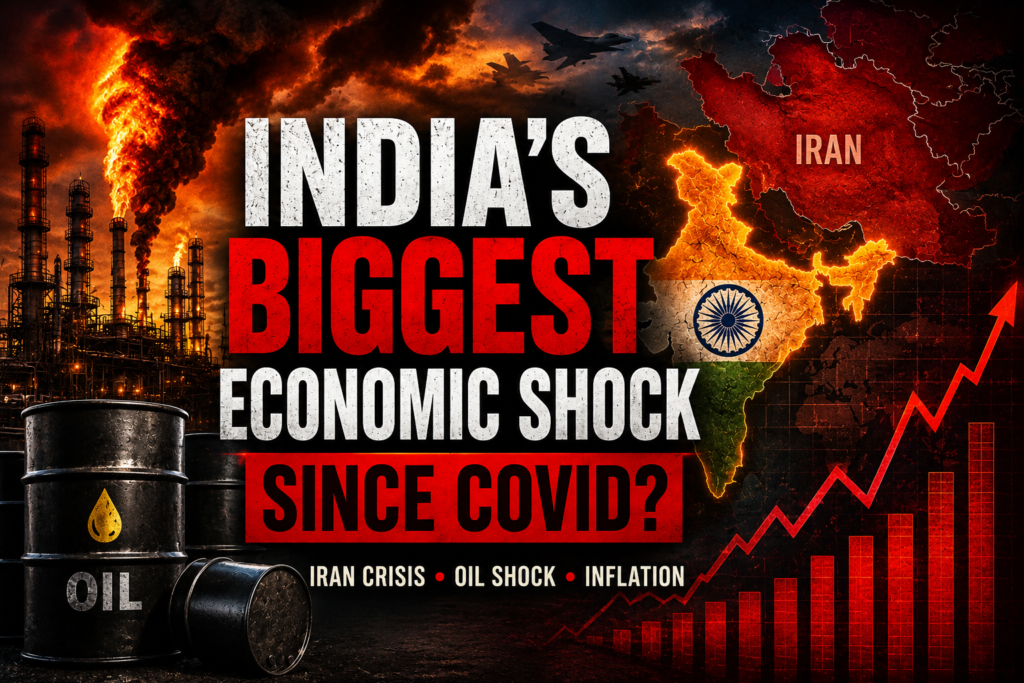
Tensions involving Iran have raised concerns about energy supplies and critical shipping routes. The war in Ukraine continues to influence defense spending, sanctions policy, and Europe’s energy strategy. Trade friction between Western economies and China remains unresolved. Several major economies are also struggling with slower growth, elevated debt burdens, and inflation that has proved more persistent than many policymakers expected.
None of these issues sits neatly in its own lane.
Energy affects inflation. Inflation affects interest rates. Interest rates affect growth, investment, and household spending.
Nothing operates in isolation anymore.
In many ways, that may be the defining economic challenge of this decade. Problems that once appeared separate now tend to arrive bundled together.
That is why this summit is attracting attention well beyond diplomatic circles.
The real question is not whether the summit matters. It is whether leaders can reduce uncertainty at a time when uncertainty itself has become an economic force.
Why This Year’s G7 Summit Matters More Than Usual
G7 meetings traditionally focus on economic coordination, international cooperation, and long-term priorities.
This year feels different.
Several major challenges are colliding at once, and policymakers are confronting them with fewer easy solutions than they had even a few years ago.
The situation involving Iran illustrates the problem. Even without a direct interruption to oil flows, rising tensions can alter market behavior. Energy traders, insurers, shipping companies, and manufacturers begin adjusting assumptions before any physical disruption occurs.
Markets often react to uncertainty more than disruption itself.
Anyone who has watched commodity markets for long enough knows that prices often move on anticipation rather than reality. Sometimes the feared disruption never arrives. Occasionally the disruption arrives from somewhere markets were barely watching.
The war in Ukraine presents a different challenge. What initially appeared to many observers as a regional conflict has evolved into a long-term economic factor. Defense budgets are rising. Governments remain committed to sanctions. Energy security is now treated as a strategic priority rather than a temporary concern.
Then there is China.
Trade disputes, manufacturing dependence, technology restrictions, and strategic competition have become recurring features of the relationship between China and the West.
A decade ago, governments mostly worried about whether supply chains were efficient.
Today many are asking a different question: would those supply chains still function during a geopolitical crisis?
That shift helps explain much of the discussion likely to take place at this summit.
Growth across much of the developed world remains uneven. Public debt levels are elevated, productivity gains have been inconsistent, and inflation has not disappeared entirely.
None of these challenges would be easy on their own.
Together, they create one of the most economically sensitive G7 meetings in recent memory.
The Oil Market Question Hanging Over the Summit
If there is one issue capable of influencing almost every major economy at once, it is energy.
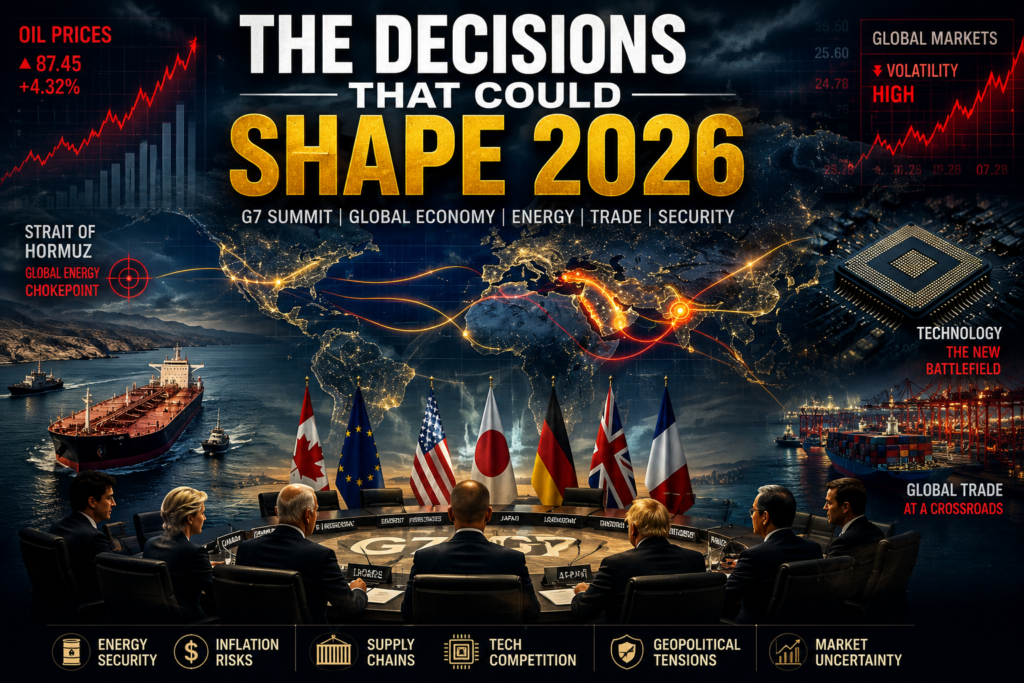
Much of the current concern centers on the Strait of Hormuz, one of the world’s most important energy chokepoints.
A large share of globally traded oil passes through this narrow waterway. Because of that, markets react quickly whenever tensions rise in the region.
Or more accurately, they react to the possibility that something might happen.
Markets rarely wait for tankers to stop moving. They react to the possibility that they might.
That distinction matters more than it might seem at first glance.
Similar concerns have surfaced repeatedly over the past few decades. Yet markets continue to relearn the same lesson: even the threat of disruption can reshape prices long before any disruption occurs.
Energy markets have a long history of worrying about disruptions that never happen—and occasionally missing the ones that do.
Those costs rarely stay confined to the energy sector.
Airlines face higher fuel bills. Freight companies pay more. Manufacturers absorb higher transportation expenses.
A delayed shipping route may sound like a problem for logistics companies. In reality, it can influence the price of electronics, household appliances, industrial equipment, and supermarket goods weeks later.
One overlooked factor is insurance.
When geopolitical risks increase, shipping insurance premiums can climb sharply. Cargo still moves, but moving it becomes more expensive.
The result is not usually a dramatic economic shock.
More often it is a gradual accumulation of costs that spreads through the economy almost unnoticed until inflation data begins reflecting it.
Can the G7 Prevent a New Inflation Problem?
Not long ago, many policymakers believed inflation was finally moving under control.
Interest rate hikes had cooled demand. Supply chains had largely recovered from earlier disruptions. Inflation rates across several economies were moving in the right direction.
That progress now faces fresh risks.
Energy is the most visible concern.
But inflation rarely returns wearing a name tag.
Shipping disruptions can increase logistics costs. Delays can force companies to hold more inventory. Higher transportation expenses can affect everything from food distribution to manufacturing.
Most consumers never think about global shipping routes while buying groceries.
Yet those routes influence the cost of moving countless products that eventually end up on store shelves.
The larger challenge is that inflation can reappear without a dramatic trigger. A series of relatively small cost increases across transportation, energy, insurance, and manufacturing can gradually become something larger.
For central banks, that creates an uncomfortable dilemma.
If inflation begins rising again, expected interest-rate cuts may be delayed.
This is where geopolitics stops feeling abstract.
The Growing Economic Rivalry Between the West and China
For decades, globalization prioritized efficiency.
Companies built supply chains around cost, speed, and scale. The system delivered cheaper goods and helped support decades of economic expansion.
That calculation is changing.
Rare earth minerals have become a major focus because they sit at the center of industries governments increasingly view as strategic. Electric vehicles, batteries, advanced electronics, renewable energy systems, and defense technologies all depend on them.
The materials themselves are not particularly visible.
The leverage attached to them is.
Technology competition is intensifying as well.
Semiconductors, artificial intelligence, advanced manufacturing, and digital infrastructure are no longer treated purely as commercial sectors. Governments increasingly view them as strategic assets tied to long-term economic strength.
People often talk about semiconductors as a technology story.
Governments increasingly treat them as infrastructure.
The bigger question is whether countries can reduce dependence on strategic suppliers without making inflation harder to control.
That balance is proving difficult.
Diversifying supply chains improves resilience. It can also increase costs.
Not every effort to reduce dependence on foreign supply chains will succeed. In some cases, the economic costs of diversification may prove larger than policymakers currently expect.
Political speeches often make supply-chain diversification sound faster than it really is.
Businesses are discovering that replacing deeply integrated global networks is a far more complicated task than announcing the intention to do so.
What the Summit Could Mean for Global Trade
Trade remains one of the most important drivers of global growth.
But the rules governing trade are becoming more complicated.
Tariffs, export controls, industrial subsidies, reshoring initiatives, and friend-shoring strategies are reshaping international commerce.
Governments increasingly want greater control over critical industries. Businesses are mostly focused on keeping supply chains predictable and costs manageable.
Those priorities overlap sometimes.
Not always.
Manufacturers are paying close attention because policy shifts can influence where factories are built, where capital is deployed, and how supply chains are structured over the next decade.
The effects extend well beyond the G7 itself.
The deeper shift may be psychological.
For decades, many policymakers assumed greater economic integration would gradually reduce geopolitical tensions. Increasingly, governments are preparing for the possibility that economic integration itself can create vulnerabilities.
That represents a significant change in thinking.
And it may outlast many of today’s specific disputes.
Why Financial Markets Are Paying Close Attention
Investors tend to view international summits differently than the general public.
They are not particularly interested in ceremonial moments.
They are looking for clues.
Stock markets are assessing growth prospects. Bond markets are evaluating inflation risks and interest-rate expectations. Currency traders are watching for signs of policy coordination—or signs that coordination is breaking down.
Commodity markets are focused on energy and trade.
Investors understand something that is easy to overlook: markets often respond to signals before policies.
Sometimes the market reaction to a summit says more about investor confidence than the summit itself.
That may seem unfair.
But expectations are economic forces in their own right.
What It Means for India
For India, the summit carries both risks and opportunities.
Energy remains the most immediate concern.
As a major oil-importing economy, India is sensitive to fluctuations in global energy prices. Higher crude prices can affect inflation, transportation costs, corporate profitability, and government finances.
At the same time, broader shifts in global trade could create opportunities.
Many multinational firms continue searching for alternatives to highly concentrated supply chains. That search has created opportunities for countries capable of offering manufacturing capacity, infrastructure, skilled labor, and policy stability.
India has spent years positioning itself for that moment.
Infrastructure investment has expanded. Manufacturing initiatives have gained momentum. The domestic market remains attractive in its own right.
Yet diversification does not automatically translate into investment.
Businesses still care about costs, regulations, infrastructure quality, labor availability, and execution.
Countries compete for capital every day.
Still, if current diversification trends continue, India is likely to remain one of the major economies investors watch closely.
Three Scenarios for the Global Economy After the Summit
Scenario 1: The Optimistic Outcome
Geopolitical tensions ease.
Energy markets stabilize. Oil prices remain relatively contained. Inflation continues moderating, giving central banks more flexibility to support growth.
Investor confidence improves and economic momentum strengthens during the second half of the year.
This outcome depends less on breakthrough agreements and more on the absence of new shocks.
Scenario 2: The Most Likely Middle Ground
Progress occurs, but slowly.
Tensions remain manageable rather than resolved. Growth continues at a moderate pace. Inflation stays present but contained.
Many analysts view this as the most realistic path because it requires neither major diplomatic breakthroughs nor major geopolitical deterioration.
Scenario 3: The Risk Scenario
Middle East tensions escalate.
Energy prices rise sharply. Shipping costs increase. Inflation returns as a more serious concern.
Growth slows while costs continue climbing.
Policymakers have spent much of the past few years trying to avoid exactly that combination.
The Bigger Picture
No summit can solve every geopolitical dispute or economic challenge.
The forces shaping the global economy are too large, and too interconnected, for any single meeting to provide definitive answers.
The deeper challenge facing policymakers is that many of today’s risks are connected to one another.
Energy affects inflation.
Inflation affects interest rates.
Interest rates influence growth.
Trade policy affects supply chains. Supply chains affect costs. Costs affect inflation again.
In a more stable era, governments could often address problems one at a time. Increasingly, solving one challenge risks creating pressure somewhere else.
That reality sits quietly behind many of the discussions taking place at this summit.
Still, dismissing the 2026 G7 Summit as another round of diplomatic symbolism would be a mistake.
The discussions involve energy security, inflation risks, trade policy, technological competition, and investor confidence. Those are not peripheral issues. They sit close to the center of the global economic outlook.
Perhaps the most overlooked point is that markets, businesses, and governments are all trying to answer the same question: how much uncertainty lies ahead?
The most significant outcome may not be a headline announcement or a new policy commitment.
It may simply be whether major economies leave with a shared understanding of the risks ahead.
In uncertain periods, coordination itself can become an economic asset.
And regardless of the summit’s formal outcomes, investors are likely to spend the second half of 2026 watching energy markets far more closely than diplomatic communiqués.
That alone says a great deal about the world economy today.