
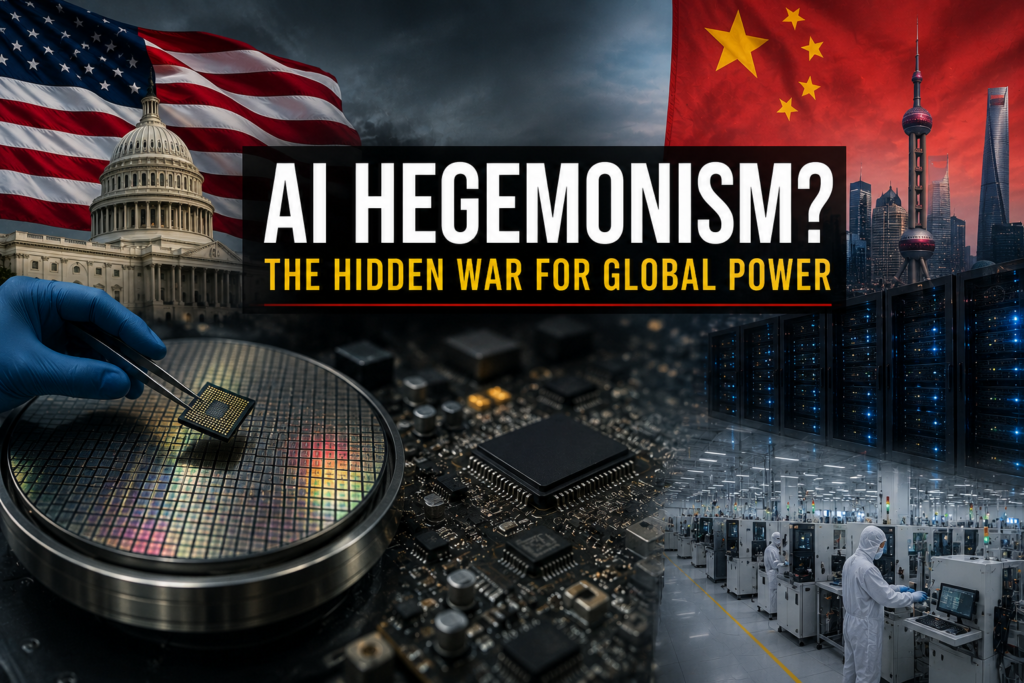
Introduction: The Real AI Race Is Happening Out of Sight
Most people will never see the machines at the centre of today’s AI revolution.
They sit inside semiconductor fabrication plants where even microscopic dust particles are treated as serious threats. Engineers work in highly controlled cleanrooms, surrounded by equipment so complex that a single advanced lithography machine can cost hundreds of millions of dollars. Outside those facilities, the world debates chatbots, image generators, and the latest AI breakthroughs. Inside them, another contest is unfolding—one that may prove even more important.
That contrast is easy to miss.
Artificial intelligence has become one of the most talked-about technologies on the planet, yet much of the public conversation revolves around products people can actually use. ChatGPT writes essays. Gemini answers questions. DeepSeek surprised Silicon Valley by showing how quickly new competitors could emerge. Every few months another model appears, each claiming to be faster, smarter, or more capable than the last.
But the companies building those systems are competing on top of something much deeper.
Behind every powerful AI model lies an immense industrial network of semiconductor manufacturers, cloud-computing providers, advanced networking systems, specialised software, electricity infrastructure, and thousands of engineers. Remove enough of those foundations and the world’s most sophisticated AI model quickly becomes impossible to train.
In other words, AI headlines often focus on software.
Governments increasingly focus on everything underneath it.
That shift explains why discussions surrounding artificial intelligence now sound very different from those of only a few years ago. Political leaders speak about export controls, strategic competition, compute power, AI infrastructure, semiconductor supply chains, and digital sovereignty with the same urgency once reserved for oil security or nuclear technology.
It didn’t happen overnight.
One moment, in particular, marked a turning point.
In October 2022, the United States introduced sweeping export controls designed to restrict China’s access to some of the world’s most advanced AI chips and semiconductor technologies. The announcement received considerable attention within the technology industry, but outside specialist circles it appeared to be another complicated trade measure.
It wasn’t.
For many analysts, those restrictions signalled something much larger: artificial intelligence had officially moved from being primarily a commercial technology to becoming a central issue of geopolitical strategy.
Markets noticed almost immediately.
Technology companies began reassessing supply chains. Governments accelerated domestic semiconductor programmes. Investors started paying closer attention to export-control announcements that previously would have attracted little public interest.
The language changed as well.
Instead of discussing who would build the best AI assistant, policymakers increasingly debated who would control access to the computing power needed to build future generations of artificial intelligence.
Those are very different conversations.
History offers a useful perspective.
The Industrial Revolution was not won simply by inventing better machines. It was shaped by access to factories, steel, coal, railways, capital, and skilled labour. The internet revolution depended not only on software but also on fibre-optic cables, satellites, servers, and global telecommunications networks.
Artificial intelligence appears to be following a similar pattern.
The technologies attracting the least public attention are quietly becoming the ones with the greatest strategic value.
This helps explain why relations between Washington and Beijing have become increasingly tense over semiconductors.
American officials argue that restricting certain advanced technologies is necessary to protect national security. Chinese leaders argue that those same restrictions amount to an attempt to preserve technological dominance by preventing competitors from reaching the frontier of AI.
Beijing has given that accusation a name.
“AI hegemonism.”
At first glance, the phrase sounds like another piece of diplomatic rhetoric destined to disappear into international headlines.
Look a little closer, however, and it reveals something far more significant.
It reflects two fundamentally different visions of how the future of artificial intelligence should develop—and, perhaps more importantly, who gets to shape that future.
The disagreement is not really about chatbots.
Nor is it only about semiconductors.
It is about whether the next era of global technological leadership will be built through open competition, strategic restrictions, or an emerging world where access to critical AI infrastructure becomes as politically important as access to energy once was.
That question reaches far beyond the United States and China.
Its answer will influence businesses deciding where to invest, governments designing industrial policy, researchers seeking computing power, and countries trying to avoid becoming dependent on technologies they do not control.
The AI race, it turns out, is no longer just about building smarter machines.
It is increasingly about building the foundations on which every future breakthrough will depend.
What Does China Mean by “AI Hegemonism”?
The phrase is deliberately provocative.
But it is also more nuanced than it first appears.
When Chinese officials accuse the United States of pursuing “AI hegemonism,” they are not claiming that America simply wants to build better artificial intelligence. Every major economy with serious technological ambitions wants to lead in AI. Beijing’s argument is different. It contends that Washington is attempting to shape the rules, infrastructure, and access points through which advanced AI develops around the world.
That distinction matters.
Much of the public conversation still revolves around AI models. Governments increasingly worry about everything those models depend upon.
Think about what it actually takes to train a frontier AI system.
A research team needs thousands—sometimes tens of thousands—of high-performance AI chips. It needs enormous quantities of electricity, sophisticated cooling systems, specialised networking hardware capable of moving data at extraordinary speeds, advanced software frameworks, and data centres operating around the clock. The model itself may receive the headlines, but it rests on an industrial foundation that is vastly more expensive than the software people eventually interact with.
That reality changes the strategic calculation.
If access to those underlying resources can be restricted, influenced, or delayed, governments begin viewing them less as commercial products and more as strategic assets.
This is where semiconductors move to the centre of the story.
Take NVIDIA, for example.
Its H100 AI accelerator quickly became one of the world’s most sought-after chips because it dramatically reduced the time required to train advanced AI models. Yet NVIDIA’s influence does not come solely from designing powerful processors. Over many years, developers have built research tools, software libraries, and machine-learning workflows around its CUDA platform. That ecosystem creates a powerful network effect. Companies rarely change hardware simply because an alternative exists; they change when switching becomes worthwhile.
And switching is rarely simple.
The irony is that some of the most valuable assets in artificial intelligence cannot be touched.
Software ecosystems.
Developer communities.
Engineering experience.
Technical standards.
These are advantages measured over years, sometimes decades—not product cycles.
The semiconductor supply chain tells a similar story.
A cutting-edge AI processor might be designed in California, rely on electronic design automation software developed in the United States, require extreme ultraviolet (EUV) lithography systems built by ASML in the Netherlands, incorporate specialised materials from Japan, be manufactured by TSMC in Taiwan, packaged elsewhere in Asia, and finally deployed inside cloud data centres serving customers across dozens of countries.
Few industries illustrate global interdependence so clearly.
Yet that very interdependence has become a source of strategic anxiety.
From Beijing’s perspective, this concentration of critical technologies creates a structural imbalance. If one country—and a small group of its allies—can influence access to advanced chips, manufacturing equipment, or compute infrastructure, they can also influence the pace at which competitors develop frontier AI.
China argues that this is no longer simply about trade.
It is about technological sovereignty.
That phrase appears frequently in Chinese policy discussions, and for good reason. The concern is not merely today’s generation of AI models but whether future technological progress could become dependent on decisions made outside China’s borders.
Washington rejects that interpretation.
American officials argue that the objective is not to monopolise artificial intelligence but to reduce national security risks associated with the most advanced technologies. They point out that AI systems capable of accelerating scientific discovery can also improve military planning, cyber capabilities, autonomous weapons, and intelligence analysis. From that perspective, limiting access to certain technologies is a matter of strategic caution rather than economic dominance.
Both sides begin with different assumptions.
One sees critical technologies as strategic safeguards.
The other sees many of those same restrictions as strategic barriers.
Neither interpretation can be understood by looking only at AI models.
The real contest lies beneath them.
History offers an interesting parallel.
During the twentieth century, countries did not compete merely to manufacture aircraft. They competed to control aviation technology, production capacity, skilled engineers, and global supply networks. The aircraft mattered, of course.
But the ecosystem mattered more.
Artificial intelligence appears to be entering a similar phase.
Perhaps the most overlooked shift is this: countries are no longer competing simply to invent smarter AI.
Increasingly, they are competing to shape who has access to the infrastructure that makes tomorrow’s AI possible.
That is the idea Beijing captures—accurately or not—when it speaks of “AI hegemonism.”
Why China Is Making This Accusation Now
Diplomatic language usually evolves slowly.
When governments introduce new phrases into official speeches, policy papers, and international forums, they are often signalling that their understanding of the world has changed. China’s repeated use of the term “AI hegemonism” reflects exactly that.
It is the product of several years of accumulating events rather than a single political disagreement.
The turning point most analysts identify came in October 2022.
The United States announced sweeping export controls that limited China’s access to some of the world’s most advanced AI chips, semiconductor manufacturing equipment, and technologies required to produce them. The measures were expanded and refined over the following months, eventually covering additional processors, performance thresholds, and related technologies.
Inside the semiconductor industry, the significance was immediately understood.
Outside it, many people saw another technical trade dispute.
The comparison wasn’t entirely accurate.
Export restrictions on advanced AI hardware are fundamentally different from tariffs on consumer goods. They target technologies that governments increasingly view as foundational to economic competitiveness, scientific research, intelligence capabilities, and military power.
That is a much bigger calculation.
One announcement illustrated this better than any policy paper could.
When NVIDIA revealed that export restrictions would affect sales of some of its most advanced AI chips to China, investors weren’t simply evaluating quarterly revenue. They were trying to understand how geopolitics might reshape the future of one of the world’s fastest-growing industries.
A few years earlier, such a discussion would have seemed surprisingly niche.
Not anymore.
From Washington’s perspective, the logic behind these restrictions is relatively straightforward.
Artificial intelligence has become a dual-use technology. The same high-performance computing infrastructure that can help researchers discover new medicines or improve climate models can also accelerate military simulations, intelligence analysis, advanced surveillance, and autonomous defence systems.
Once governments accept that premise, unrestricted exports become much harder to justify.
China, however, interprets the same sequence of events through a very different lens.
Viewed from Beijing, the issue is no longer whether one export licence is approved or rejected. It is whether a broader pattern is emerging—one in which access to frontier AI depends increasingly on decisions made in Washington and supported by allied governments.
That concern extends beyond chips.
Restrictions involving advanced semiconductor equipment, investment screening, cloud-computing access, and cooperation with partners such as Japan and the Netherlands reinforce the perception that China faces obstacles across multiple layers of the semiconductor ecosystem rather than at a single point.
Whether that perception is entirely correct is almost beside the point.
Governments respond to what they believe their strategic environment looks like, not necessarily to how others describe it.
That has produced an important feedback loop.
The United States tightens restrictions to protect technologies it considers strategically sensitive.
China responds by accelerating investment in domestic alternatives.
Washington then interprets those investments as further evidence that AI has become a strategic competition requiring continued vigilance.
Each side’s actions reinforce the other’s assumptions.
History suggests this pattern is hardly unique.
During the space race, technological competition drove extraordinary investment on both sides of the Cold War. Restrictions in aerospace, telecommunications, and computing often encouraged countries to build capabilities they might otherwise have imported more cheaply.
Pressure sometimes slows competitors.
Sometimes it motivates them.
Artificial intelligence may eventually produce both outcomes at once.
That possibility deserves more attention than it usually receives.
If China ultimately succeeds in reducing dependence on foreign semiconductor technologies, historians may look back on today’s restrictions not only as attempts to preserve technological leadership but also as catalysts for a new phase of Chinese industrial policy.
There are already signs of that shift.
Huawei has increased investment in its Ascend AI processors. Chinese semiconductor firms continue expanding domestic research despite significant technological hurdles. Companies such as DeepSeek have demonstrated that efficient AI models can emerge even under tighter computing constraints, prompting renewed debate over whether software innovation might partially offset hardware limitations.
None of this means China’s challenges have disappeared.
Manufacturing the world’s most advanced semiconductors remains extraordinarily difficult, particularly without unrestricted access to leading-edge lithography equipment. Closing that gap could take many years.
Still, the strategic direction is unmistakable.
China is no longer planning on the assumption that global access to frontier AI technologies will eventually return to business as usual.
It is preparing for a world in which technological self-reliance becomes increasingly valuable.
Why the United States Defends Its AI Restrictions
Washington begins with a different assumption.
Its central argument is not that China should be prevented from developing artificial intelligence altogether. Rather, American policymakers argue that certain frontier technologies have become so strategically important that allowing unrestricted access would create unacceptable national security risks.
Everything else flows from that premise.
At first glance, Washington’s position appears contradictory.
For decades, successive American administrations promoted open markets, global supply chains, and the relatively free movement of technology. Today, the same government is placing tighter controls on some of the world’s most advanced AI-related exports.
The shift seems dramatic.
In reality, it reflects a broader change in how governments define strategic technology.
American officials increasingly argue that artificial intelligence belongs in the same category as nuclear technologies, cryptography, satellite systems, or advanced aerospace capabilities—not because AI is identical to those fields, but because its long-term military and economic implications could be equally significant.
That changes the policy conversation.
Instead of asking whether companies should be free to sell a particular chip, policymakers ask a different question: Could this technology materially strengthen a strategic competitor’s military or intelligence capabilities?
Once the question is framed that way, export controls become easier to justify.
Supporters of the policy also point to the pace of AI development.
Unlike previous industrial revolutions, artificial intelligence evolves in months rather than decades. Models improve rapidly, computing requirements expand continuously, and breakthroughs often emerge unexpectedly. Waiting until a technology has obvious military applications may simply be too late.
Seen from Washington, precaution has become part of strategy.
The CHIPS and Science Act, signed into law in 2022, reflects the same thinking.
Although much public attention focused on the billions of dollars allocated to encourage semiconductor manufacturing inside the United States, the legislation represented something larger than industrial investment. It acknowledged that manufacturing capacity itself had become a strategic asset.
For years, efficiency dominated corporate decision-making.
Governments are now adding resilience to the equation.
The semiconductor industry illustrates why.
Designing a cutting-edge processor requires extraordinary expertise. Manufacturing it requires even more specialised facilities. Only a handful of companies anywhere in the world possess the capability to produce the most advanced chips at scale.
That concentration creates vulnerability.
If one critical link in the chain is disrupted—whether by geopolitical tensions, natural disasters, or supply shortages—the consequences extend far beyond a single company.
The pandemic offered a glimpse of that reality.
Automobile production slowed because of semiconductor shortages. Consumer electronics became harder to obtain. Industries that had rarely thought about chip manufacturing suddenly realised how dependent they had become on complex global supply chains.
Artificial intelligence magnifies those dependencies.
Training frontier AI models demands computing clusters containing thousands of advanced processors connected through high-speed networking infrastructure. Building those systems requires years of planning, enormous financial investment, reliable electricity, and specialised engineering talent.
The challenge is industrial before it is digital.
Critics, however, raise important objections.
Some economists argue that broad technology restrictions may unintentionally encourage competitors to develop domestic alternatives more quickly. Others warn that excessive fragmentation could slow scientific collaboration and make innovation more expensive for everyone.
History offers evidence for both possibilities.
Technological containment has sometimes delayed rivals.
At other times, it has accelerated their determination to innovate independently.
No one can say with confidence which pattern artificial intelligence will ultimately follow.
That uncertainty rarely appears in political speeches.
It should.
Why China Calls It “AI Hegemonism”
Beijing does not see export controls as isolated policy decisions.
It sees an emerging architecture.
From the Chinese perspective, restrictions on advanced AI chips, limits on semiconductor manufacturing equipment, tighter investment screening, and closer coordination among the United States, Japan, and the Netherlands all point in the same direction: limiting China’s ability to compete at the technological frontier.
Whether that interpretation fully reflects Washington’s intentions is open to debate.
What matters is that it shapes Beijing’s response.
Chinese policymakers increasingly argue that access to advanced technology should not depend on the strategic calculations of another government. They frame technological development as an issue of national sovereignty rather than commercial competition.
That distinction explains the language.
When Beijing speaks of “AI hegemonism,” it is not referring simply to market leadership.
It is describing a situation in which one country possesses enough influence over semiconductor ecosystems, compute infrastructure, technical standards, and critical supply chains to shape how other countries innovate.
The accusation, in other words, is about leverage.
Not leadership.
This concern also helps explain China’s growing emphasis on technological self-reliance.
Over the past several years, Beijing has expanded investment in domestic semiconductor research, AI infrastructure, high-performance computing, and indigenous chip development. Companies including Huawei have accelerated work on alternatives such as the Ascend AI processors, while domestic cloud providers and research institutions continue investing heavily in home-grown capabilities.
Progress remains uneven.
Manufacturing the most advanced semiconductors without unrestricted access to leading-edge EUV lithography technology remains one of China’s greatest challenges. That gap cannot be closed overnight, regardless of investment.
Yet strategic planning is rarely about overnight results.
It is about reducing future dependence.
Ironically, policies designed to preserve one country’s technological advantage can also strengthen another country’s incentive to become technologically independent.
Whether that proves to be the defining consequence of today’s AI rivalry remains one of the most intriguing questions of the decade.
The AI Cold War: A Useful Comparison—or a Misleading One?
The phrase appears in headlines almost every week.
“The AI Cold War.”
It is memorable.
It is convenient.
And it is only partly accurate.
Cold War analogies are appealing because they simplify a complicated story.
They also risk hiding what makes this rivalry fundamentally different.
The United States and the Soviet Union built largely separate economic systems. Trade between them was limited, technological cooperation was minimal, and supply chains rarely crossed ideological boundaries. Today’s AI competition operates under almost the opposite conditions.
The world’s two largest economies remain deeply interconnected.
That creates an unusual paradox.
Washington is trying to reduce dependence on strategically important technologies without completely dismantling decades of economic integration. Beijing is attempting to become more technologically self-reliant while remaining deeply connected to global trade.
Neither objective is simple.
Consider what happens before a single AI model is trained.
Engineers may write chip architectures in California. ASML’s extreme ultraviolet lithography systems are produced in the Netherlands. Japanese firms supply highly specialised chemicals and silicon wafers. TSMC manufactures many of the world’s most advanced processors in Taiwan. Those chips are then shipped to cloud providers, where they eventually train models used by businesses, researchers, and consumers across the globe.
A single AI system may represent the work of half a dozen countries.
That is why complete technological separation remains extraordinarily difficult.
Even companies caught in the middle of geopolitical tensions continue operating across international markets. Many American firms generate substantial revenue in China. Chinese manufacturers remain deeply integrated into global supply chains. European and Asian economies benefit from commercial relationships with both sides.
Economic reality refuses to fit neatly into political narratives.
This is where the phrase “technology decoupling” deserves careful attention.
Despite frequent headlines, the world is not witnessing complete decoupling. What is emerging instead is something far more selective. Governments increasingly distinguish between technologies they consider strategically sensitive and those they continue to treat as ordinary commercial goods.
Artificial intelligence sits near the top of that strategic list.
The practical consequences are already visible.
Technology companies are redesigning supply chains.
Governments are subsidising domestic semiconductor manufacturing.
Cloud providers are expanding regional data-centre capacity.
Universities are paying closer attention to research partnerships involving advanced technologies.
None of these developments would have seemed unusual during the Cold War.
The difference is that they are happening within a still-globalised economy.
That makes every policy decision more complicated.
There is another important distinction.
The Cold War centred primarily on military power and ideological competition.
Today’s AI rivalry also revolves around economic productivity.
Whoever develops more capable AI systems could influence manufacturing efficiency, pharmaceutical research, financial services, logistics, scientific discovery, and countless other sectors. Competitive advantage is no longer measured only by military strength but increasingly by computing capacity, engineering talent, and innovation ecosystems.
In that sense, the competition is broader than the Cold War ever was.
History offers another perspective.
The railway networks of the nineteenth century transformed trade because they changed how quickly goods could move. The internet transformed commerce because it changed how quickly information could move.
Artificial intelligence may reshape economies because it changes how quickly knowledge itself can be generated, analysed, and applied.
That possibility explains why governments are investing so heavily before the technology has reached maturity.
Economic Consequences Beyond the United States and China
It is tempting to think this rivalry concerns only Washington and Beijing.
Markets disagree.
When export-control rules change, the effects ripple through investors, manufacturers, software developers, cloud providers, universities, and governments far beyond either country. Decisions taken in one capital increasingly influence business strategies on the other side of the world.
The semiconductor industry demonstrates this unusually well.
Imagine an advanced AI processor moving through its lifecycle.
It may begin as a design concept inside an American engineering team.
Manufacturing equipment comes from Europe.
Precision materials arrive from Japan.
Fabrication takes place in Taiwan.
Packaging and testing occur elsewhere in Asia.
The finished processor eventually powers AI models running inside data centres located across North America, Europe, or the Middle East.
Each stage depends on the others.
That complexity once represented efficiency.
Today it also represents exposure.
Corporate boardrooms have responded accordingly.
A decade ago, discussions about artificial intelligence focused largely on research talent, product development, and commercial opportunities. Now they routinely include geopolitical risk assessments, export-compliance teams, supply-chain diversification, cybersecurity, and long-term access to compute infrastructure.
Business strategy has become inseparable from geopolitical strategy.
The shift extends well beyond semiconductor companies.
Electricity providers are expanding generation capacity to meet the enormous energy demands of AI data centres. Construction firms are building specialised facilities. Cooling technology has become a competitive industry in its own right. Even countries with relatively small AI sectors are investing in digital infrastructure because they recognise that compute power is becoming an increasingly valuable national asset.
Interestingly, many of these investments are not driven by today’s demand alone.
They are bets on where the AI economy will be ten years from now.
That changes investment horizons.
It also changes government priorities.
Perhaps the most significant consequence is this: countries are beginning to compete not merely to host technology companies, but to become indispensable parts of the global AI supply chain.
That competition is only just beginning.
What This Means for India and the Rest of the World
For countries outside Washington and Beijing, the question is rarely, “Which side should we support?”
The more practical question is, “How do we avoid becoming dependent on either?”
That subtle difference is shaping technology policy across much of the world.
Governments increasingly want access to American innovation, Chinese manufacturing, global investment, and resilient supply chains—all at the same time. Achieving all four is becoming progressively more difficult.
India is one of the clearest examples.
Only a few years ago, conversations about India’s AI future focused primarily on software engineers, digital services, and startup growth. Today, those discussions include semiconductor fabrication, AI infrastructure, sovereign compute capacity, advanced research, electronics manufacturing, and strategic partnerships.
The conversation has become industrial.
Not just digital.
That reflects a broader global shift. AI is no longer viewed as another fast-growing technology sector. It is increasingly treated as foundational infrastructure—something governments believe will influence productivity, defence, healthcare, manufacturing, finance, education, and scientific research for decades.
Countries want a place in that future.
India enters this period with several advantages.
A large engineering workforce.
One of the world’s fastest-growing digital economies.
Strong public digital infrastructure.
Increasing government support for semiconductor manufacturing and electronics production.
Growing interest from multinational companies looking to diversify supply chains beyond a single geography.
Those advantages matter.
But they do not guarantee success.
History offers a useful reminder.
Countries rarely become technology leaders through market size alone. They build ecosystems—universities, skilled labour, reliable infrastructure, patient capital, industrial policy, and research institutions that reinforce one another over many years.
Semiconductor manufacturing illustrates this perfectly.
Constructing a fabrication plant is difficult.
Building the surrounding ecosystem is even harder.
Japan and South Korea face a different challenge.
Both possess world-class semiconductor industries and remain close security partners of the United States, yet China continues to be one of their largest trading partners. Their objective is less about choosing sides than managing competing strategic realities.
Europe has adopted another approach.
The European Union increasingly speaks about strategic autonomy—remaining closely connected to global markets while reducing excessive dependence on any single country for critical technologies.
The phrase sounds cautious.
It is.
Across Southeast Asia, meanwhile, governments have largely chosen pragmatism over ideology. Vietnam, Malaysia, Singapore, Indonesia, and Thailand continue attracting investment from companies seeking more geographically diverse manufacturing networks.
They are not replacing China.
They are becoming part of a broader semiconductor and AI supply chain.
This may ultimately become one of the defining economic stories of the decade.
The competition is no longer only about producing better technology.
It is also about deciding where that technology gets built.
Possible Future Scenarios
Predicting technology is difficult.
Predicting geopolitics is even harder.
Trying to predict both simultaneously demands a degree of humility.
Several outcomes remain possible.
The first is managed competition.
The United States and China continue competing intensely in AI, semiconductors, and advanced manufacturing while preserving substantial commercial ties in less sensitive industries. Export controls remain targeted rather than universal, allowing global trade to continue despite strategic rivalry.
Many analysts consider this the most likely path.
A second possibility is gradual fragmentation.
Not complete separation.
Something messier.
Different AI standards.
Different cloud ecosystems.
Different semiconductor supply chains.
Different approaches to AI governance and digital sovereignty.
Businesses would increasingly operate across parallel technology ecosystems instead of one integrated global market.
That would almost certainly increase costs.
It might also encourage faster innovation in some areas by creating competing centres of technological development.
There is another possibility that receives less attention.
Selective cooperation.
Climate modelling, medical research, AI safety, disaster prediction, and certain scientific challenges may continue encouraging collaboration despite geopolitical tensions. Strategic competition and practical cooperation are not mutually exclusive.
History contains several examples of rivals working together when shared interests outweighed political differences.
Then there is the less optimistic scenario.
Broader export restrictions.
Deeper technology decoupling.
Reduced academic collaboration.
Greater pressure on multinational companies to align with one ecosystem over another.
Innovation would not stop.
It would become more fragmented—and considerably more expensive.
Which future emerges will depend less on algorithms than on political choices.
That may be the least appreciated aspect of the entire AI debate.
Final Thoughts
The debate over “AI hegemonism” is often presented as another chapter in the broader US-China rivalry.
It is.
But it is also something more.
Artificial intelligence is forcing governments to reconsider assumptions that shaped the global economy for decades. Efficiency is no longer the only priority. Resilience matters. Supply chains matter. Compute power matters. Semiconductor ecosystems matter.
Perhaps most importantly, infrastructure matters.
That represents a profound shift.
For years, discussions about AI focused almost entirely on what intelligent software could accomplish. Increasingly, the more consequential questions concern who builds the chips, who manufactures the equipment, who supplies the electricity, who owns the data centres, and who sets the technical standards that everyone else follows.
Those questions receive fewer headlines.
They may prove far more important.
The United States argues that restricting access to certain frontier technologies protects national security.
China argues that those same restrictions risk creating a world in which technological leadership depends not only on innovation but also on control over access.
Both positions reflect genuine strategic concerns.
Neither fully captures the complexity of a global technology ecosystem built through decades of international cooperation.
Perhaps that is why this debate feels so different from previous geopolitical disputes.
It is unfolding inside an economy that remains deeply interconnected even as governments prepare for greater technological separation.
The tension is unresolved.
And it may remain that way for years.
Most people following artificial intelligence will continue watching the next chatbot release, the next benchmark, or the next breakthrough model.
Those developments matter.
Yet history has a habit of assigning greater importance to events that initially attract less attention.
Years from now, the defining moments of the AI era may not be remembered as the launch of a single model or the rise of a single company.
They may instead be traced back to export-control decisions, semiconductor factories, infrastructure investments, and quiet policy meetings where governments began treating artificial intelligence not merely as software—but as the foundation of future economic and geopolitical power.
The machines inside those cleanrooms will probably never become famous.
Their influence, however, almost certainly will.