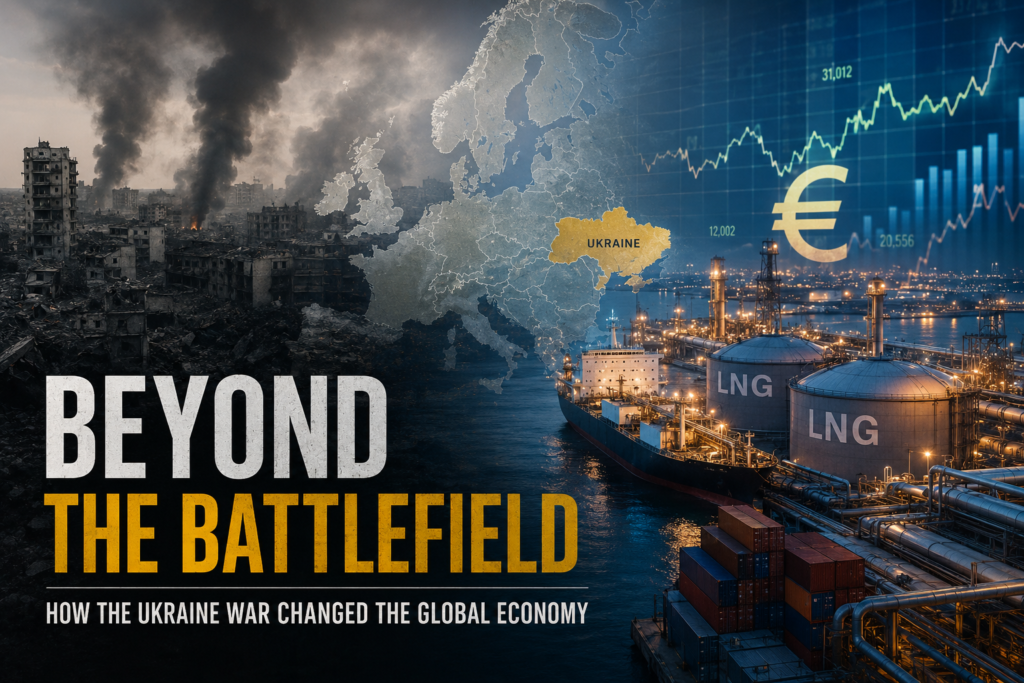
How the conflict is reshaping Europe’s economy, global energy markets, government spending, trade, and the future of international business
For most people, the Ukraine war is still measured in military terms.
The headlines are familiar: missile strikes, drone attacks, shifting front lines, diplomatic meetings, and military aid packages. Television coverage follows maps, while daily updates focus on territory gained or lost.
Those developments matter. They always will.
But they also make it easy to miss a quieter story that has been unfolding in parallel—one with consequences that could last well beyond the fighting itself.
The war has become an economic event as much as a military one. Not because financial markets suddenly replaced battlefields, but because governments, businesses, and investors have gradually started making decisions based on the assumption that geopolitical instability is no longer an exception. It is becoming part of the operating environment.
That shift is surprisingly easy to overlook because it rarely arrives with a dramatic announcement.
A European government signs a long-term LNG contract instead of renewing an old energy partnership. A multinational manufacturer adds another production facility in India or Vietnam, even though the existing one still works perfectly well. An investor demands a higher return before financing a factory located in a politically sensitive region. None of these decisions dominate the evening news. Together, they begin to reshape the global economy.
In many corporate boardrooms, geopolitical risk has quietly moved from the final slide of investor presentations to one of the first questions discussed.
That may turn out to be one of the conflict’s most enduring legacies.
Wars often destroy infrastructure. They also rewrite assumptions.
For decades, businesses optimized for efficiency. Governments encouraged deeper global integration. Investors generally treated stable trade relationships as a given. The economic model rewarded lower costs, lean inventories, and increasingly interconnected supply chains.
Those assumptions now look far less certain.
The irony is difficult to ignore. The same globalization that created extraordinary economic growth also created dependencies that many governments are now trying to reduce. What once looked like efficiency increasingly looks, in some sectors, like vulnerability.
This change extends well beyond Europe.
Energy security is being reconsidered in Asia. Supply-chain strategies are changing across North America. Manufacturing investment is being redirected toward countries viewed as politically reliable. Even nations geographically distant from the conflict are adjusting economic policy because the risks exposed by the war are not confined to one region.
That is why understanding the Ukraine war requires looking beyond troop movements.
The deeper story is unfolding inside government budgets, energy policy, industrial strategy, financial markets, and boardrooms where investment decisions are being made with a very different set of assumptions than they were only a few years ago.
Military historians will eventually debate campaigns and turning points.
Economists may remember something else.
They may remember this as the moment when efficiency stopped being the unquestioned goal of globalization.
Key Takeaways
- The Ukraine war has evolved into a long-term economic story, not just a military conflict.
- Governments are placing greater emphasis on energy security, industrial policy, and supply-chain resilience.
- Businesses increasingly factor geopolitical risk into investment decisions alongside cost and efficiency.
- Europe’s economic model is changing in ways that are likely to outlast the war itself.
- Countries such as India could benefit from shifting manufacturing and investment patterns if they remain competitive.
The War Has Entered a Different Economic Phase
When Russia launched its full-scale invasion in early 2022, governments had little choice but to focus on the immediate emergency. Humanitarian relief, military assistance, sanctions, and energy shortages dominated policy discussions.
Four years later, those emergency measures have gradually evolved into something more permanent.
Europe is redesigning parts of its energy system rather than simply replacing lost supplies. Defense spending is no longer being debated as a temporary response but as a recurring budget commitment. Industrial policies once considered exceptional are increasingly becoming mainstream.
Financial markets have adapted as well.
Investors still monitor developments on the battlefield, but they also watch bond markets, electricity prices, shipping costs, insurance premiums, and industrial production with equal attention. Those indicators often provide a better sense of where the long-term economic impact is heading.
Not every government has reached the same conclusions.
Not every company is responding in the same way.
But the direction of travel has become increasingly clear.
Ukraine’s Economy: Rebuilding More Than Cities
The destruction caused by the war is easy to measure in photographs.
Damaged apartment blocks. Destroyed bridges. Power stations hit by repeated attacks. Factories standing idle. Entire towns where normal economic activity has all but disappeared.
The harder losses are the ones that never appear in satellite images.
Businesses delay investment. Banks become more cautious. Skilled workers build new lives elsewhere. Young graduates postpone career plans. Entrepreneurs decide that launching a company can wait another year. None of those decisions makes international headlines, yet together they shape an economy’s future just as much as damaged infrastructure.
That distinction matters because reconstruction is often misunderstood.
Rebuilding roads and power lines is expensive, but it is also relatively straightforward. Rebuilding confidence is slower. Investors rarely commit billions of dollars simply because construction has begun. They need functioning institutions, predictable regulation, affordable insurance, reliable logistics, and some confidence that today’s investment will still make sense ten years from now.
In post-conflict economies, insurance premiums can become just as important as engineering capacity.
Agriculture: A Reminder That Food Security Is Global
Long before the war, Ukraine had earned a reputation as one of the world’s most important agricultural exporters.
Its wheat, corn and sunflower oil reached markets across Europe, the Middle East, Africa and Asia. That made agriculture not just a domestic industry but part of the global food system.
When Black Sea exports were disrupted in 2022, the consequences spread well beyond Eastern Europe. Grain prices climbed sharply, import-dependent countries faced renewed pressure, and governments were reminded that food security is closely tied to geopolitics. The eventual Black Sea Grain Initiative helped restore some exports, but it also exposed how fragile global supply networks can become when a single shipping corridor is interrupted.
Even where farming has resumed, recovery remains uneven.
Fields must be cleared. Equipment replaced. Storage facilities repaired. Access to financing remains difficult in many areas, and labor shortages continue to complicate production.
Growing crops is only part of the business.
Farmers also need confidence that those crops can reach international buyers without repeated disruption.
The Human Capital Challenge
Every economy depends on infrastructure.
The strongest economies also depend on people.
Millions of Ukrainians have been displaced since the conflict began, with many settling temporarily across Europe. Some will return when conditions improve. Others may remain where they have found work, education, or long-term stability.
That uncertainty creates a structural bottleneck for reconstruction.
Replacing experienced engineers, doctors, teachers, software developers, and skilled technicians is considerably harder than rebuilding physical assets. Countries can finance new roads. They cannot quickly recreate decades of accumulated experience.
Population trends often shape economic recovery long after the headlines move elsewhere.
Investment Doesn’t Return on Optimism Alone
It is tempting to assume that reconstruction itself will attract investment.
History suggests the picture is more complicated.
Private investors evaluate far more than growth projections. Political stability, legal protections, financing costs, insurance availability, transport networks, and currency risk all influence whether capital actually arrives.
There is a reason international development banks often play such an important role in post-conflict economies. Their participation can reduce risk enough for private investment to follow.
Confidence, in that sense, becomes contagious.
So does uncertainty.
Some companies are already preparing for future opportunities in Ukraine’s infrastructure, renewable energy, construction, and technology sectors. Others are watching from the sidelines, waiting for stronger signals that conditions have become durable rather than temporary.
The difference between those two groups may ultimately depend less on engineering projects than on institutions.
Public Finance and the Long Road Ahead
International financial support has helped Ukraine maintain essential public services while financing emergency spending throughout the conflict.
Recent assessments from institutions such as the International Monetary Fund, World Bank, and European Commission broadly point in the same direction, even if they differ on the pace of recovery: external assistance will remain essential for some time, but long-term prosperity cannot rely on aid alone.
Sustained growth requires functioning businesses, productive industries, private investment, stable tax revenues, and access to international markets.
Aid can prevent economic collapse.
It cannot substitute for a self-sustaining economy.
That may be the biggest challenge Ukraine faces—not rebuilding what has been lost, but creating the conditions that encourage people, businesses, and capital to return and stay.
Europe’s Economic Reset: When Security Started Competing With Efficiency
Few places illustrate the war’s economic consequences more clearly than Europe.
The immediate challenge in 2022 was straightforward enough: replace lost energy supplies, contain inflation, support households, and prevent industrial disruption. Those were emergency decisions.
The longer-term response has become something quite different.
Across much of Europe, policymakers are redesigning parts of the continent’s economic model around a question that received far less attention before the war: what happens if efficiency comes at the expense of security?
That question now reaches into energy policy, industrial strategy, defense planning, and public finance.
Energy Is No Longer Just About Price
For decades, relatively inexpensive Russian pipeline gas helped power European industry.
Energy-intensive manufacturers—from chemical producers to steelmakers—benefited from costs that supported their global competitiveness. Germany’s industrial base, for example, was built partly on the assumption that affordable energy would remain available over the long term.
That assumption broke down remarkably quickly.
European governments accelerated investment in LNG terminals, signed supply agreements with alternative exporters, expanded renewable energy projects, strengthened electricity networks, and in several countries reopened discussions about nuclear power.
The goal was never simply to replace one supplier with another.
It was to reduce the risk of becoming heavily dependent on any single source again.
The economic trade-off is becoming clearer.
Greater energy security often comes with higher costs, at least in the short term. For manufacturers already competing against lower-cost producers elsewhere, that raises difficult questions about future competitiveness.
For many European businesses, the biggest challenge is no longer today’s energy price.
It’s uncertainty about next year’s.
That uncertainty influences hiring decisions, factory expansion, and long-term investment every bit as much as the price itself.
Defense Spending Has Become Economic Policy
Defense budgets have risen across much of Europe, but the story extends beyond military preparedness.
Larger procurement programs are reshaping industrial activity.
Factories producing ammunition, air-defense systems, precision components, electronics, and specialized machinery are expanding capacity. Supply chains supporting those industries are growing alongside them.
This creates employment, investment, and manufacturing demand.
It also creates difficult budget choices.
Every additional euro directed toward defense is a euro unavailable for something else. Governments can borrow more, raise taxes, reduce spending elsewhere, or combine all three. None of those options is politically comfortable.
The debate, then, is no longer whether defense spending should increase.
It is how societies absorb the economic cost over time.
Strategic Industries Have Moved to the Center
A few years ago, discussions about semiconductors, battery production, or critical minerals were often treated as industrial policy.
Today they are increasingly discussed alongside national security.
The change is subtle but important.
Semiconductors are still commercial products. Critical minerals still serve industrial markets.
Governments simply no longer view uninterrupted access to them as something that can be taken for granted.
The same thinking now extends to pharmaceuticals, digital infrastructure, advanced manufacturing, and artificial intelligence.
The objective is not complete economic self-sufficiency.
Very few economists believe that would be practical.
Instead, governments are trying to reduce the strategic vulnerabilities created by concentrating too much production in too few places.
Ironically, the global economy is not becoming less interconnected.
It is becoming more selective about which interconnections are considered acceptable.
Russia’s Economy: Adaptation Has Limits
Early predictions about Russia’s economy tended to fall into two opposing camps.
One forecast rapid economic collapse under sanctions.
The other suggested Russia would adapt with relatively little long-term damage.
Neither fully captured what has happened.
Russia has redirected large volumes of energy exports toward Asian markets, strengthened trade relationships with countries outside the Western sanctions framework, and expanded domestic production in several industries.
Those adjustments softened the immediate shock.
They did not remove deeper structural constraints.
Access to advanced technologies remains more restricted than before the invasion. Foreign direct investment has declined substantially. Labor shortages, demographic pressures, and weaker productivity growth continue to weigh on longer-term prospects.
Recent assessments from institutions including the OECD and the IMF suggest a similar conclusion, even where their forecasts differ: short-term adaptation should not be confused with long-term economic strength.
The evidence currently points more strongly in one direction.
Russia has demonstrated greater resilience than many expected in 2022.
Whether that resilience translates into sustained long-term growth remains a far more difficult question.
The Quiet Revolution in Global Supply Chains
Long before the war, multinational companies were already questioning whether supply chains had become too concentrated.
The pandemic exposed one set of weaknesses.
The Ukraine war exposed another.
Together, they changed the conversation inside corporate boardrooms.
For years, efficiency was the dominant objective. Manufacturers searched for the lowest production costs, suppliers were consolidated to improve margins, and inventories were reduced wherever possible. The system worked remarkably well—until it encountered repeated shocks.
Now executives are asking different questions.
What happens if sanctions suddenly affect a critical supplier?
What if an important shipping route becomes politically unstable?
Can production continue if one country unexpectedly restricts exports?
Those questions rarely have simple answers, which is precisely why companies are investing in redundancy instead of eliminating it.
That represents a notable shift in corporate thinking.
Redundancy was once viewed as inefficiency.
Increasingly, it is viewed as insurance.
The result has been a gradual acceleration of strategies such as friend-shoring, near-shoring, and supplier diversification. Rather than concentrating production in one location, many firms are spreading operations across multiple countries—even if doing so raises costs.
The trend is already visible.
Apple has expanded manufacturing capacity in India alongside China. Electronics companies continue increasing investment across Southeast Asia. Mexico has benefited from near-shoring demand linked to the North American market, while Poland has strengthened its position as a logistics and manufacturing hub within Europe.
None of these changes signals the end of globalization.
Trade volumes remain enormous, and international supply chains are still deeply interconnected.
What’s changing is the definition of efficiency.
Today, a supply chain that survives disruption may be considered more valuable than one that simply minimizes costs.
That is a subtle shift in language.
It is a much bigger shift in capital allocation.
Public Spending, Debt, and the Cost of a Longer Conflict
Wars rarely end when military operations slow.
Their financial consequences often continue for years, sometimes decades.
Across Europe and beyond, governments have committed substantial resources to military support, humanitarian assistance, refugee programs, infrastructure protection, and preparations for Ukraine’s eventual reconstruction.
Those commitments are becoming embedded in long-term budgets rather than treated as one-off expenditures.
That has implications for public finances.
Some governments have greater fiscal flexibility than others. Countries with lower debt burdens can absorb higher spending more comfortably. Others face more difficult choices as borrowing costs rise and demographic pressures place additional strain on public finances.
Not every European government begins from the same financial position.
That partly explains why policy responses have differed despite broadly shared strategic objectives.
The debate is no longer simply about how much should be spent.
It increasingly revolves around what governments may have to postpone in order to finance those commitments.
Infrastructure.
Healthcare.
Education.
Tax reductions.
Economic policy is often described as a series of trade-offs.
Periods like this make those trade-offs unusually visible.
There is another connection that receives less attention.
Higher energy costs affect industrial competitiveness.
Weaker industrial competitiveness can reduce investment.
Lower investment influences tax revenues.
That, in turn, affects governments already managing higher defense spending.
These issues are often discussed separately.
In practice, they reinforce one another.
Why This Matters Beyond Europe
One of the more surprising consequences of the conflict is that some of its most enduring economic effects may emerge outside Europe.
Countries that were never directly involved in the war are adjusting industrial policy, energy strategy, and investment priorities because the assumptions underpinning globalization have changed.
India is one example.
As manufacturers diversify production across multiple regions, India has become a more attractive destination for investment in electronics, pharmaceuticals, engineering, and advanced manufacturing. Government initiatives such as the Production-Linked Incentive (PLI) scheme were already encouraging domestic manufacturing before the war. Supply-chain diversification has added further momentum.
That does not guarantee success.
Reliable infrastructure, predictable regulation, skilled labor, and competitive logistics remain decisive factors when companies choose where to invest.
Geopolitical shifts may create a competitive opening.
Countries still have to earn it.
The same pattern is visible elsewhere.
Vietnam continues attracting export-oriented manufacturing. Mexico benefits from proximity to the United States. Several Gulf economies are investing heavily in logistics and industrial diversification as global trade routes evolve.
The conflict has reinforced a broader lesson.
Economic shocks rarely remain confined to the countries where they begin.
Looking Beyond the War
The Ukraine war has prompted governments to rethink far more than military strategy.
Economic security has moved closer to the center of policymaking. That shift is visible in decisions about energy, semiconductor production, critical minerals, digital infrastructure, food supplies, and industrial policy. These issues were once discussed by separate ministries. Increasingly, they are part of the same conversation.
Recent assessments from institutions including the International Monetary Fund (IMF), World Bank, OECD, International Energy Agency (IEA), and the European Commission differ on the pace of recovery and future growth, but they broadly point in the same direction. The conflict has accelerated structural changes that were already beginning to emerge after the pandemic, particularly around supply chains, public investment, and energy diversification.
One lesson stands out.
Efficiency remains important, but it is no longer sufficient on its own.
Governments are increasingly willing to accept higher short-term costs if they believe those costs reduce strategic vulnerability later. Businesses are making similar calculations. What once looked like unnecessary redundancy now looks, to many executives, like prudent risk management.
That represents a meaningful change in how economic decisions are made.
What Comes Next?
No credible analyst can predict exactly how the conflict will evolve.
The economic outcomes, however, broadly fall into three possible paths.
Gradual Stabilization
If hostilities continue to ease over time, reconstruction could gather momentum. Private investment would become more willing to return, cross-border trade could expand, and sectors such as infrastructure, engineering, logistics, and energy would likely experience sustained demand.
History suggests recovery would still be uneven. Some regions would rebound faster than others, and attracting long-term private capital would remain as important as rebuilding physical assets.
A Prolonged Period of Uncertainty
If the conflict continues without a clear resolution, many of today’s temporary adjustments may become permanent.
Businesses would keep redesigning supply chains. Governments would continue prioritizing defense and energy security. Investors would place a higher premium on political stability, making geopolitical risk a routine part of financial decision-making rather than an occasional consideration.
Over time, economies adapt to uncertainty.
That adaptation often changes investment patterns more than the original crisis itself.
A Political Settlement
A broader political agreement could unlock one of the largest reconstruction programs in modern Europe.
Construction firms, engineering companies, renewable energy developers, financial institutions, logistics providers, and technology businesses would all see potential opportunities.
Even then, success would depend on governance, institutional reform, financing conditions, and investor confidence as much as reconstruction spending itself.
Peace creates possibilities.
It does not automatically create prosperity.
Why the Story Doesn’t End With a Ceasefire
It is tempting to think of wars as events with clear beginnings and endings.
Economies rarely work that way.
An energy contract expires and is replaced with a different supplier.
A manufacturer builds its next factory in another country.
An investor adjusts how political risk is priced into future projects.
A government quietly rewrites the assumptions behind its industrial strategy.
Individually, these decisions seem ordinary.
Collectively, they alter the direction of global commerce.
That may be the most enduring economic lesson of the Ukraine war.
The conflict has not simply disrupted trade, energy markets, or investment flows. It has changed the way governments and businesses think about them. Some of those adjustments may eventually be reversed, but many already appear to be becoming permanent features of the international economy.
Years from now, military historians will continue debating battles and political leaders will debate diplomacy.
Economists may look elsewhere.
They may point instead to thousands of quieter decisions—where companies chose to build factories, how governments redefined energy security, why investors began pricing geopolitical risk differently—and conclude that this was the period when the rules of globalization began to change.
Not all at once.
Almost quietly.