
Every day, billions of people interact with artificial intelligence without giving much thought to what happens after they hit “Enter.”
A student asks ChatGPT to explain a physics problem. A designer generates a handful of images in seconds. A programmer lets an AI assistant write part of a software application. The exchange feels almost frictionless, as though intelligence itself has become another internet service that simply exists in the background.
It hasn’t.
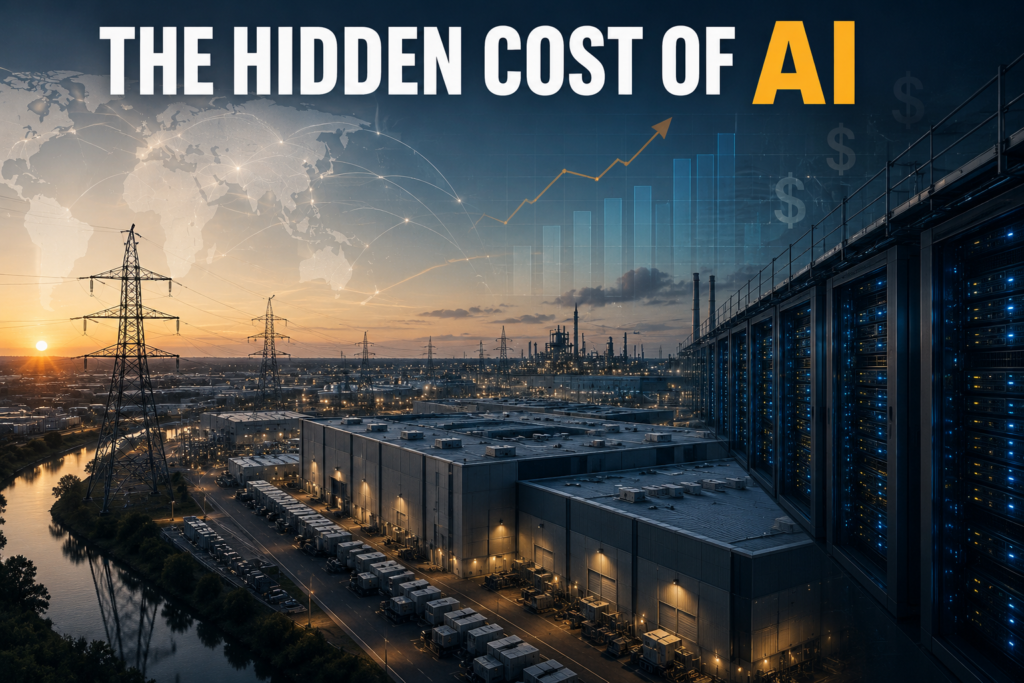
Somewhere, thousands of processors have just come alive. Cooling systems are moving enormous volumes of water and air. Electricity is flowing through racks of specialised hardware inside warehouse-sized data centres. Fibre-optic cables are carrying data across continents. All of it happens in a fraction of a second, which is precisely why most people never notice.
One irony of the AI boom is that the more seamless the technology becomes, the easier it is to overlook the physical world supporting it.
For years, artificial intelligence was treated primarily as a software story. The discussion centred on algorithms, model capabilities and breakthrough research. Those things still matter, but they’re no longer the whole story. Increasingly, AI is also an infrastructure story—one built from silicon, concrete, copper, electricity and capital.
That shift changes the conversation.
The companies leading AI are no longer competing only to build better models. They’re racing to secure chips, construct data centres, lock in long-term energy supplies and strengthen supply chains. Governments are offering generous incentives to attract these investments, while utilities are revising demand forecasts that, until recently, would have seemed implausibly high.
History offers a useful reminder here. Every major technological revolution has depended on infrastructure that initially received far less attention than the innovation itself. Railways needed tracks before they transformed trade. Electrification required decades of investment before factories fully changed the way they operated. The internet eventually became wireless and invisible to most users, but only after enormous spending on cables, servers and telecommunications networks.
AI appears to be following a similar path.
What’s different is the pace. Infrastructure that might once have been built over decades is now being planned over a few years, sometimes even faster. Companies are investing extraordinary sums today in anticipation of demand that has not fully arrived.
That’s an unusual position for any industry to be in.
It also raises a question that receives surprisingly little attention. If artificial intelligence is generating trillions of dollars in market value and promising to reshape almost every sector of the economy, who is actually paying to build the foundation beneath it?
The answer extends far beyond the technology industry.
Governments absorb part of the cost through subsidies and public investment. Investors finance expansion with the expectation of future returns. Businesses pay to integrate AI into their operations. Consumers contribute through subscriptions, software pricing and advertising. Communities hosting large facilities often shoulder pressures on land, energy infrastructure and water resources that don’t appear on corporate balance sheets.
The costs are distributed. The benefits may be too.
That makes AI infrastructure more than a technology issue. It’s becoming an economic, industrial and geopolitical one.
Why AI Suddenly Needs So Much Infrastructure
Only a few years ago, most AI systems performed relatively narrow tasks. They translated languages, recommended products, recognised images or filtered spam. The computing requirements were substantial, but they remained within the reach of existing cloud infrastructure.
Then the economics changed.
Today’s frontier models don’t just classify information. They generate text, write software, analyse legal documents, assist scientific research and increasingly serve as general-purpose tools for businesses. Millions of people expect those systems to respond almost instantly, regardless of when or where they ask.
Meeting that expectation requires far more computing power than most people realise.
Training a frontier AI model can involve tens of thousands of specialised processors operating continuously for weeks or months. Once the model is released, the workload doesn’t disappear. Every prompt, every image request and every AI-assisted search adds to an infrastructure that never really stops running.
At first glance, software shouldn’t be constrained by physical resources. For decades, computing became cheaper, faster and more efficient with each generation of hardware.
AI is beginning to challenge that assumption.
The bottleneck is no longer just better algorithms. It’s whether there are enough chips to buy, enough electricity to power them, enough transmission lines to deliver that electricity and enough facilities to house the computing itself.
People often describe AI as a race to build smarter models.
Increasingly, it looks just as much like a race to build the industrial system capable of supporting them.
The Five Pillars of AI Infrastructure
Chips: The New Strategic Resource
If AI has a defining raw material, it isn’t data.
It’s advanced computing power.
That distinction matters because data can be copied almost infinitely. High-end AI chips cannot. They require years of research, highly specialised manufacturing and one of the most complex industrial supply chains ever assembled.
The companies designing these processors have become some of the most valuable businesses in the world for good reason. NVIDIA’s graphics processing units, or GPUs, have emerged as the industry’s preferred choice for training and running large AI models. AMD is investing aggressively to expand its presence, while Taiwan’s TSMC manufactures many of the world’s most advanced chips for a range of technology companies. High-bandwidth memory has become equally important, allowing processors to move enormous amounts of information without creating performance bottlenecks.
At first, this looked like another technology cycle.
It no longer does.
Governments increasingly treat advanced semiconductors as strategic assets rather than commercial products. Export controls, investment restrictions and efforts to build domestic manufacturing capacity have all intensified. The debate around chips now sits alongside conversations about national security, industrial policy and economic resilience.
One irony is hard to miss. For years, software companies were celebrated because they required relatively little physical infrastructure compared with traditional industries. AI is reversing part of that story. The companies writing the software are becoming increasingly dependent on manufacturers, foundries and suppliers they don’t fully control.
In other words, some of the industry’s bargaining power is quietly shifting away from software and toward the businesses that build the hardware underneath it.
Data Centres: The Factories of the AI Economy
The phrase cloud computing has always been slightly misleading.
It suggests something light, almost intangible. In reality, the cloud occupies vast campuses of concrete, steel and high-voltage electrical equipment.
Walk inside a modern hyperscale data centre and it feels less like visiting a technology office than an industrial facility. Long rows of server racks stretch across enormous halls. Cooling systems operate continuously. Backup generators stand ready in case the local grid fails. Every detail, from airflow to cable placement, is engineered to minimise interruptions.
None of this is inexpensive.
Building a large AI-ready data centre can require billions of dollars before it processes a single customer request. The spending doesn’t stop once construction is complete. Hardware must be replaced, cooling systems upgraded and electricity secured through long-term agreements. Maintaining these facilities is almost as demanding as building them.
That helps explain why technology companies continue announcing record capital expenditure.
To some investors, the numbers look excessive. Others argue they’re unavoidable. If demand for AI computing keeps growing, companies that fail to expand capacity today may struggle to compete a few years from now.
We’ve seen similar thinking before.
During the early days of cloud computing, several companies invested heavily in infrastructure long before demand fully materialised. At the time, critics questioned whether they were spending too aggressively. In hindsight, much of that investment became the foundation of today’s digital economy.
The comparison is useful—but only up to a point.
Cloud computing largely replaced existing IT infrastructure. AI is creating entirely new demand on top of it. That makes forecasting far more uncertain. Companies aren’t just expanding capacity for current customers; they’re trying to anticipate how businesses, governments and consumers will use AI several years from now.
There’s another shift happening beneath the surface.
Local governments increasingly compete to attract data-centre investment in much the same way they once competed for automobile plants or large manufacturing facilities. Jobs matter, of course. Tax revenue matters too. But these projects also reshape regional electricity demand, broadband networks, transport infrastructure and long-term development plans.
Data centres are no longer simply supporting the digital economy.
They’re becoming part of a country’s industrial strategy.
And that’s a very different conversation from the one the technology sector was having just a few years ago.
Electricity: The Resource That May Decide AI’s Future
For years, the technology industry assumed computing power would keep becoming cheaper and easier to access. Better chips arrived every few years, cloud providers expanded capacity and software companies rarely had to think much about where the electricity came from.
AI is beginning to change that relationship.
Training a frontier model consumes an extraordinary amount of energy. Running that model for millions of users every day can consume even more over its lifetime. As businesses embed AI into search engines, productivity software, customer service and industrial operations, electricity demand grows alongside digital demand.
At first glance, this sounds like an engineering problem.
It isn’t only that.
Power grids take years to expand. New transmission lines often require lengthy regulatory approvals. Large-scale generation projects can take even longer. AI development, meanwhile, is moving at software speed. Infrastructure rarely does.
That mismatch may become one of the defining constraints of the decade.
A few years ago, utilities were rarely mentioned alongside semiconductor companies during discussions about artificial intelligence. Today, they’re part of the conversation because reliable electricity has become a competitive advantage. Some technology companies are signing long-term power agreements years in advance. Others are investing directly in renewable energy or exploring nuclear partnerships to secure future supply.
The interesting shift isn’t simply that AI needs more electricity.
It’s that electricity is becoming a strategic technology input rather than just another operating expense.
Countries with dependable grids, abundant generation capacity and room to expand transmission networks may find themselves in a stronger position than many expected. For decades, discussions about digital competitiveness centred on software talent and internet connectivity. Increasingly, they also include transformers, substations and power plants.
That would have sounded unusual not long ago.
Today, it feels increasingly practical.
Water: The Resource Hidden Behind the Servers
Electricity attracts most of the attention.
Water usually doesn’t.
Yet every high-performance processor generates heat, and that heat has to go somewhere. Many modern data centres rely on sophisticated cooling systems that consume significant quantities of freshwater, particularly during periods of heavy demand.
It’s an easy detail to overlook because users never see it.
Communities do.
In several regions around the world, proposals for large data centres have sparked local debate—not because residents oppose technology, but because they want to understand what it means for water supplies, land use and public infrastructure. Those concerns tend to become more pronounced in areas already dealing with recurring drought or rapid population growth.
The trade-offs are rarely straightforward.
A new facility can bring investment, skilled jobs and additional tax revenue. It can also increase pressure on local resources that are already under strain. Neither side of that equation can simply be dismissed.
What’s often overlooked is that these debates are likely to become more common, not less. As AI infrastructure expands beyond traditional technology hubs, decisions about cooling systems, water recycling and environmental management will increasingly shape where future facilities are built.
This is no longer only a technology discussion.
It’s becoming part of urban planning, environmental policy and regional economic development.
Global Supply Chains: The Invisible Foundation
When people think about AI infrastructure, they usually picture advanced chips.
Those chips are only one piece of a much larger industrial puzzle.
Copper carries electricity through data centres. Rare minerals support batteries and electronic components. Highly specialised packaging facilities prepare advanced semiconductors before they reach customers. Undersea fibre-optic cables move enormous volumes of information between continents. Precision manufacturing equipment comes from a remarkably small group of companies spread across different parts of the world.
Remove any one of those links and the entire system begins to slow.
The past few years have already demonstrated how vulnerable globally integrated supply chains can be. Pandemic disruptions, geopolitical tensions and shipping bottlenecks reminded manufacturers that efficiency and resilience are not always the same thing.
There’s an irony here.
Globalisation created the supply networks that allowed the AI industry to grow so quickly. At the same time, that dependence has encouraged governments to pursue greater technological self-reliance. Both trends are unfolding together.
Complete independence, however, remains unrealistic.
Even the world’s largest economies continue relying on specialised suppliers outside their own borders. Advanced semiconductor manufacturing, for example, still depends on expertise, equipment and materials sourced from multiple countries. Building domestic capacity helps reduce risk, but it doesn’t eliminate interdependence.
That reality is easy to forget amid headlines about technological competition.
Modern AI isn’t supported by a single country or a single company. It’s sustained by an industrial ecosystem that stretches across continents, where thousands of specialised businesses contribute components that most users will never know exist.
Invisible infrastructure is still infrastructure.
And without it, the AI economy simply doesn’t function.
Who Is Actually Paying?
One of the biggest misconceptions about the AI boom is that technology companies are footing the entire bill.
They’re not.
The costs are distributed across the economy, often in ways that are difficult to see because they don’t arrive as a single invoice. Instead, they’re embedded in public spending, corporate investment, electricity infrastructure, financial markets and, eventually, the products and services people use every day.
Governments are among the first to contribute.
Around the world, countries are offering tax incentives, grants, infrastructure support and semiconductor subsidies to attract AI investment. The logic is understandable. Large data centres create jobs, stimulate local construction, attract suppliers and can anchor wider technology ecosystems. Policymakers increasingly view AI infrastructure much like ports, airports or industrial corridors—assets expected to generate economic activity for years.
Whether every project delivers those returns is another question.
Technology companies are carrying an enormous share of the financial burden as well.
Microsoft, Alphabet, Amazon, Meta and several others are committing tens of billions of dollars each year to data centres, networking equipment, specialised chips and long-term energy agreements. In previous technology cycles, investors often focused on software margins. Today, capital expenditure has become just as important because it signals how aggressively companies are preparing for an AI-driven future.
What’s unusual is that much of this investment is being made before demand is fully understood.
Businesses know AI adoption is accelerating. They don’t yet know exactly how quickly every industry will integrate it, or how much computing capacity customers will ultimately require. They’re building ahead of certainty.
That’s a calculated risk.
Investors, meanwhile, are financing much of that expansion.
Every pension fund holding technology stocks, every index fund tracking major markets and every retail investor buying shares in AI-related companies is indirectly participating in this infrastructure buildout. Shareholders understandably focus on future profits, but those profits depend on years of heavy spending first.
The relationship works both ways. Investors are funding the AI revolution, while the AI revolution is increasingly shaping where global capital flows.
Consumers contribute too, although it’s less visible.
Premium AI subscriptions, enterprise software licences, cloud computing services and advertising-supported digital platforms all generate revenue that helps pay for this infrastructure. A slightly more expensive software subscription may seem unrelated to a new data centre, yet those economics are increasingly connected.
Businesses face another layer of cost.
Adopting AI often involves much more than purchasing a chatbot. Companies invest in cloud migration, cybersecurity, employee training, workflow redesign and new digital systems. For many organisations, the software itself isn’t the largest expense. Integrating it into existing operations is.
Then there are the communities hosting these facilities.
A hyperscale data centre can transform a local economy through construction activity, permanent jobs and new tax revenue. It can also increase demand for electricity, roads, housing and water infrastructure. Those benefits and costs rarely fall on the same people.
That makes the economics of AI infrastructure surprisingly broad.
Almost everyone is paying for it in some form. The difference lies in how visible those payments are.
Is AI Infrastructure Becoming the Next Global Arms Race?
Technology leadership has always mattered.
Today, it increasingly overlaps with economic security.
The United States is investing heavily in domestic semiconductor manufacturing while expanding AI research and data-centre capacity. China continues pursuing technological self-reliance, reducing dependence on foreign chip technology wherever possible. Europe has focused on digital sovereignty, balancing industrial investment with regulation.
Other countries are carving out their own roles rather than trying to copy the same strategy.
Japan and South Korea remain essential to the semiconductor ecosystem. Taiwan occupies an outsized position in advanced chip manufacturing. India is strengthening digital infrastructure, encouraging semiconductor investment and leveraging one of the world’s largest engineering talent pools.
What’s becoming clear is that this competition extends well beyond software.
Countries are competing for advanced manufacturing capacity, engineering expertise, reliable electricity, cloud infrastructure, critical minerals and resilient supply chains. Those assets determine who can build AI at scale—not just who can design the next impressive model.
Some analysts compare today’s investment cycle with the telecom boom that preceded the dot-com crash, arguing that enthusiasm may be running ahead of commercial reality.
The comparison is worth considering.
But there’s an important difference. Much of today’s AI infrastructure spending is being driven by highly profitable hyperscale companies with established cash flows rather than speculative startups relying solely on future promises. That doesn’t eliminate risk, but it changes its nature.
The larger question may not be whether countries can develop sophisticated AI.
It’s whether they can sustain the industrial ecosystem needed to support it over the long term.
Nobody knows the answer yet.
Can Companies Earn Back These Trillions?
History rarely repeats itself exactly, but it often offers useful perspective.
Railways transformed commerce while producing waves of speculation. Electrification reshaped manufacturing, although many investors waited years before seeing meaningful returns. The internet permanently changed business, yet countless companies disappeared before sustainable business models emerged.
AI may ultimately join that list.
Or it may follow a different path entirely.
Technology companies are investing extraordinary sums because they believe AI will become as fundamental to business as cloud computing or the internet itself. If that assumption proves correct, today’s spending could eventually look conservative.
If adoption disappoints, the picture changes.
Not every company integrating AI will become more productive. Not every pilot project will produce measurable returns. Some businesses will spend aggressively because competitors are doing the same, only to discover later that implementation was more difficult than expected.
We’ve seen behaviour like this before.
During periods of technological excitement, companies often invest partly out of opportunity and partly out of fear of being left behind. Distinguishing between those motivations isn’t always easy, especially while the transformation is still unfolding.
That uncertainty is precisely why investors continue debating whether current AI spending represents disciplined long-term investment or the early stages of another infrastructure cycle that has yet to prove its economics.
The answer will take years to emerge.
For now, companies are making one of the largest coordinated capital bets the technology industry has ever attempted—and doing so before the final shape of the market is fully visible.
Winners and Losers
Every major technological transition creates new centres of economic power. AI is unlikely to be any different.
The obvious winners are the companies supplying the infrastructure. Chip designers, semiconductor manufacturers, networking firms, cooling technology specialists and cybersecurity providers all benefit as computing demand grows. Utilities, once regarded as slow-moving businesses with predictable earnings, suddenly find themselves supporting one of the fastest-expanding industries in the global economy.
That shift deserves more attention than it usually receives.
For decades, software companies held much of the bargaining power because they scaled quickly without owning vast physical assets. AI is changing that balance. Reliable electricity, specialised manufacturing, transmission networks and advanced semiconductor capacity have become strategic assets in their own right. In some respects, the companies controlling those resources now have greater leverage than many software developers.
Not every business will benefit equally.
Traditional software firms that fail to integrate AI risk losing competitiveness. Companies investing heavily without a clear commercial strategy may discover that larger infrastructure bills don’t automatically produce higher productivity. Regions with weak power grids or limited digital infrastructure could struggle to attract the next wave of investment, even if they have skilled workforces.
The AI economy isn’t simply rewarding innovation.
It’s rewarding preparedness.
India’s Place in the Global AI Infrastructure Race
India is often described as a software powerhouse. That reputation is well deserved, but it no longer tells the whole story.
The country is expanding digital infrastructure, encouraging semiconductor manufacturing, investing in data centres and supporting a growing AI startup ecosystem. Combined with one of the world’s largest engineering talent pools, those investments position India to play a larger role in the global AI economy than previous technology cycles might have suggested.
Still, ambition and execution aren’t the same thing.
Reliable electricity, advanced manufacturing capability, logistics, research investment and policy consistency will all shape how competitive India becomes over the next decade. Building AI infrastructure requires patience as much as capital. Semiconductor plants, transmission networks and hyperscale facilities are measured in years, not months.
India’s opportunity, then, extends beyond developing AI applications.
If it succeeds in strengthening the physical infrastructure behind those applications, it could become an increasingly important link in the global AI supply chain rather than simply one of its largest markets.
The Risks Nobody Talks About
Most public discussion focuses on what AI can achieve.
Less attention is given to what happens if the infrastructure beneath it struggles to keep pace.
Electricity is one obvious concern. If computing demand grows faster than generating capacity and transmission networks, access to reliable power could become a competitive advantage rather than a basic utility. Water availability presents similar questions in regions where data-centre expansion coincides with long-term resource constraints.
There are financial risks too.
Some infrastructure projects will almost certainly prove more successful than others. History suggests that periods of intense technological investment rarely allocate capital perfectly. Certain facilities will be underused. Some forecasts will turn out to be overly optimistic. That isn’t necessarily evidence that the broader transformation has failed. It’s often how major industrial transitions unfold.
Another issue receives surprisingly little attention: concentration.
Training frontier AI models increasingly requires extraordinary financial resources, specialised chips and vast computing clusters. As those requirements grow, the number of organisations capable of competing at the highest level may shrink. The result could be an AI industry that becomes more centralised even as the technology itself spreads across the economy.
Then there’s supply-chain resilience.
Recent disruptions have already shown how quickly shortages of critical components can ripple across industries. AI adds another layer of dependence. A delay in semiconductor production, specialised packaging equipment or electricity infrastructure doesn’t simply slow one company. It affects an entire ecosystem connected through manufacturing, logistics and cloud computing.
Technology rarely advances in isolation.
Neither do its risks.
Can the World Afford AI?
Artificial intelligence is often presented as something intangible—software that exists somewhere in the cloud, responding instantly to whatever people ask of it.
Look a little closer and a different picture emerges.
Behind every AI response are semiconductor fabrication plants operating with microscopic precision, data centres consuming vast amounts of electricity, transmission networks carrying that power, engineers maintaining complex systems, miners extracting critical minerals and investors committing unprecedented amounts of capital long before they know exactly how those investments will pay off.
The digital experience is real.
So is the physical infrastructure that makes it possible.
History suggests that societies are willing to fund transformative technologies when the long-term economic benefits appear large enough. Railways, electrification, highways, telecommunications and the internet all demanded enormous upfront investment before they reshaped the economy. AI is unlikely to be the exception.
The difference is that this transformation touches almost every strategic resource at once—energy, manufacturing, finance, water, computing and geopolitics. Few previous technology waves have depended on so many interconnected systems simultaneously.
That’s why the future of AI may be determined by factors that, at first glance, seem unrelated to artificial intelligence itself.
The speed at which a country expands its electricity grid.
The time required to approve a new transmission line.
The capacity of a semiconductor factory.
The resilience of a global supply chain.
The willingness of investors to keep financing infrastructure whose full returns may not be visible for years.
Those decisions will shape the AI era just as surely as breakthroughs in model architecture.
When people open an AI application tomorrow morning, they’ll probably experience the same effortless conversation they had yesterday. The technology will still feel almost weightless.
It never really was.
The intelligence may exist in software, but the AI revolution is ultimately being built—and paid for—in the physical world. That’s where its greatest opportunities, its hardest constraints and many of its most important economic questions now reside.