Part 1: When Monetary Policy Meets a More Unpredictable World
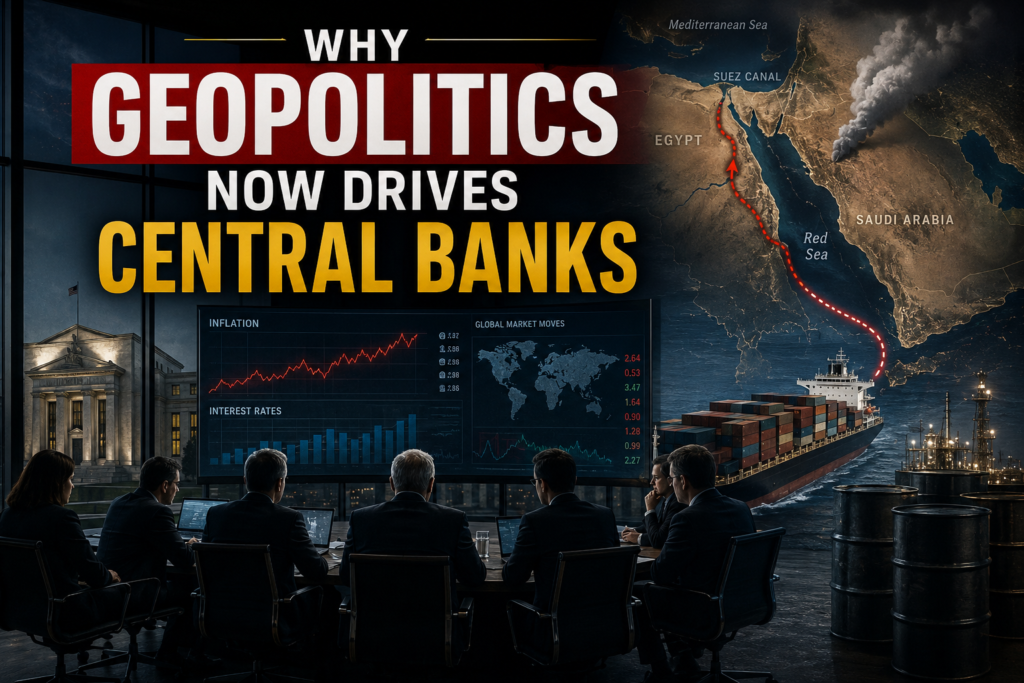
Shortly after dawn, a container vessel approaching the southern entrance to the Red Sea receives updated security advice. Rather than continuing through one of the world’s busiest shipping corridors, it turns south, beginning a far longer journey around the Cape of Good Hope. The detour adds days to the voyage. Fuel costs rise. Shipping insurance becomes more expensive. Retailers waiting for inventories revise delivery schedules. Somewhere else, a factory manager quietly delays production because a shipment of electronic components will arrive later than expected.
None of this appears in that morning’s inflation report.
Yet events like these increasingly shape the conversations taking place inside the world’s most influential central banks.
For decades, monetary policy appeared relatively straightforward. Inflation accelerated, central banks raised interest rates. Economic growth weakened, they lowered them. While the real world was always more complicated than that simple description, the framework itself remained remarkably stable. Policymakers focused primarily on domestic demand, employment, wages and consumer prices. Geopolitics certainly mattered, but it usually arrived as an occasional external shock rather than a permanent feature of the economic landscape.
That assumption has become much harder to defend.
Today, a conflict thousands of kilometres away can alter freight costs within days. A new export restriction can reshape investment decisions before factories have time to respond. An energy dispute can move financial markets long before any official production figures change. Political decisions increasingly travel through supply chains with surprising speed, often reaching consumers as higher prices months later.
Central bankers have noticed.
Not because they have become geopolitical strategists, but because geopolitics now influences many of the variables they were created to manage.
It would be easy to conclude that inflation has become less important.
That would overstate the case.
Inflation remains the primary objective for most major central banks. Stable prices are still fundamental to economic growth, investment and household confidence. What has changed is the range of forces capable of pushing inflation higher—or keeping it there for longer than traditional economic models might predict.
In other words, the destination has not changed.
The journey has.
From Predictable Globalisation to Strategic Competition
For much of the three decades following the end of the Cold War, businesses built increasingly global supply chains on a simple assumption: efficiency would continue to outweigh politics.
A smartphone might contain chips designed in one country, manufactured in another, assembled somewhere else and sold worldwide. An automobile could cross several borders before reaching a dealership. Companies focused relentlessly on reducing costs because international trade was becoming faster, cheaper and more predictable.
There were interruptions, of course.
Natural disasters disrupted production. Financial crises slowed demand. Oil prices occasionally spiked.
But these were generally viewed as temporary disturbances within a system that continued expanding.
The past few years have challenged that confidence.
The pandemic exposed how dependent modern economies had become on highly concentrated supply chains. Factory closures in one region created shortages across continents. Ports became congested. Shipping costs surged. Businesses that had perfected just-in-time manufacturing suddenly found themselves competing for basic components.
As those disruptions gradually eased, another reality became harder to ignore.
Economic security and national security were becoming increasingly intertwined.
Governments began paying closer attention to where semiconductors were produced, who controlled critical mineral supplies and how dependent domestic industries had become on overseas manufacturing. Investment decisions that had once been driven almost entirely by commercial logic increasingly acquired strategic importance.
That shift did not happen overnight.
Nor is it complete.
Some economists argue that globalisation is simply evolving rather than retreating, with supply chains becoming more diversified instead of less international. Others believe the world is entering a more fragmented era in which resilience will increasingly compete with efficiency.
Both arguments contain elements of truth.
Which is precisely the challenge confronting today’s central banks.
Their models were designed to interpret economic data.
The economy itself is being shaped by forces that are no longer purely economic.
That doesn’t mean monetary policy has become ineffective. Higher interest rates can still cool demand. Lower rates can still encourage borrowing and investment. Those mechanisms remain powerful.
But interest rates cannot reopen a blocked shipping lane.
They cannot produce more oil.
And they cannot persuade companies to ignore geopolitical risks when deciding where to build their next factory.
Those decisions are being made in boardrooms, ministries and diplomatic meetings as much as they are in financial markets.
For central bankers, understanding inflation increasingly means understanding the world beyond inflation itself.
And that raises a more interesting question than whether geopolitics matters.
How do institutions designed to respond to economic cycles adapt when some of the biggest inflationary forces originate outside the economy they directly control?
How Geopolitics Finds Its Way into Inflation
Inflation doesn’t usually arrive with a dramatic announcement.
It often begins quietly.
A shipping company adjusts its insurance premiums after attacks near a major maritime corridor. An importer agrees to pay slightly more to secure inventory before another disruption occurs. An energy trader builds a risk premium into oil prices because no one is certain whether a diplomatic crisis will escalate or fade away.
Consumers rarely notice these decisions as they happen.
Months later, they notice the bill at the supermarket.
That delay is one reason inflation has become harder to interpret than it once was. By the time official statistics reveal higher prices, businesses have already spent weeks—or even months—responding to events unfolding elsewhere in the world.
The chain of events is rarely linear.
A conflict may not interrupt oil production, yet prices rise because markets begin preparing for the possibility that it might. Export controls on advanced technology may initially affect only a handful of companies, but investment decisions shift almost immediately. Shipping routes remain open, yet freight rates climb because insurers and logistics firms start pricing in additional risk.
Sometimes perception changes before reality does.
Markets understand this instinctively.
Financial markets are, by nature, forward-looking. Investors attempt to price tomorrow’s risks using today’s information. Central bankers, by contrast, rely heavily on economic data that describes what has already happened. The challenge is deciding whether market signals reflect genuine economic risks or simply temporary anxiety.
The distinction is rarely obvious.
Consider crude oil.
A rise in oil prices doesn’t automatically translate into persistent inflation. If the increase proves short-lived, businesses may absorb higher costs rather than passing them on to consumers. But if companies believe elevated energy prices could last for months, pricing behaviour begins to change. Airlines reconsider ticket prices. Logistics companies revise contracts. Manufacturers reassess production costs.
Inflation expectations quietly evolve alongside them.
That is precisely why policymakers pay such close attention to expectations.
People often assume inflation is driven only by what things cost today.
In reality, expectations about tomorrow can be almost as powerful.
The Federal Reserve’s Challenge Is No Longer Just Domestic
The U.S. Federal Reserve has a dual mandate: to promote maximum employment and maintain price stability.
On paper, that mandate is entirely domestic.
In practice, the world’s largest economy cannot be separated from global developments.
The United States imports goods from every region of the world, participates in global financial markets and issues the currency that underpins much of international trade. When uncertainty spreads through energy markets, shipping networks or international finance, the effects rarely stop at America’s borders.
Federal Reserve officials know this.
Listen carefully to speeches delivered over the past several years and a pattern begins to emerge. Policymakers continue to emphasise inflation, labour markets and consumer demand, but they increasingly acknowledge supply-side risks that monetary policy alone cannot resolve.
Notice the language.
Officials speak about uncertainty more often than they once did.
Not because uncertainty is new, but because it has become more persistent.
There is a temptation to assume central bankers are expected to forecast every geopolitical event.
They are not.
Their task is considerably narrower—and arguably more difficult.
They must judge whether geopolitical developments are likely to produce temporary price movements or something more durable that could influence inflation expectations and wage-setting behaviour.
That distinction matters enormously.
Raising interest rates in response to a short-lived oil spike could unnecessarily weaken economic activity. Ignoring a more persistent supply shock, on the other hand, risks allowing inflation expectations to become entrenched.
There is no formula that perfectly separates one from the other.
Even with sophisticated economic models, policymakers spend a surprising amount of time wrestling with uncertainty rather than certainty.
Perhaps that’s inevitable.
After all, monetary policy can influence borrowing costs.
It cannot determine whether a diplomatic breakthrough arrives next week—or whether another unexpected disruption emerges somewhere entirely different.
Which raises a broader question.
If many of today’s inflationary pressures originate beyond the reach of interest-rate policy, what exactly can central banks still control?
The answer depends partly on how other major central banks are confronting the same dilemma.
And their approaches are not all alike.
Different Economies, Different Risks: Why One Policy Doesn’t Fit All
It is tempting to think that every central bank faces the same problem.
Inflation rises.
Interest rates follow.
The differences are merely a matter of timing.
Reality is considerably messier.
The forces driving inflation in Washington are not necessarily the ones shaping prices in Tokyo or London. Geography matters. Energy dependence matters. Exchange rates matter. Even demographics can influence how policymakers interpret the same global event.
A disruption in the Middle East, for example, may be viewed very differently by an energy exporter than by an economy that imports most of its fuel. Likewise, a stronger U.S. dollar may create relatively modest domestic effects for the United States while placing significant pressure on countries that rely heavily on imported commodities priced in dollars.
The destination—price stability—is shared.
The route to getting there is not.
Japan’s Inflation Story Begins Outside Japan
For years, the Bank of Japan confronted an unusual challenge.
Its biggest concern was not inflation that was too high, but inflation that was too low.
While many central banks worried about rising prices, Japan spent decades trying to encourage households and businesses to expect modest inflation instead of persistent stagnation. Low wage growth, an ageing population and cautious consumer behaviour combined to create an economic environment unlike that of most advanced economies.
Then the global landscape shifted.
Higher energy prices, a weaker yen and rising import costs began pushing prices upward. Yet much of that inflation was imported rather than generated by strong domestic demand.
That distinction mattered.
If inflation is being driven by households spending enthusiastically, higher interest rates can help cool demand. But when prices rise because imported fuel, food or raw materials become more expensive, monetary policy becomes a less precise instrument.
Higher interest rates cannot produce additional shipments of liquefied natural gas.
Nor can they reduce global shipping costs.
The Bank of Japan therefore found itself confronting a question that has become increasingly familiar elsewhere: should policymakers respond aggressively to inflation whose origins lie beyond the country’s borders?
Reasonable economists offered different answers.
Some argued that imported inflation could eventually change wage behaviour and domestic pricing, making policy normalisation unavoidable. Others warned that tightening too quickly might weaken an economy that had only recently begun escaping years of exceptionally low inflation.
Neither position was obviously wrong.
That is often the nature of monetary policy. Decisions must be made long before certainty arrives.
Britain Offers a Different Lesson
The United Kingdom illustrates the issue from another angle.
Unlike Japan, Britain has long operated as one of the world’s largest financial centres. Capital flows move rapidly through London. The British economy is deeply connected to international trade, financial markets and energy prices.
When Russia’s invasion of Ukraine triggered a sharp rise in European natural gas prices, the consequences extended well beyond utility bills.
Manufacturers faced higher production costs.
Restaurants saw energy expenses climb.
Farmers paid more for fertilisers.
Transport companies recalculated operating costs.
Inflation spread through the economy in ways that were difficult to isolate from domestic factors.
Some analysts argued that tighter monetary policy was essential to prevent inflation expectations from becoming entrenched.
Others questioned how much influence higher interest rates could realistically have over an energy shock that originated thousands of kilometres away.
It would be easy to frame those positions as opposing camps.
In reality, they often overlapped.
Most policymakers accepted that interest rates could not lower global gas prices. At the same time, they believed monetary policy still played an essential role in preventing temporary supply shocks from evolving into persistently higher inflation across the broader economy.
That balance—acknowledging the limits of monetary policy without surrendering its importance—has quietly become one of the defining characteristics of modern central banking.
Markets Often React Before Economists Do
There is another reason central bankers spend so much time watching geopolitical developments.
Financial markets rarely wait for official confirmation.
Insurance premiums on shipping routes sometimes rise before freight rates themselves begin climbing. Commodity traders frequently adjust prices before supply disruptions become visible in production data. Currency markets can respond within minutes to a policy announcement or an unexpected geopolitical headline.
The economy moves more slowly.
Factories continue producing.
Retailers continue selling.
Consumers continue shopping.
At first, very little appears different.
That lag creates a persistent dilemma.
Should policymakers respond to risks that markets are already pricing in, even if the economic data has yet to confirm them?
Or should they wait for clearer evidence, accepting that policy always works with a delay?
There is no universally accepted answer.
In fact, one could argue that modern central banking increasingly involves managing probabilities rather than certainties.
Not every geopolitical crisis becomes an inflation crisis.
Not every market reaction proves justified.
Sometimes investors overestimate the economic consequences of a headline.
Sometimes they underestimate them.
The difficulty lies in knowing which is which before the evidence becomes obvious.
And by then, central banks are often already behind the curve.
What This Means for Businesses—And Why It Matters to Everyone Else
Not long ago, a company’s risk register might have listed geopolitical tensions somewhere near the bottom.
Today, they often appear much closer to the top.
That isn’t because corporate leaders have suddenly become students of international relations. It is because the cost of ignoring geopolitical risk has become considerably higher.
Imagine a manufacturer planning to build a new factory.
Twenty years ago, the conversation would have revolved around labour costs, tax incentives, transport infrastructure and proximity to customers. Those factors still matter, but another question now enters the discussion much earlier.
What happens if this supply chain is disrupted five years from now?
No spreadsheet can answer that with confidence.
As a result, businesses increasingly pay for resilience rather than simply efficiency.
Multiple suppliers replace a single supplier. Warehouses carry larger inventories. Production is spread across different countries instead of concentrated in one. Some firms are even willing to accept slightly lower profits in exchange for greater certainty.
These decisions rarely make headlines.
Collectively, they shape inflation.
A company paying more for logistics eventually reflects those costs somewhere in its pricing. A manufacturer investing in duplicate production facilities accepts higher operating expenses. A retailer that wants inventory available during uncertain times often carries more stock than it once did.
None of these choices are irrational.
Neither are they free.
There is an irony here that deserves more attention.
For years, economists celebrated efficiency because it reduced costs for consumers. Today’s emphasis on resilience is equally rational, yet resilience often comes with a price tag. The world may become more secure in some respects while becoming slightly more expensive in others.
Whether that trade-off proves temporary or permanent remains an open question.
The Signals That Rarely Reach the Evening News
When people think about inflation, they usually imagine supermarkets, fuel stations or monthly electricity bills.
Central bankers begin much earlier.
Sometimes they are watching markets that most households never think about.
Marine insurance provides one example.
When insurers perceive greater risks along important shipping routes, premiums can rise before freight costs themselves move significantly. Shipping companies absorb part of the increase. Importers renegotiate contracts. Eventually, those higher costs ripple through supply chains.
The average consumer never notices the insurance market.
They notice higher prices months later.
Or consider semiconductor manufacturing.
Building an advanced chip fabrication plant is measured in years rather than months. Decisions made today about where those facilities are located will influence industrial production well into the next decade. That is one reason governments increasingly view semiconductor capacity as a strategic asset rather than merely a commercial one.
The same pattern appears in electricity.
The rapid expansion of artificial intelligence has triggered an extraordinary increase in demand for computing infrastructure. Data centres require enormous amounts of reliable electricity, encouraging fresh investment in power generation and transmission networks.
This is not, at first glance, a central banking story.
Yet it becomes one if stronger electricity demand contributes to higher energy prices or influences investment across the broader economy.
Not every technological trend becomes an inflation problem.
But some eventually do.
This illustrates a broader point.
Inflation is no longer shaped only by what households spend.
Increasingly, it is influenced by how governments secure supply chains, where companies invest, how insurers price risk and how rapidly new technologies reshape demand for critical resources.
The economy has become more interconnected than many traditional models anticipated.
India and the Emerging Market Balancing Act
Emerging markets experience these shifts differently.
When uncertainty rises globally, investors often seek assets perceived to be safer. Capital flows can change direction surprisingly quickly, strengthening the U.S. dollar while placing pressure on other currencies.
That movement matters.
Many commodities—including crude oil—are traded internationally in dollars. If an emerging-market currency weakens while oil prices are rising, importing energy becomes more expensive even before domestic demand changes.
India understands this balancing act well.
As one of the world’s fastest-growing major economies, India has attracted increasing international investment while simultaneously expanding its role in global manufacturing. Initiatives encouraging domestic production have strengthened its position in sectors ranging from electronics to pharmaceuticals.
Those opportunities are real.
So are the constraints.
India remains a significant importer of crude oil. Global commodity prices therefore continue to influence domestic inflation. At the same time, stronger international investment and expanding manufacturing offer long-term advantages that many economies would welcome.
The Reserve Bank of India operates within that reality.
Its responsibility remains domestic price stability, but the variables it monitors extend far beyond India’s borders. Exchange-rate movements, commodity markets, capital flows and global financial conditions increasingly influence the decisions facing policymakers.
It would be tempting to conclude that central banks have become hostage to geopolitics.
That would go too far.
Interest-rate decisions still matter. Credible communication still anchors inflation expectations. Sound monetary policy still shapes borrowing, investment and financial stability.
But central bankers are increasingly playing a game whose rules they did not write.
And some of the most consequential moves are now made well outside the institutions responsible for responding to them.
A New Era for Central Banking—Or Simply a Return to Reality?
It is tempting to describe the current moment as a revolution in monetary policy.
It probably isn’t.
Central banks are still trying to achieve the same objectives they pursued decades ago: stable prices, sustainable economic growth and confidence in the financial system. Their fundamental responsibilities have not changed, nor have the tools available to them changed as dramatically as headlines sometimes suggest.
What has changed is the environment in which those tools must operate.
For many years, economists grew accustomed to a world where inflation was relatively subdued, supply chains expanded with remarkable efficiency and geopolitical events often appeared to remain outside the day-to-day business of monetary policy. That period now looks less like a permanent feature of the global economy and more like an unusually stable chapter in history.
History, after all, has rarely been so accommodating.
The oil shocks of the 1970s, the Gulf War, the Asian financial crisis, the global financial crisis of 2008 and the pandemic each demonstrated, in different ways, that politics and economics have never been entirely separate. What feels different today is not that geopolitics suddenly matters.
It always has.
What has changed is the speed with which geopolitical decisions now travel through financial markets, supply chains and inflation itself.
A sanctions announcement can influence commodity markets within minutes. Shipping companies alter routes before cargo leaves port. Currency markets react while policymakers are still delivering speeches. Social media, algorithmic trading and twenty-four-hour financial news compress the time between an event and its economic consequences.
Central bankers are no longer responding to a slower-moving world.
Neither are businesses.
The Limits of Monetary Policy
There is another lesson emerging from this period—one that is easy to overlook.
People often expect central banks to solve inflation because interest rates are the most visible policy tool. Yet many of today’s inflationary pressures originate in places where monetary policy has only limited influence.
Higher interest rates cannot produce additional semiconductors.
They cannot reopen a disrupted shipping corridor.
They cannot persuade energy producers to increase supply.
Nor can they prevent a geopolitical dispute from spilling into global trade.
Recognising those limits is not a criticism of central banking.
It is an acknowledgement of reality.
It would also be wrong to swing to the opposite extreme and conclude that interest rates no longer matter.
They do.
Higher borrowing costs can reduce excessive demand, anchor inflation expectations and reinforce confidence that policymakers remain committed to price stability. Those effects are significant.
But monetary policy increasingly shares the stage with trade policy, industrial strategy, energy security and international diplomacy.
That is a subtle but important shift.
The economy central banks were designed to manage has become deeply interconnected with decisions being made far beyond ministries of finance or monetary policy committees.
Perhaps the better way to think about modern central banking is this:
Policymakers are no longer trying to control every source of inflation.
They are trying to prevent external shocks from becoming permanent inflation.
That distinction changes almost everything.
Looking Ahead
Imagine picking up your smartphone tomorrow morning.
Before reading the business section, you glance at the headlines.
A new trade agreement has been signed.
An important shipping route has reopened.
Export controls on advanced technology have been tightened.
A major oil-producing country announces an unexpected policy change.
At first glance, these appear to be stories about diplomacy, security or international politics.
Increasingly, they are also stories about inflation.
The smartphone in your hand exists because of a supply chain stretching across continents. The fuel used to reach work depends on markets shaped by global events. Even the price of everyday groceries can reflect decisions taken thousands of kilometres away.
The distance between geopolitics and daily life has become much shorter than most people realise.
That is why central bankers spend so much time discussing risks that seem unrelated to interest rates.
They are not trying to predict the next geopolitical crisis with perfect accuracy. No institution can.
Instead, they are asking a more practical question:
If today’s uncertainty becomes tomorrow’s inflation, how prepared are we to respond?
There will be times when markets overreact. There will be times when economists misjudge the persistence of a supply shock. There will also be moments when a seemingly minor geopolitical event proves far more economically significant than anyone initially expected.
That uncertainty cannot be eliminated.
It can only be managed.
Which brings us back to the central idea of this article.
The real question is not whether geopolitics influences monetary policy. It always has, even if the connection was less visible.
The real change is that political decisions now move through global supply chains, financial markets and business investment with unprecedented speed. By the time inflation appears in official data, companies, investors and consumers have often been adjusting to those changes for weeks or even months.
Central banks are not watching geopolitics because they have become political institutions.
They are watching because the economy they were created to manage no longer stops at national borders.
And as the lines between economics, technology, trade and national security continue to blur, understanding the next interest-rate decision may begin not with an inflation report—but with a headline from somewhere else in the world.