
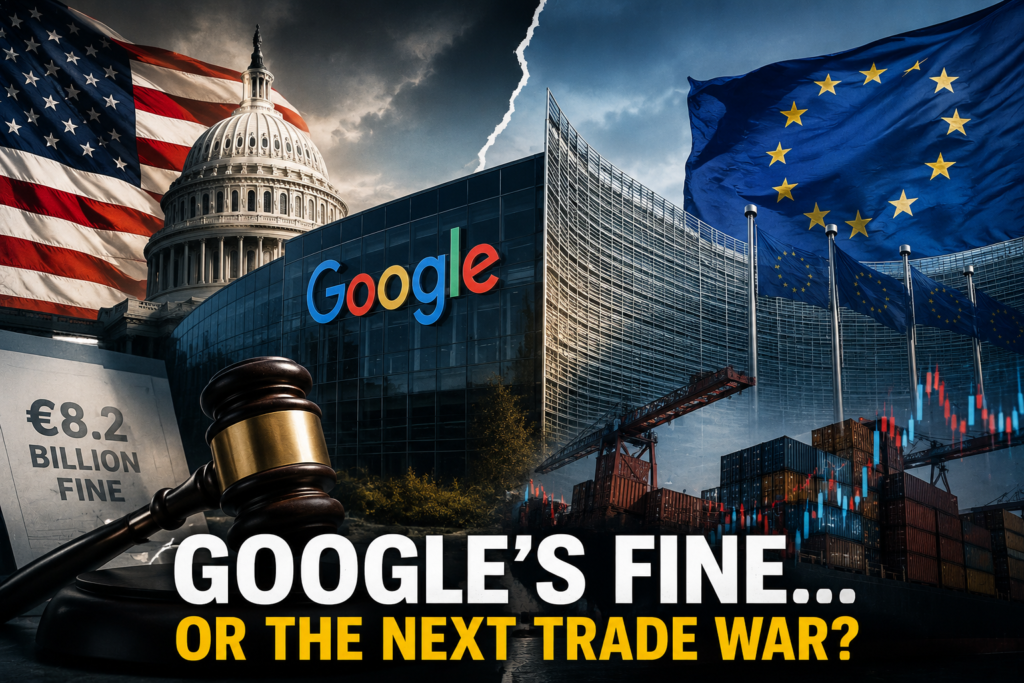
Trade wars used to be easier to recognise.
A government announced tariffs. Another government retaliated. Exporters recalculated costs, importers looked for alternatives, and economists tried to estimate who would lose more. The dispute usually revolved around something tangible—steel, automobiles, aircraft, agricultural products, or energy. Even if the politics became complicated, the battleground itself was easy to identify.
Today’s economic conflicts are different.
Increasingly, they begin inside software.
Not literally, of course. Ships still carry goods across oceans, factories still matter, and supply chains remain the backbone of global commerce. But some of the most important disputes now emerge from places most people never see: cloud servers, smartphone operating systems, online advertising markets, artificial intelligence models, and the digital platforms that quietly connect them all.
That shift has happened gradually enough that it can be easy to miss.
If you had asked ten years ago what might trigger the next serious transatlantic economic disagreement, most people would probably have mentioned tariffs, manufacturing subsidies, or perhaps electric vehicles. Few would have guessed that competition policy directed at a technology company would become part of a much wider geopolitical conversation.
Yet here we are.
Google’s legal and regulatory battles with the European Union are often reported as another chapter in the long-running story of Big Tech facing tougher oversight. That description is accurate, but it also feels incomplete.
The interesting question is no longer whether Google should be regulated. Serious people can disagree on that and still make reasonable arguments.
The more revealing question is why a competition case now attracts the attention of trade officials, diplomats, investors, and even national security analysts.
Something has changed.
Exactly what that change looks like depends on where you’re standing.
More Than Another Antitrust Headline
To many readers, Google’s latest dispute with European regulators probably sounds familiar.
Another investigation.
Another accusation of anti-competitive behaviour.
Another headline mentioning billions in potential penalties.
It’s understandable if some people stopped paying close attention years ago.
Large technology companies have become regular fixtures in legal and regulatory news. Apple, Meta, Amazon, Microsoft and Google have all faced increasing scrutiny in different jurisdictions. After a while, individual cases begin to blur together.
But every so often, one of those cases ends up representing something much larger than the legal arguments inside it.
This appears to be one of them.
Not because Google is unique.
Rather, because the company happens to sit at the intersection of several industries that governments now consider strategically important. Search, digital advertising, artificial intelligence, cloud computing, mobile operating systems and enterprise software are no longer just commercial businesses. Together, they form part of the infrastructure that modern economies increasingly depend upon.
Calling that infrastructure “critical” may sound dramatic. The comparison isn’t perfect.
A cloud platform is obviously not the same thing as an electricity grid or a container port.
And yet, imagine a large bank losing access to its cloud systems for several days. Or an airline. Or a hospital network. Modern economies rely on digital infrastructure in ways that were difficult to imagine even fifteen years ago.
That dependence changes how governments think.
It also changes what they worry about.
A Company That Became an Ecosystem
Google is still widely described as a search engine.
That description isn’t wrong. It’s simply no longer sufficient.
Search remains the company’s most recognisable product, but the business surrounding it has expanded into something much broader. Android powers billions of smartphones. Google Cloud supports businesses, public institutions and developers around the world. YouTube has become one of the largest media platforms ever created. AI products are increasingly woven into search, productivity software and enterprise services.
Most users interact with only one or two of those products at a time.
Governments don’t have that luxury.
Regulators tend to look at the entire ecosystem.
That perspective explains why European authorities often speak about “gatekeepers” rather than individual products. Their concern isn’t necessarily one service in isolation. It’s what happens when multiple essential services belong to the same company and reinforce one another over time.
Whether that concern is fully justified is still debated.
Some economists argue that digital markets remain highly competitive because innovation can rapidly reshape consumer behaviour. Others believe that network effects make it extraordinarily difficult for new competitors to challenge established platforms once they reach global scale.
The evidence exists for both views.
Which is one reason this debate has lasted so long.
The Argument Isn’t Really About Google
There’s another reason this story deserves attention.
Imagine replacing Google’s name with another large technology company.
Many of the underlying questions would remain almost unchanged.
How much influence should a handful of private companies have over digital infrastructure?
When does market success become market dominance?
Can governments encourage innovation while also limiting concentration?
And perhaps the hardest question of all:
At what point does regulating a technology company become an act of economic strategy rather than simply an exercise in competition law?
There’s no universally accepted answer.
In fact, it’s possible that different countries will arrive at different conclusions for perfectly rational reasons.
That uncertainty is worth keeping in mind because discussions about technology regulation often become more polarised than they need to be. One side tends to present regulation as an attack on innovation. The other sometimes speaks as though tighter regulation carries almost no economic cost.
Reality is usually less accommodating.
Trade-offs exist.
Some of them won’t become obvious for years.
How We Got Here
The current dispute didn’t appear overnight.
It emerged over more than a decade, through investigations into Google’s search practices, Android business model, advertising technology and app ecosystem. Individually, those cases looked like separate legal battles.
Taken together, they began to reveal a broader shift in European thinking.
Competition policy was no longer being used only to respond to problems after they appeared. Increasingly, it was also being viewed as a way to shape how digital markets would develop in the future.
That distinction matters.
It’s also where this story begins to move beyond Google itself.
Because once governments start thinking about technology in those terms, they’re no longer debating a single company.
They’re debating the architecture of the digital economy.
Europe’s View: Regulating Markets Before They Close
It’s tempting to describe Europe’s approach as being “tough on Big Tech.”
That isn’t entirely wrong, but it misses the reasoning behind it.
Brussels doesn’t see itself as fighting successful companies. It sees itself as trying to preserve competitive markets before they become too difficult to change. Whether it has chosen the right tools is another question, but the objective has been remarkably consistent for years.
European officials often make a simple observation.
Digital markets behave differently from many traditional industries.
If a new restaurant opens across the street, customers can easily decide to try it. If a new airline offers lower fares, travellers might switch on their next trip. Digital platforms, however, tend to become more valuable as more people use them. More users attract more developers. More developers improve the service. Better services attract even more users.
The cycle feeds itself.
Economists have been describing these as network effects for decades. The phrase sounds technical, but the idea isn’t particularly complicated. Once a platform reaches a certain scale, being slightly better isn’t always enough for a rival to catch up.
Of course, there are exceptions. Technology history is full of companies that looked untouchable until they weren’t. Nokia, BlackBerry and Yahoo are reminders that dominance isn’t permanent.
Still, Europe’s argument is that those examples shouldn’t make policymakers complacent. Waiting for markets to correct themselves can take years, and by then businesses and consumers may have become deeply dependent on a handful of platforms.
That concern lies behind much of the European Union’s digital agenda.
From Antitrust to the Digital Markets Act
For years, the European Commission relied mainly on traditional competition law.
Investigations would begin after regulators believed a company had abused its market position. Lawyers gathered evidence. Companies responded. Appeals followed. Cases often stretched across many years.
By the time some decisions were reached, the technology itself had already changed.
That frustrated regulators.
It also frustrated businesses, including some that wanted clearer rules rather than years of uncertainty.
The Digital Markets Act, or DMA, reflects a different philosophy.
Instead of waiting for potential harm to occur and then investigating it afterwards, the law establishes obligations in advance for the largest digital platforms designated as “gatekeepers.” The idea is preventive rather than reactive.
Supporters argue that this creates fairer conditions for smaller competitors.
Critics worry that it could make product development slower and more complicated.
Neither argument should be dismissed too quickly.
Regulation often produces unintended consequences, whether it is too weak or too ambitious.
Why Google Became the Centre of the Conversation
Google wasn’t the only company affected by Europe’s changing approach.
Nor was it the first.
But it became one of the clearest examples because its services extend across so many parts of the digital economy.
Search is the obvious one.
Then there is Android, which powers a large share of the world’s smartphones. Google Maps is embedded in countless applications. Google Ads helps businesses of every size reach customers online. YouTube is not only an entertainment platform but also a significant advertising marketplace. Google Cloud has become part of the infrastructure used by companies, universities and governments.
Each service has its own market.
Viewed separately, they tell one story.
Viewed together, they tell another.
That difference explains why regulators increasingly stopped asking whether Google dominated a particular product category and started asking something broader: what happens when one company becomes an important gateway across several markets at the same time?
It’s a subtle shift in perspective, but an important one.
The Debate Isn’t as One-Sided as It Sometimes Appears
Public discussions often make this issue sound simpler than it really is.
One narrative says Europe is punishing innovation.
Another says Google became too powerful and meaningful oversight was inevitable.
Neither captures the whole picture.
Take a small software company trying to launch a new product.
Its founders might appreciate rules that make app stores more open or digital advertising markets more competitive. Those changes could genuinely lower barriers to entry.
At the same time, the very same startup may depend on Google’s cloud infrastructure, advertising tools or AI services to grow. If regulation increases costs or slows innovation in those areas, smaller businesses could feel those effects too.
It’s not hard to imagine three people around the same meeting table reaching different conclusions.
One worries about competition.
Another worries about compliance costs.
A third is simply trying to ship the next version of the product before the company’s funding runs out.
That last perspective doesn’t usually make headlines, but it’s part of the story nonetheless.
A Different Economic Philosophy
Perhaps the deepest difference between Europe and the United States isn’t about Google at all.
It’s about when governments should intervene.
Europe has generally been more comfortable with setting rules early if policymakers believe markets could become excessively concentrated.
The United States has historically been more willing to allow markets to evolve before stepping in, particularly in fast-moving technology sectors where today’s market leader may not remain tomorrow’s leader.
Neither philosophy guarantees success.
Intervening too early can discourage investment or create unnecessary complexity.
Waiting too long can make competition much harder to restore.
The difficult part is knowing where that line actually is.
Looking back, almost everyone can identify the point where action should have been taken.
Looking forward, the answer is rarely so obvious.
That uncertainty is one reason debates around Google’s role have persisted for so long—and why they are unlikely to disappear anytime soon.
Why Washington Sees a Bigger Risk
Viewed from Brussels, the argument is largely about competition.
Viewed from Washington, it looks rather different.
That difference doesn’t mean one side is right and the other is wrong. It reflects the fact that governments often judge the same event through their own economic interests.
For the United States, companies such as Google are more than successful private businesses. They are among the country’s most valuable economic assets.
That matters.
Technology has become one of America’s strongest export industries. Millions of businesses around the world rely on software, cloud services, digital advertising, operating systems and AI tools developed by American firms. Those companies employ hundreds of thousands of people directly, support far more indirectly, and invest enormous sums into research every year.
When European regulators impose significant restrictions or penalties on one of those companies, Washington rarely sees it as an isolated legal dispute.
It sees part of its economic base coming under pressure.
There is, of course, another side to that argument.
European officials would point out that regulators are not supposed to consider a company’s nationality when enforcing competition law. If an American company happens to dominate several digital markets, they argue, that reflects the structure of the industry rather than any political preference.
That is a perfectly reasonable position.
Whether every business or policymaker accepts it is another matter.
The Cost of Regulation Isn’t Always the Fine
Public attention usually focuses on the size of financial penalties.
A fine worth billions of dollars naturally attracts headlines.
Inside technology companies, however, executives often worry about something less visible.
Time.
Imagine spending three years building a new digital product.
Now imagine discovering that the product has to operate differently in Europe, the United States, Japan, India and Australia because each jurisdiction has adopted its own rules governing competition, privacy or artificial intelligence.
The engineering challenge becomes considerably more complicated.
One software feature may require multiple versions. Product launches become staggered. Legal teams grow. Compliance specialists become part of product development from the very beginning rather than reviewing decisions afterwards.
There is a slightly ironic consequence to all this.
For years, technology companies competed by hiring more engineers.
Today, they also compete by hiring more lawyers.
That sentence sounds almost humorous, but anyone who has worked inside a large multinational company knows there is some truth behind it.
None of this proves that regulation is misguided.
It simply reminds us that regulation carries costs as well as benefits. Those costs are not always obvious to people outside the industry.
The Conversation Has Quietly Expanded
Something else has happened over the past decade.
The discussion is no longer confined to competition law.
Increasingly, the same policymakers who debate digital markets are also discussing semiconductor manufacturing, export controls, cybersecurity, artificial intelligence, cloud infrastructure and national resilience.
At first, those topics seem unrelated.
Look more closely and the connections begin to appear.
A country hoping to become a leader in artificial intelligence needs advanced chips.
Those chips require sophisticated manufacturing equipment.
The resulting AI models need cloud infrastructure and enormous amounts of computing power.
Businesses then integrate those models into software used across finance, healthcare, manufacturing and education.
What begins as a discussion about AI eventually becomes a discussion about energy, supply chains, industrial investment and economic strategy.
Some comparisons are imperfect, but one observation keeps resurfacing.
Technology has become part of national infrastructure.
That wasn’t always how governments thought about software.
Today, many clearly do.
Digital Sovereignty Moves From Theory to Policy
A phrase that once appeared mostly in academic papers now turns up regularly in speeches by government ministers.
Digital sovereignty.
It can mean different things depending on who is using it, but the central idea is fairly straightforward: countries want greater control over the technologies that support their economies.
Sometimes that means encouraging domestic cloud providers.
Sometimes it involves stricter rules governing data storage.
Elsewhere, it means investing in semiconductor production or supporting local AI research.
The approaches differ.
The motivation is remarkably similar.
Very few governments are comfortable depending entirely on technology developed somewhere else for services they increasingly regard as essential.
Europe has pursued digital sovereignty largely through regulation and standards.
China has combined industrial policy with extensive state involvement.
The United States has traditionally relied more heavily on private-sector innovation while, in recent years, becoming much more active in supporting strategic industries such as semiconductors.
These models are often presented as competing visions.
In practice, they overlap more than political debates sometimes suggest.
Governments that once insisted markets would solve most problems are becoming more willing to intervene in strategically important technologies. Governments known for strong regulation are simultaneously trying to encourage greater innovation and investment.
Everyone, it seems, is adjusting.
Why This Matters Beyond Google
It is tempting to treat Google’s dispute with Europe as an isolated case.
History suggests that would be a mistake.
The questions being asked today about search, advertising and mobile operating systems are already spreading to artificial intelligence.
Tomorrow they may extend further still.
Who controls cloud infrastructure?
Who sets technical standards?
Where should sensitive data be stored?
How dependent should one country become on another’s digital platforms?
These are not entirely new questions. They simply sound different in a digital economy than they did in an industrial one.
And they have a habit of reappearing.
By this point, Google almost feels secondary.
The company remains central to the legal cases, but the broader conversation has moved beyond any single business.
It has become a discussion about who shapes the next generation of the global economy—and under whose rules.
The AI Race Changed the Stakes
A few years ago, most conversations about Google centred on search.
People debated search rankings, digital advertising, Android, or whether one company had become too influential online. Those questions haven’t disappeared, but they no longer dominate the discussion in quite the same way.
Artificial intelligence has changed the context.
Not because AI makes those earlier issues irrelevant. Rather, it has connected them to something much larger.
Training advanced AI models requires enormous computing power. Running them requires vast data centres. Those facilities consume significant amounts of electricity, rely on sophisticated cooling systems and are filled with some of the world’s most advanced semiconductor chips.
An AI assistant may feel like software.
Behind the screen, it is also an industrial project.
That is one reason governments have become far more interested in the companies building AI infrastructure than they were just a few years ago.
The software attracts public attention.
The infrastructure attracts policymakers.
The Race Isn’t Only About Better AI
It’s easy to think of the AI race as a competition to build the smartest chatbot.
That is certainly part of it.
But governments are increasingly asking different questions.
Who manufactures the chips?
Who controls the cloud infrastructure?
Who owns the data centres?
Who supplies the electricity?
Who develops the underlying models?
Those questions don’t produce flashy headlines, yet they probably matter more over the long term.
An AI model can improve surprisingly quickly.
Building a network of advanced semiconductor factories or hyperscale data centres is measured in years, sometimes decades.
That difference explains why technology policy and industrial policy are beginning to overlap.
The distinction between the two is becoming harder to draw.
From Silicon to Strategy
For a long time, software companies and manufacturing companies occupied different worlds.
One built code.
The other built physical products.
Artificial intelligence has blurred that distinction.
Every breakthrough in AI depends on physical infrastructure somewhere in the background—semiconductors, networking equipment, fibre-optic cables, specialised servers and reliable power supplies.
It’s an odd reversal.
The digital economy, often described as “virtual,” turns out to depend heavily on very real factories and very real supply chains.
Perhaps that shouldn’t be surprising.
Every technological revolution has eventually required physical infrastructure.
The railway age needed railways.
The automobile age needed roads.
The internet age needed cables, servers and satellites.
AI is following a similar pattern, even if the infrastructure looks different.
The comparison isn’t exact, but it helps explain why governments have become increasingly interested in sectors that once attracted relatively little political attention.
Where Google Fits Into That Picture
Google is not the only company shaping this landscape.
Nor is it necessarily the most important in every area.
Nvidia dominates conversations about AI chips. Microsoft and Amazon are major cloud providers. OpenAI has transformed expectations around generative AI. Numerous Chinese companies continue developing their own ecosystems despite restrictions in several international markets.
Even so, Google occupies an unusually broad position.
It develops AI models.
It operates one of the world’s largest cloud businesses.
It designs specialised AI hardware.
Its search engine processes vast amounts of information.
Its productivity software reaches businesses across the globe.
Its research laboratories continue publishing influential work in machine learning.
Very few companies operate across so many parts of the AI ecosystem simultaneously.
That breadth creates opportunities.
It also attracts scrutiny.
Regulators are no longer evaluating a company that simply helps people find websites.
They’re evaluating a business involved in several technologies that governments increasingly describe as strategic.
Those are not quite the same thing.
A Startup Founder Sees the Story Differently
It’s easy for debates like this to become abstract.
Competition policy.
Industrial strategy.
Digital sovereignty.
The language can feel distant from everyday business.
Picture, instead, a small AI startup with a handful of employees.
Its engineers are trying to improve a product before the next funding round. The founders spend mornings talking to customers and evenings talking to investors. Somewhere in between, someone has to work out whether new European regulations require changes to the product, whether customer data can be stored in one region or another, and whether future expansion into the United States will involve a different set of compliance obligations.
None of those tasks generates revenue.
Yet they still have to be done.
Large technology companies usually have teams dedicated to these questions.
Small companies often have one exhausted founder reading legal summaries late at night.
That doesn’t mean regulation is the wrong approach.
It simply illustrates that policy choices rarely affect only the companies making headlines.
Their effects tend to ripple through the wider ecosystem, sometimes in ways that become visible only years later.
A More Fragmented Digital World?
For decades, technology companies became accustomed to building products for a largely global internet.
Localisation mattered, of course, but the underlying product was often the same.
That assumption is becoming harder to maintain.
Privacy rules differ.
Competition rules differ.
AI regulations are beginning to differ.
Cybersecurity requirements differ.
Governments are asking different questions and, increasingly, expecting different answers.
Some executives have started talking about a future in which software is developed not for one global market but for several overlapping digital jurisdictions.
Whether that future fully materialises remains uncertain.
Businesses have a long history of adapting to regulation.
Still, the direction of travel seems difficult to ignore.
The global internet isn’t disappearing.
It may simply become a little less uniform than many people assumed it would be.
Does This Become a Trade War?
The short answer is probably not.
At least, not in the way most people imagine.
When people hear the phrase trade war, they usually picture tariffs, retaliatory duties, or containers waiting at ports while governments negotiate. Those tools haven’t disappeared, but they no longer tell the whole story.
Economic competition has become more layered.
A disagreement over cloud infrastructure can influence investment decisions. A rule governing app stores may affect software companies on several continents. AI regulations written in one market can shape how products are designed for many others.
None of these developments looks like a traditional trade barrier.
Businesses often experience them as one.
That doesn’t automatically make them protectionist. Countries have every right to regulate markets for privacy, competition or consumer protection. The challenge is that regulation can sometimes produce economic consequences beyond its original purpose.
Whether that happens intentionally is a different debate altogether.
The Transatlantic Relationship Is More Complicated Than the Headlines Suggest
It’s easy to portray Europe and the United States as economic rivals.
The reality is considerably more complicated.
The two remain each other’s largest investment partners. Their companies employ millions of people across both sides of the Atlantic. Universities collaborate on research, businesses share supply chains, and governments cooperate on everything from cybersecurity to defence.
Disagreements happen within a relationship that is still unusually close.
That context matters because headlines often reward conflict more than cooperation.
Take a typical week in international business.
A European regulator might announce an investigation into a major American technology company. On the same day, American and European firms could be announcing joint investments in AI infrastructure or semiconductor research. Both stories are true, but only one usually dominates the news cycle.
Economic relationships are rarely defined by a single dispute.
They’re shaped by hundreds of decisions happening simultaneously.
Businesses Adapt Faster Than Governments Expect
One lesson from previous regulatory shifts is that companies rarely stand still.
If rules change, businesses adjust.
Sometimes they redesign products.
Sometimes they restructure operations.
Sometimes they create regional versions of the same service.
None of those options is free, but companies have become remarkably good at adapting to different legal environments.
The question is how much fragmentation they can absorb before it begins affecting innovation itself.
There isn’t a universally accepted answer.
A multinational technology company may have the resources to maintain different compliance teams around the world. A smaller business hoping to expand internationally faces a much tougher calculation.
For some founders, entering a new market is no longer only a technical challenge.
It has become a regulatory one.
One entrepreneur recently described international expansion as “adding another full-time job before you’ve hired another full-time employee.”
That may be an exaggeration.
It probably isn’t a completely inaccurate one.
Where India Fits Into the Picture
India occupies an interesting position in this changing landscape because it is not approaching the digital economy from exactly the same starting point as either Europe or the United States.
It has one of the world’s fastest-growing digital markets, a large technology workforce, expanding AI ambitions and an increasingly important role in global supply chains.
At the same time, it isn’t trying to defend decades of dominance in global consumer technology platforms in the way the United States often is.
Nor is it attempting to regulate an already mature digital market in quite the same way Europe has.
That creates room for a different approach.
India has already shown that it can build digital public infrastructure at remarkable scale.
The Unified Payments Interface, better known as UPI, transformed digital payments in a relatively short period of time. Aadhaar and other digital public initiatives demonstrated that government-led infrastructure can coexist with private-sector innovation, even if debates continue around privacy and implementation.
Those experiences don’t provide a blueprint for AI or cloud computing.
They do suggest that India is willing to experiment rather than simply import another country’s model.
Opportunity Comes With Difficult Choices
There is growing optimism about India’s role in the next phase of the global technology economy.
Much of that optimism is justified.
Major investments are flowing into semiconductor manufacturing, electronics production, cloud infrastructure and artificial intelligence. Global companies increasingly view India as both a large consumer market and a strategic production base.
Still, success is not guaranteed.
Building semiconductor capacity is expensive.
Developing world-class AI requires talent, computing resources and long-term investment.
Creating predictable regulation without slowing innovation is easier to describe than to achieve.
India, like every major economy, will have to make trade-offs.
Should it prioritise attracting global investment?
Should it encourage domestic champions?
Should it regulate early, or allow markets more room to evolve?
There are sensible arguments on each side.
And that is perhaps the most important point.
The choices facing India are not fundamentally different from those facing Europe or the United States.
The circumstances differ.
The underlying questions are becoming surprisingly similar.
By the end of this decade, the countries leading the digital economy may not simply be those with the most advanced technology.
They may also be the ones that prove most successful at governing it without suffocating it.
Looking Beyond Google
If this were only a story about one company, it probably wouldn’t have held the world’s attention for so long.
Technology companies have faced lawsuits before. Regulators have imposed large fines before. Markets have moved on before.
Something feels different this time.
Perhaps it’s because the questions surrounding Google are now being asked about almost every major technology platform in one form or another. Artificial intelligence, cloud computing, digital advertising, app marketplaces, semiconductors and data governance all seem to be converging into a single policy conversation.
That wasn’t inevitable.
In fact, it happened gradually enough that many people—including governments—only recognised the shift after it was already underway.
There is a tendency to think of economic change as something dramatic. Sometimes it is. More often, it happens through dozens of smaller decisions that only make sense when viewed together.
This may be one of those moments.
What Happens Next?
The easiest prediction would be that regulators will become stricter and technology companies will become more defensive.
That may happen.
It is also possible that both sides slowly adapt to one another.
Large technology companies have already begun designing products with regulatory requirements in mind much earlier than they once did. Governments, meanwhile, are gaining a better understanding of how digital markets actually function. Neither process is complete, but both are evolving.
There are other possibilities too.
Some countries may align more closely with Europe’s regulatory model. Others may prefer the American approach. A few might try to combine elements of both while pursuing their own industrial priorities.
No one really knows which model will prove most durable over the next decade.
History is not especially generous to confident forecasts.
Twenty years ago, very few analysts predicted today’s AI race, just as few anticipated that cloud infrastructure would become a strategic policy issue. That doesn’t mean today’s expectations are wrong. It simply suggests a little humility is useful when discussing technologies that continue to evolve at extraordinary speed.
The Balance Governments Are Trying to Find
Every government is trying to solve a similar puzzle.
How do you encourage innovation without allowing markets to become uncompetitive?
How do you regulate powerful platforms without discouraging the investment needed to build the next generation of technology?
How do you protect consumers while avoiding rules so complicated that only the largest companies can afford to comply with them?
These are difficult questions because the answers often pull in different directions.
A rule that benefits consumers today might increase costs for businesses tomorrow.
A policy that encourages investment could reduce competition over time.
Neither outcome is automatically good or bad.
Much depends on how those policies are designed—and how willing governments are to adjust them when circumstances change.
That last point is easy to overlook.
Good regulation is rarely static.
Neither are successful markets.
A Quiet Shift in Global Competition
Looking back, the world did not stop competing over physical resources.
It simply added new ones.
Oil still matters.
Shipping lanes still matter.
Factories, ports and supply chains remain central to the global economy.
But alongside them sits another layer of infrastructure—less visible, yet increasingly important.
Data centres.
Cloud platforms.
Semiconductor ecosystems.
Artificial intelligence.
Digital payment networks.
Software standards.
Most people interact with these systems every day without giving them much thought. That is probably a sign that they are doing their job well.
Governments, however, don’t have the luxury of ignoring them.
Increasingly, they see digital infrastructure in much the same way earlier generations viewed railways, telecommunications networks or energy systems: as assets with economic and strategic value.
The comparison has limits, of course. Software evolves much faster than railways ever did.
Still, both shape the movement of commerce in their own way.
The Real Story
So, is Google’s dispute with Europe the beginning of a U.S.–EU trade war?
Probably not.
At least, not if we define a trade war in the traditional sense.
The United States and the European Union remain close allies with deeply interconnected economies. They will continue to cooperate in many areas even as they disagree in others.
But if the broader question is whether digital regulation is becoming part of global economic competition, the answer appears much clearer.
It already has.
Google’s legal battles are therefore less interesting as isolated court cases than as signals of a wider transformation. They reveal how governments increasingly view technology—not simply as a source of innovation or corporate profit, but as infrastructure that influences productivity, security and long-term economic resilience.
That doesn’t automatically mean every regulatory decision will be the right one.
Some may prove effective.
Others may need to be revised.
That is how policymaking usually works.
What seems increasingly unlikely is a return to the period when technology companies operated largely outside the centre of geopolitical and economic strategy.
Those days appear to be fading.
The companies involved will change over time. New technologies will emerge. Today’s dominant platforms will eventually face challenges from tomorrow’s innovators.
The underlying debate, however, is likely to remain.
Who should shape the rules of the digital economy?
Governments?
Markets?
Or, as has often been the case throughout economic history, some evolving balance between the two.
The answer won’t come from a single court ruling or one regulatory fine.
It will emerge gradually, through the choices countries make over many years.
And when historians look back at this period, they may conclude that the most consequential economic rivalry of the 2020s wasn’t defined by tariffs alone.
It was defined by the rules written for the technologies that increasingly underpin the global economy.