A single shipping lane, only a few dozen kilometers wide at its narrowest point, has an outsized influence on the global economy.
If traffic through that corridor were suddenly interrupted, the first signs of trouble probably wouldn’t appear in the Persian Gulf. They would show up on trading screens in London, Singapore, New York, and Tokyo. Oil prices would begin moving before many ships had even changed course. Freight companies would reassess schedules. Governments would request emergency briefings. Financial markets, as they often do, would start reacting to uncertainty before the full picture was clear.
That corridor is the Strait of Hormuz.
It’s easy to see it as just another flashpoint in a region that rarely stays out of the headlines for long. But Hormuz is different. It sits at the intersection of energy, trade, finance, and geopolitics. A disruption there wouldn’t remain a regional issue for very long.
Nearly one-fifth of the world’s seaborne oil passes through this narrow waterway, linking energy producers in the Gulf with customers across Asia, Europe, and beyond. That dependence has been built over decades. Replacing it isn’t something countries can do overnight.
Renewed tensions between the United States and Iran have once again pushed the strait into global headlines. Military deployments, increasingly sharp political rhetoric, and concerns within the shipping industry have revived a familiar question:
What would actually happen if the Strait of Hormuz closed completely?
The answer isn’t simply that oil prices would rise.
A prolonged closure would test supply chains, complicate inflation-fighting efforts, unsettle financial markets, and force governments and businesses to make difficult decisions with incomplete information. For ordinary households, the effects would arrive more gradually, appearing first in fuel prices and transport costs before spreading into everyday goods and services.
Modern economies often appear remarkably resilient—until one critical connection is disrupted. Hormuz is one of those connections.
Why Is Everyone Talking About the Strait of Hormuz Again?
The Strait of Hormuz tends to return to the global conversation whenever tensions between Iran and the United States begin to rise. That has happened repeatedly over the past several decades, and each episode follows a familiar pattern: military activity increases, political warnings become sharper, commercial shipping comes under closer scrutiny, and energy markets grow uneasy.
Recent developments have followed much the same course.
Although there has been no complete shutdown of the waterway, governments, shipping companies, insurers, and commodity traders have all been watching events more closely. The concern isn’t limited to what has happened. It’s equally about what could happen next.
That’s an important distinction.
Energy markets rarely wait for certainty. By the time a disruption is confirmed, prices have often been moving for days. Traders spend just as much time assessing probabilities as they do reacting to events, which is why a warning from a government official or an increase in regional military activity can move markets even when no tanker has been delayed.
The shipping industry works in much the same way.
A vessel doesn’t have to come under attack for costs to rise. If insurers judge that risks have increased, premiums climb. Shipowners reconsider routes. Charter rates adjust. Every additional layer of uncertainty adds another cost, and those costs eventually work their way through global trade.
Ironically, the physical flow of oil may remain unchanged while the economics of moving it become more expensive.
That dynamic is easy to overlook because headlines tend to focus on dramatic scenarios. Businesses are usually more concerned with uncertainty itself. Planning becomes harder, contracts become more expensive, and companies begin preparing for disruptions that may never fully materialize.
There’s another reason Hormuz attracts so much attention.
The global energy system has become highly efficient over the past few decades. Tankers, pipelines, refineries, and shipping schedules operate with remarkable precision. Efficiency has lowered costs and supported economic growth, but it has also concentrated enormous importance in a relatively small number of strategic routes.
Globalization made moving energy cheaper.
It also made a handful of maritime chokepoints far more important than most people realize.
That’s why developments around the Strait of Hormuz receive so much attention, even during periods when no ships are being blocked and oil continues to flow.
Before considering what a complete closure might mean, it helps to understand why this relatively narrow stretch of water carries such extraordinary economic weight.
What Is the Strait of Hormuz?
On a map, the Strait of Hormuz doesn’t look particularly remarkable.
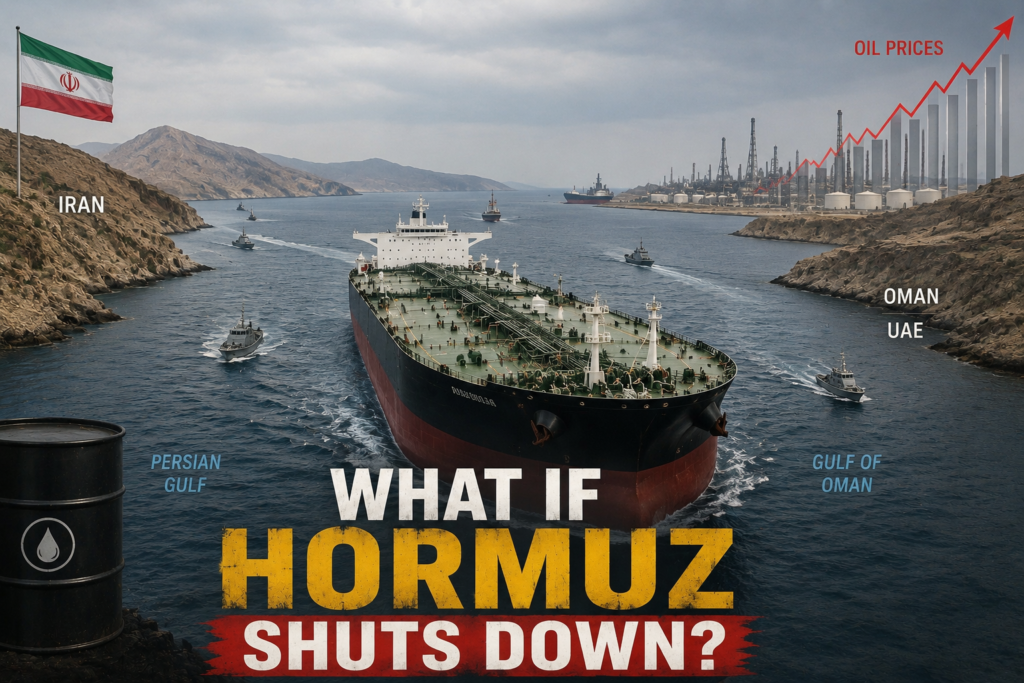
It is a narrow waterway connecting the Persian Gulf to the Gulf of Oman and, from there, the Arabian Sea. Iran borders the northern side, while Oman and the United Arab Emirates lie to the south. At first glance, it’s simply a maritime passage between two larger bodies of water.
Its importance comes from what moves through it, not its size.
Every day, a steady procession of oil tankers and liquefied natural gas (LNG) carriers passes through these shipping lanes, carrying energy from Gulf producers to customers across Asia, Europe, and other parts of the world. For countries such as Saudi Arabia, Iraq, Kuwait, Qatar, the UAE, and Iran, Hormuz is the principal maritime gateway to global markets.
That dependence didn’t emerge overnight. It reflects decades of investment in ports, pipelines, refineries, and shipping infrastructure designed around the assumption that this route would remain open.
People often think of supply chains in terms of container ships stacked with electronics or consumer goods. Energy supply chains are no different. They simply operate on a scale that is easier to overlook because the cargo is less visible.
This is why the Strait of Hormuz is widely regarded as the world’s most important oil chokepoint.
If traffic through the strait were interrupted, there isn’t another route capable of absorbing the same volume of exports without significant disruption. Geography imposes limits that diplomacy and economics can’t easily overcome.
Why Is It So Important to the Global Economy?
The significance of the Strait of Hormuz extends well beyond the Middle East.
It sits at the center of one of the world’s largest energy-exporting regions. Saudi Arabia, Iraq, Kuwait, the United Arab Emirates, Qatar, and Iran collectively account for a substantial share of global crude oil and liquefied natural gas exports. Much of that energy reaches international markets through this single passage.
The countries importing that energy are just as important to the story.
Asia has the greatest exposure. China, India, Japan, and South Korea rely heavily on Gulf oil to power industries, transportation networks, and electricity generation. A prolonged disruption wouldn’t simply create a supply problem. It would force governments and companies to rethink procurement strategies, shipping schedules, and inventory management almost immediately.
The effects would spread well beyond the energy sector.
Oil isn’t only a transportation fuel. It underpins modern manufacturing. Petrochemicals derived from crude are used in plastics, fertilizers, synthetic fabrics, pharmaceuticals, packaging materials, and thousands of industrial products that rarely attract much attention until costs begin to rise.
That broader connection is easy to underestimate.
People usually associate higher oil prices with more expensive petrol. Manufacturers see something different. A chemical producer paying more for feedstocks, a logistics company facing higher fuel bills, or an airline deciding whether to absorb rising costs or increase ticket prices—all are responding to the same disruption from different angles.
The economic ripple effects often begin long before consumers notice them.
It’s also worth remembering that oil markets are global. A country doesn’t have to import directly through Hormuz to feel the impact of a disruption there. When supplies tighten or even appear likely to tighten, benchmark oil prices tend to rise worldwide. Those higher prices eventually filter into economies with very different energy mixes.
That’s one reason governments pay close attention even if they have relatively limited direct exposure to Gulf imports.
A natural question follows.
Couldn’t shipments simply be redirected elsewhere?
Only to a limited extent.
Saudi Arabia operates the East-West Pipeline, which allows part of its oil exports to reach the Red Sea without passing through Hormuz. The United Arab Emirates has invested in infrastructure that also bypasses the strait for some exports.
Those alternatives matter, but they don’t solve the larger problem.
Their combined capacity is well below the enormous volume that normally transits Hormuz each day. Expanding existing pipelines—or building entirely new ones—is measured in years, not weeks. Infrastructure of that scale requires billions of dollars, political coordination, and long construction timelines.
The modern energy system is remarkably efficient because it relies on established routes.
The trade-off is that efficiency leaves less flexibility when one of those routes comes under pressure.
That’s why even the possibility of disruption is enough to move markets. Physical shortages may never materialize, yet businesses still adjust procurement plans, insurers recalculate risk, and traders begin pricing in uncertainty.
In other words, Hormuz matters not because every crisis results in a shutdown.
It matters because the global economy has very few practical substitutes if one ever did.
What Would Happen Immediately If the Strait Closed?
A complete closure wouldn’t unfold as a single dramatic event. It would develop in phases, with different parts of the global economy reacting at different speeds.
Financial markets would move first.
Physical supply disruptions would take longer.
That distinction matters because modern markets price expectations almost instantly, while supply chains operate in days and weeks. By the time the first cargoes were delayed, traders, insurers, and governments would already be responding to a world that suddenly looked much riskier.
The First 24 Hours
The immediate reaction would almost certainly come from energy markets.
Oil prices could climb sharply as traders priced in the possibility of interrupted supplies. Whether the closure ultimately lasted two days or two months would still be unknown, but markets generally don’t wait for certainty. They respond to the balance of probabilities.
Stock markets would likely become more volatile as investors reassessed sectors most exposed to higher energy costs. Airlines, logistics firms, shipping companies, and energy-intensive manufacturers could all face immediate pressure.
Commercial shipping would slow almost by default.
Some vessels already in the region might continue cautiously, while others would delay departure until the security picture became clearer. Charter rates could rise as uncertainty increased, and marine insurers would almost certainly raise premiums. In practice, shipping often becomes more expensive before it becomes impossible.
Governments would be moving just as quickly.
Energy ministries would assess domestic inventories. Military officials would monitor the security situation. Diplomatic channels would become unusually active as governments tried to determine whether the disruption looked temporary or the start of a much broader crisis.
The first day would be dominated by one thing: uncertainty.
The First Week
If the closure continued for several days, attention would shift from market sentiment to physical supply.
Refineries expecting crude from Gulf producers would begin adjusting delivery schedules. Some could draw on existing inventories, while others would start looking for replacement cargoes from different exporters. Neither option would be cheap.
This is where logistics start becoming as important as production.
The world may still have enough oil underground, but getting the right grade of crude to the right refinery at the right time is a much more complicated problem. Energy markets rarely struggle because resources disappear overnight. More often, they struggle because transport becomes unpredictable.
Businesses would begin activating contingency plans.
Airlines might review fuel purchasing strategies. Manufacturers with energy-intensive operations would reassess production costs. Freight companies would evaluate whether higher transport expenses should be absorbed or passed on to customers.
Central banks would also be watching carefully.
A sustained increase in oil prices has a way of spreading through the wider economy. Higher transportation costs eventually feed into food prices, consumer goods, and industrial production, making inflation harder to control even in countries far removed from the Gulf.
The First Month
If the disruption extended into weeks rather than days, the conversation would change.
The focus would no longer be on whether markets had overreacted. It would be on how businesses and households were adapting to persistently higher costs.
By then, companies operating with lean inventories could begin feeling real pressure. Many global supply chains have been designed for efficiency rather than redundancy. That keeps costs low during normal times but leaves less room for disruption when a major trade route is affected.
A manufacturer waiting for imported raw materials might slow production.
An airline facing sustained fuel price increases could adjust ticket prices for future bookings rather than absorb the additional cost indefinitely.
Retailers, too, would face difficult decisions. Rising freight and distribution expenses don’t usually appear as a separate line on a receipt. They become part of the price consumers eventually pay.
This is often how global shocks spread.
Not through a single dramatic event, but through thousands of individual business decisions made over weeks, each one logical on its own, yet collectively capable of pushing inflation higher and slowing economic growth.
Which Countries Would Be Hit the Hardest?
The impact wouldn’t be uniform.
Exposure depends on how much energy a country imports, where that energy comes from, how diversified its suppliers are, and how prepared it is to manage temporary disruptions. Geography matters, but so do strategic reserves, domestic production, and the flexibility of national energy systems.
Asia: The Most Direct Exposure
For most Asian economies, the Strait of Hormuz is more than a distant geopolitical concern. It is a vital commercial artery.
China, India, Japan, and South Korea collectively import enormous volumes of Gulf oil. Their economies differ in many respects, but they share one important characteristic: reliable maritime energy supplies are fundamental to their industrial output and economic stability.
China has diversified its sources over the years and maintains substantial strategic reserves. Even so, replacing large volumes of Gulf crude would be expensive and logistically challenging.
India faces a different set of pressures. A prolonged disruption could increase its import bill, place additional strain on inflation, and raise costs across transportation, manufacturing, and agriculture. Because energy feeds into so many sectors, the effects would extend well beyond petrol prices.
Japan and South Korea, with limited domestic energy resources, would also face significant challenges. Stable shipping routes are not simply convenient for these economies—they are essential.
Europe: Less Direct, Still Vulnerable
Europe has spent years diversifying its energy supplies, particularly after recent geopolitical disruptions.
That provides greater resilience than in the past, but it doesn’t provide isolation.
Oil is traded in a global market. If benchmark prices rise because of a disruption in Hormuz, European businesses and consumers still pay more, regardless of where individual cargoes originate.
The same principle applies to industries that depend heavily on transportation, chemicals, or manufacturing. Even indirect exposure can become economically significant over time.
The United States: Better Positioned, Not Immune
The United States is in a stronger position than it was several decades ago.
Higher domestic oil production has reduced its dependence on Gulf imports, giving policymakers greater flexibility during international supply disruptions.
Even so, geography doesn’t exempt the United States from global pricing.
American drivers could still face higher fuel costs. Airlines would confront the same increase in jet fuel prices as competitors elsewhere. Businesses moving goods across the country would still pay more for transportation.
This is one of the more counterintuitive aspects of global oil markets.
A country can produce a large share of its own crude and still experience higher prices because oil is traded internationally. The disruption doesn’t have to occur at home for households to notice its effects.
How Would This Affect Ordinary People?
For most people, the Strait of Hormuz is little more than a name on a map.
The economic effects, however, would feel surprisingly familiar.
Fuel prices are usually the first place consumers notice a disruption. If crude oil becomes more expensive, petrol and diesel prices tend to follow. That alone affects millions of daily decisions, from commuting to running a business.
The impact doesn’t stop at the fuel pump.
Transportation sits behind almost everything people buy. A truck delivering groceries, a cargo ship carrying electronics, or a warehouse moving goods across a country all depend on energy. When those costs increase, businesses eventually face a choice: absorb the additional expense or pass it on to customers.
Most do a bit of both.
Consider a supermarket chain. It isn’t simply paying more to transport products from distribution centers. Farmers may be facing higher diesel costs, food processors could be paying more for electricity, and packaging manufacturers might see raw material prices rise. By the time a product reaches the shelf, several small cost increases have accumulated into a noticeable price difference.
The same pattern appears elsewhere.
An airline may not immediately raise ticket prices after oil jumps in a single day. But if fuel remains expensive for weeks, future fares are likely to reflect that reality. Logistics companies renegotiate contracts. Manufacturers revisit production budgets. Businesses that rely heavily on imported materials start looking for ways to cut costs elsewhere.
Consumers rarely see these decisions happening.
They simply notice that everyday expenses become a little harder to avoid.
This is one of globalization’s less obvious characteristics. A disruption thousands of kilometers away can eventually influence household budgets in places with no direct connection to the Middle East. The link isn’t always visible, but it’s remarkably consistent.
Could Other Routes Replace the Strait?
At first glance, the solution seems straightforward.
If one route is blocked, use another.
The problem is that global energy infrastructure doesn’t work like a road network with multiple equivalent options.
Saudi Arabia operates the East-West Pipeline, allowing some oil exports to reach the Red Sea without passing through Hormuz. The United Arab Emirates has also invested in pipeline infrastructure that bypasses the strait for part of its exports.
Those systems provide valuable flexibility.
They were built precisely because governments recognized the strategic risk of depending on a single maritime corridor.
Even so, they have limits.
Their combined capacity falls well short of the volume that normally passes through Hormuz every day. They reduce exposure; they don’t eliminate it.
Longer maritime routes are another possibility. Some cargoes could be redirected around Africa.
Technically, yes.
Commercially, the calculation is much less attractive.
A longer voyage means more fuel, more time at sea, higher insurance costs, and fewer ships available for other routes while vessels spend additional days completing each journey. Those delays gradually ripple through global shipping schedules, even for cargo unrelated to the Gulf.
Infrastructure can be expanded over time, but not during a crisis.
That’s one reason governments continue to treat the Strait of Hormuz as a strategic priority despite years of investment in alternative routes.
Could the World’s Oil Supply Actually Stop?
Probably not.
This is one of the most common misunderstandings surrounding the Strait of Hormuz.
Closing the waterway would disrupt exports far more than production itself.
Oil fields across the Gulf wouldn’t suddenly stop pumping because ships could no longer move freely. In many cases, production would continue, at least initially. The challenge would be transporting that crude to international buyers quickly and efficiently.
It’s an important distinction.
The world could still have millions of barrels of oil available underground while markets experienced shortages where they mattered most—at refineries waiting for deliveries.
That’s the difference between having resources and being able to move them.
Many countries have spent decades preparing for precisely this kind of scenario.
Strategic petroleum reserves exist to cushion temporary disruptions, giving governments time to respond while reducing the risk of immediate panic. The United States, China, Japan, India, and several European countries all maintain emergency stockpiles for situations in which normal supply chains are interrupted.
These reserves are valuable.
They can calm markets, stabilize domestic supplies, and reduce the pressure created by sudden disruptions.
They are not a permanent solution.
If a major shipping route remained closed for an extended period, emergency stockpiles would eventually begin running down. Strategic reserves buy time. They don’t replace the continuous flow of oil that the global economy depends on every day.
How Would Financial Markets React?
If there’s one lesson markets have reinforced repeatedly over the years, it’s that uncertainty carries its own price.
Oil prices would almost certainly react first.
Not because traders knew exactly how events would unfold, but because they wouldn’t. Markets dislike uncertainty more than bad news with clear boundaries. Investors can adapt to known risks. It’s the unknown timeline that creates the greatest volatility.
That uncertainty would spread quickly across other asset classes.
Gold could attract investors seeking relative safety during a period of geopolitical tension. Government bonds might also see increased demand, while the US dollar could strengthen if investors shifted toward traditionally defensive assets.
Equity markets would tell a more complicated story.
Airlines, logistics companies, chemical producers, and other businesses with high energy costs could face selling pressure as investors reassessed future earnings.
Some sectors, however, might move in the opposite direction.
Oil producers could benefit from higher crude prices. Defense companies might attract renewed investor interest if geopolitical tensions intensified. Marine insurers would come under close scrutiny as higher risk translated into higher premiums and potentially greater claims exposure.
Financial markets rarely move as a single block.
A crisis for one industry can become an opportunity for another.
That’s why investors tend to look beyond the headline itself and ask a more practical question: who bears the cost, and who benefits from the new environment?
Could This Trigger a Global Recession?
It’s an understandable question, but not an easy one to answer.
History shows that major energy shocks have often coincided with periods of slower economic growth. That doesn’t mean they automatically cause recessions. Timing, duration, and the broader economic backdrop all matter.
The first few days of a disruption would be disruptive but manageable.
The bigger concern would emerge if higher energy prices became a feature of the economy rather than a temporary spike.
When fuel remains expensive for months, the effects begin to compound. Households spend more on essentials and less on discretionary purchases. Businesses see operating costs rise while consumers become more cautious. Investment decisions are delayed. Hiring plans become less ambitious.
None of those changes, on their own, guarantee a recession.
Taken together, they can gradually slow economic activity.
Central banks would face an especially difficult balancing act. If inflation accelerated because of higher energy prices while economic growth weakened, policymakers would have fewer straightforward options. Cutting interest rates could risk fueling inflation. Keeping rates high could place additional pressure on businesses and consumers.
It’s a dilemma that has appeared before.
The oil shocks of the 1970s demonstrated how sustained energy disruptions could reshape the global economy for years rather than months. Today’s economy is more diversified, energy-efficient, and financially resilient than it was half a century ago. Governments also have larger strategic reserves and more sophisticated policy tools.
Even so, one lesson has remained remarkably consistent.
Energy continues to influence almost every sector of the global economy. When it becomes significantly more expensive, very few industries remain untouched.
What Role Would the US and Its Allies Play?
Any prolonged disruption would almost certainly trigger an international response.
The United States has maintained a significant naval presence in the region for decades, working alongside allies to help safeguard one of the world’s most strategically important shipping corridors.
If commercial traffic were seriously threatened, naval operations could expand to include escorting merchant vessels, increasing surveillance, clearing shipping lanes, or coordinating multinational patrols designed to reassure commercial operators.
Military planning, however, is only part of the picture.
Diplomatic efforts would become just as important.
A prolonged closure would affect not only countries in the Gulf but also many of the world’s largest economies. That creates a strong incentive for governments to pursue negotiations alongside security measures, particularly because a wider regional conflict would carry costs that extend far beyond the Middle East.
Keeping trade flowing is usually less expensive than restoring it after a conflict has escalated.
Has the Strait Ever Been Closed Before?
Despite decades of political tension, military confrontations, and periodic threats, the Strait of Hormuz has never experienced a complete, long-term closure.
That historical record is worth paying attention to.
The closest comparison came during the Iran-Iraq War in the 1980s, particularly during what became known as the Tanker War. Commercial vessels were attacked, insurance costs climbed sharply, and naval escorts became increasingly common.
Shipping became riskier.
It did not stop.
Markets still reacted. Freight costs increased. Governments became more involved in protecting commercial traffic. Businesses adapted where they could.
That episode offers a useful reminder.
Trade doesn’t have to stop completely to become significantly more expensive. Partial disruption alone can reshape commercial decisions, alter shipping patterns, and influence global prices.
History rarely repeats itself in exactly the same way.
It often shows how markets behave when confronted with uncertainty.
Is a Complete Closure Actually Likely?
Most analysts continue to view a prolonged, total closure as possible but unlikely.
The reasons are practical as much as political.
Closing the Strait of Hormuz would not only affect countries importing energy. It would also limit exports from the Gulf, including Iran’s own shipments. Any sustained blockade would impose heavy economic costs on nearly every party involved.
That creates a powerful incentive to avoid a prolonged shutdown.
It would also invite a broad international response. Countries with very different foreign policy priorities often share one objective in this region: keeping one of the world’s most important maritime trade routes open.
None of this means the risks should be dismissed.
Temporary disruptions, isolated incidents, cyberattacks, drone strikes, or localized confrontations can still unsettle markets without resulting in a complete closure. In practice, these smaller events often matter more than people expect because they change perceptions of risk.
Markets don’t require certainty to react.
Sometimes the possibility of disruption is enough.
What Should the World Watch Next?
The most useful signals are often the least dramatic.
Oil prices provide one indication, but they should never be viewed in isolation. Shipping traffic through the Gulf, marine insurance premiums, freight rates, and tanker charter costs often reveal how the industry itself is assessing conditions.
Official government statements also deserve attention, though actions usually matter more than rhetoric.
Changes in naval deployments, diplomatic engagement, sanctions, and shipping advisories often provide a clearer indication of where events are heading than political headlines alone.
No single indicator tells the whole story.
Viewed together, they help distinguish between a temporary period of tension and a crisis that may be becoming more serious.
Final Thoughts
The Strait of Hormuz is easy to describe as a narrow stretch of water connecting the Persian Gulf to the Gulf of Oman.
That description is geographically accurate.
Economically, it barely captures the story.
Hormuz is one of the key junctions that allows the global economy to function as smoothly as it does. Every day, enormous volumes of energy move through a passage so narrow that it can easily disappear into the background—until tensions rise and the world is reminded how much depends on it.
A complete closure would extend far beyond the oil industry. It would influence inflation, trade, financial markets, manufacturing, transportation, government policy, and eventually the budgets of ordinary households.
Whether such a scenario ever unfolds remains uncertain. History suggests that sustaining a full closure would be extraordinarily difficult, and the economic costs would be immense for everyone involved.
Perhaps the more interesting lesson lies beyond the Strait of Hormuz itself.
Modern globalization has made the movement of goods faster, cheaper, and more efficient than at any point in history. But efficiency has come with an often-overlooked trade-off. The global economy now depends on a surprisingly small number of ports, canals, pipelines, semiconductor hubs, and maritime chokepoints that most people rarely think about.
The Strait of Hormuz is one of those places.
Most days, it operates quietly in the background, almost unnoticed.
When attention suddenly turns toward it, the story is usually much bigger than the waterway alone.