The Indo-Pacific has become the world’s most closely watched strategic region. It carries some of the busiest shipping routes on the planet, links energy producers with manufacturing economies, and sits at the center of global supply chains. Stability here no longer matters only to the countries that border these waters. It affects inflation, energy prices, manufacturing schedules, and investment decisions thousands of miles away.
That wasn’t always the case. For years, discussions about the Indo-Pacific largely revolved around trade and economic growth. Security certainly mattered, but it wasn’t the dominant lens through which governments viewed the region. Today, those conversations look very different.
Military competition has intensified. Territorial disputes continue to simmer in the South China Sea. Taiwan remains one of the world’s most sensitive geopolitical flashpoints. Cyberattacks, economic coercion, and competition over advanced technologies have become part of the same strategic conversation.
The boundaries between economic policy and national security have become surprisingly thin.
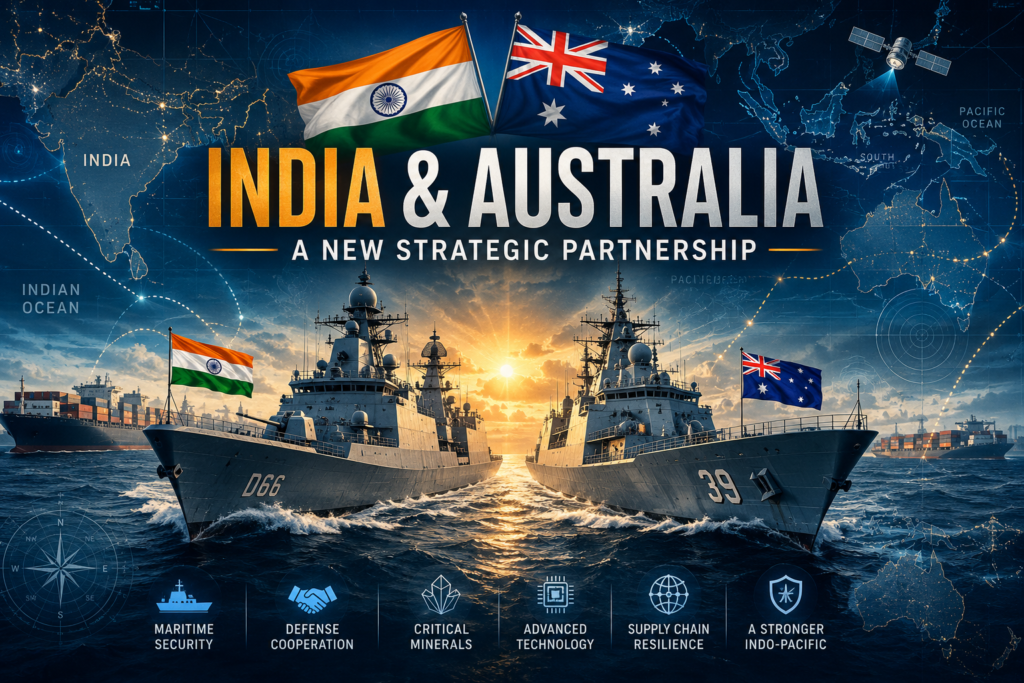
Against that backdrop, India and Australia have announced a new phase in their defense partnership.
At first glance, another bilateral declaration might not seem especially remarkable. Diplomatic calendars are full of joint statements that generate headlines for a day before fading into the background. Most never reshape the strategic landscape.
This partnership deserves a closer look.
The latest commitments—covering defense cooperation, maritime security, military exercises, technology collaboration, logistics, and broader strategic coordination—reflect a relationship that has been steadily deepening for years rather than one created overnight. The agreements themselves matter, but they also point to something larger. Both governments appear to have reached the same conclusion: the region they are operating in is becoming more uncertain, and preparing for that uncertainty is easier with trusted partners than in isolation.
One detail often gets overlooked.
India and Australia are separated by thousands of kilometers, yet they increasingly worry about many of the same things: secure sea lanes, resilient supply chains, access to critical technologies, and preserving a stable regional balance. Geography has become less important than shared strategic interests.
That helps explain why policymakers well beyond New Delhi and Canberra are paying attention.
Washington sees another capable regional partnership taking shape. Tokyo views it through the lens of maritime security and supply chain resilience. Southeast Asian governments are watching carefully, weighing what stronger cooperation between two major regional democracies could mean for the broader balance of the Indo-Pacific.
The real story isn’t simply what was signed.
It’s why agreements like these have become increasingly common—and why they are likely to continue.
Why This Meeting Happened Now
In international relations, timing often reveals as much as the agreement itself.
Several developments have been moving in the same direction for years. None explains the partnership on its own. Together, they make the latest announcements far easier to understand.
China’s expanding military capabilities are part of that picture. So are persistent tensions in the South China Sea, uncertainty around Taiwan, and a wider regional arms buildup. Across the Indo-Pacific, defense budgets have grown, military exercises have become more frequent, and governments are investing in capabilities that would have seemed excessive a decade ago.
But focusing only on military competition misses a quieter shift that has arguably changed strategic thinking just as much.
Supply chains.
When factories closed during the pandemic and shipping networks seized up, governments discovered how vulnerable highly efficient global production systems had become. For decades, efficiency had been the overriding goal. Suddenly reliability mattered just as much.
That lesson has lingered.
Today, semiconductors, rare earth elements, lithium, advanced batteries, telecommunications infrastructure, and critical energy supplies are increasingly treated as strategic assets rather than ordinary commercial goods. People often describe this as economic security. In practice, governments are beginning to treat it as national security.
Ten years ago, that argument would have sounded exaggerated. Today it has become mainstream policy in capitals across the Indo-Pacific.
Australia occupies an important place in this changing landscape. It possesses some of the world’s largest reserves of lithium and significant deposits of rare earth elements—resources that underpin everything from electric vehicles and renewable energy systems to advanced electronics and defense technologies.
India, meanwhile, is pursuing an ambitious manufacturing agenda while trying to avoid replacing one strategic dependency with another. Reliable access to critical inputs has become as important as attracting new factories.
The conversation naturally leads to maritime security.
Almost all of those resources—and much of the trade connected to them—move by sea. The Indian Ocean links energy exports from the Middle East with manufacturing centers across Asia, while the Pacific remains central to global commerce. A disruption in either region rarely stays there. Higher freight costs eventually reach factories, retailers, and consumers.
Modern geopolitics increasingly begins with logistics.
Warships attract attention because they are visible. Shipping corridors, ports, maintenance agreements, fuel networks, and logistics arrangements receive far less coverage, even though they often determine whether economies and militaries can function smoothly during periods of disruption.
That changing view of security has also shaped the Quadrilateral Security Dialogue (QUAD), bringing together India, Australia, Japan, and the United States. While the grouping is frequently discussed in military terms, much of its recent work has focused on resilient supply chains, critical technologies, infrastructure, maritime awareness, and disaster response.
That says something about how governments increasingly define security itself.
Seen in that context, the latest India-Australia agreements look less like an isolated diplomatic initiative and more like another piece of a broader regional adjustment. It has been unfolding gradually, almost quietly, for several years. The announcements simply make it easier to see.
What Exactly Was Announced?
Most headlines described the outcome as a new defense and security agreement.
That is accurate, but it doesn’t tell the whole story.
The announcements were less about introducing a single breakthrough than about expanding cooperation across several areas that, taken together, strengthen the relationship. Some initiatives are immediately visible. Others are the kind of institutional changes that receive little public attention but tend to matter years later.
A Renewed Defense and Security Framework
At the center of the announcements is a renewed framework for defense and security cooperation, building on the steady expansion of bilateral ties over the past decade.
Its scope is broad. Defense planning, intelligence exchanges, maritime cooperation, emerging technologies, cyber resilience, logistics, and regular strategic consultations all feature prominently. That breadth is significant in itself.
Security partnerships increasingly resemble operating systems rather than individual projects. The more connected the different parts become, the more resilient the overall relationship tends to be.
Another shift is worth noticing.
Governments no longer separate military preparedness from economic resilience as neatly as they once did. Technology policy, industrial capacity, cybersecurity, and defense planning increasingly overlap. The same semiconductor fabrication plant or satellite network can carry both commercial and strategic importance depending on the circumstances.
That overlap is becoming a defining feature of modern geopolitics.
Stronger Maritime Cooperation
Maritime cooperation remains one of the partnership’s most practical priorities.
India and Australia intend to deepen coordination on maritime domain awareness, information sharing, surveillance, and efforts to support freedom of navigation across the Indian Ocean and the wider Indo-Pacific.
It is easy to treat these as technical policy goals. They are anything but.
Roughly 80 percent of global trade by volume still moves by sea. Energy shipments, industrial components, consumer electronics, and agricultural goods all depend on secure shipping routes. When maritime disruptions occur, the consequences rarely remain confined to naval strategy. They eventually reach factories, businesses, and households.
That connection has become much easier to appreciate in recent years.
Container shortages during the pandemic, disruptions in the Red Sea, and periodic bottlenecks at major maritime chokepoints reminded governments that secure sea lanes are as much an economic requirement as a security objective.
Expanded Military Exercises
Joint military exercises between India and Australia are expected to become more frequent and more sophisticated.
The objective extends well beyond training.
Exercises improve interoperability—the ability of two militaries to communicate, plan, coordinate logistics, and operate effectively alongside one another. That process is gradual. It cannot be built during a crisis.
One point often receives less attention.
Many of the operational procedures developed through military exercises prove equally valuable during humanitarian assistance, disaster relief, evacuation missions, or large-scale search-and-rescue operations. The same coordination mechanisms serve different purposes depending on the situation.
Preparation rarely attracts headlines.
Its absence usually does.
Defense Technology Collaboration
Military capability is changing.
For decades, discussions centered on the number of soldiers, fighter aircraft, warships, or armored vehicles a country possessed. Those metrics still matter, but they no longer tell the whole story.
Increasingly, strategic advantage depends on technologies that are far less visible: artificial intelligence, autonomous systems, cybersecurity, quantum research, advanced sensors, satellite networks, and secure communications.
The competition is becoming industrial as much as military.
Modern defense planning increasingly resembles advanced manufacturing policy. Countries that can design chips, build satellites, secure software systems, and manufacture precision components often gain strategic advantages long before any military confrontation occurs.
That is one reason India and Australia are placing greater emphasis on research partnerships, innovation, defense industry collaboration, and technology development. Building those capabilities requires years of investment. They cannot simply be purchased when circumstances deteriorate.
Enhanced Logistics Cooperation
If there is one part of the agreements that is likely to be underestimated, it is logistics.
Warships and fighter aircraft dominate headlines because they are visible symbols of military power.
Logistics is different.
Fuel supplies. Maintenance facilities. Spare parts. Port access. Transportation networks. Repair capabilities.
None of these attracts much public attention. Yet together they determine whether military assets remain operational beyond the first phase of any sustained mission.
Military historians have understood this for centuries. Contemporary strategic planning increasingly reflects the same reality.
The logistics arrangements announced by India and Australia improve operational flexibility during joint exercises, humanitarian missions, and potential regional contingencies. More importantly, they build familiarity between institutions that may need to cooperate under pressure in the future.
That kind of trust cannot be improvised.
Why Australia Is Deepening Defense Ties With India
Australia’s strategic outlook has evolved considerably over the past decade.
Its traditional alliances remain central to national security, particularly the alliance with the United States. But Canberra has also recognized that a more contested Indo-Pacific requires a broader network of capable regional partners.
India stands out for several reasons.
It is not simply the world’s largest democracy or one of the fastest-growing major economies. It is also a resident power in the Indian Ocean, an increasingly influential diplomatic actor, and a country whose strategic importance continues to expand as global supply chains diversify.
Those trends reinforce one another.
As India’s economic weight grows, so does its strategic relevance. As its strategic relevance increases, other countries naturally invest more heavily in long-term partnerships with New Delhi.
Australia’s own geography also shapes this calculation.
Much of its trade depends on secure maritime routes stretching across the Indian Ocean and into Asia. Stability in those waters is therefore not an abstract foreign policy objective but a practical economic necessity.
For Canberra, deeper engagement with India is less about responding to a single event than adapting to a regional environment that is steadily becoming more competitive.
Why India Needs Australia More Than Ever
The partnership is equally valuable from India’s perspective, although the priorities are not identical.
One issue quietly sits behind much of the relationship.
Manufacturing.
India’s ambitions to become a larger global manufacturing hub depend on reliable access to critical inputs. Australia happens to be one of the world’s most important suppliers of lithium, rare earth elements, and other minerals essential for batteries, renewable energy technologies, advanced electronics, and defense production.
Control over these resources increasingly carries geopolitical weight.
Oil shaped much of twentieth-century geopolitics. Critical minerals are unlikely to replace it entirely, but they are becoming an increasingly important source of strategic influence as countries compete to secure future industrial supply chains.
The semiconductor ecosystem reinforces that trend.
No single country controls every stage of semiconductor production. Design, fabrication, equipment manufacturing, assembly, testing, and raw materials are spread across multiple economies. That complexity creates vulnerabilities—but it also creates opportunities for trusted partnerships.
India is positioning itself to become part of that broader ecosystem rather than simply a customer within it.
The relationship extends well beyond industrial policy.
Education, research, technology, investment, defense manufacturing, clean energy, and innovation all create additional links between the two countries. Relationships built across multiple sectors tend to prove more resilient because they are not dependent on a single strategic objective.
That breadth may ultimately become one of the partnership’s greatest strengths.
Not because every initiative will succeed.
But because the relationship no longer depends on just one.
The China Factor: Why Beijing Is Watching Closely
No assessment of the India-Australia partnership is complete without considering China.
That does not mean the relationship exists solely because of Beijing. It doesn’t. Trade, technology, critical minerals, and shared maritime interests all have their own logic. Even so, China’s growing influence provides much of the strategic context in which these agreements are being interpreted.
Over the past decade, Beijing has expanded its military capabilities, deepened its economic presence, and become more active diplomatically across the Indo-Pacific. At the same time, disputes in the South China Sea, military activity around Taiwan, and competition over advanced technologies have heightened concerns across the region.
The result has been a subtle shift in behavior.
Many countries continue to strengthen economic ties with China while simultaneously broadening their security relationships elsewhere. At first glance, that looks contradictory. In reality, it has become one of the defining characteristics of Indo-Pacific diplomacy.
Few governments want to choose between economic opportunity and strategic security.
Most are trying to preserve both.
That balancing act explains why the India-Australia partnership should not be viewed in isolation.
It sits alongside a growing web of regional arrangements: the QUAD, AUKUS, Japan’s expanding defense cooperation with partners across the Indo-Pacific, and a series of bilateral agreements that receive far less public attention but collectively reinforce regional coordination.
Individually, none of these partnerships transforms the strategic balance.
Collectively, they begin to look different.
Security architecture rarely emerges through a single treaty. More often, it develops gradually as countries build habits of cooperation, improve interoperability, exchange information, and establish institutions that become more valuable over time.
That is precisely what Beijing is watching.
From China’s perspective, the concern is unlikely to be one specific agreement. It is the cumulative effect of many overlapping partnerships that gradually make regional coordination easier during periods of tension.
Whether those concerns are justified is a separate question.
Either way, they influence strategic calculations.
It is also worth remembering that competition does not automatically lead to confrontation.
Much of today’s geopolitical rivalry unfolds long before military force enters the picture. It plays out through technology standards, infrastructure investment, industrial policy, access to critical minerals, cyber capabilities, diplomatic influence, and control over supply chains.
In many respects, the competition is about shaping tomorrow’s environment rather than responding to today’s crisis.
How the New Partnership Changes the Indo-Pacific Security Landscape
Major shifts in regional security are rarely dramatic.
Looking back, they often appear obvious. Living through them is different. They usually consist of dozens of incremental decisions that seem modest on their own but gradually reshape the strategic landscape.
The India-Australia partnership fits that pattern.
Its immediate impact is practical rather than transformational. Greater maritime awareness, improved logistics, more frequent military exercises, closer technology cooperation, and stronger institutional links all increase the ability of both countries to work together when circumstances require it.
None of those changes dominates headlines.
Together, they matter.
One detail deserves more attention than it usually receives.
The value of security partnerships is not measured only during conflict. Their greatest contribution often lies in reducing uncertainty beforehand. Businesses invest more confidently, governments coordinate more effectively, and smaller countries gain reassurance when credible partnerships already exist before a crisis develops.
In that sense, security partnerships resemble insurance.
Their importance is easiest to overlook when everything is functioning normally.
Smaller Indo-Pacific states are likely to interpret these developments through a different lens.
Many have little interest in becoming part of strategic blocs. Their priorities are more immediate: secure shipping routes, economic stability, disaster response, fisheries protection, and preserving room to conduct independent foreign policy.
A more connected regional security network can support those objectives without necessarily forcing difficult political choices.
At least, that is how many governments hope it will work.
Economic Impact Beyond Defense
The economic implications of this partnership may ultimately prove as significant as the defense dimension.
That possibility receives less attention because economic effects tend to emerge gradually.
Critical minerals provide the clearest example.
Australia is one of the world’s leading producers of lithium and possesses substantial reserves of rare earth elements essential for batteries, advanced electronics, renewable energy technologies, and defense manufacturing. For India, securing reliable access to these materials supports ambitions that extend far beyond the defense sector.
Manufacturing competitiveness increasingly depends on supply chain resilience.
So does investment.
Companies deciding where to build factories or establish research facilities look beyond labor costs and tax incentives. They consider geopolitical stability, infrastructure reliability, access to critical inputs, and the resilience of transportation networks.
Those decisions are shaping global investment flows more than they did even a decade ago.
Another consequence is beginning to emerge.
Industrial policy has returned.
For years, governments largely assumed markets would allocate production efficiently across borders. Recent disruptions—from the pandemic to semiconductor shortages and shipping crises—have prompted many countries to reconsider that assumption.
Efficiency remains important.
Resilience now sits alongside it.
The India-Australia partnership reflects that broader shift.
What It Means for Other Countries
Washington is likely to view deeper India-Australia cooperation positively.
It aligns with a long-standing U.S. objective of encouraging capable regional partners to shoulder a greater share of responsibility for maintaining stability across the Indo-Pacific. Rather than relying exclusively on American military presence, the emphasis has increasingly shifted toward strengthening cooperation among regional democracies themselves.
Japan’s perspective is broadly similar.
Its own concerns about maritime security, resilient supply chains, critical technologies, and regional deterrence closely overlap with many of the priorities reflected in the India-Australia partnership. Closer cooperation between New Delhi and Canberra reinforces trends that Tokyo has been encouraging for several years.
ASEAN’s response is likely to be more nuanced.
Southeast Asian governments have spent decades balancing relationships with competing major powers. Most have little appetite for rigid alliance structures and generally prefer arrangements that preserve strategic flexibility while supporting regional stability.
That balancing strategy is unlikely to disappear.
Pacific Island countries often approach these discussions from a different angle altogether.
Maritime surveillance, illegal fishing, disaster preparedness, infrastructure, and climate resilience frequently rank higher than great-power competition. Security, from their perspective, is often measured through practical outcomes rather than geopolitical symbolism.
European countries have also become more engaged in the Indo-Pacific through naval deployments, trade initiatives, infrastructure investment, and strategic partnerships.
A decade ago, such involvement might have seemed peripheral.
Today it increasingly reflects a wider recognition that developments in the Indo-Pacific influence global trade, technological competition, energy security, and economic growth far beyond the region itself.
That broader international attention may be one of the clearest indicators of how much the geopolitical landscape has changed.
What Does This Mean for India?
For India, the value of this partnership extends well beyond defense cooperation.
Access to Australia’s critical minerals supports ambitions that range from battery manufacturing and electric vehicles to semiconductors and advanced electronics. Technology partnerships create opportunities for joint research and industrial collaboration. More regular military exercises strengthen operational familiarity, while deeper maritime cooperation reinforces India’s broader presence across the Indian Ocean.
Taken individually, each of those developments is useful.
Together, they support a larger objective: reducing strategic vulnerability while expanding India’s options.
That distinction matters.
India’s foreign policy has long been shaped by the idea of strategic autonomy—the ability to work closely with multiple partners without becoming dependent on any single one. The partnership with Australia fits comfortably within that approach. It expands cooperation without fundamentally changing the principles that have guided Indian diplomacy for decades.
There is another implication that receives less attention.
As India’s economic and strategic influence continues to grow, expectations from other countries are changing as well. Increasingly, New Delhi is viewed not only as a country protecting its own interests but also as one expected to contribute to the wider stability of the Indo-Pacific.
Influence, in other words, brings responsibility.
Risks and Challenges
Strong agreements do not automatically produce strong outcomes.
History offers plenty of examples where ambitious declarations generated enthusiasm at the time but delivered far less than expected. Implementation has always been the harder part.
Whether these latest commitments translate into lasting strategic gains will depend less on the language of the agreements than on consistent political attention over the coming years.
That sounds obvious.
It is also where many international partnerships begin to lose momentum.
Political leadership changes. Economic priorities shift. Budgets tighten. Bureaucratic coordination slows. Governments remain committed in principle while progress becomes far more gradual in practice.
There are technical challenges too.
Building defense-industrial cooperation, expanding technology partnerships, protecting sensitive research, aligning procurement systems, and strengthening logistics networks all require sustained investment. None of this happens quickly, even between countries with strong political relations.
External developments will matter just as much.
Relations between the United States and China, tensions surrounding Taiwan, developments in the South China Sea, and the broader trajectory of regional competition will all influence how this partnership evolves. Neither New Delhi nor Canberra controls those variables, but both will have to adapt to them.
International partnerships are rarely shaped by strategy alone.
Events have a habit of intervening.
What Happens Next?
The agreements announced today are unlikely to represent the final destination.
They look more like the next stage of a relationship that has been expanding steadily across defense, technology, trade, education, and critical industries.
Military exercises will probably become more ambitious. Defense technology collaboration is likely to deepen. Cooperation on cybersecurity, critical minerals, artificial intelligence, maritime domain awareness, and advanced manufacturing is also expected to expand.
Some of those initiatives will receive considerable public attention.
Others almost certainly will not.
Yet the quieter initiatives may prove just as consequential over time because they strengthen the institutional foundations that make broader cooperation possible.
The QUAD will continue to play an important role in that process.
Although public discussion often focuses on its strategic significance, much of the group’s work has increasingly centered on practical issues such as resilient supply chains, critical technologies, maritime awareness, infrastructure, and disaster response. Those priorities closely mirror the direction in which India-Australia cooperation is already moving.
One question remains.
Will this partnership eventually be remembered as a series of individual agreements—or as part of a much larger strategic shift across the Indo-Pacific?
The answer will take years to become clear.
Conclusion
The India-Australia defense partnership is best understood not as a sudden breakthrough but as the product of a broader transformation that has been unfolding across the Indo-Pacific.
Military competition is part of that story.
So are supply chains, industrial policy, technological leadership, critical minerals, and the growing realization that economic resilience and national security are becoming increasingly difficult to separate.
That shift is reshaping how governments define strategic partnerships.
Countries are investing less in isolated bilateral relationships and more in networks of trusted cooperation that span defense, technology, industry, infrastructure, and trade. The objective is no longer simply responding to crises when they emerge. Increasingly, it is about reducing vulnerabilities before those crises occur.
Viewed through that lens, the latest agreements between India and Australia become easier to understand.
On their own, they will not transform the regional balance of power. Few diplomatic announcements ever do.
Their significance lies elsewhere.
They add another layer to a regional security architecture that has been taking shape gradually through dozens of similar decisions, many of which attracted far less attention at the time they were made.
That may ultimately be how these agreements are remembered.
Not as a single defining moment, but as one of the quieter building blocks in a longer strategic transition—one whose full significance may only become obvious years after the headlines have faded.