Imagine you’re responsible for deciding where a company should invest its next billion dollars. A new smartphone assembly plant. An auto-parts factory. A pharmaceutical production line expected to operate for the next twenty years. In that position, tariff uncertainty matters long before any tariff actually takes effect.
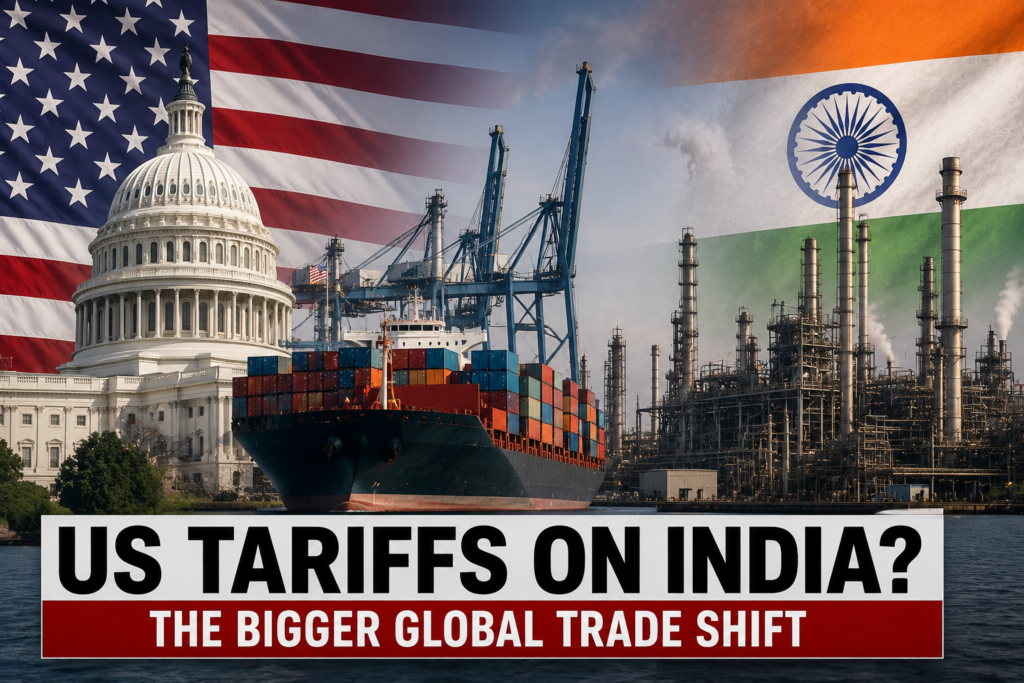
That is partly why recent discussions in Washington about possible new tariffs on selected Indian imports have attracted attention far beyond trade specialists. No broad measures have been finalized, and negotiations between the United States and India continue. Yet the debate itself reflects a broader shift. Trade policy is becoming less about moving goods across borders and more about shaping where industries, investment and technological capability will be built.
For years, global trade revolved around one dominant storyline: the United States and China. Companies diversified supply chains, governments promoted economic resilience, and businesses searched for alternatives to concentrated manufacturing. India emerged as one of the biggest beneficiaries of that shift.
Success, however, tends to invite closer examination.
More Than a Tariff Debate
The current situation is often described as a possible tariff dispute, but that oversimplifies what is happening.
Officials from both countries are still negotiating a broader trade agreement aimed at improving market access and resolving longstanding commercial disagreements. At the same time, Washington is considering additional trade measures affecting selected imports from India.
Those developments are unfolding simultaneously, not sequentially.
It is easy to assume businesses simply wait for governments to reach a decision. They rarely do. Investment committees, procurement teams and multinational manufacturers must make decisions months or even years in advance. Delaying an expansion project can be as consequential as cancelling it.
Ironically, uncertainty itself may influence investment decisions more than the tariffs eventually imposed.
Businesses generally adapt faster to expensive rules than constantly changing ones. A predictable tariff can often be incorporated into long-term financial planning. An uncertain policy environment is much harder to model when billions of dollars and thousands of jobs are involved.
Why Washington Is Paying More Attention
Trade policy has gradually become an extension of industrial strategy.
Across successive administrations, tariffs have increasingly been used not only to protect domestic industries but also to strengthen America’s negotiating position. Market access, manufacturing incentives, supply-chain resilience and national security are now discussed in the same policy conversations.
India’s rapid industrial expansion naturally places it within that framework.
As companies diversify beyond China, India has attracted investment in electronics, engineering products, pharmaceuticals and advanced manufacturing. That growth has been encouraged by governments and welcomed by many multinational companies. Yet once a country becomes strategically important, it inevitably receives closer policy scrutiny from its trading partners.
That may sound contradictory, but it is a recurring pattern in international economics. The countries that matter most commercially often experience the toughest trade negotiations.
India’s Position Has Changed
Five years ago, India was largely viewed as a promising alternative manufacturing destination.
Today the discussion is different.
Global technology companies have expanded smartphone production. Pharmaceutical manufacturers continue supplying large volumes of generic medicines to international markets. Engineering goods, automotive components, chemicals and specialty manufacturing have all strengthened India’s export profile.
No single policy created that momentum. Infrastructure investment, production-linked incentives, changing corporate strategies and shifting geopolitical realities all played a role.
Factories usually receive the headlines. The supplier networks built around them rarely do.
When a major manufacturing plant opens, hundreds of smaller businesses often follow—tool makers, logistics providers, packaging companies, industrial equipment suppliers and specialized service firms. Industrial ecosystems develop gradually, which is one reason governments compete so aggressively to attract them.
Once those ecosystems mature, relocating them becomes considerably harder than many headlines suggest.
Which Industries Could Feel the Pressure?
The answer depends less on whether tariffs are introduced than on where they are applied.
Electronics would almost certainly attract immediate attention. India has become an increasingly important assembly base for smartphones and electronic components. Higher import costs could narrow margins, forcing manufacturers to reassess pricing or production strategies.
Textiles present a different challenge.
In industries where buyers compare production costs down to a few percentage points, relatively modest tariff changes can influence sourcing decisions. Countries such as Bangladesh or Vietnam could become more competitive in some product categories without making any changes of their own.
Engineering goods and automotive components would face similar competitive pressures, particularly in markets where alternative suppliers already exist.
Pharmaceuticals are different.
The United States relies heavily on Indian manufacturers for affordable generic medicines. Any broad trade measures affecting that sector would inevitably raise questions extending beyond manufacturing policy. Healthcare affordability becomes part of the discussion almost immediately.
That is why pharmaceutical trade rarely fits neatly into standard tariff debates.
Supply Chains Rarely Move Like Headlines Suggest
Financial headlines sometimes create the impression that manufacturers can relocate production almost overnight.
Boardrooms know otherwise.
A supply chain is not simply a collection of factories. It includes supplier relationships built over years, trained workers, shipping contracts, certification processes, local infrastructure and countless operational details that rarely appear in public discussion.
Modern supply chains increasingly resemble investment portfolios. Companies are spreading production across multiple countries for the same reason investors diversify assets—not because every location offers identical advantages, but because concentration itself has become a risk.
Vietnam, Indonesia, Mexico and Bangladesh may continue attracting additional investment. That does not necessarily come at India’s expense. Many multinational companies are no longer searching for a single manufacturing hub. They are building networks.
What Could It Mean for India?
Export growth remains central to India’s long-term manufacturing ambitions.
Prolonged policy uncertainty could delay investment decisions in export-oriented sectors, particularly where companies depend heavily on access to the American market.
India’s broader economic picture, however, is more complicated than a simple export story.
Domestic consumption remains substantial. Public infrastructure spending continues. Manufacturing has become a long-term policy objective supported through multiple initiatives rather than a short-term economic response.
That provides a degree of resilience.
New Delhi is also unlikely to treat negotiations purely as a commercial issue. India increasingly presents itself as both a manufacturing destination and a strategic economic partner. Maintaining that reputation carries value beyond any single tariff dispute.
The American Side of the Equation
Trade restrictions rarely affect only exporters.
American manufacturers importing engineering products, pharmaceutical ingredients, electronics or industrial components from India could face higher costs. Some businesses may absorb those increases. Others will eventually pass them along through higher prices.
Counterintuitively, tariffs do not always reduce trade immediately. In some industries they encourage stockpiling before implementation. In others they accelerate supplier diversification or increase domestic investment. The economic effects often unfold gradually rather than appearing all at once.
That complexity explains why trade policy continues to generate debate long after new measures are announced.
Beyond Commerce
Reducing the relationship between Washington and New Delhi to tariffs misses a much larger picture.
The two countries cooperate on defence, advanced technology, critical minerals, semiconductor supply chains and Indo-Pacific security. The Quad has strengthened strategic coordination, while commercial ties have expanded alongside it.
History offers plenty of examples of close partners negotiating aggressively on trade while continuing to deepen security cooperation. Governments often separate those priorities more effectively than public debate suggests.
Trade disagreements matter. They simply do not define the entire relationship.
What Comes Next?
Several outcomes remain possible.
Negotiations could produce a limited agreement addressing specific concerns while avoiding broader disruption. Targeted tariffs on selected sectors remain another possibility. A wider trade dispute appears less likely, though it cannot be dismissed entirely if negotiations stall.
Whatever the immediate outcome, a larger shift is already underway.
Trade disputes are becoming less about customs duties and more about industrial ecosystems. Governments increasingly compete for semiconductor plants, pharmaceutical production, battery manufacturing and advanced engineering because they view those capabilities as strategic assets rather than ordinary industries.
That changes how businesses think about investment as well.
The next generation of global supply chains will probably not be organized around finding the single cheapest production base. They will be organized around resilience, political stability and access to trusted partners.
In that sense, the current debate extends far beyond Washington or New Delhi. It reflects an international trading system that is quietly being redesigned—one investment decision, one factory and one negotiation at a time.
The eventual tariff decision will matter. But years from now, it may be remembered less for the duties themselves than for what it revealed about the direction of global trade.