For decades, much of the developed world worked from a fairly straightforward assumption: deeper economic integration would make major conflict less likely.
Governments reduced defense budgets, expanded trade relationships, outsourced manufacturing, and built supply chains that stretched across continents. Security concerns never disappeared, but economic efficiency became the dominant organizing principle.
Today, many of those assumptions are being reconsidered.
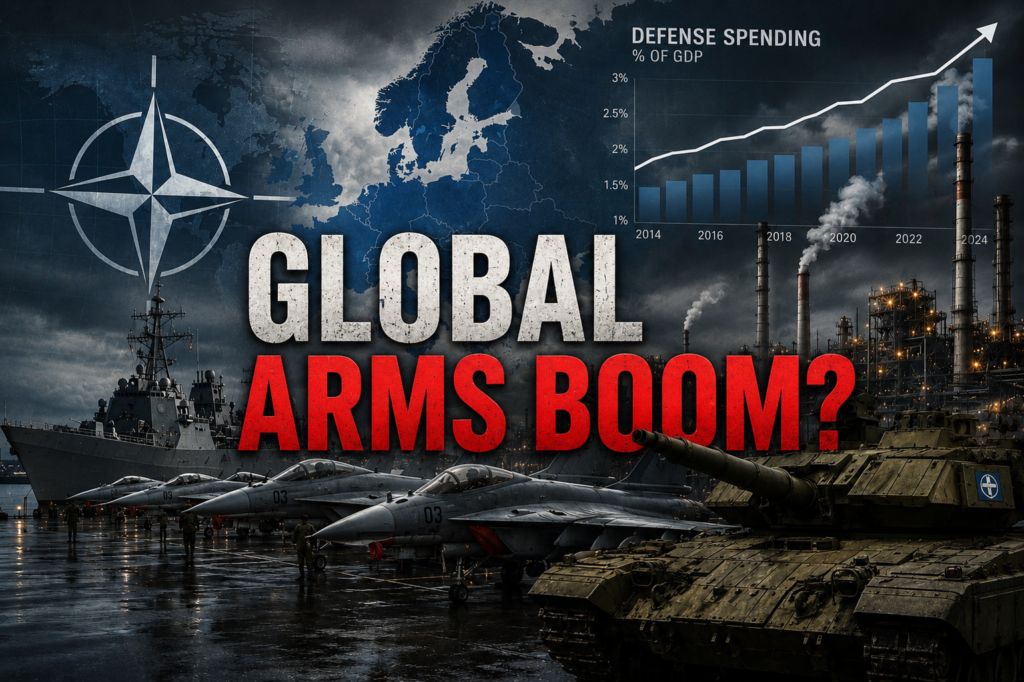
Defense spending is rising across Europe. Military production is expanding. Governments are discussing stockpiles, supply-chain security, industrial resilience, and strategic autonomy with a sense of urgency that would have seemed unusual just a few years ago.
The immediate trigger is Russia’s invasion of Ukraine.
The larger story may be that security is returning to the center of economic policymaking.
The question is not simply whether NATO members will spend more on defense. That appears increasingly likely.
The more interesting question is whether this shift encourages similar responses elsewhere, creating a broader cycle of military expansion and defense-driven industrial investment.
If it does, the consequences will extend far beyond military budgets. Manufacturing strategies, labor markets, public finances, technology investment, and trade relationships could all be affected.
Why NATO Wants Higher Defense Spending
The current debate did not emerge overnight.
Russia’s invasion of Ukraine forced many European governments to revisit assumptions that had shaped policy for years. Large-scale conventional warfare had returned to Europe, and with it came uncomfortable questions about preparedness.
The war exposed vulnerabilities that had accumulated gradually.
Governments discovered that ammunition reserves could be consumed much faster than expected during a prolonged conflict. Production lines that had operated at relatively modest levels suddenly faced pressure to expand. In some cases, officials found that capabilities lost over decades could not simply be rebuilt in a few budget cycles.
The lesson extended beyond defense.
The same economic logic that rewarded efficiency often discouraged redundancy. Spare capacity looked expensive. Stockpiles looked unnecessary. Maintaining multiple suppliers appeared less attractive than relying on the cheapest option.
Those decisions made sense in a different environment.
They look different now.
One of the stranger consequences of recent geopolitical tensions is that concepts once associated with business-school discussions—inventory buffers, supplier diversification, redundancy, strategic reserves—are increasingly appearing in national-security debates.
That would have sounded unusual twenty years ago.
At the same time, pressure from Washington has been building for years. Successive U.S. administrations have argued that European allies should contribute more to collective defense. What was once an occasional source of friction inside NATO is increasingly becoming a structural expectation.
As a result, spending targets that appeared ambitious five years ago are beginning to look less ambitious today.
Why the Rest of the World Is Paying Attention
Military spending rarely stays confined to one region.
One of the enduring contradictions of international politics is that measures intended to increase security can sometimes make others feel less secure.
A government increases defense spending.
Its competitors respond.
Those responses trigger further reactions.
The process is rarely as mechanical as it sounds. Domestic politics, economic conditions, and fiscal constraints all matter. Still, uncertainty has a way of influencing decisions.
Capabilities are visible.
Intentions are not.
Governments can count ships, factories, aircraft, and defense budgets. Future intentions are considerably harder to measure.
That uncertainty often shapes policy long before any direct threat emerges.
Europe: Where The Story Actually Begins
If NATO’s spending push becomes the starting point for a broader global trend, Europe is where the most significant changes are already taking place.
For years, many European governments prioritized economic integration while allowing parts of their defense-industrial base to shrink. Factories closed. Production lines slowed. Certain capabilities were reduced because they no longer seemed essential.
Now the process is reversing.
Germany’s €100 billion special defense fund became one of the clearest signals that European security thinking was changing. The symbolism mattered almost as much as the money itself.
Across Europe, governments are signing long-term contracts, reopening production lines, expanding procurement programs, and funding factory upgrades aimed at increasing output over the coming decade.
Writing a larger defense budget is relatively easy.
Building the factories, supply chains, and workforce needed to support it is much harder.
Many manufacturers are already dealing with labor shortages, supplier bottlenecks, and long delivery timelines. Some have order books stretching years into the future.
Whether governments can rebuild defense-industrial capacity as quickly as they hope remains uncertain.
Political announcements operate on election cycles.
Industrial expansion operates on engineering timelines.
Those are not always the same thing.
The economic dimension is becoming harder to ignore.
Defense spending is increasingly being presented not only as a security necessity but also as a strategy for supporting domestic manufacturing, technological development, and skilled employment.
Not everyone is convinced.
Some economists argue governments often overestimate the economic benefits of defense-driven industrial policy while underestimating the long-term fiscal costs. Others counter that a world becoming less predictable requires accepting those costs.
The debate is unlikely to disappear.
The Defense Spending Paradox
Governments today are pursuing several objectives simultaneously.
They want stronger militaries.
They want more resilient supply chains.
They want larger domestic manufacturing sectors.
They want to manage debt burdens.
They want affordable energy.
They want to support aging populations.
These goals are not necessarily incompatible.
But they are not always easy to reconcile either.
The political appeal of higher defense spending is relatively clear.
The fiscal arithmetic is less straightforward.
China: The Most Important External Variable
Outside Europe, China may be the most important country to watch.
Not because NATO directly threatens China.
But because Chinese policymakers are observing the broader strategic environment that is emerging.
China has spent years investing in shipbuilding, advanced manufacturing, aerospace programs, semiconductor development, artificial intelligence, and military modernization.
Those efforts began long before NATO’s current spending debate.
Still, larger Western defense budgets may strengthen arguments within China for maintaining a similar trajectory.
In many ways, the competition between major powers increasingly resembles a contest over industrial ecosystems rather than territory alone.
Shipyards matter.
So do semiconductor fabrication facilities, machine-tool manufacturers, rare-earth processing plants, power infrastructure, research institutions, and engineering talent.
The competition is increasingly about who can build, maintain, and scale complex industrial systems.
People often discuss semiconductors as a technology story.
Governments increasingly treat them as a strategic asset.
The chips themselves are tiny.
The industrial networks behind them are enormous.
A century ago, great powers worried about access to coal, steel, and oil.
Today they worry about advanced chips, critical minerals, and manufacturing ecosystems.
The underlying logic is not entirely new.
The inputs have changed.
A Possibility Worth Considering
There is another possibility.
Current defense spending plans may represent a significant adjustment without becoming the beginning of a long-term global spending boom.
History offers examples of defense budgets rising sharply after major geopolitical shocks before eventually stabilizing.
The world is clearly becoming more security-conscious.
What remains less clear is whether that translates into decades of continuously rising military expenditures.
The answer may depend as much on economic conditions as geopolitical ones.
Russia
Russia is unlikely to ignore sustained increases in NATO spending.
Economic constraints remain significant, particularly under sanctions pressure. Yet military capability remains central to Moscow’s strategic calculations.
If NATO continues investing heavily in defense, Russia has incentives to maintain substantial military spending of its own.
Some critics argue governments risk preparing for the last conflict rather than the next one. Modern warfare evolves rapidly, while large procurement programs often take years to produce results.
Whether current spending priorities prove well-targeted may only become clear much later.
Strategic decisions are often judged long after they are made.
The Economic Story May Matter More Than The Military Story
Much of the public discussion focuses on weapons systems, defense budgets, and military competition.
The economic consequences may ultimately prove more significant.
Defense production relies on engineers, logistics specialists, software developers, metal producers, transportation networks, equipment manufacturers, and thousands of smaller suppliers that rarely appear in headlines.
Military spending creates jobs.
That is one reason politicians find it attractive.
But those jobs come with costs.
Resources allocated to defense cannot simultaneously fund infrastructure projects, healthcare systems, scientific research, tax reductions, or other priorities.
Supporters argue higher defense spending is a necessary response to a more dangerous world.
Critics worry governments may be responding to today’s security concerns in ways that create tomorrow’s fiscal pressures.
Neither argument is easy to dismiss.
A Less Discussed Constraint: Demographics
One overlooked challenge has little to do with military strategy.
It has to do with demographics.
Many advanced economies are aging rapidly. Labor-force growth is slowing. Healthcare obligations are rising. Pension systems face growing pressure.
These trends existed before defense spending began moving higher.
Now governments are trying to expand manufacturing capacity while competing for many of the same workers needed elsewhere in the economy.
Engineers are not unlimited.
Neither are skilled technicians.
Or experienced machinists.
Or construction workers.
In some cases, labor shortages may become as important as budget constraints.
Building military capacity requires people.
Finding enough of them may prove difficult.
Could Military Spending Become Self-Reinforcing?
History suggests it can.
Defense budgets are often easier to increase than reduce.
Once factories expand, contracts are signed, workers are hired, and local economies become dependent on military production, defense spending stops being solely a security issue.
It becomes an economic constituency.
That does not guarantee permanent expansion.
Political priorities change. Governments change. Economic downturns force difficult choices.
Still, large defense-industrial systems tend to develop their own momentum.
The Bigger Picture
NATO’s push for higher defense spending began as a response to a specific security crisis.
It is increasingly becoming part of a broader reassessment of how governments think about economics, manufacturing, technology, and resilience.
Perhaps the most important consequence is not military at all.
A generation of policymakers that built careers around efficiency, integration, and globalization is gradually being replaced by one focused on resilience, redundancy, and strategic competition.
That shift may outlast any single defense budget.
Whether it produces greater stability remains uncertain.
What nobody can say with confidence is whether today’s spending plans will look insufficient, excessive, or entirely reasonable ten years from now. Strategic decisions are often evaluated long after they are made.
For now, governments appear increasingly willing to accept the economic costs associated with higher defense spending.
Whether voters remain equally willing is a question that may take years to answer.