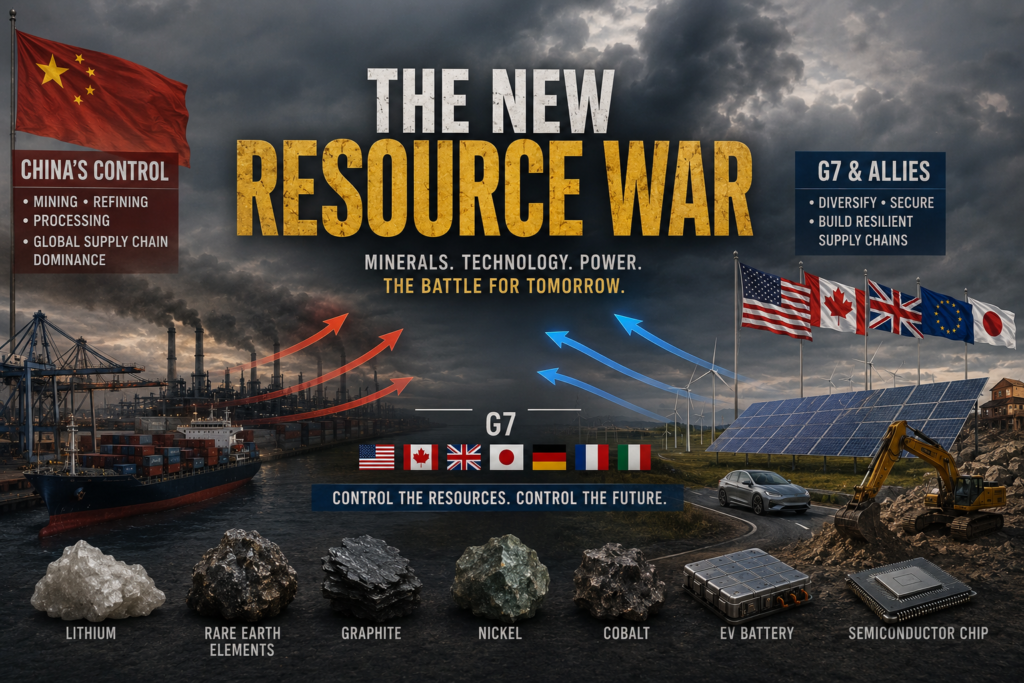
When China introduced export restrictions on materials such as gallium and germanium, the move was widely viewed as another episode in an increasingly tense global trade environment.
The reaction elsewhere suggested something larger was unfolding.
Across the G7 and several major economies, conversations about mining investment, industrial policy, refining capacity, and supply-chain resilience suddenly became more urgent. Materials that rarely appeared in mainstream economic discussions started showing up in national-security strategies and corporate planning documents.
The immediate issue involved specific export controls.
The broader issue was dependency.
A growing number of governments now believe that many of the technologies expected to drive economic growth over the coming decades depend on a relatively small group of minerals that have quietly become strategic assets.
Lithium. Rare earth elements. Graphite. Cobalt. Nickel.
For much of the twentieth century, global influence was closely tied to oil. Access to energy shaped military planning, trade routes, industrial development, and foreign policy. Oil remains essential, but another resource competition is emerging alongside it as governments focus on technologies that require very different inputs.
Electric vehicles, advanced semiconductors, artificial intelligence, renewable-energy systems, satellites, aerospace technologies, and modern defense platforms all rely on materials that most consumers rarely think about.
The future may run on software, but software still depends on things that come out of the ground.
That realization is beginning to reshape how governments think about economic security.
Not because these minerals are new. In many cases they have been used for decades. What has changed is the number of industries that now depend on them simultaneously.
The New Resource Competition
Unlike oil, critical minerals are generally not consumed as fuel. They become part of products.
Electric vehicle batteries require lithium, graphite, nickel, and other specialized inputs. Wind turbines and solar infrastructure depend on materials designed to improve efficiency and durability. Semiconductor manufacturing relies on highly refined mineral inputs. Defense systems require rare earth elements used in sensors, communications equipment, radar technologies, and precision-guided systems.
Even artificial intelligence has a mineral story behind it.
Most discussions about AI focus on software models, computing power, and data. Less attention is paid to the physical infrastructure supporting that growth. Every new data center requires chips, cooling systems, electrical equipment, transmission infrastructure, and large amounts of specialized hardware. Behind that hardware sits a supply chain that often begins in mines and processing facilities located far from the technology hubs that eventually use the finished products.
The more digital the economy becomes, the more dependent it becomes on physical resources.
There is a curious contrast here. Policymakers often talk about digital sovereignty as though it were primarily a software issue. Yet many of the dependencies they worry about begin much further upstream, in mining operations, chemical processing facilities, and industrial zones that rarely attract public attention.
A decade ago, graphite processing was not the sort of topic likely to appear in discussions about geopolitical competition. Today it does.
That shift happened surprisingly fast.
How China Built Its Position
Much of today’s debate centers on China, although China’s position did not emerge overnight.
One of the persistent misconceptions about critical minerals is that influence comes mainly from owning resources in the ground. In practice, extraction is only one part of a much longer process.
Raw materials often require refining, separation, chemical processing, transportation, and manufacturing before they become usable industrial inputs. Those stages require infrastructure, technical expertise, investment, and scale.
China spent decades building those capabilities.
One reason many governments appear surprised by today’s mineral debate is that processing capacity attracted relatively little political attention while it was being built. Mining projects occasionally generated headlines. Refineries, separation facilities, and industrial processing plants usually did not.
By the time many policymakers began treating mineral supply chains as strategic assets, much of the infrastructure already existed.
Looking back, that may be one of the more consequential industrial developments of the globalization era.
While many advanced economies focused on reducing costs and improving efficiency, China expanded across multiple stages of the value chain. Mining, refining, processing, manufacturing, and logistics capacity developed together.
The story is often framed as one of resource ownership. In reality, it is at least as much a story about industrial capability.
Many critical mineral supply chains now pass through Chinese facilities before reaching manufacturers elsewhere. That position reflects decades of investment, infrastructure development, and industrial planning.
Ironically, the same globalization model that improved efficiency also helped create some of the dependencies governments are now trying to reduce.
Why the G7 Is Paying Attention
The concern among major economies is less about competition itself and more about concentration.
Recent events have reinforced that concern. The pandemic exposed weaknesses in logistics networks. Semiconductor shortages affected industries ranging from consumer electronics to automobiles. Manufacturers discovered that a single missing component could disrupt production schedules for months.
Critical minerals raise similar questions.
What happens if exports are restricted?
What happens if geopolitical disputes increasingly influence resource policy?
What happens if demand grows faster than processing capacity?
Governments, businesses, and investors are asking these questions at the same time.
One of the less discussed aspects of the mineral race is timing. Countries are attempting to redesign supply chains while simultaneously accelerating investment in artificial intelligence, semiconductors, electric vehicles, renewable energy, and advanced manufacturing. These priorities reinforce one another in some ways.
They also compete for many of the same resources.
That tension rarely receives as much attention as it probably deserves.
Why This Matters Beyond Electric Vehicles
Public discussions often frame critical minerals primarily as an electric-vehicle issue.
That captures only part of the picture.
Smartphones contain numerous rare earth elements and specialized materials. Renewable energy infrastructure depends heavily on mineral-intensive technologies. Data centers require enormous quantities of electronic equipment. Aerospace systems, communications networks, and defense technologies all rely on sophisticated material inputs.
The clean-energy transition introduces an interesting contradiction.
Governments want to reduce dependence on fossil fuels, yet achieving that goal often requires expanding access to mining, refining, and mineral processing. The transition away from one set of resource dependencies can create another.
Supporters argue these new dependencies are manageable and worth the long-term benefits. Critics point to supply-chain concentration and the difficulty of expanding production quickly. The picture is more complicated than either side sometimes suggests.
History offers a useful parallel.
When oil became central to industrial economies during the twentieth century, governments gradually learned that energy security and national security were closely connected. Critical minerals are prompting a similar reassessment, although the dynamics are not identical.
In some respects, critical minerals resemble semiconductors more than oil. The strategic value often lies less in extraction and more in processing, engineering, manufacturing, and technical expertise.
That distinction matters because processing capacity is typically harder to build than many people assume.
The Economic Risks of Concentration
Resource concentration does not automatically create a crisis.
Global supply chains have always involved specialization. Different countries develop different strengths, and international trade often improves efficiency for everyone involved.
The challenge is determining where efficiency ends and vulnerability begins.
Critical minerals happen to sit close to that boundary.
Supply disruptions can raise production costs, delay industrial projects, and complicate long-term planning. Yet uncertainty may be the more important issue. Businesses can often adapt to higher prices. Predicting future availability is harder.
When companies become uncertain about future access to key materials, investment decisions become more cautious.
That is not unique to mining. It is a pattern that appears across industries whenever critical inputs become difficult to secure.
The Push to Build Alternatives
Several countries are now attempting to reduce supply-chain concentration.
The United States has expanded support for domestic mining and processing. The European Union is pursuing diversification strategies aimed at reducing dependence on individual suppliers. Australia and Canada have become increasingly important partners because of their resource bases and mining expertise.
India has joined this broader effort through critical-mineral partnerships, domestic initiatives, and efforts to expand manufacturing capacity.
There is a notable irony here.
Countries often talk about mineral independence.
Achieving greater resilience frequently requires deeper international cooperation.
Alternative supply chains depend on investment agreements, technology partnerships, infrastructure projects, and long-term coordination among governments and businesses. The objective may be greater self-reliance, but the path often involves more collaboration.
Could India Become a Major Beneficiary?
India’s position is particularly interesting because of timing.
Unlike several advanced economies that are trying to rebuild industrial capabilities they previously outsourced, India is attempting to expand manufacturing while parts of the global supply chain are being redesigned.
That creates opportunities that did not exist a decade ago.
India’s electronics sector is growing. Renewable-energy investments continue to expand. Policymakers have identified manufacturing as a strategic priority. Each of these developments increases the importance of reliable access to critical minerals.
There is another aspect that receives less attention.
Countries usually gain influence in global supply chains when large shifts are already underway. They rarely design those shifts entirely on their own. They position themselves to benefit from them.
India finds itself operating during one of those periods.
Whether it captures the opportunity remains uncertain. Mining projects take years to develop. Processing infrastructure requires substantial investment. Environmental reviews, community concerns, regulatory approvals, and financing constraints can all slow progress.
Governments want secure supply chains.
Voters often want faster clean-energy deployment.
Environmental safeguards remain important.
Balancing those priorities is rarely simple.
Why This Debate Reflects a Bigger Change
The most important shift may not be geological.
It may be conceptual.
For decades, globalization rewarded efficiency. Companies optimized supply chains around cost, speed, and scale. Geographic concentration was often viewed as an economic strength rather than a strategic concern.
That perspective has changed.
Governments increasingly speak about resilience, economic security, strategic autonomy, and trusted supply chains. The language itself reflects a broader reassessment of how modern economies should manage risk.
A supply chain can be efficient and still be fragile.
A resource can be commercially available today and strategically important tomorrow.
Critical minerals have become one of the clearest examples of that tension.
Are We Entering a New Era of Resource Geopolitics?
Several outcomes remain possible.
Supply chains may become more diversified, reducing concentration risks while preserving global trade. Competing resource networks could emerge as countries deepen relationships with preferred partners. Mineral-rich nations that once attracted relatively little attention may gain greater geopolitical significance.
Technology remains an important wildcard.
Advances in battery chemistry, recycling, and alternative materials could eventually reduce dependence on certain resources. History contains many examples of innovations reshaping markets in ways that were difficult to predict beforehand.
Whether today’s mineral competition ultimately proves as consequential as the oil era remains unclear.
What is becoming harder to dispute is its growing strategic importance.
The debate over critical minerals is often described as a resource story.
It may ultimately be remembered as an industrial story.
The minerals themselves matter, but much of the competition revolves around something else: who can process them, refine them, manufacture with them, and build the industries that depend on them.
That question reaches far beyond mining.
And it is likely to remain relevant long after the current disputes over individual commodities have faded.