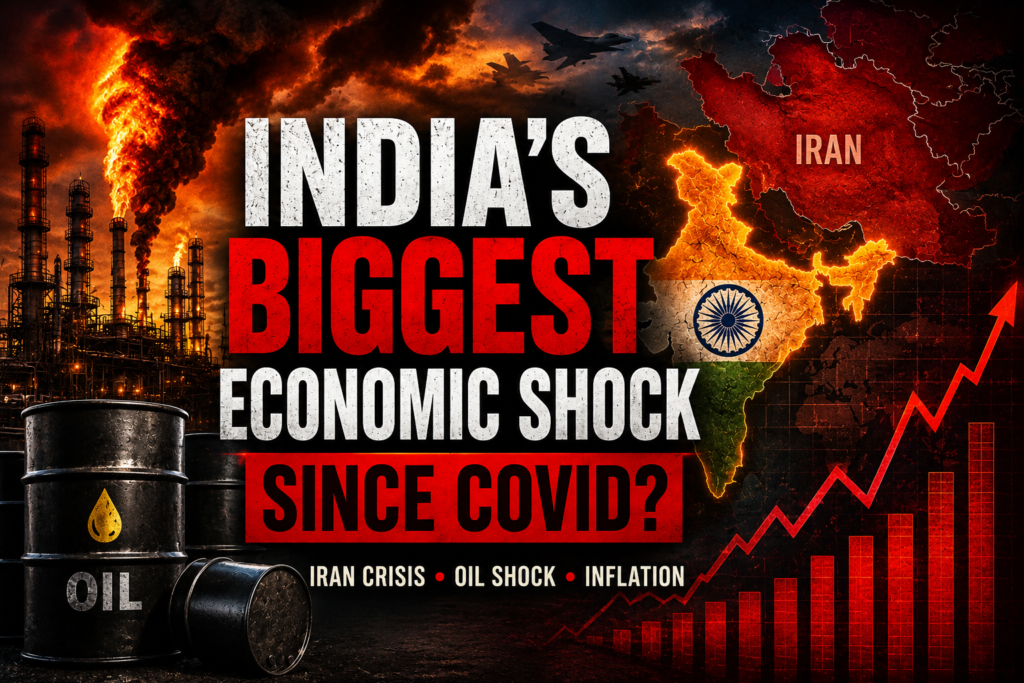
Whenever tensions rise around the Strait of Hormuz, the world’s attention tends to move in the same direction.
Oil prices become the story. Traders watch tanker movements. Governments assess energy risks. Television coverage fills with discussions about crude markets, inflation, and potential economic disruption.
That focus makes sense. Few waterways carry the strategic importance of Hormuz.
Still, one pattern appears repeatedly during major economic shocks. Public attention usually concentrates on the first visible problem. Businesses, meanwhile, often spend more time worrying about the second and third consequences that receive far less coverage.
If a serious disruption were to affect Hormuz, the immediate concern would almost certainly be energy.
The more interesting question is what happens afterward.
Food inflation rarely begins where consumers first notice it.
By the time higher prices show up in grocery stores, some of the decisions that contributed to them may have been made months earlier inside fertilizer plants, commodity markets, shipping firms, and government procurement offices. Cause and effect become surprisingly difficult to untangle once enough time passes.
Looking Beyond Oil
The Strait of Hormuz is usually described as an oil chokepoint.
It is.
But the description leaves out much of the story.
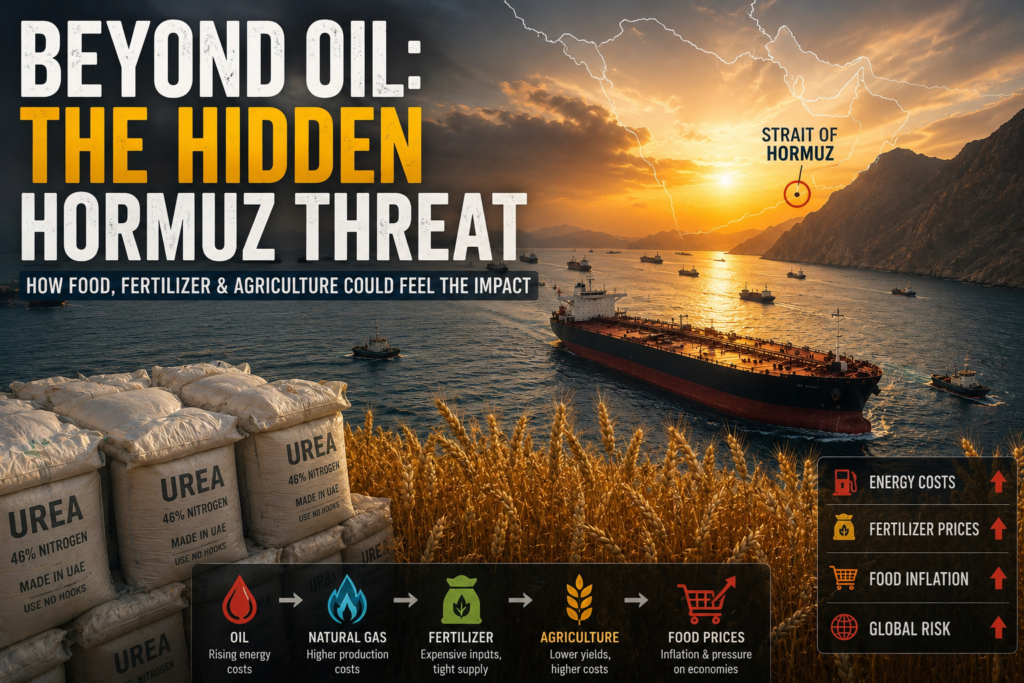
The Gulf also serves as an important route for natural gas, petrochemicals, industrial chemicals, and a range of products that rarely receive public attention despite supporting large parts of the global economy. Agriculture is one of them.
At first glance, the connection seems indirect.
A disruption in a shipping corridor does not immediately suggest higher food prices. Yet modern agriculture depends on a web of systems that extend far beyond farms themselves. Energy markets, transportation networks, industrial production, financing conditions, and international trade all play a role.
One reason these connections are often underestimated is that most consumers experience food systems almost entirely through retail prices. They see the final result. The infrastructure that helps determine those prices remains largely invisible.
That invisibility matters.
The Fertilizer Link
Fertilizer markets rarely dominate headlines.
Interestingly, they rarely attract much attention even during periods when they are becoming critically important.
Nitrogen fertilizers, ammonia, urea, and phosphates remain essential to modern farming. In many regions, maintaining current levels of agricultural productivity without them would be difficult.
Natural gas sits near the center of that relationship.
For fertilizer producers, gas is not simply an operating expense. It is often part of the production process itself. When natural gas prices rise sharply, fertilizer costs tend to follow.
What happens next is usually less dramatic than people expect.
Farmers do not suddenly abandon planting plans because fertilizer becomes more expensive. The decisions tend to be smaller than that.
A farmer preparing for planting season may decide to delay purchases. Another may reduce application rates slightly. Someone else may absorb the higher cost and hope crop prices eventually compensate.
None of those decisions make news.
Yet agriculture is full of situations where thousands of small decisions accumulate into something much larger.
There is another reason fertilizer risks are easy to overlook. Consumers rarely buy fertilizer directly. They buy food. The connection exists, but it often stays hidden until prices begin moving further down the chain.
Why Food Markets Often React After Headlines Fade
Food inflation creates a strange problem for anyone trying to trace economic events.
Markets react quickly. Agriculture does not.
An energy shock can become global news within hours. Fertilizer prices may adjust within weeks. Agricultural production operates on a much slower timeline shaped by planting schedules, growing seasons, weather conditions, transportation networks, and harvest cycles.
By the time those pressures begin showing up in food markets, the original event may no longer dominate headlines.
In some ways, this is what makes food-related risks difficult to communicate. The timeline works against public attention.
A television audience can follow oil prices daily. Few people track fertilizer purchasing decisions made months before harvest.
Yet those decisions can matter.
Sometimes quite a lot.
Lessons From Recent Crises
Recent history offers a useful example.
Following Russia’s invasion of Ukraine, global attention focused heavily on oil, natural gas, and grain exports. Those concerns were understandable. But another story was unfolding at the same time inside fertilizer markets.
As natural gas prices surged, several fertilizer producers across Europe reduced production because operating costs became increasingly difficult to justify. Industry groups, the International Fertilizer Association, and international organizations including the FAO all warned about potential consequences for agricultural systems.
In hindsight, the lesson had surprisingly little to do with Europe itself.
What stood out was how quickly pressure in one sector began appearing in places that initially seemed unrelated.
Economic disruptions have a habit of doing that.
The Hidden Cost Of Uncertainty
There is another angle worth considering.
In some cases, markets may care less about whether a disruption occurs than about how long uncertainty persists.
Bad news can be managed.
Uncertainty is harder.
Businesses can respond to known costs. They can reroute shipments, adjust inventories, renegotiate contracts, or seek alternative suppliers. Those responses may be expensive, but they are still responses.
Prolonged ambiguity creates a different problem.
When companies cannot estimate future costs with confidence, investment decisions become more difficult. Procurement strategies change. Inventories increase. Risk premiums begin appearing throughout supply chains.
Supply chains do not need to fail completely to become economically painful.
They simply need to become more expensive.
Which Countries Could Feel The Pressure?
Not every country would experience the effects in the same way.
Nations that rely heavily on imported food, fertilizer, or energy generally face greater exposure when costs begin rising across multiple categories at once.
Many countries across parts of Africa, the Middle East, and South Asia already operate with limited flexibility when it comes to food affordability. Higher import costs can place pressure on governments and households simultaneously.
Large agricultural economies face a different set of challenges.
Brazil and India, for example, produce enormous volumes of agricultural goods. Yet maintaining that productivity often requires substantial fertilizer imports. It is a slightly uncomfortable reality: some of the world’s agricultural powerhouses remain dependent on supply chains that begin far beyond their own borders.
Agricultural strength reduces certain risks.
It does not remove dependency.
Why India Should Pay Attention
India sits at an interesting intersection of several different vulnerabilities.
The country depends heavily on imported energy. It relies on fertilizer inputs connected to global markets. At the same time, food-price stability remains economically and politically important because food still represents a significant share of household spending for millions of people.
A prolonged increase in energy costs could raise import bills.
Higher fertilizer prices could increase pressure on subsidy programs.
The challenge is that governments may find themselves balancing competing priorities. Keeping fertilizer affordable can support agricultural output, but doing so may increase fiscal pressure elsewhere. Neither objective is easy to ignore.
This is where the discussion begins moving beyond oil prices.
Questions about public spending, inflation management, agricultural incentives, and long-term economic planning start becoming part of the same conversation.
Predicting exactly how those pressures would unfold is difficult. No two crises develop in quite the same way. Duration matters. Policy responses matter. Market adaptation matters.
Which is another way of saying that certainty should be approached cautiously.
Why The Worst-Case Scenario May Never Happen
It is also worth acknowledging that the most alarming scenarios often receive more attention than the most likely ones.
Global markets are adaptive.
Strategic reserves exist. Governments intervene. Businesses diversify suppliers. Alternative shipping arrangements emerge. Markets adjust, sometimes more effectively than expected.
A Hormuz disruption would certainly create challenges.
That does not automatically mean it would trigger the most severe outcomes that analysts occasionally discuss.
The future tends to be messier than forecasts.
The Bigger Lesson
The Strait of Hormuz is often discussed as an energy story.
It may be more useful to think of it as a reminder.
A farmer in India, a fertilizer producer in Europe, a shipping company operating in the Gulf, and a consumer buying groceries may appear disconnected from one another. Yet all of them participate in systems that move energy, raw materials, food, and capital across borders every day.
One of the more striking features of modern economies is how difficult these connections are to see during normal times. The system feels local right up until it doesn’t.
Whether Hormuz becomes a major economic challenge will depend on many factors that remain uncertain today. Markets may adapt. Governments may intervene. Supply chains may prove more resilient than expected.
What seems easier to observe is how closely food and energy systems have become intertwined.
The real lesson may not be about a single waterway at all. It may be about how disruptions travel—slowly, unevenly, and often in directions that receive very little attention at first.
The challenge is that by the time those connections become visible, businesses and policymakers may already be responding to decisions made months earlier. And by then, the conversation is usually about food prices rather than the events that helped shape them.