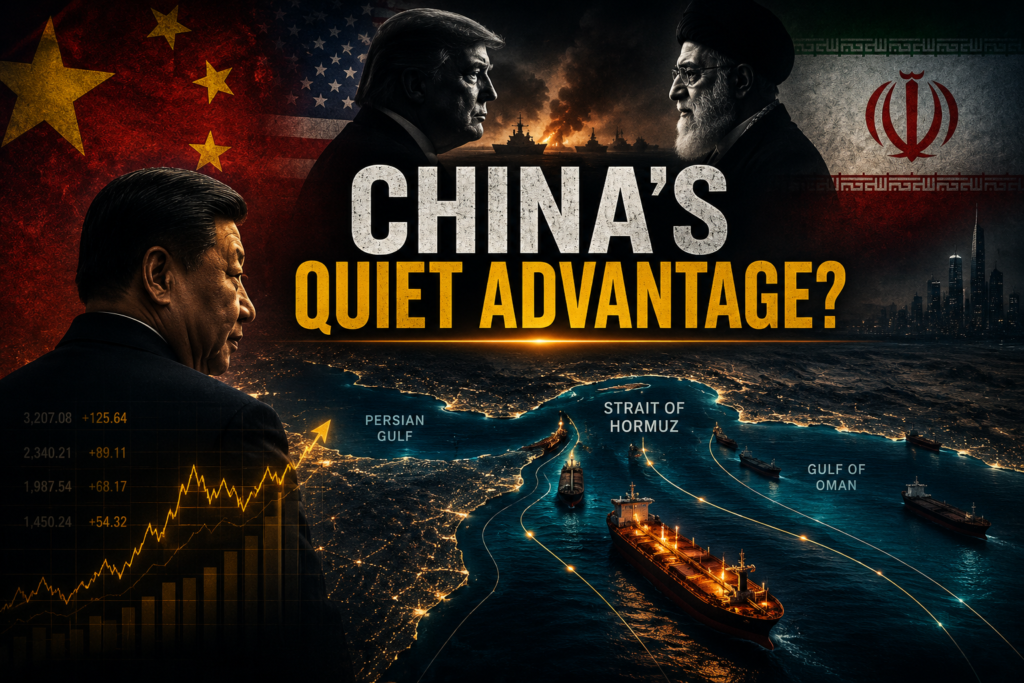
While most global attention is focused on whether the U.S.-Iran ceasefire will stabilize oil prices or prevent a wider regional conflict, another country may quietly emerge as one of the longer-term beneficiaries: China.
At first glance, that sounds counterintuitive.
China is not directly involved in the military confrontation. It is not leading ceasefire negotiations. Publicly, Beijing has mostly positioned itself as a cautious observer calling for restraint and regional stability.
But geopolitics is rarely only about the countries exchanging strikes. Sometimes the more important story is about who gains breathing room while everybody else is distracted by the immediate crisis.
That is where China enters the picture.
The tensions surrounding the Strait of Hormuz rattled markets almost immediately. Oil traders started tracking tanker routes more aggressively. Shipping firms recalculated exposure across Gulf corridors. Marine insurance discussions intensified in London and Singapore before many governments even settled on official messaging.
Insurance firms usually react before politicians admit there is a real problem.
None of this required a full-scale war.
Because everyone understands the broader reality: if the Strait of Hormuz becomes unstable, the economic consequences spread quickly beyond the Middle East. Roughly one-fifth of global oil consumption passes through that narrow corridor. Even temporary disruption creates ripple effects through shipping markets, freight systems, refinery operations, and industrial planning.
Few major economies are more exposed to that risk than China.
Why Iran Matters So Much to China
China’s relationship with Iran is not simply diplomatic.
Energy sits underneath almost everything.
China remains one of the world’s largest energy importers, and a significant share of those imports still moves through the Gulf region. Iran, despite years of sanctions and isolation from Western markets, continues to hold strategic value in Beijing’s long-term calculations.
There is also the geopolitical layer, which is harder to quantify but probably just as important.
Iran gives China influence inside a region historically shaped by American military power. At the same time, Beijing has steadily expanded ties with Saudi Arabia, the UAE, and other Gulf economies that matter far more to global energy stability than many casual observers realize.
Iran is strategically useful. The Gulf monarchies are economically indispensable to China’s longer-term ambitions.
That balancing act shapes a lot of Beijing’s behavior in the region.
China’s Belt and Road strategy depends heavily on functioning shipping corridors, infrastructure access, and predictable energy flows. Persistent instability around Iran threatens all three at once. And large industrial economies do not adapt quickly when energy insecurity starts creeping into supply chains. Factories can slow production. Exporters can delay shipments. Refiners can absorb some volatility for a while, but not indefinitely.
So when ceasefire discussions emerge, Beijing is not watching as a detached outsider hoping for peace in abstract terms. It is watching as an economy deeply tied to regional stability.
A prolonged Hormuz crisis would place real strain on China’s industrial system.
The Strait of Hormuz Is More Than a Shipping Route
Most people rarely think about the Strait of Hormuz unless tensions spike suddenly.
But economically, it functions almost like a pressure valve for global trade. A large share of the world’s oil and LNG shipments passes through this narrow corridor connecting the Persian Gulf to international markets.
Energy markets also tend to panic faster than governments can respond.
For China, the exposure is unusually high because its industrial system still depends heavily on stable Gulf energy flows. Factories, refinery operations, freight systems, export schedules — all of them become harder to manage when energy markets turn volatile.
That pressure does not always appear dramatically at first.
Sometimes it starts quietly: higher shipping costs, more cautious inventory planning, delayed manufacturing timelines, tighter refinery margins.
Then companies begin adjusting forecasts. Freight planners become more conservative. Shipping executives start pricing in political risk that nobody can properly calculate.
Long before consumers notice higher prices, logistics networks are already under pressure.
Container shipping rarely becomes headline news until retailers start complaining about delays or inventory gaps months later.
Markets reacted positively to signs of de-escalation partly because uncertainty itself creates economic drag. Businesses can survive expensive energy for a period of time. What becomes dangerous is unpredictability — not knowing whether tanker routes remain stable two weeks from now, or whether another regional incident suddenly changes freight assumptions again.
For China, even a fragile ceasefire lowers some of that immediate uncertainty.
High Oil Prices Create Problems China Cannot Easily Ignore
There is a common assumption that China can absorb economic shocks more easily simply because of the scale of its economy.
Reality is less comfortable than that.
China is already dealing with softer domestic demand, prolonged weakness in the property sector, fragile consumer confidence, debt concerns, and uneven export momentum across several industries. An extended oil shock would add another layer of pressure onto an economy that is already trying to stabilize itself after years of uneven recovery patterns.
Higher energy prices raise manufacturing costs. Transport becomes more expensive. Margins tighten across export-heavy sectors.
Chinese refiners have already spent years dealing with volatile demand conditions and shifting global pricing environments. Another sustained energy shock would complicate things further, especially for manufacturers operating on thinner margins than outsiders sometimes assume.
People usually focus on oil-producing countries during Middle East crises.
But large energy importers carry quieter vulnerabilities that build slowly over time.
China’s economic model still depends heavily on industrial output and export-oriented manufacturing. That system works best when shipping routes remain predictable and energy flows stay relatively stable. Modern supply chains were designed for efficiency during decades of globalization. Not resilience during geopolitical fragmentation.
The ceasefire does not solve China’s broader economic problems. It simply removes one external pressure point for now.
America’s Attention Problem Quietly Matters Here Too
Over the past several years, the United States has steadily shifted strategic focus toward the Indo-Pacific region. Washington increasingly sees China — not the Middle East — as its primary long-term competitor.
That shift shaped semiconductor restrictions, naval deployments, alliance-building across Asia, and military planning around Taiwan.
But every major Middle East crisis complicates that strategy.
The problem is not simply military overstretch. It is attention fragmentation. Governments only have so much political bandwidth at any given time, especially during election cycles and periods of economic uncertainty.
And the Middle East has a long history of pulling Washington back into crisis-management mode even when American policymakers want to focus elsewhere.
If tensions involving Iran escalate repeatedly, the United States may find itself redirecting diplomatic resources, military assets, intelligence attention, and energy-security coordination back toward the Gulf region.
China notices that.
This does not mean Beijing wants a major regional war. A large-scale conflict would threaten global trade and energy stability, both of which China still depends on heavily.
But there is a difference between benefiting from chaos and benefiting from strategic distraction.
In some ways, temporary instability may actually suit China more than either full-scale conflict or complete resolution. Prolonged uncertainty can gradually consume American attention without completely collapsing the trade system Beijing still relies on.
That is not a comfortable reality for Washington.
The Quiet Advantage of Discounted Iranian Oil
Another part of this story receives less public attention.
Iranian oil.
China has remained one of the key buyers of discounted Iranian crude during years of Western sanctions. Those purchases matter because cheaper energy lowers costs for refineries and manufacturing sectors already operating under economic pressure.
And energy pricing matters enormously at industrial scale. Small cost differences become meaningful surprisingly quickly when factories are consuming massive amounts of fuel and electricity every day across entire production networks.
If ceasefire conditions eventually create even modest diplomatic easing or softer enforcement environments, Iranian exports could stabilize further. That possibility alone changes economic calculations behind the scenes.
Public diplomacy may sound cautious. Economic calculations usually continue regardless of the political messaging.
The Bigger Story Is Probably About Supply Chains
Most headlines during Middle East crises focus on missiles, military positioning, or diplomatic statements.
But supply chains often tell the deeper story.
When Gulf tensions rise sharply:
shipping insurance costs climb
freight rates increase
LNG transport becomes riskier
delivery schedules become less predictable
manufacturers start adjusting timelines
That affects far more than oil markets.
Electronics production, automotive manufacturing, chemical industries, logistics networks — all of them respond to instability around major shipping corridors. Consumers often notice only later through higher prices, slower deliveries, or inflation pressure appearing months afterward.
What makes markets nervous is not always actual disruption. Often it is the fear that nobody knows where escalation stops.
Energy desks in Singapore and shipping offices in Dubai tend to understand that very quickly.
China sits near the center of many of those global systems. A calmer Hormuz environment reduces pressure across trade routes connecting Asia, Europe, and the Middle East. It also helps exporters operating in an already fragile global demand environment.
But the Ceasefire Still Looks Fragile
For all the market optimism surrounding de-escalation, the underlying tensions have not disappeared.
The mistrust between Iran and the United States remains deep. Regional proxy networks are still active. Military posturing continues across parts of the Gulf. Concerns over shipping security and retaliation have not gone away.
Which is why oil markets remain sensitive even during periods of relative calm.
Traders understand how quickly sentiment can reverse in this region. One tanker incident, one drone strike, one naval confrontation — and markets react again.
China understands that vulnerability too. Its economy may benefit from reduced tensions, but it also remains deeply exposed to future disruptions in the same region.
That creates an uncomfortable reality for Beijing: China increasingly depends on a global system it still cannot fully control.
And that dependence may become one of the defining geopolitical tensions of the next decade.