While global headlines focused on missiles, retaliation, and diplomatic warnings, financial markets were watching something else entirely.
Oil routes. Tanker movements. Insurance premiums. Futures markets opening in Asia before dawn.
For a few tense days, traders, shipping firms, airlines, and governments were reacting to the same possibility: that tensions between the United States and Iran could spill into global energy flows and trigger another economic shock at a time when much of the world was already financially strained.
That is why the recent ceasefire framework mattered beyond military de-escalation.
Not because markets suddenly believed the underlying tensions had disappeared. Very few investors think that way anymore. But because the global economy looked unusually exposed to even a temporary disruption around the Gulf.
The story was never only about war. It was also about inflation, freight costs, energy markets, investor psychology, and the uncomfortable reality that modern economies still depend heavily on a few narrow choke points most people rarely think about during normal periods.
Why This Escalated So Quickly
Many geopolitical conflicts stay regionally contained. This one never really felt that way.
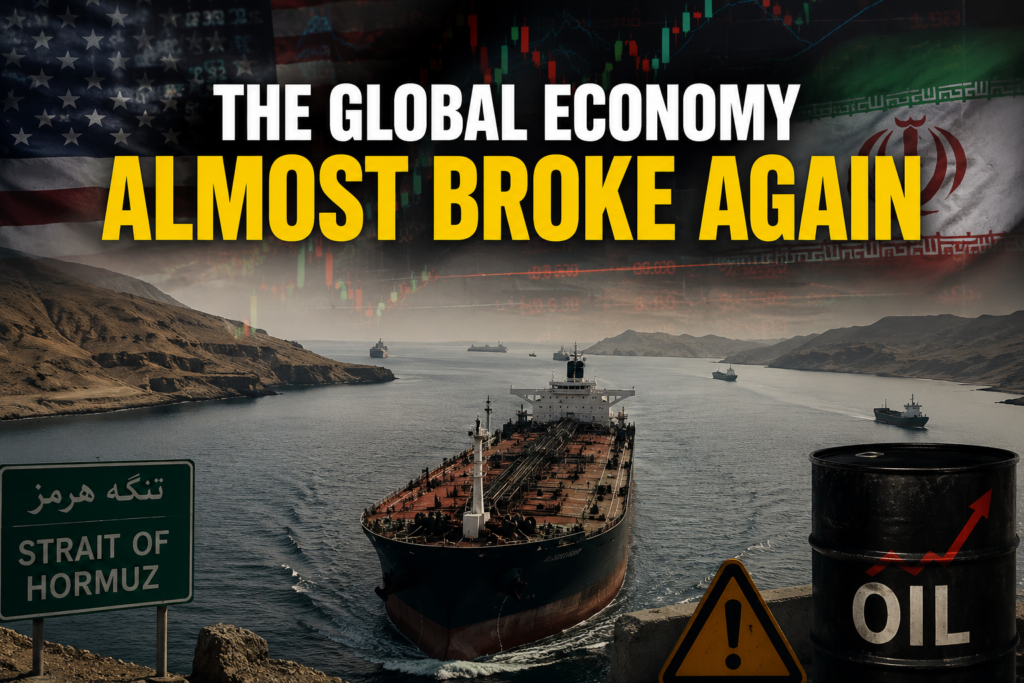
The reason sits inside a narrow stretch of water called the Strait of Hormuz.
A large share of the world’s oil and liquefied natural gas moves through that corridor every day. Tankers leaving Gulf producers pass through it toward Asian and European markets, feeding industrial systems built around the assumption that energy flows will remain stable and uninterrupted.
Even the possibility of disruption there can move markets before anything actually happens.
As tensions escalated, energy traders started pricing in worst-case scenarios almost immediately. Shipping firms reassessed exposure. Marine insurance costs began climbing. Airlines started watching fuel markets more closely because even a relatively short spike in crude prices can complicate route planning and operating costs very quickly.
At that point, this stopped looking like a distant regional confrontation.
It started looking like an economic risk.
And markets tend to react badly when uncertainty gets attached to oil supply. Usually the emotional reaction comes first. The detailed analysis arrives later.
Why Oil Markets React So Aggressively
Oil prices are driven as much by expectations as by actual shortages.
When investors believed there was even a small chance of disruption near Gulf shipping routes, crude prices rose quickly because markets understood what prolonged instability could eventually mean.
Most consumers only notice oil when fuel prices rise at petrol stations.
But crude quietly affects transport costs, airline pricing, freight rates, manufacturing expenses, food logistics, electricity prices in some regions, and inflation expectations more broadly. An oil shock rarely stays inside the energy sector for long.
It spreads outward in layers.
That was part of the concern here because the global economy was already dealing with stubborn inflation, uneven growth, weak manufacturing activity in several regions, and high interest rates that central banks still seem cautious about reversing too quickly.
There is also a psychological dimension that matters more than economists sometimes admit publicly. Traders who lived through earlier oil shocks tend to react faster when Gulf shipping routes suddenly dominate headlines again. In those moments, nobody wants to be the last person still assuming everything will stabilize on its own.
The ceasefire announcement shifted sentiment almost immediately. Oil prices cooled. Equity markets stabilized. Traders moved from defensive positioning into cautious recalculation.
Not optimism exactly. More relief.
Why Washington Suddenly Needed Stability
Military strategy was only part of the American calculation.
Economic pressure was becoming difficult to ignore.
Higher oil prices create political pressure inside the United States surprisingly fast because consumers experience fuel costs directly and repeatedly. Governments know that. Inflation becomes harder to contain, transport costs rise, consumer sentiment weakens, and financial markets become more volatile.
A prolonged Middle East crisis could have complicated several American priorities simultaneously: inflation management, recession concerns, stock market stability, trade flows, and election-year economic messaging.
This is where geopolitics and economics start blending together in ways official statements rarely acknowledge openly.
Washington may publicly frame decisions around deterrence and security. But underneath most major strategic calculations sits a quieter concern about economic stability and domestic political pressure. After years of pandemic disruptions, inflation spikes, supply-chain problems, and rate hikes, there is very little appetite left for another energy-driven economic shock.
And honestly, part of the anxiety here came from timing. If this confrontation had happened during a stronger global economy, markets probably would have reacted differently. But investors were already nervous before the first escalation headlines appeared. Growth forecasts had been weakening in several economies. Manufacturing data in parts of Europe and Asia was already soft. So the confrontation landed on top of an atmosphere that was financially uneasy to begin with, which made every development feel larger than it may have looked in isolation.
The India Angle Most International Coverage Barely Discussed
India was not directly involved in the confrontation.
Economically, though, it was highly exposed.
India imports a significant portion of its crude oil requirements, which means prolonged instability across major energy-producing regions quickly becomes India’s problem too. A sustained rise in crude prices would likely have affected inflation, transportation costs, import bills, currency stability, and broader market sentiment at roughly the same time.
And the effects would not stop there.
Fertilizer imports become more expensive. Aviation costs rise. Logistics chains tighten. Food prices eventually begin reflecting higher transportation expenses. Small businesses often feel this pressure before official inflation data fully catches up.
There is also the Gulf connection.
Millions of Indians work across Gulf countries and send remittances back home that support families and contribute significantly to India’s economy. Prolonged instability across the region creates uncertainty around employment, financial transfers, mobility, and business confidence more broadly.
Shipping routes matter too. A serious disruption near Hormuz would not only affect oil cargo. Freight and insurance costs across wider trade routes could rise sharply as well.
This is one reason India’s Middle East diplomacy often appears cautious and carefully balanced.
Energy dependence tends to encourage realism.
Why The Ceasefire Does Not Mean Stability Has Returned
The ceasefire reduced immediate fears. It did not remove the deeper tensions underneath them.
Many of the underlying disagreements remain unresolved: Iran’s regional influence, sanctions pressure, nuclear-related concerns, maritime security, Israeli security calculations, and the broader American strategic position in the region.
Markets may calm temporarily while underlying instability continues quietly in the background. That is often how geopolitical risk operates now. Long periods of uneasy calm interrupted by sudden bursts of volatility.
There is something slightly ironic about this too.
For years, governments talked about resilience, diversification, and reducing dependency on fragile supply chains. Yet when tensions rise around one narrow shipping corridor, markets still react as if the entire system could wobble.
Maybe that says less about panic and more about how tightly interconnected the modern economy actually became during the globalization era. Efficiency was prioritized for decades. Redundancy usually was not.
Who Benefits If Stability Holds
If the ceasefire evolves into something more durable, the economic benefits could spread widely.
Oil-importing economies would gain relief from price pressure. Airlines would regain some predictability around fuel costs. Manufacturers and shipping firms would feel more comfortable planning around stable supply conditions again. Central banks would also welcome lower geopolitical inflation risk after several years spent fighting post-pandemic price instability.
Countries like India would benefit significantly from calmer crude markets because stable energy prices reduce pressure on inflation and imports simultaneously.
What stood out most, though, was how quickly market sentiment improved once escalation fears eased.
That alone revealed how nervous the global financial system had already become.
A Reminder Of How Fragile The Global Economy Still Is
The most revealing part of this episode was not military.
It was structural.
A conflict thousands of kilometers away from most major economies still managed to create immediate anxiety across stock markets, shipping systems, airline planning, inflation forecasts, and energy networks worldwide.
That interconnectedness creates enormous efficiency during stable periods.
It also creates vulnerability during unstable ones.
The ceasefire may hold. It may collapse. Another flashpoint could emerge months from now and markets would probably react the same way again.
Because the deeper vulnerability never really disappeared.
The real story was not only about missiles or military retaliation. It was about how one narrow waterway in the Middle East came surprisingly close to creating another global economic shock while much of the world was still trying to stabilize from the last one.