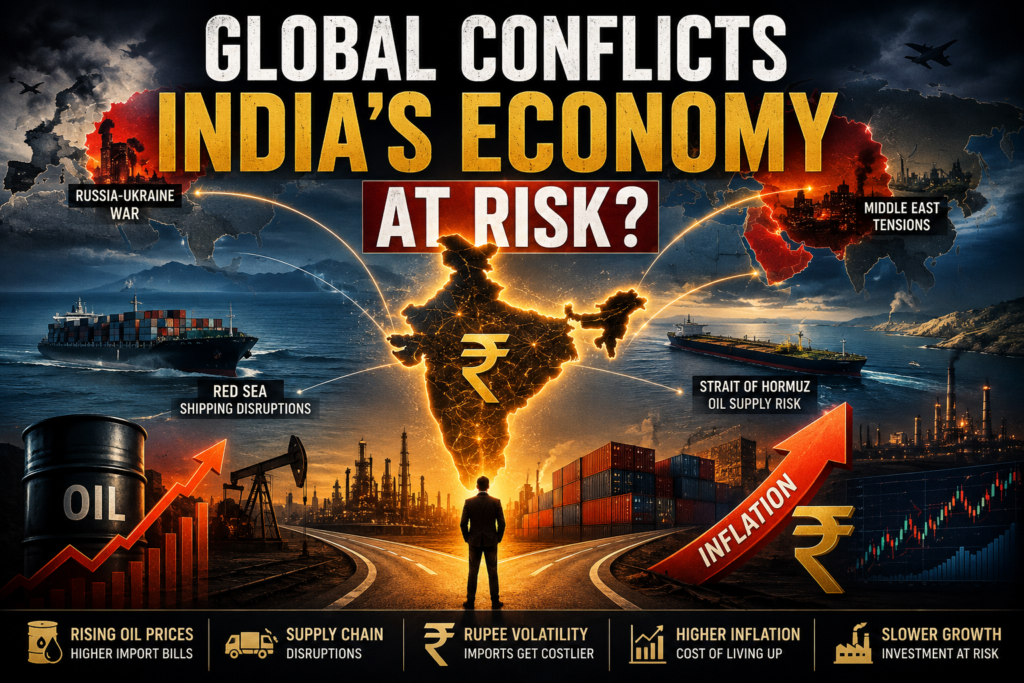
A war in the Middle East can make tomatoes cost more in Hyderabad. Fighting in Eastern Europe can influence fertilizer prices for Indian farmers. A shipping disruption near the Red Sea can delay the delivery of a smartphone ordered in Bengaluru.
At first glance, those connections seem too distant to matter.
They aren’t.
Modern economies are built on supply chains that stretch across continents. Oil extracted in one region fuels factories in another. Components manufactured in Asia are assembled elsewhere before reaching consumers thousands of kilometers away. Goods, capital, and information move constantly across borders, which means disruptions do too.
One broken link is rarely just one country’s problem anymore.
That is why economists spend so much time watching events that appear, on the surface, to have little to do with India. They are not simply following wars or diplomatic disputes. They are trying to understand how those events might alter energy prices, trade flows, investment decisions, inflation, and business confidence months before the effects become visible in official economic data.
Interestingly, markets often react before governments do. Expectations alone can change prices long before physical shortages appear.
India is not directly involved in most of today’s major geopolitical conflicts. Yet it is deeply connected to the global economy through imported energy, international trade, manufacturing supply chains, financial markets, and foreign investment. Those links have helped drive India’s economic rise over the past three decades.
They also mean that global instability has a way of arriving quietly.
Not through headlines.
Through fuel bills.
Freight charges.
Construction costs.
Interest rates.
Eventually, household budgets.
The consequences rarely appear all at once. They move through the economy in stages. A rise in crude oil prices increases shipping costs. Higher transport costs squeeze manufacturers. Businesses absorb part of the increase, pass on the rest, and consumers gradually begin paying more for products that have no obvious connection to oil.
By then, the original geopolitical event may no longer dominate the news cycle.
Perhaps that’s the easiest part to overlook. Economic shocks often outlive the headlines that caused them.
Yet focusing only on the risks tells only half the story.
History shows that periods of global disruption often reshape economic leadership. The oil crises of the 1970s accelerated investment in energy efficiency. The global financial crisis changed banking regulation for years. The pandemic forced companies to rethink how and where they manufacture.
Today’s geopolitical tensions may leave a similarly lasting mark.
As companies diversify supply chains, governments rethink energy security, and investors reassess geopolitical risk, countries that can adapt quickly stand to benefit. Those that cannot may find themselves increasingly vulnerable to forces they have little control over.
India sits at an interesting point in that transition.
The country’s large domestic market, expanding manufacturing base, improving infrastructure, and strategic diplomatic relationships create opportunities that would have looked very different a decade ago. At the same time, its dependence on imported energy and global trade leaves it exposed to external shocks that cannot simply be legislated away.
That’s where the story becomes more interesting.
The real question is no longer whether global conflicts affect India’s economy. They already do, sometimes in surprisingly ordinary ways.
The bigger question is whether India can turn an era of geopolitical uncertainty into a long-term economic advantage.
To answer that, it helps to first understand the global conflicts that are reshaping the world economy—and why policymakers, investors, and business leaders continue to watch them so closely.
Understanding Today’s Major Global Conflicts
When people hear the phrase global conflict, they often think first about military strategy or diplomacy. Economists tend to look at something else entirely.
They ask a different question: Which parts of the global economy become more expensive, slower, or less predictable because of these conflicts?
That shift in perspective matters because modern economies don’t depend only on peace. They depend on reliability. Businesses can often adapt to higher costs. What they struggle with is uncertainty.
Today’s geopolitical landscape is shaped by several flashpoints. Each is different. Each affects the global economy through its own channels. Together, they are quietly rewriting how countries think about trade, energy, manufacturing, and economic security.
Middle East Tensions and Energy Security
Few regions have as much influence over the global economy as the Middle East.
The reason is straightforward: it remains one of the world’s largest producers and exporters of crude oil. Every time tensions rise between countries such as Israel and Iran—or when conflict threatens to spread across the region—energy markets react almost immediately.
Notice what happens first.
Oil prices often move before oil supplies do.
That may sound surprising, but commodity markets don’t wait for ships to stop sailing. Traders, refiners, insurers, and governments all begin pricing in future risk the moment they believe supplies could be disrupted. In other words, uncertainty itself becomes part of the price.
Perhaps the most overlooked consequence is that markets often fear the possibility of disruption almost as much as the disruption itself.
Much of that concern revolves around the Strait of Hormuz, one of the world’s most strategically important shipping routes. A significant share of globally traded crude oil passes through this narrow stretch of water each day. Even a temporary interruption would force energy markets to rethink supply expectations almost overnight.
For India, this matters more than for many other large economies.
The country imports the majority of the crude oil it consumes. Every additional dollar added to a barrel of oil begins a long journey through the economy. It passes through refineries, fuel stations, trucks, warehouses, factories, ports, wholesalers, retailers, and eventually reaches household budgets.
By the time consumers notice higher prices at supermarkets or increased travel costs, the original movement in oil markets may have happened weeks earlier.
Oil rarely creates inflation overnight. It quietly raises costs at one stage of the economy after another until businesses have little choice but to adjust prices.
That slow progression is exactly why policymakers watch energy markets so closely.
The Russia-Ukraine War
Unlike many geopolitical crises that fade after a few months, the Russia-Ukraine war has gradually become part of the global economic landscape.
Its effects now extend well beyond Europe.
Russia remains one of the world’s largest exporters of energy, while both Russia and Ukraine play important roles in supplying grain, edible oils, and fertilizers to international markets. When those exports are disrupted—whether by sanctions, damaged infrastructure, or logistical bottlenecks—the consequences spread through global supply chains surprisingly quickly.
Agriculture offers a good example.
Higher fertilizer costs increase farming expenses. Farmers facing higher input costs often reduce margins where they can, but they cannot absorb every increase indefinitely. Eventually, some of those costs are reflected in food prices. Consumers may never connect a more expensive grocery bill with a conflict thousands of kilometers away, yet the economic link is real.
This is easy to overlook because supply chains rarely attract attention when they function normally.
Only when they break do people realize how interconnected they really are.
The conflict has also accelerated broader changes in global energy markets. European countries have spent the past few years searching for alternative energy suppliers, reshaping trade flows that had developed over decades. As buyers and sellers adjust, countries outside Europe—including India—also find themselves navigating a different energy landscape.
One development has been particularly notable.
India significantly increased purchases of discounted Russian crude after the war began. From an economic standpoint, it helped moderate some of the pressure from rising global oil prices. At the same time, it illustrated how geopolitics and economics often intersect in complex ways. Decisions that appear political on the surface are frequently driven by energy security, inflation management, and domestic economic priorities.
There is another lesson here.
Modern conflicts rarely remain confined to the countries directly involved. They change trade routes, investment decisions, commodity markets, and diplomatic relationships in ways that continue long after the headlines become less frequent.
And those longer-term shifts are often more important than the initial shock.
US–China Strategic Competition
Not every conflict is fought with soldiers.
Some are fought with export controls, semiconductor technology, investment restrictions, tariffs, and industrial policy.
The rivalry between the United States and China has increasingly become that kind of contest. It is less about controlling territory and more about controlling technologies, manufacturing capacity, and the industries likely to define the next few decades.
Semiconductors illustrate the shift better than almost anything else.
Physically, they are among the smallest products in the global economy. Economically, they sit at the center of it. Smartphones, electric vehicles, cloud computing, artificial intelligence, medical equipment, advanced defence systems—even modern factories themselves—depend on increasingly sophisticated chips.
People often think of semiconductors as a technology story. Governments increasingly treat them as strategic infrastructure.
That change has encouraged countries to rethink decades of globalization. Instead of asking where products can be manufactured most cheaply, policymakers are asking where they can be manufactured most securely.
Those are not always the same place.
For multinational companies, this has led to a gradual shift toward supply-chain diversification. The strategy is commonly described as “China Plus One”—maintaining production in China while expanding manufacturing into other countries to reduce concentration risk.
The phrase has become popular, but its implications are much larger than it sounds.
Building a new factory is relatively straightforward. Rebuilding an entire industrial ecosystem is not. Companies need skilled workers, reliable electricity, efficient ports, stable regulations, suppliers located nearby, and confidence that policies will remain predictable for years rather than months.
That is why supply-chain diversification is measured in years, not headlines.
For India, this presents one of the biggest economic opportunities of the current decade.
Global manufacturers are already looking beyond China for additional production capacity, particularly in electronics, consumer goods, pharmaceuticals, and advanced manufacturing. India is one of several countries competing for that investment.
Competition, however, extends well beyond labour costs.
Infrastructure, logistics, policy consistency, judicial efficiency, and ease of doing business increasingly determine where multinational companies choose to invest. Geopolitical shifts may create opportunities, but domestic execution ultimately decides who captures them.
Red Sea Shipping Disruptions
Shipping rarely becomes front-page news.
When it does, something has usually gone wrong.
Security concerns in the Red Sea have forced many commercial vessels to avoid the Suez Canal and travel around the southern tip of Africa instead. That alternative route adds both distance and cost. More fuel is consumed, insurance premiums rise, delivery schedules become less predictable, and freight rates increase.
At first glance, an extra week at sea may not sound particularly significant.
For businesses operating on thin margins, it can be.
Manufacturers waiting for imported components may have to slow production. Retailers receive inventory later than expected. Exporters pay more to reach overseas markets. Importers absorb higher freight bills before deciding whether those costs can be passed on to customers.
One delay often creates another.
That is the hidden nature of supply chains. A disruption affecting one shipping lane can eventually influence factory schedules, warehouse inventories, retail pricing, and consumer spending in countries with no direct involvement in the conflict.
Today’s shipping disruption can easily become tomorrow’s inflation headline.
Why Global Conflicts Matter for India’s Economy
Viewed individually, each of these conflicts appears to affect a different part of the world.
Viewed together, they tell a different story.
One influences energy markets. Another reshapes agricultural trade. A third changes where companies build factories. Yet another disrupts the movement of goods across oceans.
India sits at the intersection of all those systems.
The country imports crude oil, liquefied natural gas, fertilizers, electronic components, industrial machinery, and a wide range of raw materials. At the same time, it exports pharmaceuticals, engineering goods, automobiles, chemicals, textiles, software services, and manufactured products to markets across the world.
That degree of integration has been one of India’s greatest economic strengths. It has supported investment, created jobs, expanded exports, and connected Indian businesses to global markets.
It also means external shocks travel farther than many people realize.
A conflict does not have to involve India directly to influence its economy.
A rise in insurance premiums increases shipping costs.
Higher shipping costs raise import bills.
Manufacturers face more expensive inputs.
Businesses adjust prices where they can.
Inflation begins creeping higher.
Central banks respond.
Borrowing becomes more expensive.
Investment decisions slow.
Consumer spending weakens.
Economic growth gradually feels the pressure.
Notice how the original conflict has almost disappeared from the chain by the end.
That is often how geopolitical risk works. The first event grabs the headlines. The economic consequences quietly spread through dozens of interconnected decisions before reaching households and businesses.
Which is why economists spend as much time studying transmission mechanisms as they do the conflicts themselves.
Understanding how a shock travels through the economy is often more valuable than simply knowing where it began.
Oil Prices: India’s Biggest Economic Vulnerability
If one global indicator consistently captures the attention of economists, central bankers, and finance ministries, it is the price of crude oil.
For India, that isn’t difficult to understand.
The country imports most of the crude oil it consumes. That dependence makes oil far more than an energy story. It influences inflation, government finances, corporate profitability, consumer spending, and, ultimately, economic growth.
What receives less attention is that the biggest risk is not always high oil prices.
It is volatile oil prices.
Businesses can gradually adjust to higher costs if they believe those costs will remain stable. They can renegotiate contracts, revise pricing, and rethink investment plans. Rapid price swings are much harder to manage because they make future costs unpredictable.
Uncertainty, once again, becomes an economic cost of its own.
Every additional dollar added to a barrel of crude begins a surprisingly long journey.
It moves from oil producers to refineries.
From refineries to fuel stations.
From fuel stations to trucks, cargo ships, airlines, factories, warehouses, and retail stores.
Eventually, it reaches household budgets.
By then, crude oil is no longer just an energy commodity. It has become part of the cost of transporting vegetables, manufacturing cement, producing fertilizers, delivering online orders, and flying passengers across the country.
That is why oil is often described as the economy’s most important input.
It quietly sits behind thousands of products and services that appear to have nothing to do with energy.
The ripple effects rarely stop with inflation.
Higher transport and production costs reduce corporate margins. Businesses delay expansion plans. Some postpone hiring. Others scale back investment until conditions become more predictable.
Meanwhile, higher inflation can force central banks to maintain elevated interest rates or postpone rate cuts.
That creates another chain reaction.
Costlier borrowing affects housing demand.
Lower housing demand influences construction activity.
Construction supports millions of jobs, directly and indirectly.
Employment shapes consumer spending.
Consumer spending remains one of the biggest drivers of India’s economy.
A disruption that begins in global oil markets can eventually influence sectors that appear completely unrelated to energy.
That is the difference between a price increase and a systemic economic shock.
The government faces equally difficult choices.
Reducing fuel taxes can ease inflationary pressure but lowers tax collections. Expanding subsidies provides short-term relief yet places greater strain on public finances. Allowing prices to rise protects government revenue but increases pressure on households and businesses.
None of those options is painless.
Economic policy during periods of geopolitical uncertainty is often about choosing which costs are least damaging—not eliminating them altogether.
Inflation and the Cost of Living
Inflation is one of those economic terms that sounds technical until it starts showing up in everyday purchases.
Most households do not track crude oil futures, freight rates, or shipping insurance premiums.
They notice grocery bills.
School transport fees.
Airfares.
Restaurant prices.
Monthly electricity expenses.
That is how global events become personal.
Interestingly, inflation rarely arrives all at once. It tends to spread quietly through the economy.
A manufacturer pays more for imported raw materials.
A logistics company spends more on diesel.
A wholesaler absorbs part of the increase but cannot absorb all of it.
Retailers adjust prices.
Consumers gradually change spending habits.
Months later, official inflation data confirms what households have already been experiencing.
By then, the adjustment is well underway.
This is why economists pay close attention to early signals such as freight rates, commodity prices, and energy markets. Those indicators often begin moving long before inflation appears in government reports.
In many ways, they function as an early warning system.
Imported products are usually affected first.
Cooking oils may become more expensive because shipping costs increase. Electronics can cost more if semiconductor supply chains remain constrained. Construction projects may slow as imported machinery, steel, or industrial inputs become costlier.
But inflation rarely stays confined to imported goods.
Domestic manufacturers often rely on imported machinery, chemicals, electronic components, or fuel somewhere in their production process. Rising costs eventually spread through local supply chains as well.
The irony is that consumers may blame the shop where prices increased even though the original cause lies several countries away.
Not every business passes on higher costs immediately. Competitive markets often force companies to absorb part of the increase to protect market share.
That strategy works for a while.
If higher costs persist, however, businesses eventually reach a point where protecting margins becomes unavoidable. Prices rise—not necessarily because companies want them to, but because the underlying economics leaves fewer alternatives.
Inflation, then, is not simply about goods becoming more expensive.
It changes behaviour.
Families postpone discretionary purchases.
Businesses become more cautious.
Investors reassess growth expectations.
Banks adjust lending decisions.
Governments reconsider fiscal priorities.
By the time inflation becomes the main headline, its effects have usually been shaping economic decisions for months.
Which is why understanding its origins matters just as much as measuring its rate.
Trade, Shipping, and Supply Chain Challenges
Global trade works best when almost nobody notices it.
Containers arrive on time. Factories receive components as scheduled. Retail shelves stay stocked. Consumers rarely think about the thousands of decisions and journeys that made a product available exactly when they wanted it.
When that system is disrupted, however, the effects travel surprisingly far.
Recent attacks on commercial shipping routes, sanctions, and broader geopolitical tensions have exposed just how dependent modern economies are on predictable logistics. A longer shipping route is not simply an inconvenience. It changes costs, delivery schedules, inventory planning, and, in some industries, production itself.
One detail worth remembering is that factories do not only compete on price anymore. They compete on reliability.
Many manufacturers now operate with lean inventories rather than warehouses full of spare components. The approach improves efficiency during stable periods but leaves less room for error when supply chains come under pressure.
That changes the economics of doing business.
A delayed shipment of microchips can slow automobile production. Missing industrial machinery can postpone factory expansion. Even a shortage of shipping containers can force exporters to miss delivery deadlines.
The disruption rarely stays where it began.
Higher insurance premiums increase freight rates.
Higher freight rates raise import costs.
Importers reconsider purchasing decisions.
Manufacturers adjust production schedules.
Retailers manage tighter inventories.
Consumers eventually see higher prices or fewer choices.
Each step seems manageable on its own. Together, they become a meaningful drag on economic activity.
Perhaps the biggest lesson from recent years is that efficiency is no longer the only priority.
Resilience has become just as valuable.
That shift explains why multinational companies are redesigning supply chains that took decades to build.
The “China Plus One” Opportunity
The phrase “China Plus One” is often presented as a manufacturing trend.
In reality, it reflects a broader change in corporate thinking.
Companies are not necessarily trying to leave China. Most are trying to reduce dependence on any single country for critical production.
That distinction matters.
Building duplicate supply chains is expensive. Businesses do it only when they believe geopolitical risk has become a long-term business risk rather than a temporary disruption.
India has emerged as one of the strongest candidates to benefit from this transition.
Its large domestic market, expanding manufacturing ecosystem, improving infrastructure, and skilled workforce make it an attractive destination for companies looking to diversify production.
Yet attracting investment is only the first challenge.
Retaining it is often harder.
Global manufacturers make decisions that span ten or twenty years. Stable regulations, efficient logistics, reliable electricity, skilled labour, faster dispute resolution, and consistent policy matter just as much as labour costs.
Geopolitics may open the door.
Domestic execution determines who walks through it.
Financial Markets, the Rupee, and Foreign Investment
Unlike factories, financial markets move almost instantly.
Investors do not wait for economic reports confirming that a crisis has affected growth. They react to expectations, probabilities, and changing perceptions of risk.
That is why stock markets sometimes fall before any measurable economic damage appears.
The market is attempting to price tomorrow’s risks rather than yesterday’s facts.
During periods of geopolitical uncertainty, global investors often shift money toward assets perceived as safer, including the US dollar and government bonds. Emerging markets, including India, may experience temporary capital outflows as portfolios are rebalanced.
Currency markets respond quickly.
A stronger US dollar can place downward pressure on the Indian rupee. While a weaker rupee may improve export competitiveness, it also increases the cost of imports, particularly energy.
The trade-off is familiar.
Exporters may benefit.
Importers usually do not.
Bond markets tell another part of the story.
If investors expect inflation to remain elevated because of higher commodity prices or prolonged supply disruptions, they may anticipate higher interest rates. Governments, businesses, and households all feel the effects through increased borrowing costs.
Interestingly, financial markets often recover before the real economy does.
Investors look ahead. Businesses and consumers deal with conditions that already exist.
Understanding that difference helps explain why markets and headlines do not always move together.
Which Indian Industries Could Win or Lose?
Global conflicts rarely produce universal winners or losers.
More often, they redistribute opportunity.
The same event that increases fuel costs for airlines may encourage governments to spend more on defence. Rising geopolitical tensions can disrupt international trade while simultaneously creating demand for new manufacturing hubs.
The outcomes are rarely uniform.
Industries That Could Benefit
Defence manufacturing stands out as one of the clearest long-term beneficiaries. As countries modernize their armed forces and increase defence spending, demand for equipment, components, electronics, and related technologies is likely to remain strong.
Renewable energy is another sector gaining momentum.
The conversation is no longer driven solely by climate goals. Energy security has become an equally powerful reason for governments to invest in solar, wind, battery storage, and alternative energy infrastructure.
Domestic manufacturing could also expand as multinational companies diversify production across multiple countries. Electronics, industrial equipment, pharmaceuticals, and advanced manufacturing are among the sectors receiving growing attention.
India’s pharmaceutical industry remains particularly well positioned. Healthcare demand tends to remain relatively resilient even during periods of economic uncertainty, making it less sensitive than many other industries to economic slowdowns.
Ports, logistics, warehousing, and industrial infrastructure may also benefit if India’s role in global supply chains continues to grow.
Sometimes the biggest beneficiaries of global trade are the businesses that make trade itself possible.
Industries Facing Greater Pressure
Other sectors face a more difficult environment.
Airlines remain especially vulnerable because fuel accounts for a significant share of operating costs. Even relatively modest increases in crude oil prices can materially affect profitability.
Chemical manufacturers face similar challenges due to their dependence on petroleum-based inputs.
Import-intensive businesses must contend with higher procurement costs whenever freight charges increase or the rupee weakens. Automobile manufacturers can also experience production pressures if imported components become more expensive or harder to source.
Small and medium-sized enterprises often face the greatest challenge.
Large corporations typically have stronger balance sheets, diversified supplier networks, and greater bargaining power. Smaller businesses usually have fewer options when input costs continue rising or deliveries become less predictable.
That difference often determines who adapts—and who struggles.
Consumers, meanwhile, experience the combined impact across dozens of everyday purchases rather than one dramatic price increase.
Economic pressure rarely arrives in a single wave.
It accumulates quietly.
Can India Turn Global Uncertainty Into Opportunity?
It is easy to view today’s geopolitical tensions only through the lens of risk.
That would be incomplete.
History suggests that periods of global disruption often reshape the economic map. Industries relocate. New trade routes emerge. Investment follows countries that appear stable, predictable, and capable of supporting long-term growth.
The companies reassessing their global operations today are making decisions that may shape manufacturing for the next decade.
India has an opportunity to become one of the beneficiaries of that transition.
The ingredients are already visible: a large domestic market, improving infrastructure, an expanding digital economy, a relatively young workforce, and a government that has placed manufacturing higher on the policy agenda than at any point in recent decades.
But opportunity should not be mistaken for inevitability.
Vietnam, Indonesia, Mexico, and several Eastern European economies are competing for many of the same investments. Multinational companies are comparing logistics networks, regulatory stability, labour productivity, tax structures, and the ease of expanding operations—not simply wage costs.
In other words, global uncertainty creates opportunities.
Domestic competitiveness determines who captures them.
Energy is another area where today’s challenges may accelerate long-term change.
Higher fossil fuel prices have strengthened the economic case for renewable energy, battery storage, electric mobility, and greater investment in domestic energy infrastructure. What was once discussed primarily as an environmental objective is increasingly viewed as a question of economic resilience.
There is also a diplomatic dimension.
India has largely maintained working relationships with competing global powers while continuing to pursue its own strategic interests. That balancing approach has occasionally attracted criticism from different sides, yet it has also given policymakers greater flexibility in areas such as trade, energy sourcing, and international investment.
Whether that flexibility remains an advantage will depend on how global geopolitics evolves over the coming years.
How the Government Is Responding
Governments cannot prevent geopolitical shocks.
They can, however, reduce how exposed their economies are when those shocks occur.
India’s response reflects that broader objective.
The country has diversified crude oil imports rather than relying excessively on any single supplier. Strategic petroleum reserves provide an additional buffer during periods of market disruption, allowing policymakers more room to respond if supply conditions deteriorate.
Manufacturing has become another priority.
Production Linked Incentive (PLI) schemes aim to strengthen domestic capabilities across sectors such as electronics, pharmaceuticals, semiconductors, and advanced manufacturing. The goal extends beyond increasing output. It is about building industrial capacity that makes the economy less dependent on external supply chains over time.
Investment in highways, ports, freight corridors, airports, logistics parks, renewable energy, and digital infrastructure serves a similar purpose.
Infrastructure rarely dominates geopolitical discussions.
Yet it often determines which countries are best positioned to benefit once global trade patterns begin changing.
Trade policy has also evolved.
India has pursued new trade agreements with key partners while continuing efforts to expand export markets and improve access for Indian businesses abroad. Progress is gradual, but trade relationships are becoming increasingly important as global supply chains diversify.
None of these initiatives removes external risk.
Together, they increase the economy’s ability to absorb shocks and recover more quickly.
That distinction matters.
Resilience should not be confused with immunity.
What Businesses, Investors, and Consumers Should Watch
Geopolitical developments can feel overwhelming when viewed only through headlines.
Following a handful of practical indicators is often far more useful.
Businesses should watch crude oil prices, freight rates, shipping conditions, export demand, and the availability of critical inputs. Those indicators frequently signal operational challenges before they appear in financial results.
Investors tend to focus on a broader set of variables: inflation trends, RBI policy decisions, movements in the Indian rupee, corporate earnings, foreign investment flows, and commodity prices.
None of them works in isolation.
Markets are ultimately trying to answer one question: How will today’s events affect tomorrow’s earnings and economic growth?
For households, the signals are simpler.
Fuel prices.
Food inflation.
Interest rates.
Electricity bills.
Airfares.
The cost of replacing everyday appliances.
Those small changes often provide the earliest indication that global events are beginning to influence the domestic economy.
International news becomes far more meaningful once those connections are understood.
Possible Economic Scenarios for the Years Ahead
Predicting geopolitical events with precision is impossible.
Preparing for different outcomes is considerably more useful.
If tensions ease over time, global shipping could normalize, energy prices may stabilize, and inflationary pressures would likely become more manageable. That environment would support stronger investment, improved consumer confidence, and healthier global trade.
A second possibility is that today’s conflicts continue without expanding significantly.
Businesses would gradually adapt to a world of moderately higher logistics costs, periodic market volatility, and greater emphasis on supply-chain resilience. In many ways, that adjustment has already begun.
The more disruptive scenario involves a broader escalation of geopolitical tensions.
Sustained increases in oil prices, deeper trade fragmentation, prolonged inflation, weaker global demand, and tighter financial conditions would place additional pressure on businesses, governments, and households alike.
Reality, of course, is unlikely to follow any one script.
Some conflicts may ease while new ones emerge. Markets may recover even as diplomatic tensions persist. Political agreements can change economic expectations overnight, just as unexpected events can undo years of stability.
That uncertainty is no longer an exception.
It has become part of the global economic environment.
Conclusion
Modern conflicts no longer remain confined to battlefields.
They reshape energy markets, alter shipping routes, influence inflation, redirect investment, and change where companies choose to build factories. Long before governments announce new economic data, businesses and households often begin adjusting to those changes in quieter ways.
For India, the risks are clear.
Dependence on imported energy leaves the economy sensitive to oil price shocks. Global trade disruptions can increase business costs. Financial market volatility affects investment decisions. Inflation places pressure on both households and policymakers.
Yet the same forces creating uncertainty are also encouraging companies to diversify supply chains, governments to rethink industrial strategy, and investors to search for new growth markets.
That creates an opening.
Whether India ultimately benefits from this period of global fragmentation will depend less on the conflicts themselves than on decisions made within India over the next decade.
Infrastructure.
Manufacturing competitiveness.
Energy security.
Education and skills.
Regulatory consistency.
Institutional capacity.
Those factors will shape India’s economic trajectory long after today’s geopolitical headlines have faded.
Perhaps that is the most important takeaway.
Wars eventually end. Trade routes change. Commodity prices rise and fall.
The structural decisions countries make during uncertain periods tend to last much longer.
India cannot determine how global conflicts unfold.
It can determine how prepared it is when the world changes around it.
And in the long run, that may prove to be the more consequential decision of all.