The Indo-Pacific has quietly become the world’s strategic crossroads. Trade routes, semiconductor supply chains, energy security, naval competition, and technological leadership increasingly intersect in this one region. Decisions made here now ripple through financial markets, manufacturing networks, and foreign ministries thousands of miles away.
That helps explain why India’s recent diplomatic tour of Australia and New Zealand drew more attention than a routine series of bilateral meetings normally would.
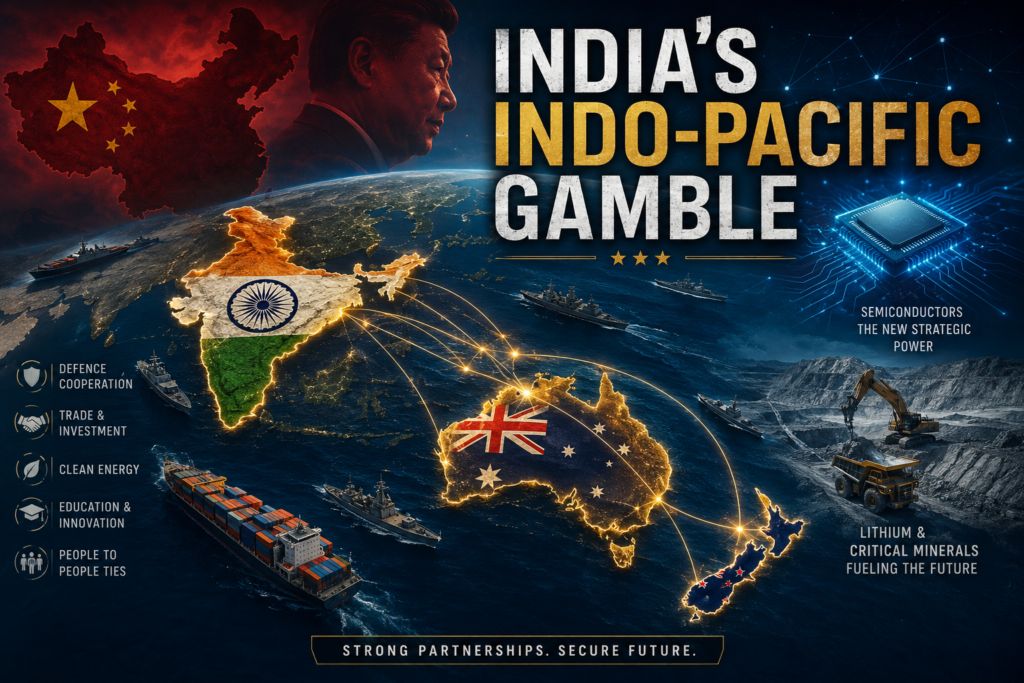
Officially, the agenda was familiar: trade, investment, education, defense cooperation, clean energy, and regional engagement.
Unofficially, many governments were watching for something else.
Not because a single agreement was expected to change the regional balance overnight. It rarely works that way. Geopolitics usually shifts through accumulation—a steady layering of partnerships that only looks obvious in hindsight.
That is the more interesting story behind the tour.
The real question isn’t why India visited Australia and New Zealand.
It’s why Beijing paid such close attention.
The answer extends well beyond the meetings themselves. Across the Indo-Pacific, economics and security are becoming increasingly difficult to separate. Critical minerals influence defense planning. Technology partnerships affect diplomacy. Supply chains have become strategic assets rather than purely commercial networks.
Oddly enough, globalization has made geography matter even more.
For years, businesses optimized efficiency by concentrating production wherever costs were lowest. Governments largely accepted that logic. The pandemic, semiconductor shortages, disruptions in the Red Sea and the earlier Suez Canal blockage, along with growing geopolitical tensions, exposed the risks of depending too heavily on a handful of locations. Resilience has since become a strategic objective in its own right.
India’s outreach to Australia and New Zealand fits squarely into that broader adjustment.
What Happened During India’s Australia and New Zealand Tour?
At first glance, the tour followed a familiar diplomatic script.
There were bilateral meetings, joint statements, official ceremonies, and commitments to strengthen cooperation. None of that, by itself, stood out.
The substance did.
In Australia, discussions covered trade, investment, maritime security, defense cooperation, education, renewable energy, critical minerals, and emerging technologies. Leaders reaffirmed their Comprehensive Strategic Partnership while emphasizing a shared commitment to an open and stable Indo-Pacific.
The emphasis wasn’t limited to traditional diplomacy. Economic security featured almost as prominently as defense. That reflects a wider shift taking place across the region, where governments increasingly view supply chains, industrial policy, and advanced technology as matters of national security rather than simply economic growth.
New Zealand’s agenda looked different, but only on the surface.
The discussions focused on education, agriculture, technology, people-to-people ties, innovation, and deeper engagement across the Pacific. Wellington is seldom described as a military heavyweight, yet that misses much of its strategic value. Through regional diplomacy, development partnerships, and its role within the Five Eyes intelligence network, New Zealand carries influence that extends beyond the size of its economy.
History offers a useful reminder here.
Countries do not always become strategically important because they possess the largest militaries. Singapore’s ports, Taiwan’s semiconductor industry, and Australia’s mineral reserves all illustrate the same principle: in modern geopolitics, economic capabilities often translate into strategic influence.
That logic increasingly applies across the Indo-Pacific.
Taken separately, the announcements made during the tour appeared measured rather than dramatic. There was no landmark treaty or headline-grabbing breakthrough.
Viewed together, however, they reveal a consistent direction.
India is steadily broadening its network of trusted partners at a time when governments are rethinking how trade, technology, and security fit together. It is not trying to replicate Cold War-style alliances. Instead, it is building overlapping relationships that provide greater flexibility in a far less predictable international environment.
That distinction matters.
Many countries across the Indo-Pacific are pursuing a similar approach. They are expanding cooperation without necessarily abandoning existing economic relationships, particularly with China. Strategic competition today is less about choosing one camp over another and more about reducing vulnerabilities before they become crises.
It is an approach built for uncertainty rather than confrontation.
Why This Visit Matters Beyond Diplomacy
One of the easiest mistakes in geopolitics is to judge a diplomatic visit by what is announced before the leaders leave the podium.
Most of the time, the real significance emerges later.
Trade agreements evolve into investment. Research partnerships become industrial collaboration. Military exercises lead to greater interoperability. A relationship that once looked largely economic gradually develops strategic weight. None of those changes makes front-page news on its own, but together they can reshape how countries respond to future crises.
That is why governments often pay as much attention to who is meeting as to what is being signed.
The Indo-Pacific sits at the center of this shift.
Roughly two-thirds of global maritime oil trade and a significant share of container shipping pass through the Indian and Pacific Oceans. Manufacturing hubs across East and Southeast Asia remain deeply connected to these sea lanes, while many of the minerals needed for electric vehicles, batteries, semiconductors, and renewable energy move through the same network.
A disruption in one part of the region rarely stays there.
The COVID-19 pandemic exposed how quickly supply-chain interruptions could spread across industries. The 2021 blockage of the Suez Canal delayed shipments worldwide despite occurring thousands of kilometers away from many affected businesses. More recently, attacks on commercial shipping in the Red Sea forced vessels to take longer and more expensive routes, raising freight costs and delivery times.
Geography never disappeared. For a while, global business simply behaved as though it had.
That assumption has become harder to sustain.
As governments rethink resilience, diplomatic relationships increasingly serve multiple purposes. They support trade, encourage investment, strengthen technology cooperation, improve access to strategic resources, and create channels for political coordination during periods of uncertainty.
In that environment, India’s engagement with Australia and New Zealand looks less like a routine diplomatic schedule and more like part of a broader regional strategy.
India’s Growing Indo-Pacific Strategy
India’s foreign policy has changed noticeably over the past decade, though not in the dramatic way it is sometimes portrayed.
Rather than abandoning its traditional approach, New Delhi has expanded it.
India continues to place importance on strategic autonomy, but it has become far more willing to build deeper partnerships with countries that share overlapping interests. The goal is not to create rigid alliances. It is to widen India’s diplomatic and economic options as global politics becomes more fragmented.
That distinction often gets overlooked.
The Quadrilateral Security Dialogue, or QUAD, illustrates this evolution.
Although the grouping brings together India, Australia, Japan, and the United States, it is frequently described almost entirely through a military lens. In practice, much of its work extends well beyond defense. Cooperation now includes cybersecurity, critical and emerging technologies, resilient supply chains, vaccine distribution, disaster response, maritime awareness, and infrastructure development.
People often think geopolitical competition begins with warships.
Increasingly, it begins with research laboratories, semiconductor fabrication plants, undersea data cables, and mineral processing facilities.
India’s broader regional engagement reflects that reality.
Naval exercises have expanded. Defense partnerships have grown stronger. Cooperation in renewable energy, digital infrastructure, artificial intelligence, critical minerals, and advanced manufacturing has accelerated alongside more traditional security initiatives.
There is an economic logic behind these moves.
India wants to become a larger manufacturing base as global companies reduce excessive dependence on any single production hub. Initiatives such as “China Plus One” have encouraged multinational firms to diversify operations, and India sees an opportunity to attract a greater share of investment in sectors ranging from electronics to clean energy.
That ambition depends on more than competitive labor costs.
Reliable access to critical minerals, trusted technology partnerships, resilient logistics, research collaboration, and stable diplomatic relationships all influence where companies choose to invest. Boardrooms increasingly weigh geopolitical risk alongside financial projections.
Diplomacy now reaches into investment decisions in ways that would have seemed unusual twenty years ago.
Australia, for example, is not simply a defense partner. Its lithium and rare earth reserves have become strategically important as countries compete to secure supply chains for batteries, electric vehicles, and advanced electronics. New Zealand contributes differently, offering strengths in agricultural innovation, education, Pacific engagement, and scientific collaboration.
Each relationship serves a distinct purpose.
Together, they make India’s broader Indo-Pacific strategy more resilient.
Perhaps that is the most significant change in India’s foreign policy. Security and economics are no longer treated as parallel tracks. Industrial policy, technology, energy, investment, and defense increasingly reinforce one another.
The boundaries between economic strategy and national security have become much harder to define.
Why China Is Watching Closely
Calling China “nervous” makes for a compelling headline, but it also flattens a far more complex reality.
Beijing is unlikely to interpret every new partnership involving India as an immediate strategic threat. What attracts attention is the cumulative direction of these relationships. A single agreement can be managed. A steady expansion of diplomatic, economic, technological, and security ties across the Indo-Pacific presents a different picture.
Chinese policymakers tend to think in long time horizons. They are less concerned with today’s announcement than with where a series of seemingly modest developments might lead five or ten years from now.
That helps explain why visits like this receive careful scrutiny in Beijing.
Strategic Partnership Concerns
The concern is not simply that India is strengthening ties with Australia or New Zealand.
It is that several regional powers are gradually building denser networks of cooperation at the same time.
Over the past decade, India has expanded engagement with Australia, Japan, the United States, France, Southeast Asian nations, and several European partners. None of these relationships, taken individually, fundamentally alters the regional balance.
Collectively, they begin to change how influence is distributed.
Diplomatic coordination becomes easier. Intelligence-sharing improves. Joint military exercises become more routine. Technology standards, investment frameworks, and supply-chain initiatives start reinforcing one another.
Relationships create infrastructure of their own.
Once governments establish regular channels for consultation and cooperation, those networks often prove far more durable than the political leaders who created them.
History offers plenty of examples.
NATO did not become influential because of one summit. ASEAN did not emerge through a single declaration. Even the European Union evolved gradually through decades of economic integration before becoming a broader political project.
Strategic architecture is usually built piece by piece.
Beijing understands that as well as anyone.
Australia’s Growing Role
Australia’s growing importance has as much to do with geology as geography.
Much of the world’s attention focuses on Australia’s alliance with the United States or its expanding defense cooperation across the Indo-Pacific. Those factors matter, but they are only part of the story.
Another source of influence lies underground.
Australia possesses some of the world’s largest reserves of lithium, rare earth elements, cobalt, nickel, and other critical minerals that have become indispensable for batteries, semiconductors, renewable energy systems, defense equipment, and advanced manufacturing.
The minerals themselves are relatively small.
The industries built around them are enormous.
As governments race to secure future supply chains, countries rich in these resources are acquiring strategic importance that extends well beyond mining. Access to critical minerals increasingly shapes industrial policy, investment decisions, and even diplomatic priorities.
Australia’s value to India reflects exactly that shift.
Defense cooperation continues to deepen through naval exercises, maritime coordination, intelligence exchanges, and broader security dialogue. At the same time, collaboration in clean energy, research, education, advanced manufacturing, and resource development is expanding just as quickly.
The relationship no longer fits neatly into one category.
It is economic.
It is technological.
It is strategic.
It is increasingly all three at once.
That is a broader pattern visible across much of the Indo-Pacific. Governments are no longer building partnerships around a single issue. They are creating relationships that span multiple sectors, making them more resilient and considerably harder to unravel when political conditions change.
For Beijing, that gradual convergence is likely more significant than any individual agreement signed during the tour.
Why New Zealand Matters More Than Many Assume
New Zealand rarely dominates geopolitical discussions.
When conversations turn to the Indo-Pacific, attention usually shifts toward Australia, Japan, China, or the United States. Wellington often sits in the background, which can make its strategic role easy to underestimate.
That would be a mistake.
New Zealand’s influence comes less from military power than from the position it occupies within a broader network of relationships. It remains an active voice in Pacific affairs, participates in the Five Eyes intelligence partnership, and has spent decades building political and development ties across the Pacific Islands.
Influence is not always measured by the size of a country’s armed forces.
Sometimes it is measured by trust.
That matters in a region where competition increasingly extends beyond naval deployments. Development finance, infrastructure projects, climate cooperation, fisheries, digital connectivity, and disaster relief have become part of the geopolitical conversation. Pacific Island nations are no longer viewed as remote players on the edge of international politics. They sit across vital maritime routes and occupy a region where larger powers are investing far more diplomatic attention than they did a decade ago.
India has recognised that shift.
Its engagement with New Zealand reflects an interest in strengthening economic ties while also expanding its presence across the wider Pacific. Education, agriculture, food technology, scientific research, innovation, and people-to-people links may not generate dramatic headlines, but they create relationships that tend to endure beyond election cycles.
The quieter partnerships often last the longest.
The Changing Indo-Pacific Balance
Perhaps the most significant story is not that countries are forming new partnerships.
It is how they are forming them.
The Cold War encouraged governments to think in terms of competing blocs. Today’s Indo-Pacific is considerably more complicated. Most countries are not looking to replace one major partner with another. They are trying to avoid becoming overly dependent on any single power.
That balancing act has become a defining feature of regional diplomacy.
India has strengthened ties with Australia, Japan, France, Southeast Asian nations, Europe, and the United States while continuing to maintain channels of engagement with others, including China. ASEAN members have adopted similar approaches, seeking security cooperation in some areas while preserving economic relationships in others.
This is diplomacy built around flexibility rather than alignment.
It also reflects an important lesson from recent years. Whether the disruption came from the pandemic, the semiconductor shortage, energy shocks following Russia’s invasion of Ukraine, or interruptions to global shipping, governments discovered that excessive dependence carries strategic costs.
Diversification has become a form of insurance.
China now faces a regional environment that is more interconnected than it was ten years ago. Influence increasingly depends not only on bilateral relationships but also on how countries fit into wider networks of cooperation. That makes the diplomatic landscape more fluid—and, in many ways, more difficult to predict.
The Economic Story Behind the Visit
Security tends to dominate geopolitical headlines.
Economics often determines how lasting those geopolitical shifts become.
The discussions during India’s tour reflected that reality. Trade, investment, technology, energy, research, and industrial cooperation featured just as prominently as defense. That mix would have seemed unusual a generation ago. Today it has become standard practice because economic capacity increasingly underpins strategic influence.
Factories, research centres, ports, and processing facilities have become part of national security conversations.
Critical Minerals
Few issues illustrate this better than critical minerals.
Lithium, rare earth elements, cobalt, nickel, and graphite are no longer simply commodities traded on global markets. They have become essential inputs for electric vehicles, battery storage, renewable energy systems, advanced electronics, artificial intelligence infrastructure, and modern defense equipment.
Countries able to secure reliable access to these resources enjoy advantages that extend well beyond manufacturing.
Australia occupies a particularly strong position.
Its resource base makes it one of the world’s most important suppliers of several minerals needed for the global energy transition. For India, whose manufacturing ambitions continue to expand, building reliable access to those resources has become increasingly important.
The competition is no longer just over oil.
It is increasingly about the materials that will power the next generation of industries.
Supply Chain Diversification
For decades, businesses concentrated production wherever costs were lowest.
Efficiency drove decision-making.
Recent events have exposed the limits of that model.
The pandemic halted production across multiple industries. Semiconductor shortages disrupted automobile manufacturing around the world. Shipping bottlenecks delayed deliveries for months. Companies that once measured success primarily through efficiency began adding resilience to the equation.
The shift did not happen overnight, and it is still unfolding.
Many multinational firms are adopting a “China Plus One” strategy, expanding manufacturing into countries such as India, Vietnam, and others rather than relying too heavily on a single production base. Apple’s growing manufacturing footprint in India is one widely discussed example of this broader trend, though it is far from the only one.
That creates opportunities for countries able to combine political stability, skilled labour, infrastructure, trusted partnerships, and reliable access to strategic resources.
India is working to position itself within exactly that space.
Trade, Technology, and Investment
Economic cooperation now reaches well beyond traditional trade agreements.
Investment decisions increasingly intersect with technology policy, research collaboration, cybersecurity, digital infrastructure, clean energy, advanced manufacturing, and talent development. These sectors reinforce one another in ways that were far less obvious twenty years ago.
A semiconductor factory, for example, is not simply a manufacturing project.
It requires reliable electricity, highly skilled engineers, secure supply chains, trusted equipment suppliers, stable diplomatic relationships, and long-term investor confidence. Remove one piece, and the entire ecosystem becomes harder to sustain.
That systems perspective is becoming central to geopolitical strategy.
India’s partnerships with Australia and New Zealand reflect more than commercial opportunity. They strengthen access to resources, knowledge, investment, and regional networks that support long-term economic resilience alongside strategic influence.
How China May Interpret These Developments
The word “nervous” works as a headline.
It is less useful as an analytical description.
Beijing is more likely to see India’s expanding regional engagement as a long-term strategic trend than as an immediate challenge. Chinese policymakers have spent decades thinking about shifts in the regional balance through the lens of cumulative change. Individual agreements matter, but they rarely determine outcomes on their own.
The concern is what happens when diplomatic relationships, technology partnerships, industrial cooperation, defense coordination, and investment flows begin reinforcing one another across the same network of countries.
That process is already underway.
From Beijing’s perspective, India’s closer ties with Australia, deeper engagement across the Pacific, an increasingly active QUAD, and growing efforts by multinational companies to diversify supply chains all point in a similar direction. None of these developments is aimed exclusively at China, yet together they gradually reduce Beijing’s ability to shape the regional environment on its own.
That distinction is easy to miss.
Many countries involved continue to trade extensively with China. Australia remains economically linked to the Chinese market despite years of political tension. India, despite border disputes and strategic competition, also maintains significant commercial ties with Beijing.
Competition and interdependence now exist side by side.
That may sound contradictory.
It has become one of defining characteristics of twenty-first century geopolitics.
Governments compete over technology while expanding trade.
They strengthen military partnerships while protecting commercial relationships.
They seek strategic autonomy without complete economic separation.
This is not a temporary transition. It is increasingly the operating model of the Indo-Pacific.
Global Implications Beyond Asia
The implications extend well beyond the countries directly involved.
Washington has encouraged closer cooperation among regional partners for years, partly because a stronger network of capable partners reduces the burden on the United States to respond alone during every regional crisis. The objective is not simply military deterrence but a more resilient regional order.
Europe has reached similar conclusions from a different direction.
Russia’s invasion of Ukraine exposed vulnerabilities in energy supply, while earlier disruptions highlighted weaknesses in global manufacturing and logistics. European governments are now paying greater attention to economic resilience, critical technologies, and trusted supply chains than they did a decade ago.
The conversation is becoming remarkably similar across continents.
ASEAN countries continue to pursue a careful balancing strategy. Most have little interest in choosing between Washington and Beijing. Instead, they are trying to preserve strategic flexibility while attracting investment from multiple directions.
Pacific Island nations face their own calculations.
Competition among larger powers has brought greater investment, infrastructure funding, and diplomatic engagement. That creates opportunities, but also new pressures. Smaller states increasingly find themselves managing relationships with several major powers at once rather than relying predominantly on one.
The private sector is adapting just as quickly.
Investment committees now evaluate geopolitical risk alongside labour costs, tax incentives, logistics, and market access. Decisions about where to build semiconductor facilities, battery plants, cloud infrastructure, or critical manufacturing capacity increasingly depend on political stability as much as commercial potential.
Boardrooms have become part of the geopolitical landscape.
What This Means for India
For India, the potential gains extend far beyond the immediate outcomes of this tour.
Reliable access to Australia’s critical minerals supports ambitions in electronics, renewable energy, electric vehicles, and advanced manufacturing. Closer research partnerships can strengthen innovation. Greater investment expands industrial capacity. Deeper educational links help develop the skilled workforce that modern industries increasingly require.
These advantages reinforce one another.
That is precisely why governments now discuss education, technology, investment, and defense within the same diplomatic meetings. They are no longer separate policy areas.
India also stands to gain diplomatically.
A broader network of trusted relationships gives New Delhi greater influence in discussions on regional security, digital governance, climate cooperation, trade standards, and emerging technologies. Influence is rarely built through dramatic announcements.
It grows through consistency.
Countries become more willing to coordinate with partners they have worked with repeatedly, particularly during periods of uncertainty. Trust, although difficult to measure, remains one of diplomacy’s most valuable assets.
Challenges and Risks Ahead
None of this guarantees success.
India continues to manage one of the world’s most complicated bilateral relationships with China. The two countries remain major trading partners despite unresolved border disputes and deep strategic disagreements. That combination of economic interdependence and geopolitical rivalry is unlikely to disappear.
Nor do India’s partners always share identical priorities.
Australia, New Zealand, Japan, ASEAN members, European countries, and Pacific Island nations each approach the Indo-Pacific from different political, economic, and security perspectives. Their interests overlap frequently, but not universally.
Coalitions built around shared interests are rarely uniform.
That is both their strength and their limitation.
There is also a broader question that extends beyond India.
As more countries strengthen strategic partnerships, will regional stability improve through greater resilience and deterrence? Or will increasingly competitive diplomacy create new areas of friction that become harder to manage?
History offers examples supporting both outcomes.
Much will depend on whether governments continue viewing cooperation and competition as processes that can coexist rather than as mutually exclusive choices. The Indo-Pacific is already demonstrating that international relations have become far less binary than they once appeared.
What to Watch Next
The importance of this tour will not be measured by the number of agreements announced or the photographs released after each meeting.
It will be measured by what follows.
If India and Australia move ahead on critical minerals, semiconductor cooperation, advanced manufacturing, clean energy, and defense technology, the tour will be remembered as another step in a much larger strategic realignment rather than an isolated diplomatic event.
The same applies to New Zealand.
Future collaboration in research, agricultural technology, education, innovation, and Pacific engagement may attract fewer headlines than defense agreements, but they can shape relationships for decades. Some of the most durable strategic partnerships begin with exchanges between universities, scientists, businesses, and investors long before they become security discussions.
The next few years will provide clearer signals.
QUAD initiatives, infrastructure projects, investment announcements, maritime exercises, technology partnerships, and supply-chain agreements will reveal whether today’s diplomatic momentum translates into lasting institutional cooperation.
China’s response will be equally important to watch.
Beijing is unlikely to remain passive as regional relationships evolve. It has already expanded its own diplomatic outreach, economic initiatives, and infrastructure investments across Asia and the Pacific. Competition in the Indo-Pacific is not one-sided; every major player is adapting to a changing strategic environment.
The interesting question is not whether competition will continue.
It almost certainly will.
The real question is what form that competition takes. Will countries prioritize economic resilience while preserving open trade? Will strategic rivalry remain manageable, or will it spill into areas that make cooperation increasingly difficult?
Those answers are still being written.
A Visit That Reflects a Larger Strategic Shift
Viewed in isolation, India’s Australia and New Zealand tour was a routine diplomatic engagement.
Viewed in context, it tells a much larger story.
Across the Indo-Pacific, governments are rethinking assumptions that shaped international politics for much of the past three decades. Efficiency is no longer the only objective. Resilience matters. Diversified supply chains matter. Trusted technology partners matter. Secure access to energy, critical minerals, and advanced manufacturing increasingly matters just as much.
The boundaries between economics and national security have become increasingly blurred.
That may be the defining geopolitical shift of this decade.
For much of the post-Cold War era, many governments assumed that expanding trade would naturally reduce strategic tensions. Reality has proved more complicated. Economic interdependence has endured, but it now exists alongside sharper competition over technology, industrial capacity, critical resources, and geopolitical influence.
The Indo-Pacific sits at the center of that transformation.
India’s closer engagement with Australia and New Zealand reflects this changing reality. So do similar efforts by Japan, ASEAN members, Europe, the United States, and even China itself. Every major actor is adjusting to a world in which strategic advantage depends not only on military capability but also on manufacturing strength, technological leadership, investment networks, energy security, and resilient supply chains.
In many ways, diplomacy now begins long before foreign ministers meet.
It starts with where companies invest, where researchers collaborate, where critical minerals are processed, where semiconductors are manufactured, and which countries choose to build trusted networks together. Boardrooms and laboratories increasingly shape geopolitical outcomes alongside parliaments and foreign ministries.
History rarely announces its turning points in real time.
Most appear ordinary while they are unfolding.
A diplomatic visit. A trade agreement. A new research partnership. A supply-chain investment. Individually, they can seem incremental. Collectively, they reshape the strategic landscape.
India’s tour of Australia and New Zealand is unlikely to transform the Indo-Pacific overnight.
It does, however, reflect the direction in which the region is moving.
And that may ultimately matter more than any single announcement made during the visit.