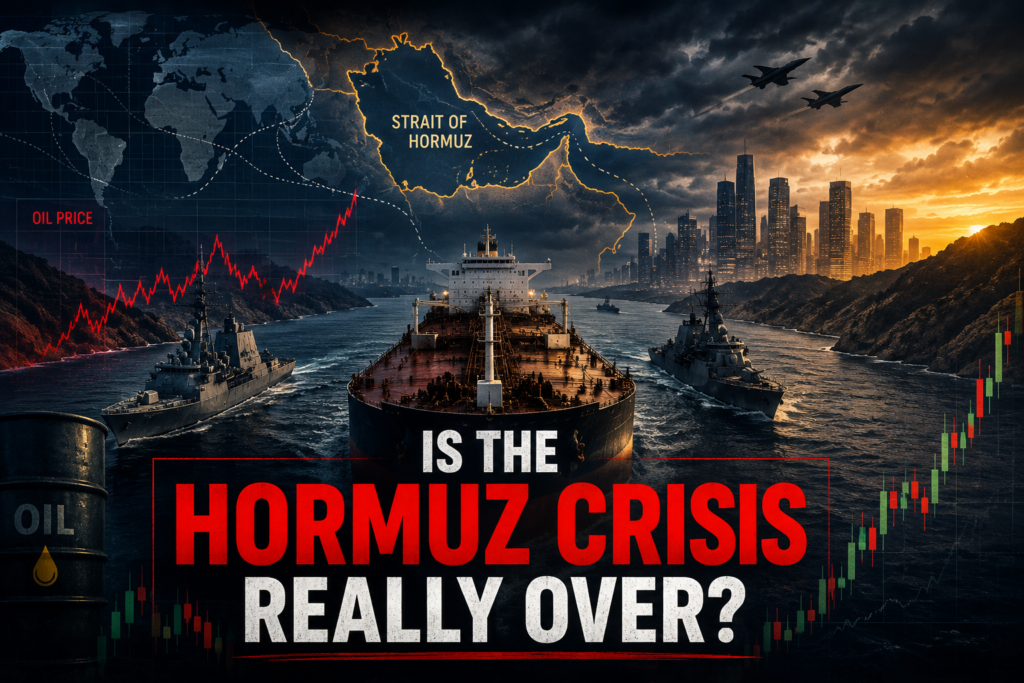
For several weeks, the Strait of Hormuz became the market’s favorite source of anxiety.
Military activity. Shipping updates. Diplomatic statements. Almost every development out of the Gulf seemed capable of moving oil prices before the trading day was over. It wasn’t necessarily because supplies had changed overnight. Markets were constantly recalculating the odds that they might.
Then the tone shifted.
Tankers kept sailing.
Export volumes recovered more quickly than many analysts had expected.
Several shipping operators gradually returned to routes they had avoided during the most uncertain period, even if they continued to build extra caution into voyage planning.
To anyone watching only the headlines, the crisis appeared to be fading.
The market’s behavior tells a slightly different story.
Oil prices have retreated from their most volatile levels, yet they remain unusually sensitive to even relatively minor developments in the region. Marine insurers continue pricing risk carefully. Governments have maintained a visible security presence. Investors, meanwhile, haven’t stopped watching the Gulf—they’ve simply become more selective about what they react to.
That distinction is easy to miss.
Markets have a habit of regaining confidence faster than geopolitical risks actually disappear. The absence of alarming headlines is often mistaken for the absence of danger, even though those are very different things.
So the real question isn’t whether the recent crisis has completely ended.
It’s whether the underlying conditions that created it have changed in any meaningful way.
Answering that requires looking beyond the latest news cycle. It means understanding why this narrow waterway still occupies such an outsized place in global markets, what has improved over recent weeks, and why investors continue treating the region with far more caution than they did only a few months ago.
Why the Strait of Hormuz Matters
The Strait of Hormuz is, in purely geographic terms, a remarkably small passage. Economically, it’s something else entirely.
Positioned between the Persian Gulf and the Gulf of Oman, it serves as the primary maritime outlet for crude oil and liquefied natural gas exported by several of the world’s largest energy producers. Saudi Arabia, Iraq, the United Arab Emirates, Kuwait and Qatar all depend on this route to reach international markets. For Qatar’s LNG exports in particular, there are few practical alternatives.
That concentration creates a vulnerability that has existed for decades but only attracts widespread attention when tensions rise.
As long as ships move normally, the system appears almost effortless. Millions of barrels of oil pass through the corridor each day, buyers receive cargoes on schedule and markets focus on more immediate concerns.
Disruptions don’t have to be dramatic to change that equation.
Sometimes shipping doesn’t stop—it simply becomes slower, more expensive or more uncertain. A vessel may require additional security measures. War-risk insurance premiums can change rapidly during periods of heightened tension. Operators may adjust voyage planning, delay departures or build extra costs into contracts. None of those developments necessarily make front-page news, but collectively they affect the price of moving energy around the world.
The market notices long before consumers do.
By the time households see higher fuel prices or businesses begin paying more for transportation, traders have often spent weeks repricing expectations. Commodity markets rarely wait for physical shortages. They price probability.
That is one reason geopolitical events in the Gulf attract such close attention from investors. They’re rarely responding only to today’s oil supply. More often, they’re trying to estimate tomorrow’s risk.
And that difference matters.
The Strait of Hormuz isn’t simply an energy story anymore. It’s a financial one. A shift in perceived risk can influence inflation expectations, corporate planning, shipping costs and monetary policy well before a single barrel of oil fails to reach its destination.
Look beyond the waterway itself and it becomes clear why governments, central banks and institutional investors continue watching it so closely. The question has never been whether the passage is important.
It’s how quickly uncertainty there can spread through the rest of the global economy.
What Triggered the Crisis?
The latest bout of tension wasn’t the result of a single dramatic event. It emerged from a series of developments that, taken together, steadily increased the market’s sense of vulnerability.
Military exchanges across the region became more frequent. Commercial vessels faced heightened security concerns. Naval deployments expanded as governments sought to protect one of the world’s busiest energy corridors. None of those developments automatically meant oil exports would stop, but they changed how companies—and investors—began assessing risk.
Shipping firms were among the first to respond.
Few operators abandoned the route altogether. That would have been commercially difficult given the volume of energy moving through the Gulf. Instead, many adjusted how they operated. Voyage planning became more cautious. Security procedures were reviewed. Some departures were delayed, while others proceeded with additional precautions built into the schedule.
The insurance market reacted just as quickly, if not more so.
War-risk premiums rose as underwriters reassessed the probability of disruption. Those premiums can change within days when geopolitical tensions escalate, making them one of the earliest indicators that professionals who price risk are becoming less comfortable with the operating environment.
Financial markets followed a familiar pattern.
Oil prices climbed, not because supplies had suddenly disappeared, but because traders began attaching a higher probability to future disruptions. Energy producers generally benefited from stronger crude prices. Businesses with heavy fuel exposure—from airlines to manufacturers—faced the opposite prospect.
It’s an important distinction, and one investors sometimes overlook.
Markets rarely wait for certainty. By the time a physical shortage becomes visible, prices have often spent days—or weeks—adjusting to the possibility that it could happen. In commodities, expectations are often as influential as events themselves.
That helps explain why periods of geopolitical tension can produce significant volatility even when oil continues flowing.
Why Markets Now Believe the Situation Has Improved
Over the past several weeks, the immediate picture has become less alarming.
Commercial shipping has continued moving through the Strait. Export volumes have remained resilient, and the disruption many traders feared simply hasn’t materialized. That alone has eased some of the pressure that built up during the height of the crisis.
Shipping companies have gradually become more comfortable using established routes again, although “comfortable” may not be the right word. A better description is that many now view the risks as manageable rather than prohibitive.
Oil prices reflect that change in sentiment.
After climbing sharply during the most uncertain period, crude prices have retreated as fears of an imminent supply shock faded. The geopolitical risk premium embedded in prices has narrowed, though it hasn’t disappeared entirely.
Diplomacy has also played a role.
Efforts to reduce tensions, combined with a continued international naval presence, have helped reassure markets that the region’s main shipping corridor remains open. Investors tend to place considerable weight on those practical signals. As long as cargoes continue arriving and shipping patterns remain broadly intact, worst-case scenarios become harder to justify.
That doesn’t mean markets have become complacent.
If anything, the recent episode has reminded investors how quickly sentiment can change. Confidence has improved because the feared disruption didn’t occur—not because the structural risks have vanished.
That’s a subtle but important difference.
Geopolitical crises rarely end with a clear announcement. More often, they fade into the background until another event brings them back into focus. Investors who follow energy markets have seen that pattern before.
The current environment reflects cautious normalization rather than complete resolution.
And perhaps that’s the biggest takeaway from the past few weeks. Stability and certainty are not the same thing. Markets may no longer expect an immediate disruption, but they’re still assigning value to the possibility that conditions could deteriorate again.
For long-term investors, that distinction is probably more useful than asking whether the crisis is “over.”
Why Investors Should Not Assume the Risk Has Disappeared
The market has become calmer. That much is clear.
Calmer, however, doesn’t necessarily mean safer.
One of the recurring lessons from financial markets is that confidence often returns before uncertainty has fully receded. Investors gradually become accustomed to elevated risks, volatility subsides and attention shifts elsewhere. The underlying conditions, though, can remain largely unchanged.
That’s where the current situation deserves a closer look.
Military Risk Hasn’t Gone Away
The Gulf remains one of the world’s most heavily militarized regions. Naval forces from multiple countries continue operating in close proximity, while regional rivalries that predate the latest crisis remain unresolved.
A major conflict isn’t the only concern.
History suggests that isolated incidents—a miscalculation at sea, an unexpected confrontation or damage to commercial infrastructure—can alter market sentiment surprisingly quickly. Large geopolitical events don’t always begin with carefully planned decisions. Sometimes they emerge from moments that, at first glance, appear relatively contained.
Markets understand this even when the news cycle moves on.
That’s one reason oil prices still respond sharply to developments that might have attracted far less attention a year ago. Investors aren’t just assessing today’s risks; they’re asking how easily today’s situation could become tomorrow’s crisis.
Political Risk Can Reprice Markets Overnight
Military developments are only part of the picture. Politics often has an equally powerful influence on market expectations.
Diplomatic negotiations can make steady progress for weeks before breaking down unexpectedly. Sanctions can be tightened or relaxed. Governments can shift strategy following elections or changes in leadership. None of those developments require a disruption to physical oil flows to move markets.
The expectation is often enough.
Investors sometimes focus on tankers and pipelines because they’re visible. Political decisions are less tangible, yet they frequently have a greater influence on how markets price future risk.
In other words, the biggest moves don’t always follow the biggest events. They often follow the biggest surprises.
Shipping Has Become More Resilient—Not Less Risky
Commercial traffic has held up better than many expected, but that shouldn’t be mistaken for a return to business as usual.
Shipping companies have adapted rather than relaxed.
Operators continue reviewing security protocols, monitoring insurance costs and adjusting voyage planning when necessary. In some cases, longer routes or additional precautions remain commercially sensible despite the higher expense.
Those adjustments rarely generate headlines because they don’t interrupt global trade. They simply make it more expensive.
That’s easy to overlook.
A supply chain doesn’t have to break to become less efficient. Small increases in insurance costs, fuel consumption, transit times and operational complexity can accumulate across thousands of shipments. By the time those costs reach manufacturers or consumers, the original cause may have faded from public attention.
Markets tend to notice those changes earlier than the broader economy.
Why Energy Markets Still React So Quickly
Energy traders spend much of their time pricing possibilities rather than certainties.
A credible report of shipping delays.
An unexpected military exercise.
A breakdown in diplomatic talks.
None of these guarantees a supply disruption. Yet each has the potential to change expectations, and expectations remain one of the strongest drivers of oil prices.
The effects don’t stop there.
Higher energy prices can reshape inflation forecasts. Those forecasts influence bond markets, expectations for interest rates and, eventually, broader investor sentiment. The chain of events isn’t always linear, but it often unfolds faster than many assume.
That’s one of the defining characteristics of today’s financial system. Information moves almost instantly, and markets increasingly respond before the economic consequences become visible.
What Investors Should Watch Next
Daily headlines provide context, but they’re rarely the best guide to changing conditions.
The more useful question is this: Where is risk actually being repriced?
Oil prices remain the most obvious place to start. Sustained increases usually suggest that traders are assigning a higher probability to future supply disruptions, even if exports continue without interruption.
Shipping activity through the Gulf offers another practical signal. Most investors never track vessel movements directly, but commercial traffic often reveals more about conditions than political statements do. If operators continue using established routes with relatively few adjustments, confidence is generally improving.
Insurance markets deserve just as much attention.
War-risk premiums rarely attract public interest, yet they’re among the earliest indicators of how professionals who evaluate maritime risk every day view the security environment. In some periods, insurance pricing begins changing before oil markets fully react.
That’s worth remembering.
Diplomatic negotiations also matter—not because every meeting produces a breakthrough, but because markets constantly reassess the likelihood of escalation or de-escalation. Expectations shift long before official agreements are signed.
Military deployments belong on the same list. Significant changes in naval posture don’t automatically signal conflict, but they often indicate that governments are preparing for a less predictable environment.
Beyond the region itself, investors should also pay attention to OPEC decisions, inflation expectations and central bank communication. Energy prices rarely remain confined to commodity markets. They influence borrowing costs, corporate earnings, consumer confidence and, ultimately, investment decisions across almost every major asset class.
Perhaps the most overlooked indicator, though, is the behavior of shipping companies themselves.
Unlike governments, shipping operators have little incentive to send political messages. Their decisions are usually driven by practical assessments of cost, safety and commercial viability. Watching what they do can sometimes be more informative than listening to what officials say.
No single indicator provides a complete picture.
Taken together, however, they reveal something more valuable than the headlines alone: how markets are actually pricing uncertainty rather than simply talking about it.
Which Countries Have the Most at Stake?
The effects of disruption in the Strait of Hormuz don’t stop at the Gulf. They spread through global energy markets, supply chains and financial systems, reaching countries with very different economic priorities.
What changes from one country to another isn’t the existence of the risk. It’s the way that risk shows up.
India: Inflation Becomes the Immediate Challenge
For India, the issue is as much economic as it is strategic.
A large share of the country’s crude oil imports originates in the Gulf, leaving it particularly exposed to prolonged price increases or supply uncertainty. Higher crude prices quickly feed into transportation costs, manufacturing expenses and consumer inflation, making monetary policy considerably more complicated.
The pressure doesn’t end there. A larger import bill can widen the trade deficit and weigh on the rupee, creating additional challenges for policymakers already balancing growth with price stability.
China: Protecting the Manufacturing Engine
China approaches the Strait from a different perspective.
As the world’s largest manufacturing economy and one of its biggest energy importers, China depends on stable and affordable energy supplies to keep factories operating efficiently. Rising oil prices don’t simply increase fuel costs—they gradually work their way through production, logistics and exports.
Because China occupies such a central position in global supply chains, higher manufacturing costs rarely remain a domestic issue. They eventually ripple outward to businesses and consumers around the world.
Japan: Energy Security Above All
Japan has spent decades treating energy security as a national priority, largely because of its limited domestic energy resources.
Reliable shipping through the Gulf remains essential to that strategy. Even relatively modest disruptions can increase import costs, affecting everything from industrial production to household electricity prices.
For Japan, stability in the region isn’t simply about avoiding market volatility. It’s about ensuring predictable access to the resources that support its economy.
South Korea: Competitiveness Under Pressure
South Korea’s concern is closely tied to its export-driven industrial base.
Industries such as semiconductors, automobiles, petrochemicals and shipbuilding all depend on secure and competitively priced energy. A temporary rise in oil prices can usually be absorbed. A prolonged period of elevated costs is more difficult.
The challenge isn’t just paying more for energy. It’s remaining competitive while doing so.
Europe: Imported Inflation Returns
Europe has diversified parts of its energy supply since the shocks of recent years, reducing dependence on individual suppliers. That has improved resilience, but it hasn’t eliminated exposure to global oil prices.
If crude becomes more expensive because of disruptions in the Gulf, European businesses still face higher transportation costs, more expensive imports and renewed inflationary pressure.
The source of the oil matters less than the price the global market ultimately sets.
United States: Global Prices, Global Consequences
The United States produces far more oil than it once did, making it less dependent on imported crude than many other advanced economies.
Yet domestic production doesn’t isolate it from global pricing.
Oil is traded in an international market where prices are shaped by worldwide expectations of supply and demand. A disruption affecting Gulf exports can therefore influence fuel prices, inflation expectations and financial markets in the United States even if American production remains unchanged.
Strategically, Washington also has broader interests in maintaining freedom of navigation through one of the world’s most important maritime trade corridors.
Taken together, these examples highlight a broader reality.
Countries aren’t affected equally—but very few remain unaffected.
Industries That Could Be Affected
The impact spreads through the economy in stages rather than all at once.
Some industries feel the effects almost immediately. Others notice them only after higher costs begin working their way through supply chains.
The first group is the most obvious.
Energy producers and commodity traders respond directly to movements in crude prices. Their revenues, costs and investment decisions can change quickly as markets reassess supply risks.
Shipping companies sit close behind. Increased insurance premiums, higher security requirements and adjustments to voyage planning can raise operating costs even when vessels continue using the same routes. Trade doesn’t have to stop to become more expensive.
The next wave is broader.
Airlines are especially sensitive because fuel remains one of their largest operating expenses. Logistics providers face similar pressures as transportation costs rise and delivery schedules become harder to optimize.
Manufacturers experience a more gradual squeeze.
Higher energy prices increase production costs, while more expensive freight raises the price of moving raw materials and finished goods. Businesses with thin margins often feel those changes long before consumers do.
The chemical industry occupies a unique position because petroleum serves both as an energy source and as a raw material. That means price volatility affects multiple parts of its cost structure simultaneously.
Some consequences are less obvious.
Retailers can eventually face higher import costs as transportation becomes more expensive. Agricultural businesses may see fertilizer, fuel and distribution costs increase at the same time. None of those developments begins in a supermarket or on a farm, but that’s often where consumers eventually notice the impact.
Insurance companies deserve particular attention because they sit near the beginning of this chain rather than the end.
War-risk premiums, cargo insurance and broader assessments of maritime exposure influence the cost of global trade long before inflation statistics capture the effects. In many cases, insurers start repricing geopolitical risk before the rest of the market fully catches up.
That may be one of the quieter lessons from the recent tensions.
The economic impact of geopolitical risk isn’t limited to places where conflict occurs. More often, it travels through invoices, freight contracts, insurance policies and supply chains before it appears in consumer prices.
By then, markets have usually moved on to worrying about the next source of uncertainty.
Could Another Crisis Happen?
No one can predict how geopolitical events will unfold. Markets, however, don’t need certainty—they simply need to decide which outcome looks more likely.
That’s why thinking in scenarios is often more useful than trying to predict the next headline.
Scenario 1: Stability Holds
The most straightforward outcome is that current conditions largely persist.
Commercial shipping continues without major interruption. Diplomatic channels remain open. Regional tensions don’t disappear, but they stay contained. Oil prices fluctuate within a relatively normal range, allowing inflation pressures to ease further and giving central banks room to focus on domestic economic conditions.
Markets would welcome that outcome, even if they never become completely comfortable with the underlying risks.
Scenario 2: Periodic Disruptions
This is arguably the scenario investors should spend the most time thinking about.
The Gulf has a long history of moving through cycles of tension and relative calm. Under this scenario, isolated incidents periodically unsettle markets without developing into a broader regional conflict.
Shipping continues, though not always as efficiently. Insurance costs rise and fall with changing conditions. Oil prices experience short-lived spikes before settling back.
For businesses, this can be more challenging than it first appears. Constant uncertainty makes planning more difficult. Companies may hold larger inventories, diversify suppliers or accept higher operating costs simply to reduce exposure to future disruptions.
None of those decisions dominates the headlines. Together, they quietly reshape the economics of global trade.
Scenario 3: A Broader Military Escalation
The most severe outcome remains a wider regional conflict that disrupts commercial shipping through the Gulf.
In that environment, higher oil prices would likely be only the beginning. Transportation costs would rise sharply, inflation could reaccelerate and central banks might once again find themselves balancing economic growth against persistent price pressures.
Financial markets would probably react well before the full economic impact became visible. They usually do.
Scenario 4: A Lasting Diplomatic Breakthrough
The most optimistic outcome is also the hardest to predict.
A sustained improvement in regional relations could gradually reduce the geopolitical risk premium embedded in energy markets. Shipping companies would operate with greater confidence, insurance costs could decline and long-term investment decisions would become easier to make.
Even then, markets would remain cautious.
Trust takes considerably longer to rebuild than it does to lose.
The broader lesson is difficult to ignore. Geopolitical risk rarely disappears in a single moment. More often, it fades into the background until another event reminds markets that it never completely went away.
The Bigger Picture
The recent tensions have already influenced decisions that will outlast the crisis itself.
Governments are expanding strategic petroleum reserves, strengthening energy partnerships and accelerating investments in LNG infrastructure, pipelines and alternative energy sources. These projects are increasingly being justified not only on environmental or economic grounds but also as matters of national resilience.
Energy security has become as much a financial issue as an energy one.
Businesses are adapting as well.
For years, many supply chains were built around efficiency above all else. The past few years—from the pandemic to geopolitical conflicts—have changed that calculation. Resilience now carries a measurable economic value, even if it means accepting higher costs.
It’s a noticeable shift in corporate thinking.
A decade ago, companies often treated geopolitical events as temporary disruptions. Increasingly, they’re planning for a world where periodic disruptions are part of the operating environment rather than rare exceptions.
Financial markets have undergone a similar adjustment.
Investors now pay closer attention to shipping routes, commodity flows, sanctions and diplomatic negotiations than they once did. Not because every geopolitical event becomes a global crisis, but because recent history has shown how quickly regional tensions can spill into inflation, monetary policy and corporate earnings.
The Strait of Hormuz illustrates a much broader trend.
Political stability, energy security and financial markets have become more tightly connected than many investors appreciated only a few years ago.
The Real Question for Investors
By most practical measures, the immediate crisis has eased.
Ships continue to transit the waterway. Oil exports have remained resilient. The worst-case scenarios that dominated market discussion during the height of the tensions have not materialized.
That’s encouraging.
But it shouldn’t encourage complacency.
One of the more consistent patterns in financial markets is that confidence often returns before uncertainty fully recedes. Investors stop reacting to every headline, volatility declines and attention shifts elsewhere. The underlying vulnerabilities, however, don’t necessarily change at the same pace.
That may be the most useful lesson from the recent Hormuz episode.
The real challenge for investors isn’t predicting the next geopolitical crisis. Very few people do that consistently. It’s understanding how risk moves through markets long before it becomes visible in the real economy—and building portfolios that remain resilient even when those risks change unexpectedly.
After all, successful investing has never depended on forecasting every crisis.
It’s depended on recognizing that uncertainty is permanent, while confidence is not.