Imagine a container ship leaving an Asian port loaded with electronics, machinery, clothing, and everyday household goods.
Until recently, its route to Europe would have been almost automatic. It would pass through the Suez Canal, one of the world’s most important maritime chokepoints, before entering the Mediterranean and continuing toward European ports.
Over the past year, that assumption disappeared.
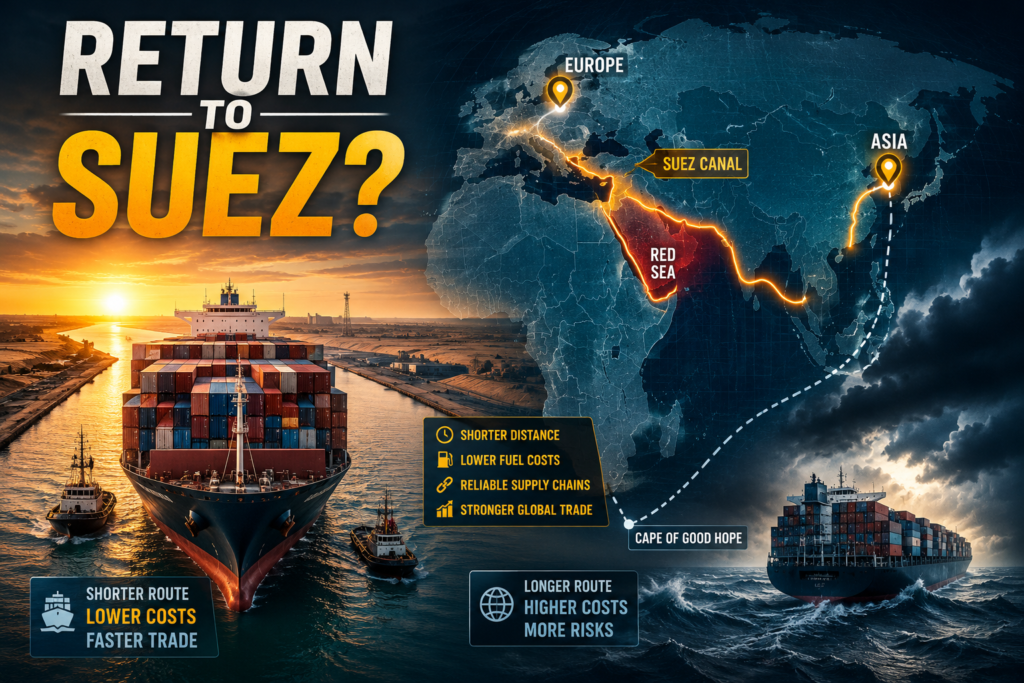
As security risks escalated in the Red Sea, shipping companies faced a choice that was neither simple nor inexpensive: continue through a corridor carrying growing geopolitical risk or divert around the Cape of Good Hope, adding thousands of nautical miles to every voyage.
Many chose the longer route.
The consequences extended well beyond shipping. Longer voyages tied up vessels for days or even weeks, fuel consumption increased, insurance premiums climbed, and delivery schedules became harder to predict. Those costs gradually worked their way through supply chains until manufacturers, retailers, and ultimately consumers began paying the price.
Yet the real cost wasn’t measured only in dollars.
Modern manufacturing depends on timing as much as transportation. A delayed shipment of seasonal clothing may leave store shelves looking sparse for a few weeks. A delayed shipment containing one specialized electronic module can leave thousands of completed vehicles parked outside a factory, unable to be delivered because one critical component never arrived. Supply chains are often only as resilient as their smallest missing part.
Now there are signs that this period of disruption may be easing.
Several major shipping companies, including operators that had previously avoided the route, have begun cautiously restoring services linked to the Suez Canal as security assessments improve and commercial pressures mount. The shift has attracted considerable attention across global markets.
The bigger question, however, is not whether more ships are returning.
It is whether global trade is returning to its previous model—or quietly adapting to a very different one.
More Than a Shortcut
The Suez Canal is often described as a shortcut between Europe and Asia. While technically accurate, that description understates its importance.
The canal connects the Mediterranean Sea with the Red Sea, allowing ships to avoid the far longer voyage around Africa. For shipping companies, saving even a week on a major route can transform fleet efficiency. A vessel completing more voyages each year generates more revenue without adding a single new ship.
That helps explain why roughly 12% of global trade and a significant share of the world’s container traffic normally passes through this narrow waterway.
Every year, enormous volumes of manufactured goods, industrial machinery, raw materials, oil, liquefied natural gas (LNG), food products, and consumer electronics move through the canal. European factories depend on components produced across Asia. Asian exporters rely on European consumers. Energy producers in the Middle East use the same corridor to reach customers across Europe.
The dependence extends much further than many people realize.
Automobile manufacturers waiting for precision-engineered components, pharmaceutical companies replenishing medical inventories, retailers preparing for holiday shopping seasons, and technology firms importing semiconductor manufacturing equipment all rely on shipping schedules that often appear routine—until they stop being routine.
Ironically, one of globalization’s greatest strengths has also become one of its vulnerabilities.
For decades, businesses optimized supply chains around efficiency, assuming the fastest route would almost always remain available. The more successful that model became, the more dependent industries grew on a relatively small number of trade corridors.
Most consumers rarely think about any of this.
Supply chains are largely invisible when they function properly. People notice the products on store shelves, not the routes those products followed to get there.
Disruptions change that almost overnight.
What Went Wrong?
The immediate trigger was a deterioration in security across the Red Sea.
Commercial vessels transiting the region faced repeated attacks, forcing shipping executives to reassess risks that had previously been considered manageable. International naval patrols increased and governments coordinated efforts to improve maritime security, but shipping companies still had to make commercial decisions in real time.
For many operators, avoiding the area became the safer option.
Major carriers such as MSC, Maersk, Hapag-Lloyd, and CMA CGM either suspended or significantly reduced transits through the region at various stages of the crisis, redirecting vessels around the Cape of Good Hope instead. The decision was expensive, but uncertainty can be even more costly than higher fuel bills.
At first glance, the consequences seemed straightforward: longer routes meant higher operating costs.
The reality was more complicated.
Every additional day at sea affected vessel availability, disrupted carefully planned schedules, increased fuel consumption, and reduced the number of voyages ships could complete each year. Because global shipping networks operate like interconnected timetables rather than isolated journeys, one delayed vessel often created knock-on effects across multiple routes.
Logistics planners have become acutely aware of this domino effect over the past few years. The challenge is rarely one delayed shipment. It is hundreds of small disruptions arriving simultaneously.
Insurance costs also rose sharply as underwriters reassessed regional risks. Freight rates increased across several trade lanes, adding fresh inflationary pressure just as many economies were beginning to recover from earlier supply chain shocks.
Recent events also reinforced lessons businesses thought they had already learned.
The pandemic exposed how vulnerable just-in-time supply chains could be when factories shut down unexpectedly. The blockage of the Suez Canal in 2021 demonstrated how heavily global trade depended on a single maritime chokepoint. The Red Sea disruptions added another reminder: even when infrastructure remains open, geopolitical instability can make critical trade routes effectively unusable.
Those experiences have left a lasting impression in boardrooms.
Procurement teams that were once rewarded primarily for finding the lowest-cost supplier are increasingly evaluated on something else entirely: ensuring production never stops. That shift may prove more significant than the shipping disruptions themselves.
Most consumers never saw ships changing course on a map.
They simply noticed goods arriving later than expected, imported products becoming more expensive, or businesses warning that supply chains remained under pressure. The route changed thousands of kilometers away. The effects showed up much closer to home.
Why Are Shipping Companies Returning Now?
If the disruption developed gradually, the recovery is proving even more gradual.
There has been no single announcement that suddenly made the Red Sea safe again. Instead, shipping companies are responding to a series of smaller changes: evolving security assessments, international naval operations, commercial pressure from customers, and the simple reality that the longer route around Africa is expensive to maintain indefinitely.
That helps explain why the industry’s response has been uneven.
Some carriers have cautiously resumed selected transits through the region, while others continue to route vessels around the Cape of Good Hope or make decisions voyage by voyage. Shipping executives increasingly describe the situation as one that requires constant reassessment rather than permanent decisions.
Economics, however, is becoming difficult to ignore.
Every additional day at sea means more than higher fuel consumption. A ship delayed for ten days is a ship that cannot begin its next journey. Over the course of a year, that reduces the productive capacity of an entire fleet without removing a single vessel from service.
Container shipping is often compared to an airline schedule for good reason. When one flight is delayed, aircraft, crews, and passengers across the network are affected. Global shipping works in much the same way. One vessel arriving late in Singapore can eventually disrupt schedules in Rotterdam, Dubai, or Felixstowe weeks later.
Customers have also become less willing to absorb uncertainty.
Retailers planning for major shopping seasons cannot afford inventory arriving after demand has already peaked. Manufacturers face a different problem. Missing a low-value component can delay the delivery of a product worth thousands of dollars. The value of the shipment is not always what determines its importance.
That distinction matters.
A container carrying specialized industrial sensors may be economically far more critical than several containers filled with consumer goods. Modern supply chains depend on synchronisation as much as volume.
At the same time, there are reasons for caution.
Some analysts argue that shipping companies will quickly return to previous routes as soon as costs fall. Others believe recent disruptions have permanently changed corporate risk calculations. Even if security conditions continue improving, boardrooms tend to remember expensive mistakes longer than financial markets do.
That may be why many operators are restoring services carefully rather than declaring a full return to normal.
If the Suez Canal Fully Recovers, What Actually Changes?
The obvious answer is shorter shipping routes.
The more interesting answer is what those shorter routes allow businesses to do.
A vessel completing faster round trips becomes available sooner for its next cargo. Ports experience more predictable arrival schedules. Warehouses can reduce the amount of inventory they hold simply as insurance against transport delays.
That last point is easy to overlook.
Inventory is expensive. Every product sitting in storage represents capital that cannot be invested elsewhere. During recent disruptions, many companies accepted those costs because uncertainty left them with little alternative. More reliable shipping allows some of that capital to become productive again.
Not every industry benefits in the same way.
Retailers care deeply about timing because seasonal demand has fixed deadlines. Winter clothing arriving in spring has already lost much of its commercial value.
Energy importers look at the equation differently. Their concern is often less about seasonal timing and more about transport reliability, freight costs, insurance premiums, and uninterrupted supply. The same improvement in shipping conditions creates different advantages depending on who is using the route.
Manufacturers sit somewhere in between.
A factory producing industrial machinery may tolerate minor delivery delays for finished products, but it cannot easily continue operating if one essential imported component fails to arrive. Recent years have reminded manufacturers that supply chains are constrained by their weakest link rather than their strongest.
Transport costs could also begin easing if more carriers return to shorter routes.
That should not be confused with an immediate decline in consumer prices.
Shipping represents only one part of the final cost of most products. Exchange rates, labour costs, tariffs, raw material prices, taxation, and domestic distribution expenses all remain significant. Cheaper shipping helps, but it rarely works in isolation.
The same applies to inflation.
Lower freight rates reduce one source of pricing pressure, yet central banks and businesses know inflation rarely depends on a single variable. Global trade has become more resilient, but also more complex.
Energy markets may experience some of the earliest operational benefits.
Oil and liquefied natural gas (LNG) cargoes moving through shorter routes spend less time at sea, reducing transport costs and improving scheduling efficiency. For countries heavily dependent on imported energy, even relatively small improvements in logistics can strengthen energy security during periods of volatile prices.
There is another consequence that receives far less attention.
Shipping companies are unlikely to abandon the contingency plans they developed during the crisis. Alternative routes, revised risk assessments, diversified logistics networks, and emergency operating procedures required considerable investment. Businesses rarely discard systems that proved valuable under pressure.
That may become one of the quiet legacies of this period.
The return of ships to the Suez Canal does not necessarily mean companies are returning to the assumptions they held before the disruptions began.
Who Stands to Benefit the Most?
A more reliable Suez Canal benefits far more than the shipping industry itself.
The gains spread through the global economy, although not evenly. Some sectors see immediate operational improvements, while others benefit more gradually as lower costs and greater reliability work their way through supply chains.
European manufacturers are among the first to notice the difference.
Many industries across Europe depend on components sourced from Asia, often arriving on tightly coordinated production schedules. Shorter and more predictable shipping routes reduce the likelihood of costly interruptions, allowing factories to plan with greater confidence instead of constantly adjusting around delayed deliveries.
The automotive industry illustrates this particularly well.
A modern vehicle contains thousands of components sourced from suppliers across multiple countries. Production lines are designed to keep moving. If a single shipment of specialized sensors, semiconductors, or transmission parts is delayed, an entire assembly line can slow or stop despite every other component being available. The cost of waiting often exceeds the value of the missing shipment itself.
Asian exporters benefit in a different way.
Lower transport costs improve competitiveness, but reliability may be even more valuable. Buyers placing large orders increasingly ask not only about price, but also about delivery certainty. After several years of disruptions, consistency has become part of the product.
Middle Eastern ports also have much to gain.
As traffic returns, ports providing refueling, maintenance, cargo handling, and logistics services stand to recover business that shifted elsewhere during the disruption. Maritime trade supports an entire ecosystem extending well beyond the ships themselves.
Retailers are watching closely as well.
Large chains typically plan seasonal inventory months in advance. A shipment arriving only a few weeks late can mean discounted merchandise, missed sales opportunities, and warehouses filled with products that consumers no longer want. Timing, in retail, is often as important as pricing.
Consumers may eventually benefit too, although the effect is usually indirect.
Improved shipping efficiency can ease pressure on transport costs and product availability, but shoppers should not expect immediate price reductions. Businesses often absorb logistics savings in different ways—protecting profit margins, rebuilding inventories, or offsetting rising costs elsewhere.
One common misconception is that lower freight costs automatically lead to cheaper products.
They can, but not always.
For many businesses, the biggest advantage is not lower costs. It is greater confidence that goods will arrive when expected. Predictability influences purchasing decisions, inventory management, contract negotiations, and production planning in ways that rarely appear on a price tag.
That is why a stable shipping route can have an economic impact far beyond the maritime sector.
But Is Global Shipping Really Back to Normal?
Not yet.
The return of more vessels to the Suez Canal is an important development, but it should not be mistaken for a full restoration of the trading system that existed before the pandemic and the geopolitical shocks that followed.
Global commerce has changed in ways that extend well beyond a single waterway.
Governments now pay closer attention to where critical products are manufactured, how they are transported, and which countries control key links in those supply chains. Semiconductor equipment, pharmaceuticals, rare earth minerals, batteries, and energy infrastructure are increasingly viewed through a strategic lens rather than a purely commercial one.
That represents a noticeable shift from the previous era.
For many years, efficiency dominated boardroom discussions. The assumption was straightforward: produce where costs are lowest, ship through the fastest route, and minimize inventory.
Events over the past five years challenged each part of that model.
The pandemic exposed how quickly factory closures in one region could disrupt production worldwide. The blockage of the Suez Canal in 2021 demonstrated that a single stranded vessel could interrupt global trade. The Red Sea attacks reinforced a different lesson—that infrastructure can remain physically open while becoming commercially difficult to use.
Taken individually, each event looked manageable.
Together, they reshaped how businesses think about risk.
Trade disputes continue to influence investment decisions. Tariffs remain part of the commercial landscape. Companies are expanding nearshoring and friend-shoring strategies, shifting portions of production closer to customers or toward politically aligned partners.
The objective is not necessarily to eliminate global supply chains.
It is to avoid depending too heavily on any single country, supplier, or transport corridor.
Climate is adding another layer of complexity.
Low water levels have disrupted inland shipping in Europe. Drought conditions have affected traffic through the Panama Canal. Extreme weather has periodically interrupted port operations across several regions. Businesses increasingly view these events as recurring operational risks rather than isolated anomalies.
Paradoxically, global trade has become both more connected and more fragmented.
Goods continue moving across continents, but companies are building more alternatives into the system. Multiple suppliers, additional inventories, regional production hubs, and backup transport routes all increase costs to some degree. Increasingly, executives see those costs as investments in resilience rather than inefficiencies.
Some analysts believe competitive pressures will eventually push businesses back toward the lean supply chains that existed before recent disruptions.
Others argue the psychological shift inside boardrooms has become permanent.
History suggests companies often return to familiar habits after crises fade. Recent events, however, have been unusually frequent. That accumulation of disruptions may prove more influential than any single crisis on its own.
The question, then, is no longer whether global shipping is recovering.
It clearly is.
The more interesting question is what version of global trade is emerging on the other side of that recovery.
How Global Shipping Has Changed—Perhaps Permanently
The most lasting consequence of the recent disruptions may not be where ships are sailing today.
It may be how companies define risk.
For years, global supply chains were built around a fairly simple assumption: if a route was efficient and reliable today, it would probably remain so tomorrow. That belief encouraged businesses to concentrate production, reduce inventories, and eliminate anything that looked like unnecessary cost.
The strategy delivered impressive results.
Consumers benefited from lower prices, manufacturers reduced working capital, and companies became remarkably efficient at moving products across continents. Just-in-time manufacturing evolved from a competitive advantage into an industry standard.
Then the assumptions behind that model began to unravel.
The pandemic disrupted factories and ports. The Suez Canal blockage exposed the vulnerability of a single chokepoint. The Red Sea crisis reminded businesses that infrastructure can remain physically open while becoming commercially impractical.
None of those events lasted forever.
The lessons did.
Talk to logistics planners today and the conversation sounds different from what it did five or ten years ago. Cost remains important, but it no longer dominates every discussion. Resilience, visibility, redundancy, and flexibility now carry far more weight than they once did.
That change is subtle, but it influences almost every major investment decision.
Companies are spreading production across multiple countries instead of relying too heavily on one manufacturing hub. Many continue holding larger inventories of essential components despite the additional storage costs. Others are investing in digital supply-chain platforms that provide real-time visibility into shipments, allowing problems to be identified before they cascade through production networks.
There is a useful irony here.
Globalization has not gone into reverse. It has become more cautious.
Companies still source materials and products from around the world, but they increasingly ask a different question. Instead of searching only for the cheapest supplier, they ask whether a disruption in one country could bring an entire production line to a halt.
That represents a profound shift in mindset.
A decade ago, maintaining extra inventory was often viewed as inefficient. Today, many executives see it as insurance. The same warehouse that finance teams once criticized for tying up capital can now be justified as protection against a far more expensive factory shutdown.
Shipping executives sometimes describe this as building “resilient capacity” rather than excess capacity.
The distinction matters.
What once appeared to be waste increasingly looks like preparedness.
What It Means for India
For India, a more stable Suez Canal is about much more than shorter shipping times.
It affects the country’s position in a global trading system that is being quietly reorganized.
Europe remains one of India’s largest export markets for pharmaceuticals, engineering goods, chemicals, textiles, automotive components, and a growing range of manufactured products. A faster and more predictable route through the Suez Canal improves the competitiveness of those exports, particularly in industries where delivery reliability is becoming almost as important as pricing.
The benefits extend in the opposite direction as well.
Indian manufacturers import industrial machinery, electronic components, specialized chemicals, and energy supplies from multiple regions. More reliable shipping reduces uncertainty across production planning, procurement, and inventory management.
That matters because India’s manufacturing ambitions have grown considerably.
Initiatives such as Make in India are not simply about producing more goods domestically. They also depend on integrating Indian industry more deeply into global supply chains. That requires factories, but it also requires ports, rail networks, customs efficiency, warehousing, and dependable maritime connections.
Infrastructure has become part of industrial policy.
India’s west coast ports—including Mundra, Nhava Sheva (Jawaharlal Nehru Port), and Hazira—already handle a significant share of the country’s international trade. Improvements along the Suez route can strengthen those connections with European markets, reducing transit times and improving scheduling reliability for exporters.
Geography gives India an advantage, but geography alone is no longer enough.
Competition for global manufacturing investment has intensified. Countries such as Vietnam, Indonesia, Thailand, and Malaysia continue attracting companies looking to diversify production away from China. Mexico has gained from nearshoring into North America. Eastern Europe remains attractive for manufacturers serving European markets.
India is competing in that same global race.
Its large domestic market, skilled workforce, expanding infrastructure, and growing industrial base make it an increasingly attractive destination. At the same time, investors continue to compare India’s logistics performance, regulatory environment, and supply-chain efficiency with those of competing economies.
That comparison is becoming more important than labour costs alone.
There is another strategic layer to consider.
Projects such as the India-Middle East-Europe Economic Corridor (IMEC) are often discussed as alternatives to existing trade routes. In reality, they are better understood as complementary networks designed to reduce dependence on any single corridor.
That reflects a broader change in government thinking.
Rather than assuming one route will always remain available, policymakers increasingly favour building multiple options. Redundancy, once considered inefficient, is gradually becoming a strategic asset.
Even if the Suez Canal returns to operating at full capacity, interest in IMEC and similar projects is unlikely to fade.
Governments have learned that trade resilience comes from choice.
For India, that creates both opportunity and responsibility.
If global companies continue diversifying supply chains, India is well positioned to capture a larger share of manufacturing and logistics investment. But doing so will require sustained improvements in infrastructure, customs procedures, multimodal connectivity, port efficiency, and policy stability.
The opportunity is real.
So is the competition.
What Investors and Businesses Should Watch Next
The return of shipping traffic to the Suez Canal is an encouraging signal. It is not, by itself, proof that global trade has entered a more stable phase.
A more reliable assessment comes from watching several indicators together rather than focusing on any single headline.
Shipping insurance premiums remain one of the clearest measures of how the industry views risk. Companies may issue optimistic statements, but insurers price risk every day. If premiums continue to fall, it suggests confidence is improving in a way that matters commercially.
Freight rates tell a different part of the story.
If more carriers resume shorter routes through the Suez Canal, transport costs should gradually become less volatile. But freight rates also respond to changes in global demand. A decline may reflect improving logistics—or simply weaker trade. Context matters.
Port activity offers another useful clue.
Container volumes at major hubs such as Rotterdam, Singapore, and Jebel Ali can reveal whether global commerce is genuinely gaining momentum or merely settling after a period of disruption. Rising volumes accompanied by improving shipping schedules paint a very different picture from rising volumes driven by congestion.
Manufacturing data deserves just as much attention.
Purchasing Managers’ Indexes (PMIs) often provide one of the earliest signals of changing industrial demand. If manufacturers begin placing more orders while delivery times stabilize, it usually reflects growing confidence that supply chains are functioning more smoothly.
Retail inventories tell their own story.
During the height of recent disruptions, many businesses built unusually large inventories as a precaution. As confidence returns, companies may gradually reduce those stockpiles. That process will not necessarily indicate weaker demand. In many cases, it simply reflects greater trust in the reliability of logistics networks.
Shipping executives often point out that confidence returns more slowly than cargo.
That observation is worth remembering.
Vessels can be redirected within days. Supply-chain strategies, investment plans, and procurement policies often take years to change because they involve decisions that affect entire businesses rather than individual voyages.
Regional security will remain the most important variable.
Even if conditions continue improving, companies are unlikely to dismantle the contingency plans they built during the crisis. The cost of maintaining alternatives now looks far smaller than the cost of being caught unprepared again.
The Bigger Picture
The gradual return of ships to the Suez Canal is undoubtedly positive for global trade.
Shorter voyages reduce costs. More predictable schedules improve planning. Businesses gain greater confidence in moving goods between Asia, Europe, and the Middle East. For consumers, that should eventually translate into fewer disruptions and less pressure on prices, even if the effects are gradual rather than immediate.
But this story has never been only about one waterway.
It is about how businesses, governments, and investors respond when long-standing assumptions stop holding true.
For decades, efficiency shaped almost every major supply-chain decision. Companies optimized routes, reduced inventories, concentrated production, and assumed that global trade would remain largely uninterrupted. Those assumptions helped create one of the most integrated trading systems in history.
Recent years have tested each of them.
The pandemic exposed vulnerabilities that had been hidden during years of stable growth. The 2021 blockage of the Suez Canal demonstrated how much depended on a single maritime chokepoint. The Red Sea crisis reinforced a different lesson: infrastructure does not need to be physically closed to become commercially difficult to use.
Each event, on its own, could have been dismissed as an exception.
Taken together, they have changed how boardrooms think.
Businesses still pursue efficiency, but increasingly alongside resilience. Governments continue promoting trade while investing in alternative corridors. Investors pay closer attention to geopolitical developments that once seemed distant from financial markets.
Some companies will eventually return to old habits.
Others will not.
That is likely to produce a global trading system that is neither fully globalized in the old sense nor fragmented into isolated regional blocs. Instead, it will probably be more diversified, more flexible, and more willing to accept modest additional costs in exchange for greater resilience.
Perhaps that is the real significance of ships returning to the Suez Canal.
The route itself may recover, but the mindset that shaped global trade before the recent wave of disruptions probably will not. Businesses have seen how quickly familiar assumptions can unravel, and those lessons are difficult to unlearn.
The enduring story, then, is not simply that ships are returning to a familiar passage.
It is that governments and businesses are now planning for a world where no trade route, however established, can ever again be taken entirely for granted.