For much of the last three decades, the logic behind global manufacturing seemed almost settled.
A product might be designed in California, use components from Japan or South Korea, contain minerals mined in Australia or Africa, and be assembled in China before being shipped to consumers around the world. As globalization accelerated after China’s entry into the World Trade Organization in 2001, companies optimized supply chains around one overriding goal: efficiency.
The system worked remarkably well—until it didn’t.
COVID-19 exposed weaknesses that had been building quietly for years. Factory closures interrupted production on the other side of the world. Shipping delays rippled through industries that had little connection to one another. A shortage of inexpensive semiconductor chips slowed automobile production. Medical equipment became difficult to source. Suddenly, supply chains that had once been celebrated for their efficiency looked unusually fragile.
The pandemic wasn’t the only turning point. Trade disputes, export controls, geopolitical tensions, and growing concerns over economic security were already pushing governments to reconsider how much dependence on a single production hub was too much.
That conversation has changed in an important way.
A decade ago, policymakers often asked where manufacturing should be cheapest. Today, they’re increasingly asking where it will still be reliable ten or fifteen years from now.
That’s a very different calculation.
One of the biggest shifts isn’t that factories are leaving China en masse—they aren’t. It’s that companies increasingly believe they need credible alternatives, even if those alternatives are never used. In boardrooms, resilience has quietly joined cost as a deciding factor in long-term investment.
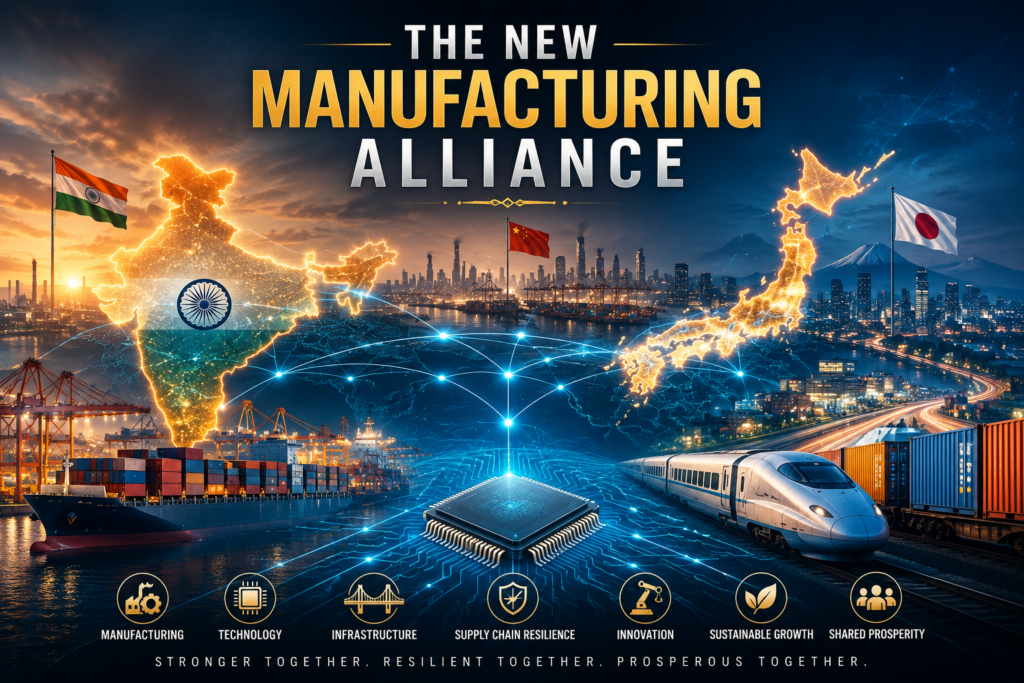
That change explains why the partnership between India and Japan deserves more attention than it usually receives.
Unlike many geopolitical stories, this one isn’t driven by dramatic confrontations or headline-grabbing summits. It has unfolded gradually through infrastructure projects, manufacturing investment, technology cooperation, and long-term industrial planning. Much of it happens well outside the daily news cycle.
Yet some of the most consequential economic changes often do.
The partnership is not designed to dismantle existing trade with China, nor does it require businesses to abandon one of the world’s largest manufacturing ecosystems. Its purpose is more practical: expanding the number of places where critical goods can be designed, produced, assembled, and shipped when global conditions become less predictable.
That distinction matters because the future of globalization may look less like a single dominant manufacturing center and more like a network of interconnected industrial hubs.
India and Japan are positioning themselves to become part of that network.
Why This Partnership Matters Now
At first glance, the growing relationship between India and Japan can look like another example of routine diplomatic cooperation. Leaders meet, agreements are signed, investment commitments are announced, and attention soon shifts elsewhere.
The bigger story is what those agreements are increasingly about.
Recent discussions have focused on manufacturing, digital infrastructure, clean energy, semiconductor development, resilient supply chains, and economic security. A decade ago, many of those issues were treated as separate policy areas. Today they are becoming part of the same strategic conversation.
There’s a reason for that.
Governments have begun to view industrial capacity differently. Manufacturing is no longer seen simply as a source of exports or employment. It has become tied to national resilience, technological competitiveness, and even foreign policy.
Japan’s interest in India reflects this broader shift.
The country has invested in Asian manufacturing for decades. After the Plaza Accord in the 1980s, many Japanese companies expanded production across Southeast Asia as costs at home rose. That experience taught Japanese manufacturers an important lesson: diversified production networks are often more resilient than concentrating capacity in one location.
The 2011 Great East Japan Earthquake reinforced that thinking. Disruptions at a relatively small number of factories affected production lines around the world, reminding businesses that modern supply chains are only as strong as their weakest links.
Those experiences continue to shape corporate decision-making.
India, meanwhile, is trying to achieve something more ambitious than attracting isolated factories. The goal is to become a long-term manufacturing base where investment, skilled labour, supplier ecosystems, logistics, and domestic demand reinforce one another over time.
That’s one reason Japanese investment carries particular weight. It often arrives with technical expertise, engineering standards, management practices, and long planning horizons rather than purely financial capital.
The relationship works because each side brings something the other lacks.
India offers scale, demographic momentum, and an expanding domestic market. Japan contributes advanced manufacturing capabilities, industrial technology, and decades of experience building globally competitive production systems.
Neither country can accomplish the other’s role.
Together, they become considerably more interesting.
The Global Supply Chain Shift
Before 2020, most multinational companies measured supply chains using familiar metrics: cost, speed, efficiency, and reliability.
Risk was there, but it was often treated as something that happened elsewhere.
The pandemic changed that assumption almost overnight.
Companies discovered that a single missing component could delay an entire production line. Procurement teams suddenly found themselves searching for alternative suppliers they had never expected to need. Inventory strategies that once looked efficient began to appear surprisingly fragile.
There’s an irony here.
Globalization created supply chains so efficient that many companies stopped noticing how dependent they had become on them.
That realization gave momentum to strategies such as “China+1.” The term is sometimes misunderstood. It doesn’t mean companies are abandoning China. In most industries, doing so would be prohibitively expensive and operationally disruptive.
Instead, manufacturers are adding options.
An executive deciding where to build the next assembly plant isn’t comparing wages alone. They’re weighing power reliability, supplier proximity, freight connectivity, permitting timelines, engineering talent, geopolitical risk, and whether that location will still make strategic sense fifteen years from now. Those decisions involve billions of dollars and can shape production for decades.
Moving a factory is difficult.
Rebuilding an industrial ecosystem is harder.
A modern manufacturing base depends on far more than assembly plants. It requires qualified component suppliers, logistics providers, industrial parks, testing facilities, financing, technical institutes, export terminals, and thousands of smaller businesses that rarely appear in investment announcements.
That’s why industrial ecosystems take years—often decades—to mature.
This is where India and Japan begin to complement one another.
Japan brings capital, advanced machinery, engineering expertise, and experience in building sophisticated supplier networks. India offers a large workforce, expanding domestic demand, improving infrastructure, and policy support aimed at attracting long-term manufacturing investment.
The headlines often focus on billion-dollar investment announcements.
The quieter story is what happens afterward: supplier qualification, workforce training, procurement contracts, transport links, and hundreds of operational decisions that determine whether those investments actually succeed.
Supply chains are rarely transformed by a single breakthrough.
More often, they change through thousands of decisions that never make the front page.
That process is already reshaping global manufacturing.
Manufacturing: Building an Alternative Production Base
It’s easy to think manufacturing is about factories.
It isn’t.
Factories are the visible part of a much larger industrial system.
Behind every assembly line sits an ecosystem of component suppliers, machinery manufacturers, logistics providers, testing laboratories, industrial parks, financing institutions, engineering talent, and thousands of procurement decisions that consumers never see. When economists talk about manufacturing capacity, this is what they’re really describing.
That’s also why it is so difficult to recreate.
Countries don’t compete for factories anymore. Increasingly, they compete to become places where entire industrial ecosystems can take root.
India’s recent manufacturing push reflects that reality.
Government initiatives aimed at expanding domestic production have focused on industries such as electronics, automotive components, pharmaceuticals, batteries, defence manufacturing, and semiconductors. Incentive programmes have attracted attention, but incentives alone rarely determine where companies invest.
Businesses eventually ask harder questions.
Can suppliers deliver consistently?
Is electricity reliable?
How quickly can imported machinery clear customs?
How long does it take to approve an expansion?
Can experienced engineers be hired locally, or will they need to relocate?
Those questions don’t generate headlines.
They often decide where the investment goes.
A company considering a new assembly plant isn’t making a decision for next year. In many industries, the investment horizon stretches fifteen or twenty years. Once equipment is installed, supplier contracts are signed, and workers are trained, relocating production becomes enormously expensive.
That helps explain why manufacturers move cautiously.
Factories don’t relocate because executives wake up optimistic one morning.
They move when years of capital allocation, risk analysis, procurement planning, and board approvals gradually point in the same direction.
This is where Japan’s role becomes particularly significant.
Japanese manufacturers have spent decades refining production systems that prioritize precision, consistency, and continuous improvement. Many of the company’s best-known industrial groups already operate across India, particularly in automobiles, electronics, machine tools, specialty materials, and transport equipment.
Those investments bring more than capital.
Engineering standards improve.
Supplier expectations change.
Local firms often upgrade their own capabilities to meet international quality requirements. Over time, that process creates industrial spillover effects that are difficult to measure but enormously valuable.
One capable supplier frequently leads to another.
Industrial clusters rarely appear all at once.
They grow through accumulation.
There’s another reason this partnership matters.
Japan isn’t simply exporting products to India. It is increasingly participating in the development of manufacturing capacity inside India itself. That distinction is easy to overlook, but it changes the relationship from buyer and seller to long-term industrial partners.
Infrastructure plays an equally important role.
Industrial corridors supported through India-Japan cooperation are intended to connect manufacturing centres with ports, freight corridors, logistics hubs, and urban infrastructure. On paper, these projects look like transport investments.
In practice, they’re investments in industrial competitiveness.
A supplier that can deliver components six hours faster may win contracts that another supplier loses. A port that clears exports more efficiently can influence where manufacturers expand capacity. Freight reliability rarely dominates political speeches, yet procurement teams pay close attention to it.
Small operational advantages accumulate surprisingly quickly.
This is one of the least understood aspects of global manufacturing.
People often compare countries by labour costs alone. Manufacturers usually don’t.
A company assembling consumer electronics, for example, may save money on wages in one country but lose considerably more through delayed shipments, unreliable electricity, weaker supplier networks, or longer procurement cycles. What appears cheaper on paper can become more expensive over the life of a factory.
That’s one reason industrial ecosystems are so difficult to replicate.
China didn’t become the world’s largest manufacturing economy simply because labour was inexpensive. It spent decades building supplier clusters, transport infrastructure, export capacity, technical expertise, and production scale that reinforced one another. Success attracted more suppliers, which attracted more manufacturers, creating a cycle that became increasingly difficult for competitors to match.
Industrial momentum has a habit of reinforcing itself.
India isn’t trying to reproduce that model exactly.
Its opportunity lies elsewhere.
Many multinational companies are no longer searching for a single manufacturing base capable of producing everything. They’re building production networks spread across several countries, reducing the risk that one disruption can interrupt an entire business.
That shift creates an opening.
India doesn’t have to replace China to become far more important than it is today.
It needs to become indispensable in specific industries.
Electronics assembly. Automotive components. Pharmaceutical manufacturing. Batteries. Semiconductor packaging. Defence production. Renewable energy equipment.
That is a more realistic ambition—and arguably a more durable one.
The headlines will continue to focus on billion-dollar investment announcements because they’re easy to measure.
The harder story is what happens over the following decade.
Do Tier-1 suppliers expand alongside the original investor?
Do local firms qualify to join global supplier networks?
Can engineering graduates move into advanced manufacturing roles?
Do logistics costs continue to fall?
Do export terminals keep pace with production?
Those questions determine whether manufacturing becomes self-sustaining or remains dependent on government incentives.
Industrial transformation is rarely dramatic.
It’s built through thousands of ordinary decisions made by factory managers, procurement teams, engineers, lenders, suppliers, and investors.
Most of them never make the news.
Collectively, they reshape the global economy.
Critical Minerals: The New Contest Beneath the Surface
For much of the twentieth century, oil shaped geopolitics.
Today, another group of resources is steadily moving into a similar position, even if most people rarely notice them.
Lithium, nickel, cobalt, graphite and rare earth elements sit deep inside technologies that define the modern economy. Electric vehicles, battery storage, wind turbines, advanced electronics, defence systems and AI hardware all depend on them in one form or another.
The interesting shift isn’t simply that demand is rising.
It’s that governments have started treating these materials less like commodities and more like strategic assets.
For years, much of the discussion focused on where these minerals were mined. Increasingly, attention has shifted to something else: who processes them.
Mining is only one stage of the supply chain. Refining, chemical processing, specialised materials manufacturing and transport infrastructure often determine where the real strategic leverage sits. A country can possess abundant resources yet remain dependent on others further down the value chain.
That’s a lesson policymakers have absorbed rather quickly.
India and Japan have been expanding cooperation through overseas investments, technology partnerships and efforts to diversify sourcing. Neither country is trying to dominate global mineral markets. The objective is more practical—reducing the risk that a disruption in one part of the world cascades through industries thousands of kilometres away.
There’s another layer to this.
Battery manufacturers planning a new production facility don’t only evaluate customer demand. They also ask whether reliable supplies of processed lithium or graphite will still be available ten years from now, whether shipping routes are dependable, and whether refining capacity can expand alongside production.
Raw materials influence investment decisions long before a factory is built.
That is why critical minerals increasingly sit at the intersection of industrial policy, trade policy and national security.
Semiconductors: Small Components, Outsized Influence
Few products illustrate the changing relationship between economics and geopolitics better than semiconductor chips.
They’re tiny.
The industries built around them are anything but.
Semiconductors now underpin everything from consumer electronics and medical equipment to industrial robots, satellites, telecommunications networks and advanced weapons systems. Modern manufacturing simply doesn’t function without them.
The global chip shortage made that painfully clear.
What began as a supply disruption quickly spread into sectors that had little connection to consumer electronics. Vehicle production slowed because relatively inexpensive chips weren’t available. Manufacturers delayed product launches. Waiting times stretched. Costs rose.
One missing component was enough to stall an entire assembly line.
That experience changed how governments think about semiconductors.
They’re no longer viewed solely as a high-tech industry. Increasingly, they’re treated as strategic infrastructure.
There’s a common misconception that building a semiconductor industry means constructing fabrication plants.
Fabrication is only part of the picture.
A competitive semiconductor ecosystem also depends on chip design, electronic design automation software, specialty chemicals, silicon wafers, manufacturing equipment, advanced packaging, testing facilities, highly specialised engineers and research institutions. Weakness in any one of those areas can limit the entire ecosystem.
That’s precisely why international partnerships matter.
India has been working to expand its semiconductor ambitions through incentive programmes, workforce development and partnerships with global firms. Japan brings decades of expertise in semiconductor materials, precision manufacturing equipment, specialty chemicals and industrial research.
Their strengths don’t overlap perfectly.
That’s an advantage.
No single country is likely to dominate every stage of the semiconductor supply chain. The industry has become too specialised and too capital intensive. Even leading economies increasingly depend on trusted partners for different parts of the production process.
Behind the headlines about billion-dollar chip investments lies a much quieter reality.
Training engineers takes years.
Qualifying suppliers takes time.
Clean-room facilities require extraordinary precision.
Equipment orders often have long lead times.
None of it happens quickly, regardless of how ambitious government announcements may sound.
The race for semiconductor leadership is measured less in election cycles than in decades.
AI and Advanced Technology Cooperation
Artificial intelligence is often discussed as though it exists entirely in the digital world.
In practice, it depends on the physical economy far more than most people realise.
AI systems require data centres, semiconductor chips, electricity, fibre-optic networks and advanced manufacturing. The software may attract the attention, but the supporting infrastructure determines how widely that software can be deployed.
That’s one reason governments increasingly describe AI as strategic infrastructure rather than simply another technology sector.
India and Japan arrive with different advantages.
India has developed one of the world’s largest pools of software engineers, a rapidly expanding startup ecosystem and digital public infrastructure that has drawn international interest. Japan contributes deep expertise in industrial automation, robotics, advanced engineering and precision manufacturing.
The partnership becomes particularly interesting when those strengths begin to intersect.
Imagine a modern manufacturing plant where AI helps predict equipment failures before they occur, robotics handle repetitive assembly tasks, and engineers monitor production remotely using real-time data. None of those technologies is revolutionary on its own.
Together, they fundamentally change how factories operate.
That’s where much of the economic value is likely to emerge—not from AI replacing manufacturing, but from AI making manufacturing more productive.
There’s a broader lesson here.
Technology leadership is becoming less about who invents the most tools and more about who integrates them most effectively across the wider economy.
Countries that combine software capability with industrial depth may ultimately hold the strongest position.
That may prove to be one of the defining economic advantages of the next decade.
Infrastructure: The Part Everyone Notices Last
Infrastructure rarely dominates headlines for long.
A new port or freight corridor might attract attention when it’s announced, then quietly disappear from public discussion while construction continues for years. Investors tend to think differently. They know infrastructure often determines whether ambitious industrial plans become commercially viable.
There’s a reason major manufacturers study maps before they study incentives.
They want to know how long it takes to move components from suppliers to assembly plants, how quickly finished goods can reach export terminals, whether rail networks can absorb higher freight volumes, and how reliable electricity and digital connectivity will be once production scales up.
Those questions sound operational.
In reality, they’re strategic.
India and Japan have spent years working together on infrastructure projects ranging from industrial corridors and metro systems to freight connectivity and logistics improvements. Each project has its own purpose, but together they address a broader challenge: reducing the friction that makes manufacturing more expensive than it needs to be.
Friction is an underrated concept in economics.
Factories don’t become globally competitive simply because labour costs are low. Delays at ports, congested highways, unreliable power supply, customs bottlenecks, or inconsistent logistics can quietly erase the advantage of cheaper production. None of those problems is dramatic on its own. Together, they influence where companies invest.
Take an electronics manufacturer evaluating two potential production sites.
Labour costs may be similar. Tax incentives may be comparable.
The deciding factor could be something far less visible: whether component shipments arrive consistently enough to support just-in-time production, or whether frequent delays force the company to hold larger inventories. Those additional costs rarely appear in headline investment figures, but finance teams calculate them carefully.
Infrastructure works in much the same way.
Its greatest value often comes from problems that never occur.
And that’s why these investments matter beyond India and Japan. Efficient ports, reliable freight corridors, and well-connected industrial parks don’t simply move goods faster. They make entire supply chains more predictable, which is increasingly valuable in a world where uncertainty has become part of normal business planning.
Economic Security Is Quietly Becoming Industrial Policy
For years, economic policy and national security were often discussed as separate fields.
That distinction is fading.
Governments now talk about energy security, food security, semiconductor supply, cyber resilience, pharmaceutical production, rare earth processing, and digital infrastructure within the same strategic framework. What changed wasn’t simply geopolitics.
It was experience.
The pandemic showed how quickly supply disruptions could spread through the global economy. Trade disputes demonstrated that commercial relationships could become geopolitical pressure points. Export controls highlighted how technologies once viewed as purely commercial could acquire strategic importance almost overnight.
There’s another factor.
Modern economies depend on systems that people rarely think about until they stop working. Electricity grids. Undersea data cables. Payment networks. Cloud infrastructure. Container shipping. Semiconductor fabrication. These systems don’t attract much public attention when they function normally.
They become impossible to ignore when they don’t.
That’s why governments increasingly see resilience as something that has to be built in advance rather than improvised during a crisis.
The India-Japan partnership reflects that broader shift.
Manufacturing, digital technology, infrastructure, critical minerals, and research cooperation are no longer isolated policy areas. Together, they form part of a wider effort to strengthen economic resilience without closing markets or abandoning international trade.
It’s a different philosophy from the one that shaped globalization during the 1990s and early 2000s.
Back then, efficiency was often treated as the primary objective.
Today, resilience sits alongside it.
Not because efficiency has become less important, but because businesses have learned that the cheapest supply chain isn’t always the most dependable.
Where China Fits Into This Picture
Any discussion about new manufacturing partnerships inevitably returns to China.
That’s understandable.
China remains the world’s largest manufacturing economy, home to industrial clusters that have taken decades to build. Its supplier ecosystems, logistics networks, export capacity, engineering talent, and production scale continue to give it advantages that few countries can match.
Those strengths aren’t disappearing.
Sometimes discussions about diversification create the impression that companies are preparing for a large-scale exit from China. The evidence suggests something more nuanced.
Many multinational firms are expanding production in India, Vietnam, Indonesia, or Mexico while continuing substantial operations in China. They’re adding capacity rather than relocating it entirely.
That distinction matters because it changes how competition should be understood.
The real contest isn’t necessarily over who replaces China.
It’s over which countries become the most valuable complements to China’s manufacturing ecosystem.
That’s a less dramatic story.
It’s probably the more accurate one.
There’s an irony here.
The same globalization that helped China become central to global manufacturing is now encouraging companies to diversify production across multiple countries. Not because China’s manufacturing model failed, but because it succeeded so completely that dependence on a single hub began to look like a strategic vulnerability.
In practice, very few companies want to rebuild supply chains from scratch.
The costs are enormous. Existing supplier relationships have been developed over decades. Quality standards have been refined through years of production. Contract manufacturers, logistics partners, procurement systems, and technical expertise are already deeply integrated.
Businesses rarely abandon those advantages voluntarily.
Instead, they’re making incremental adjustments.
A new assembly plant here.
An additional supplier there.
Alternative logistics routes.
Secondary production capacity for critical products.
None of these decisions looks transformative on its own.
Collectively, they are changing the geography of global manufacturing.
Perhaps that’s the most important point.
The future is unlikely to belong to one manufacturing superpower replacing another.
It is more likely to belong to a network of countries that become indispensable in different parts of the global production system.
India and Japan are trying to build exactly that kind of partnership.
The Global Impact
The effects of this shift won’t be confined to India and Japan.
The United States and several European economies are encouraging companies to build more diversified supply chains, particularly in industries linked to advanced technology and national security. Southeast Asian economies continue to attract manufacturers looking for additional production capacity. Australia has become increasingly important because of its role in critical minerals, while Gulf investors are directing more capital toward Asian infrastructure, logistics, and technology projects.
At first glance, these developments can seem unrelated.
They’re not.
Taken together, they suggest that globalization isn’t reversing as much as it’s being reorganized. Goods, capital, and technology will continue to move across borders, but the routes are becoming more varied and, in many cases, more deliberate.
That has practical consequences.
A decade ago, a company planning a new production network might have asked a single question: where can we manufacture at the lowest cost?
Today the conversation is usually broader.
Where are the qualified suppliers?
How resilient is the electricity grid?
Can exports move reliably through nearby ports?
Will trade policy remain predictable?
Is there enough engineering talent to support future expansion?
Those questions don’t eliminate cost considerations. They simply put them into a much larger framework.
That’s changing where investment flows.
What It Means for India
For India, the opportunity is about far more than attracting overseas investment.
A stronger manufacturing base can generate employment, deepen domestic supplier networks, encourage technology transfer, and create demand for better infrastructure, logistics, engineering services, and vocational training. Industrial development tends to spread through the economy in ways that aren’t always obvious at first.
One successful export cluster often supports dozens of smaller businesses around it.
Tooling companies.
Packaging firms.
Industrial maintenance providers.
Software vendors.
Freight operators.
Testing laboratories.
Many of these businesses never appear in announcements about billion-dollar investments, yet they are often the reason those investments succeed.
There’s another reason this matters.
Countries that become deeply integrated into global production networks usually gain influence that extends well beyond manufacturing. Trading relationships become more durable. Investment partnerships broaden. Diplomatic cooperation often follows commercial ties rather than leading them.
Economic relevance has a habit of creating strategic relevance.
That doesn’t happen overnight.
It rarely happens through a single policy announcement either.
Challenges Ahead
None of this is inevitable.
India still faces familiar challenges: infrastructure gaps in some regions, uneven logistics, regulatory complexity, skill shortages in specialised industries, land acquisition issues, and the slow execution that can affect large industrial projects.
These aren’t minor obstacles.
They’re the kinds of issues procurement teams, investors, and board directors examine before approving projects that may operate for decades.
Competition is also becoming more intense.
Vietnam continues to strengthen its export manufacturing base. Indonesia is moving aggressively into downstream mineral processing. Mexico benefits from its proximity to the United States. Other emerging economies are pursuing similar opportunities with their own mix of reforms and incentives.
Meanwhile, China retains advantages that deserve perspective rather than dismissal.
Its supplier ecosystems, industrial clusters, manufacturing scale, and logistics infrastructure represent decades of accumulated investment. Those capabilities can’t be replicated through a handful of industrial policies or headline investment announcements.
Perhaps the greatest challenge is consistency.
Industrial transformation isn’t measured by the number of memorandums signed at international summits.
It’s measured by whether projects are completed on time, whether suppliers remain competitive, whether workers develop new skills, and whether companies continue reinvesting long after the headlines fade.
Execution, more than ambition, separates industrial strategies that endure from those that gradually lose momentum.
Looking Ahead
It’s tempting to view the coming decade as a contest over which country will become the world’s next manufacturing giant.
That may be the wrong question.
Global manufacturing is becoming too complex, too specialised, and too interconnected for a single country to dominate every stage of production. Companies increasingly want redundancy alongside efficiency. Governments want resilience alongside growth. Investors want flexibility alongside scale.
Those priorities point toward a different kind of global economy.
One built less around a single industrial centre and more around trusted networks of production.
In that world, success won’t necessarily belong to the country that builds everything.
It will belong to the countries that become difficult to build without.
That distinction is subtle, but it changes how economic influence should be understood.
For India, the opportunity is not to replicate China’s development path step for step. The circumstances are different, the technologies are different, and the global economy itself has changed.
The opportunity is to become indispensable in industries where manufacturing, technology, logistics, and skilled talent increasingly intersect.
Japan, meanwhile, brings capabilities that few countries can match: advanced engineering, industrial discipline, long-term investment, and decades of experience building globally competitive manufacturing ecosystems. Together, the two countries have the potential to shape parts of the next generation of global supply chains—not because they’re acting against another economy, but because they’re responding to the needs of a changing one.
The headlines will continue to focus on trade disputes, tariffs, and geopolitical rivalry.
The quieter story is unfolding elsewhere.
It’s taking shape in industrial parks, supplier networks, freight corridors, research partnerships, engineering centres, and boardrooms where companies are making decisions that may not become visible for another decade.
That’s often how lasting economic change happens.
Not all at once.
But through thousands of choices that, over time, redraw the map of global commerce.
And that may ultimately be the most important lesson from the growing India–Japan partnership.
The future of economic influence is unlikely to be decided by who dominates global manufacturing.
It will be shaped by who becomes indispensable to it.